Vietnamese Cuisine
Fresh Spring Rolls (Gỏi Cuốn)
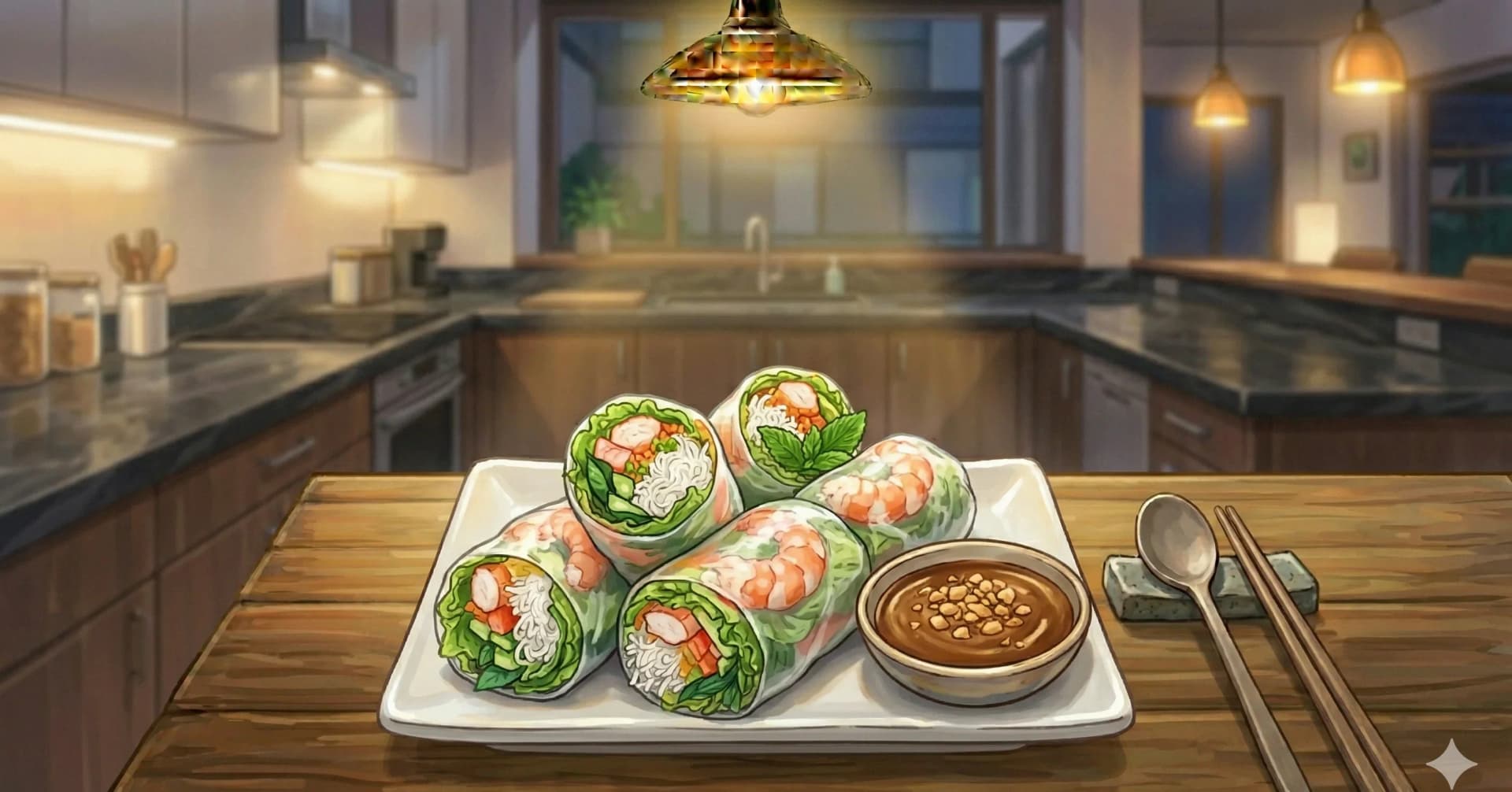
Fresh Vietnamese rice paper rolls with pork, shrimp, herbs, and peanut dipping sauce
Goi cuon translates directly as "salad rolls," and once you notice the name, the dish makes more sense. These are not cooked spring rolls. They are closer to a composed salad that has been gathered up in a translucent sheet of rice paper: poached pork, halved shrimp with their coral backs pressed against the wrapper so they show through, a tangle of rice vermicelli, fresh lettuce, mint, and sometimes chives, all rolled tight enough to hold together but loose enough to still feel light in the hand.
In Vietnam, goi cuon were traditionally street food, not something most home cooks bothered to make. As Huy Vu at Hungry Huy describes it, the number of components felt like too much fuss when vendors were selling perfect rolls outside your door. But outside Vietnam, making them at home is half the pleasure. You lay everything out on the table, set a bowl of warm water in the centre, and let people roll their own. This DIY approach turns the meal into something communal and unhurried, like the shared tables that shape banh xeo nights or the herb-heavy spreads alongside bun cha.
The dipping sauce matters as much as the rolls. A quick hoisin peanut sauce, thinned to a loose, dippable consistency, provides the sweetness and richness that the cool, clean rolls need as a counterpoint. It comes together in about two minutes, and most of that time is just waiting for the garlic to go fragrant in the pan. The rolls themselves require no cooking at all once the proteins and noodles are prepared. If you can fold a letter, you can fold goi cuon.
At a Glance
Yield
10 rolls (serves 4 to 5)
Prep
40 minutes
Cook
35 minutes
Total
1 hour 15 minutes
Difficulty
Easy
Ingredients
Pork Ingredients
- 8 ozpork belly, in one piece
- 1medium yellow onion, halved
- 1 tspsugar
- 1 tspsalt
Shrimp Ingredients
- 8 ozshrimp (size 31/35), shell on
- 1/4 tspsalt
Noodle Ingredients
- 1¾ ozdried rice vermicelli noodles (or dried banh hoi sheets)
Wrappers
- 10round rice paper wrappers, 22 cm (use 20 if doubling up for easier handling)
To Assemble
- 1head butter lettuce or green leaf lettuce, leaves separated
- 1/2 bunchfresh mint (about 20 leaves)
- 1/2 bunchgarlic chives (optional)
- 3½ ozfresh bean sprouts
Peanut Sauce Ingredients
- 2 tbspneutral oil (vegetable or rice bran)
- 2 tbspgarlic (about 4 cloves), minced
- ½ cuphoisin sauce
- 2to 3 tablespoons smooth peanut butter
- ½ cupwater
- —Crushed roasted peanuts, for serving
- —Sambal oelek or other chili paste, to taste (optional)
Method
- 1
Place the pork belly in a small saucepan with the halved onion, sugar, and salt. Add enough cold water to cover the pork by about 2 cm. Bring to a boil over high heat, then reduce to a steady simmer over medium heat. Cook for 25 to 30 minutes, until the juices run clear when you pierce the thickest part with a skewer, or an instant-read thermometer inserted into the centre reads 70C. Transfer the pork to a bowl, cover to prevent the surface from darkening as it cools, and let it rest until cool enough to handle. Slice as thinly as you can manage, about 2 to 3 mm thick. Thinner slices make the rolls easier to wrap and more pleasant to bite through.
- 2
Place the shrimp in a small saucepan with the salt and enough cold water to barely cover them. Bring to a boil over medium-high heat and cook for 90 seconds to 2 minutes, just until the shells turn pink and the flesh is opaque throughout. Drain and run under cold water to stop the cooking. Peel the shells and tails, then slice each shrimp in half lengthwise along the body. You should have about 20 halves. Set aside.
- 3
Cook the rice vermicelli (or banh hoi sheets) according to the packet instructions. Timing varies by thickness, typically 2 to 5 minutes in boiling water. The noodles are done when they are soft and pliable but not mushy. Drain and rinse under cold water to stop the cooking and wash off excess starch. Spread the noodles on a plate so they do not clump into one mass.
- 4
Wash and dry the lettuce and herbs thoroughly. A salad spinner works well here. Wet lettuce will make the rolls slippery and harder to seal. Trim any thick central ribs from the lettuce leaves so they lie flat. If using chives, leave them whole so they can be laid lengthwise with one end poking out of the finished roll for a clean visual line.
- 5
Make the peanut dipping sauce. Heat the oil in a small saucepan over medium heat. Add the minced garlic and cook, stirring, until it turns fragrant and just barely golden, about 45 seconds. Add the hoisin sauce, peanut butter, and water. Stir until smooth and bring to a brief boil, then immediately remove from the heat. The sauce will appear thin at first but thickens as it cools. Stir in sambal oelek if you want heat. Divide among small dipping bowls and sprinkle with crushed peanuts.
- 6
Set up your rolling station. Arrange the pork slices, shrimp halves, noodles, lettuce, herbs, bean sprouts, and chives on a large plate or board within easy reach. Fill a large, shallow bowl or deep plate with warm water (not hot, around 40C to 45C).
- 7
Dip one rice paper wrapper into the warm water for 2 to 3 seconds, turning it once so both sides are wet. It will still feel stiff when you pull it out. Lay it on a clean cutting board or plate. The wrapper will continue to soften as it sits. If you prefer a sturdier roll, stack two wrappers together and dip them at the same time.
- 8
Place a small nest of rice vermicelli across the lower third of the wrapper. Add a few bean sprouts and a piece of lettuce on top, folding or rolling the lettuce around the noodles and sprouts to bundle them together. This bundle trick, from Nagi at RecipeTin Eats, keeps loose bits from piercing the rice paper. Leave about 3 cm of space on the left and right sides.
- 9
On the upper half of the wrapper (the half closest to you when looking at the top), lay 3 to 4 shrimp halves in a line, cut side up and orange backs facing down against the rice paper, with a mint leaf between each pair. These will show through the translucent wrapper once rolled, giving the finished roll a clean, colourful appearance.
- 10
Add 2 to 3 slices of pork over the lettuce bundle. If using chives, lay 1 or 2 lengthwise so that one end will extend past the edge of the roll when finished.
- 11
Fold the left and right sides of the wrapper inward toward the centre. Starting from the bottom edge (the side with the noodle bundle), roll upward, tucking the wrapper snugly around the filling as you go. Keep gentle, even pressure so the roll is firm but not so tight that it tears. Continue rolling over the shrimp line and up to the top edge. The rice paper seals to itself.
- 12
Place the finished roll seam side down on a serving plate. Do not let completed rolls touch one another, as the rice paper will stick. If making ahead, lay a strip of plastic wrap between each roll. Repeat with the remaining wrappers and fillings.
Key Ingredient Benefits
Rice paper wrappers (banh trang) are made from rice flour, water, and often tapioca starch. They are naturally gluten-free and very low in fat. The caloric contribution per roll is modest, roughly 30 to 40 calories per wrapper. Most of the structural strength comes from the tapioca starch, which is why wrappers sold outside Vietnam tend to include it. Pure rice flour wrappers, more common in Vietnam, are thinner and more fragile but let the filling flavours come through more clearly.
Pork belly contributes richness and a silky texture that leaner cuts cannot replicate. The thin slicing keeps the fat content per roll reasonable. If you prefer leaner pork, shoulder or loin can be poached the same way, though the texture will be firmer and drier. Pork belly provides B vitamins (particularly B1 and B12), zinc, and selenium alongside its fat.
Shrimp are a low-calorie source of complete protein, providing about 20 g of protein per 100 g with very little fat. They are notably rich in selenium, iodine, and astaxanthin, the carotenoid pigment responsible for their pink colour when cooked, which has antioxidant properties. Splitting them in half and pressing the coloured side against the wrapper is purely aesthetic, but it transforms a simple roll into something that looks considered and deliberate.
Mint (Mentha) is the essential herb for goi cuon. Beyond its cooling, bright flavour, menthol compounds in mint have been studied for their effects on digestion, including relaxation of gastrointestinal smooth muscle. In traditional Vietnamese medicine, mint is considered a cooling herb. Its presence in goi cuon is not decorative; it is a core flavour that ties the roll together.
Hoisin sauce is a thick, sweet, and savoury condiment made from fermented soybeans, sugar, garlic, and vinegar. It provides the umami and sweetness backbone of the dipping sauce. Sodium content varies by brand but is typically 250 to 400 mg per tablespoon, so it is worth tasting the sauce before adding any extra salt.
Why This Works
Rice paper softens through hydration, not heat. A brief dip in warm water begins the process, but the wrapper continues to absorb moisture from the filling ingredients after you lay it down. This is why you want the dip to be quick, just 2 to 3 seconds. If you soak the wrapper until it feels fully soft, it will be too sticky and fragile to handle by the time you start rolling. The warm water accelerates hydration compared to cold, giving you a wider working window before the paper becomes unmanageable.
Bundling the loose ingredients inside a lettuce leaf before rolling is a technique Nagi at RecipeTin Eats developed to solve the most common problem home cooks face: bean sprouts and noodle strands that poke through and tear the delicate wrapper. The lettuce acts as a protective inner layer, smoothing out sharp edges and holding everything in a compact shape. It also means you are essentially rolling one object (the bundle) rather than trying to contain a dozen separate pieces.
Poaching the pork belly in salted, sweetened water rather than plain water seasons the meat throughout and produces slices that taste good on their own, not flat or bland against the fresh herbs. The onion in the poaching liquid adds a subtle aromatic depth. Covering the pork as it cools prevents the surface from oxidising and turning dark, which would give the rolls a less appealing appearance through the translucent wrapper.
The peanut dipping sauce uses hoisin as its base rather than building from scratch with sugar, soy, and fermented bean paste. This is the standard approach in Vietnamese home cooking, because hoisin already contains the right balance of sweet, salty, and fermented flavour. The peanut butter rounds it out, and the brief cook with garlic brings everything together into a cohesive sauce rather than a simple stir-together.
Substitutions & Variations
Pork belly: Thinly sliced poached pork shoulder, pork loin, or roast chicken all work well. For a lighter option, use poached chicken breast shredded into thin strips. Tofu (firm, sliced thin) makes a good vegetarian substitute.
Shrimp: Crab stick (surimi), thinly sliced omelette, or additional pork can replace the shrimp. For a fully vegetarian version, omit both proteins and add julienned cucumber, avocado slices, and extra herbs.
Rice vermicelli: Banh hoi (flat noodle sheets) are easier to handle and less prone to clumping, as Huy Vu at Hungry Huy recommends. If you cannot find either, thin glass noodles (mung bean noodles) work in a pinch.
Lettuce: Butter lettuce and green or red leaf lettuce are ideal because their leaves are soft and pliable. Avoid iceberg, which cracks when folded and has sharp edges that can puncture the wrapper. If only iceberg is available, shred it finely.
Herbs: Mint is the most important, but cilantro, Vietnamese perilla (tia to), Thai basil, or Vietnamese coriander (rau ram) are all traditional additions. Use whatever combination you can find.
Bean sprouts: Shredded cabbage, julienned carrot, or thinly sliced cucumber are common alternatives when bean sprouts are unavailable.
Peanut sauce alternative: For a peanut-free version, serve with nuoc cham (the sweet, sour, salty dipping sauce made from fish sauce, lime, sugar, garlic, and chili that accompanies banh xeo). Some cooks also serve goi cuon with straight sweet chili sauce, which works well enough in a hurry.
Double-wrapper technique: Using two sheets of rice paper per roll, as Nagi recommends, makes rolling much easier for beginners. The ends will be slightly chewier but not tough. This is a worthwhile trade-off while building confidence.
Serving Suggestions
Goi cuon are finger food. Pick one up, dip the cut end into the peanut sauce, and eat. The rolls can be sliced in half on a diagonal before serving, which shows off the filling and makes them easier to dip.
For a DIY spread, set out all the prepared components (sliced pork, shrimp halves, noodles, lettuce, herbs, bean sprouts, a bowl of warm water, and a stack of rice paper) and let everyone assemble their own. This is a popular menu option at Vietnamese restaurants and turns the meal into something relaxed and interactive. Refresh the warm water as it cools.
Goi cuon work well as a starter before heartier dishes. Follow them with pho bo for a full Vietnamese meal, or serve alongside bun cha for a spread centred on fresh herbs and dipping sauces. They also pair naturally with other Southeast Asian dishes that share the same bright, herbaceous character: som tam (green papaya salad), pad thai, or larb, where the cool freshness of the rolls balances richer, spicier plates.
Storage & Reheating
Assembled rolls: Goi cuon are best eaten within a few hours of assembly. The rice paper gradually dries out and turns stiff, losing its pleasant, supple chew. If you need to make them ahead, wrap each roll individually in plastic wrap immediately after rolling and refrigerate. They will hold reasonably well for up to 6 hours. Do not place unwrapped rolls touching one another; the rice paper will bond and tear when you try to separate them.
Prepared components: All the fillings can be prepared up to a day in advance and refrigerated separately. Poached pork slices, cooked shrimp, and cooked noodles keep well overnight. Bring proteins to room temperature before rolling for the best texture. Wash and dry lettuce and herbs and store loosely wrapped in a damp paper towel inside a sealed container.
Peanut dipping sauce: Keeps refrigerated in a sealed container for up to 5 days. It will thicken as it chills. Thin it with a splash of warm water and stir before serving again.
Reheating: Goi cuon are not meant to be reheated. The fresh, uncooked nature of the filling (lettuce, herbs, bean sprouts) is the whole point. If the wrapper has dried out, there is no reliable way to restore it. The best approach is to prepare the components in advance and roll just before serving.
Cultural Notes
Gỏi cuốn, Vietnamese fresh spring rolls, translates literally as "salad rolls" (gỏi means salad, cuốn means roll), and the name actually describes the dish. What you get is a composed cold salad of poached shrimp, sliced pork, rice vermicelli, fresh herbs, and lettuce, wrapped in soft rice paper rather than served on a plate. The construction is unusual. No parallel exists in the cooking of China, Cambodia, Thailand, or Laos, despite the broader regional use of rice paper.
The dish belongs most strongly to southern Vietnam, especially the Mekong Delta, where the freshest herbs, the most translucent rice papers, and the freshest river shrimp are all close at hand. Gỏi cuốn appears as a standard appetizer at almost every Vietnamese restaurant on the planet, but the authentic southern version is much more delicate than what most international restaurants serve. The rice paper used in Vietnam is thinner and more transparent than the thicker, more durable versions that show up in international Asian grocery stores. Done right, the pink shrimp, the green herbs, and the white noodles are all visible through the wrapper.
The dipping sauce decides a lot of the dish. Two distinct traditions split it. Nước chấm, the standard sweet-sour fish-sauce dip that also serves bún chả and most Vietnamese grilled dishes, is the simpler southern pairing. Tương đậu phộng, a hoisin-and-peanut-butter sauce thickened with coconut milk, is the more elaborate option associated with central Vietnam and with modern Vietnamese-American restaurant culture. Most restaurants offer both, and diners often alternate between them depending on which ingredient in the roll they want to bring forward.
The combination of fresh vegetables, lean protein, light noodles, and herbs has made gỏi cuốn one of the most explicitly health-positioned items in the Vietnamese restaurant canon. Western diners reaching for a lighter Asian option tend to land on it before they land on anything else.
Nutrition Facts
Calories: 320kcal (16%)|Total Carbohydrates: 28g (10%)|Protein: 15g (30%)|Total Fat: 16g (21%)|Saturated Fat: 5g (25%)|Cholesterol: 72mg (24%)|Sodium: 530mg (23%)|Dietary Fiber: 1g (4%)|Total Sugars: 4g
You Might Also Like
Ratings & Comments
Ratings & Comments
Ratings
Share your thoughts on this recipe.
Sign in to rate and comment