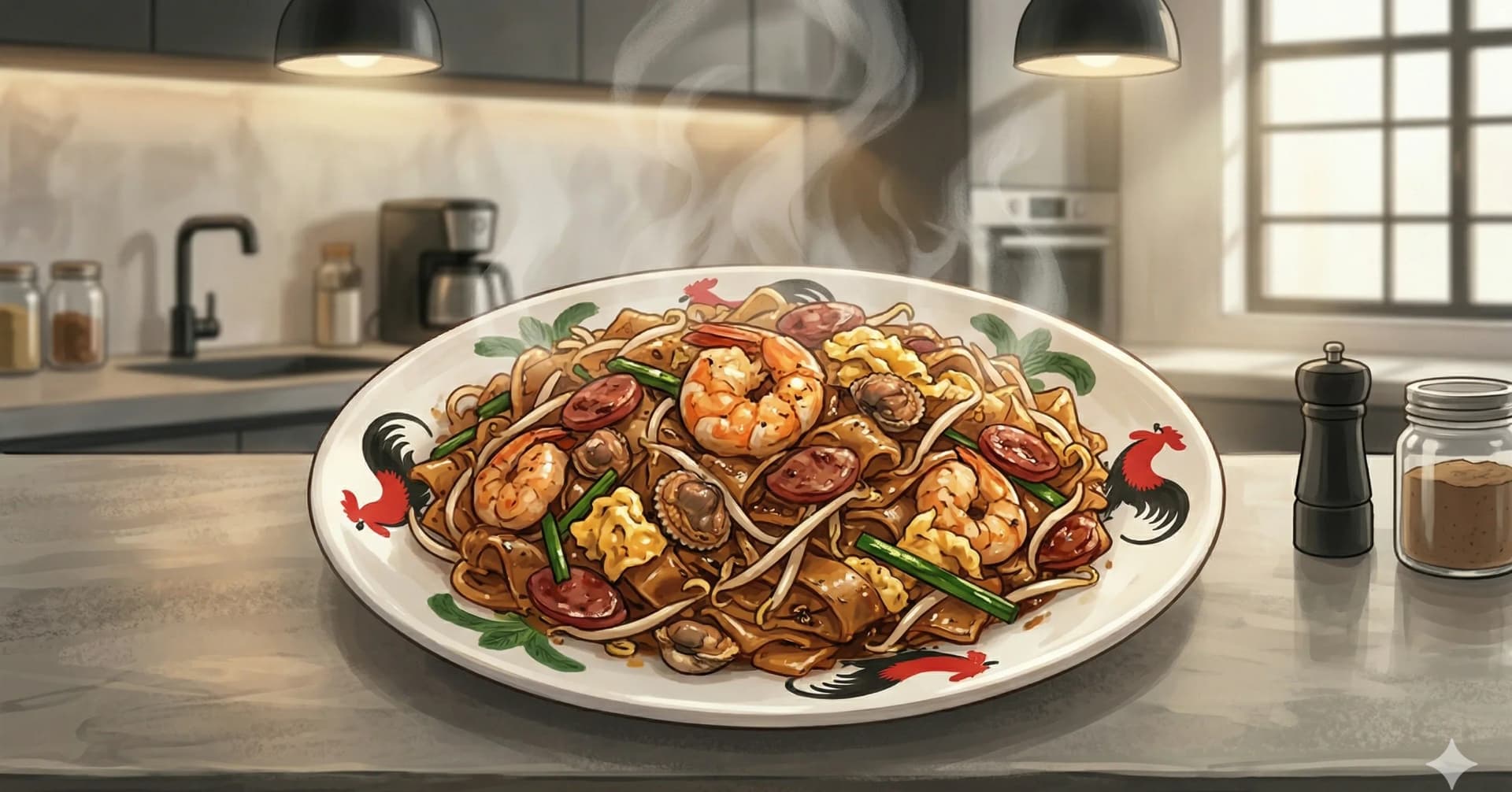
Malaysian Cuisine
Char Kway Teow (炒粿條)
Smoky wok-fried flat rice noodles with prawns, cockles, lap cheong, and chives in dark soy
The first sign that a char kway teow stall is worth your time is the sound: a violent hiss as wet rice noodles hit a wok so hot the oil is just beginning to smoke. Then comes the smell, a rush of caramelized soy and rendered pork fat and something faintly charred that Malaysians call wok hei, the breath of the wok. It is a flavor that no amount of careful seasoning can replicate without genuine, searing heat.
Char kway teow is one of the great hawker dishes of Penang, though you will find versions across Malaysia and Singapore with regional loyalties that border on the devotional. The Penang version is typically darker, smokier, and more restrained in its ingredients than its Singaporean cousin. It relies on a shorter list of components and a heavier hand with dark soy sauce, trusting the wok and the cook's timing to do the work. The best versions are made by cooks who fry no more than one or two portions at a time, because the wok must stay scorching hot throughout. A crowded wok steams instead of sears, and the noodles turn limp where they should be charred.
What this dish delivers is contrast: soft, silky noodles with crispy charred edges, briny cockles against sweet prawns, the snap of bean sprouts alongside tender egg. There is a touch of chili paste for warmth and a generous scatter of garlic chives for freshness. It comes together in under five minutes of actual cooking time, which makes it deceptively simple. The real skill is in managing heat and moving fast. Have everything measured and within arm's reach before you light the burner.
At a Glance
Yield
2 servings
Prep
20 minutes
Cook
10 minutes
Total
30 minutes
Difficulty
Medium
Ingredients
Stir-Fry Ingredients
- 1 lbfresh flat rice noodles (kway teow), about 1 cm wide
- 5½ ozmedium prawns, peeled and deveined
- 2¾ ozcockles (blood cockles), rinsed well, or substitute small clams
- 1lap cheong (Chinese sausage, about 40 g), sliced diagonally into thin ovals
- 2eggs
- 2¾ ozbean sprouts
- ½ cupgarlic chives (ku chai), cut into 5 cm lengths
- 3 clovesgarlic, minced
Sauce Ingredients
- 2 tbspdark soy sauce
- 1 tbsplight soy sauce
- 1 tbspoyster sauce
- 1 tbspchili paste (sambal oelek or ground fresh red chilies)
- 1 tspwhite pepper
For Frying
- 3 tbsplard or neutral oil (lard is traditional and preferred)
- 1 tbspadditional oil for the eggs
Method
- 1
Separate the fresh rice noodles gently with your hands if they are stuck together from the package. Cold noodles straight from the refrigerator will break. Let them sit at room temperature for at least 15 minutes, or briefly warm them in a microwave for 20 seconds to loosen the sheets. They should be pliable and easy to separate without tearing.
- 2
Mix the dark soy sauce, light soy sauce, oyster sauce, chili paste, and white pepper in a small bowl. Set it next to the stove. Arrange the prawns, cockles, lap cheong, eggs, bean sprouts, chives, and garlic on a plate or in small bowls within arm's reach. Once you start cooking, there is no time to search for ingredients.
- 3
Heat a wok over the highest flame your stove can produce. Let it heat for at least 2 minutes until the surface just begins to smoke. Add half the lard and swirl to coat. When the fat shimmers and a wisp of smoke rises from the surface, the wok is ready.
- 4
Add the garlic and stir it through the hot fat for 5 seconds, just until fragrant. Immediately add the lap cheong slices and toss for 30 seconds until the edges turn slightly translucent and the fat begins to render out. The sausage should smell faintly sweet and smoky.
- 5
Add the prawns in a single layer and let them sear without moving for 30 seconds. Flip and cook another 20 seconds until they curl and turn pink but are not fully cooked through. They will finish later.
- 6
Push everything to one side of the wok. Add the remaining oil to the cleared space and crack in the eggs. Let them set for about 15 seconds until the whites firm up on the bottom, then break the yolks with your spatula and fold roughly, leaving the eggs in large, soft pieces rather than scrambling them fine.
- 7
Add all the noodles at once. Pour the sauce mixture over them. Using your spatula and a scooping motion, toss and fold the noodles through the egg, prawns, and sausage. Work quickly, lifting the noodles high and pressing them flat against the wok surface in turns. This alternation between tossing and pressing is what creates the charred edges. Continue for about 90 seconds. The noodles should absorb the sauce and develop dark, slightly crispy patches.
- 8
Scatter the cockles over the noodles and toss twice. Cockles need only about 20 seconds in the heat to warm through. Overcooking turns them rubbery and metallic.
- 9
Add the bean sprouts and garlic chives. Toss vigorously for 15 to 20 seconds, just until the sprouts barely wilt and the chives brighten in color. They should still have crunch.
- 10
Taste a noodle. The flavor should be savory and smoky with a slight sweetness from the sausage, a gentle heat from the chili paste, and a briny pop from the cockles. If the soy flavor is too mild, add a small splash of light soy sauce and toss once more.
- 11
Slide the char kway teow onto a plate, making sure the prawns and cockles are visible on top. Serve immediately. This dish waits for no one. The wok hei fades within minutes of leaving the pan.
Key Ingredient Benefits
Flat rice noodles (kway teow): Made from rice flour and water, sometimes with a small addition of tapioca starch for chewiness. Naturally gluten-free and relatively low in fat before cooking. Fresh noodles are always preferred over dried for this dish, as they fry better and develop the right combination of soft centers and crispy edges.
Cockles (kerang): Blood cockles are traditional in Malaysian char kway teow and are a remarkably rich source of iron, providing roughly 28 mg per 100 g, far more than red meat. They also supply vitamin B12 and zinc. In Malaysian and Chinese food culture, cockles are traditionally associated with supporting blood health. They are added at the very end and barely cooked, which preserves their delicate, briny sweetness.
Lap cheong: Chinese dried sausage made from pork and pork fat, seasoned with rose water, rice wine, and soy sauce. It is calorie-dense and high in sodium, but a small amount adds an outsized impact of savory sweetness. The sugars in the sausage caramelize quickly in a hot wok, contributing to the overall char.
Garlic chives (ku chai): A flat-leafed chive with a mild garlic flavor, common across East and Southeast Asian cooking. They contain organosulfur compounds similar to those in garlic, which research has associated with antimicrobial and cardiovascular benefits in laboratory settings.
Why This Works
The defining character of char kway teow is wok hei, and achieving it at home requires understanding what creates it. When noodles make contact with a wok surface heated well above 200C, the sugars in the soy sauce and the starches on the noodle surface undergo rapid Maillard reactions and caramelization. The result is a complex smoky sweetness that cannot be replicated by adding liquid smoke or extra soy sauce. The key technique is pressing the noodles flat against the wok and leaving them undisturbed for a few seconds, then tossing to redistribute, then pressing again. This gives different sections of the noodles their turn on the hottest part of the surface.
Cooking only one or two portions at a time is not a suggestion. It is the difference between char kway teow and soggy noodles. A home burner produces far less heat than a hawker's charcoal or jet burner. Overcrowding the wok drops the temperature immediately, and the noodles release moisture faster than the wok can evaporate it. Smaller batches keep the temperature high enough for proper charring.
Lard is traditional and contributes more than just cooking fat. It carries a subtle porky richness that reinforces the lap cheong and gives the noodles a distinctive savory depth that neutral oil cannot match. The rendered fat from the sausage adds another layer of flavor. If using oil instead, the dish will be lighter but noticeably less complex.
Substitutions & Variations
Cockles: If blood cockles are unavailable, small manila clams blanched briefly, or even canned baby clams drained well, approximate the briny element. Some cooks omit them entirely and add more prawns.
Lap cheong: Chinese bacon (la rou) sliced thin works similarly. For a pork-free version, use chicken sausage, though the flavor will be milder.
Noodles: If fresh kway teow is unavailable, dried flat rice noodles (pad thai width) soaked in room temperature water for 1 hour until pliable will work. They fry slightly differently but absorb the sauce well.
Vegetarian version: Replace prawns and cockles with extra-firm tofu pressed and cubed, and substitute mushroom oyster sauce for regular oyster sauce. Use vegetable oil instead of lard. The dish will lack the seafood brininess but the smoky noodle base remains satisfying.
Singapore style: Add curry powder (about 1 teaspoon) to the sauce mixture for the yellow-tinged, curry-scented version popular in Singaporean hawker centers.
Spice level: Increase the chili paste to 2 tablespoons for serious heat, or omit it entirely for a mild version that lets the soy and wok char dominate.
Serving Suggestions
Char kway teow is traditionally a standalone dish, eaten from a hawker stall as a complete meal at any hour. It needs nothing alongside it, and Malaysians would rarely add side dishes when eating it at a market.
At home, however, it pairs well with other Malaysian hawker favorites for a shared spread. Set it next to a bowl of laksa for a surf-and-turf contrast between rich coconut curry soup and dry, smoky noodles. Or serve alongside satay and a plate of cucumber slices for a casual dinner that covers multiple textures and flavors.
For a broader Southeast Asian noodle comparison, offer char kway teow alongside pad see ew, which uses the same wide rice noodles in a Thai preparation. The two dishes share a family resemblance but differ meaningfully in seasoning and technique. Tasting them side by side reveals how wok hei and soy sauce traditions diverge across borders.
Storage & Reheating
Refrigerator: Store leftovers in a sealed container for up to 1 day. Char kway teow deteriorates faster than most stir-fries because the noodles absorb moisture from the other ingredients and lose their charred edges.
Reheating: The only acceptable method is a very hot wok or skillet with a thin film of oil. Spread the noodles in a single layer and let them sear without stirring for 30 to 45 seconds before tossing. This partially restores the crispy edges. Microwaving makes the noodles soft and gummy.
Freezer: Not recommended. The rice noodles become mushy after freezing and thawing.
Prep ahead: The sauce can be mixed and the ingredients prepped up to a day in advance. Store the prepped ingredients separately in the refrigerator and bring to room temperature before cooking.
Cultural Notes
Char kway teow (炒粿條, "stir-fried rice noodles") is a defining dish of the Malaysian-Chinese hawker tradition, especially in the city of Penang on Malaysia's northwestern coast. The Hokkien-Chinese laborer and fisherman community created it as cheap, high-calorie food made with whatever the day's catch and pantry offered. Fresh cockles, prawns, pork lard, Chinese sausage (lap cheong), eggs, chives, bean sprouts. All of it stir-fried hard over a roaring charcoal-fired wok with dark soy sauce.
What makes char kway teow what it is is wok hei (鑊氣, "the breath of the wok"). That smoky, slightly caramelized character only develops when the ingredients are tossed in a cast iron wok over flames hot enough to vaporize the surface of the food. You cannot reproduce wok hei on a typical home stove or in a non-stick pan, and the search for "good wok hei" is the central organizing principle of char kway teow connoisseurship. Penang hawker stalls compete fiercely on wok hei. Certain ones (Sister Char Kway Teow in Lorong Selamat, Ah Leng in Dato Keramat) have been run by the same families for three generations and pull long lines daily.
Char kway teow occupies an unusual cultural position. It is one of the most beloved Malaysian dishes despite (or because of) its historically working-class associations. The traditional version uses pork lard for cooking fat, fresh cockles for that briny pop, and Chinese sausage. Those ingredients mark it as unmistakably Chinese-Malaysian rather than halal Malay food. Halal versions exist (replacing pork with prawn or chicken), but most Malaysian Chinese consider the original pork-and-cockle preparation the only true form. The dish has spread to Singapore (a little sweeter, a little wetter) and to Indonesian-Chinese communities, but Penang stays its cultural capital.
Nutrition Facts
Calories: 600kcal (30%)|Total Carbohydrates: 65.8g (24%)|Protein: 38.5g (77%)|Total Fat: 19.6g (25%)|Saturated Fat: 5.2g (26%)|Cholesterol: 356mg (119%)|Sodium: 2079mg (90%)|Dietary Fiber: 3.4g (12%)|Total Sugars: 6.8g
You Might Also Like
Ratings & Comments
Ratings & Comments
Ratings
Share your thoughts on this recipe.
Sign in to rate and comment