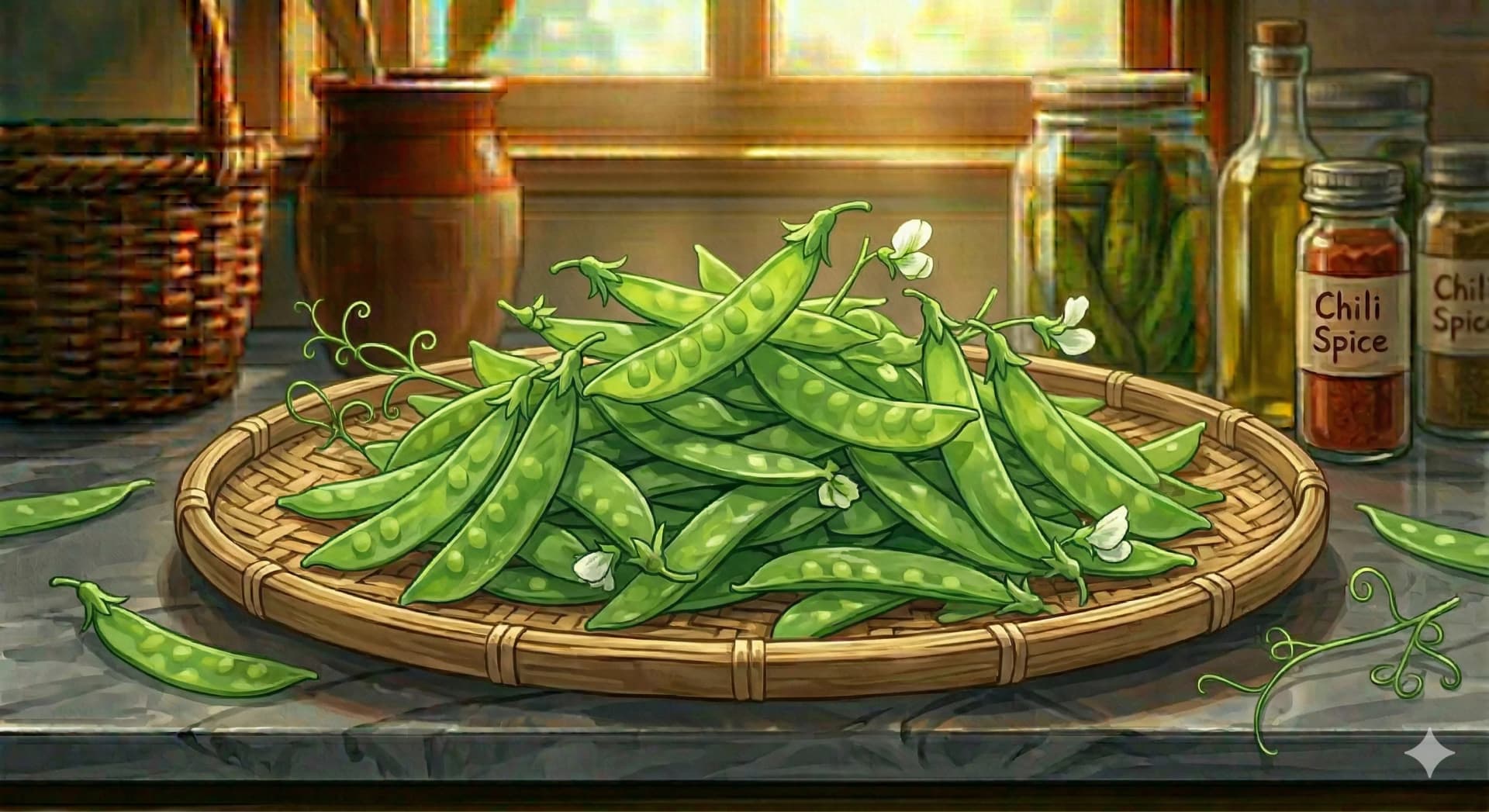
Snow Peas
Also known as: He Lan Dou, Mangetout, Sugar Peas, Pisum sativum var. saccharatum
Snow peas are flat, edible-podded peas harvested before the seeds develop, eaten whole pod and all. Their texture — crisp and satisfying, never starchy — and delicate sweetness make them one of the most pleasant vegetables to eat.
In Chinese cooking, they are used almost exclusively in stir-fries where their color, crunch, and fresh flavor contribute to a dish's overall balance.
A well-cooked snow pea remains brilliantly green and snaps; an overcooked one turns dull and limp.
Key facts at a glance:
- Edible-podded peas — harvested before the seeds develop, eaten whole
- Crisp texture and delicate sweetness — never starchy
- Central to Cantonese stir-fries — represents the aesthetic of fresh, quickly cooked vegetables
- He lan dou (Holland pea) — Chinese name reflects their journey via Dutch traders
- Rich in vitamins C and K — plus iron and flavonoids
Flavor Profile
Origin
Central Asia (origin), China, Cantonese cuisine
Traditional Medicine Perspectives
Traditional Chinese Medicine
Snow peas (He Lan Dou) are classified as neutral and sweet in TCM, associated with the Spleen and Stomach meridians. They are used to strengthen the Spleen, harmonize the Stomach, and promote diuresis. They are considered a gentle, tonifying vegetable appropriate for most constitutions, particularly those with Spleen Qi deficiency.
Modern Scientific Research
Snow peas contain vitamins C and K, iron, and flavonoids. The edible pod contains dietary fiber from the cell walls of both the pod and the developing seeds.
Research on pea consumption shows benefits for blood sugar management and digestive health from the fiber content.
The chlorophyll content and bright green color indicate high levels of carotenoids and phytonutrients.
Cultural History
Snow peas have been cultivated in China for centuries, and the name he lan dou (Holland pea) reflects their journey back to East Asia via Dutch traders, even though the pea's origins are in the Middle East and Central Asia.
They became particularly central to Cantonese and Hong Kong-style cooking, where their appearance in stir-fries with beef, scallops, and prawns represents the Cantonese aesthetic of fresh, quickly cooked vegetables that retain their vitality.
Culinary Uses
Stir-fry briefly — no more than 2 minutes — with garlic, oyster sauce, and a splash of water.
Add to beef and chicken stir-fries near the end of cooking. Use in spring rolls and dumplings for crunch.
Snow peas should be added near the end of cooking to preserve their signature crunch and bright green color.
Blanch quickly and add to cold noodle dishes. Use raw in salads.
Preparation Methods
String both sides — there is a tough string along each edge seam that should be removed.
Snap off the stem end and pull toward the opposite end to remove both strings in one motion. Cook very briefly to preserve crunch and bright green color.
Traditional Dishes
- Stir-fried beef with snow peas
- Cantonese combination stir-fry
- Spring rolls
- Shrimp with snow peas
- Cold sesame noodles with vegetables
Comments
Share your thoughts on this ingredient.
Sign in to comment0 Comments