Cross-Cultural · China
Sizzling Rice Soup (鍋巴湯)
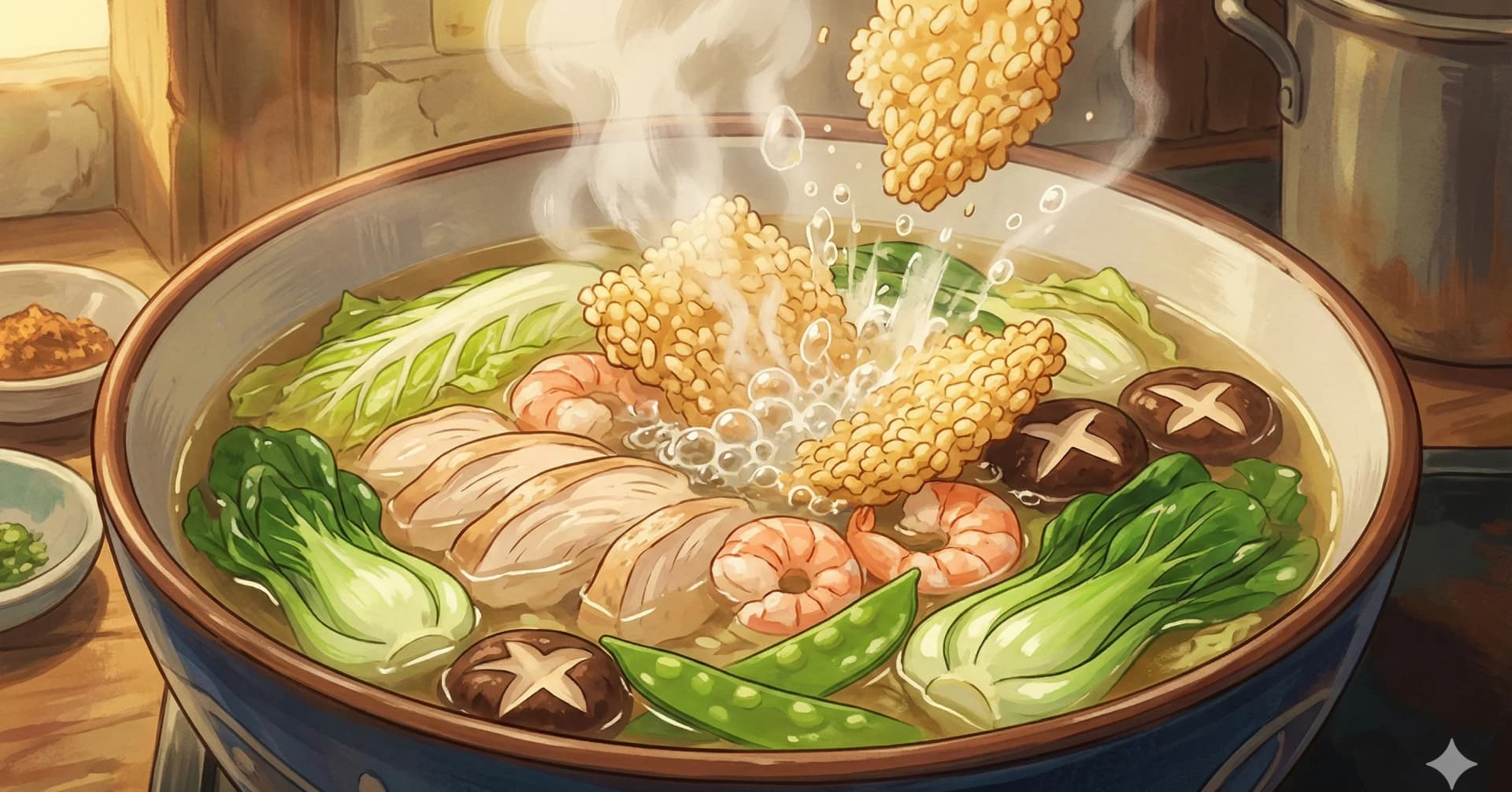
Fried rice crackers dropped tableside into a hot chicken broth loaded with shrimp, chicken, and vegetables for a dramatic sizzle
The sizzle is the point. Sizzling rice soup is built around a piece of theater: a bowl of hot broth arrives at the table, and then a plate of freshly fried rice crackers is dropped in. The crackers hit the liquid and erupt in a violent hiss that turns every head in the restaurant. The sound lasts about three seconds. The flavor lasts much longer.
The soup underneath the spectacle is a clean, well-made chicken broth loaded with shrimp, sliced chicken breast, napa cabbage, bok choy, mushrooms, and snow peas. The proteins are marinated briefly with cornstarch, which gives them the silky texture of Chinese restaurant cooking. The vegetables go in at the last moment so they stay crisp and bright. A few drops of sesame oil and white pepper finish the broth.
The rice crackers are the soul of the dish. Traditionally they are guoba, the crust of rice that forms at the bottom of a clay pot or rice cooker, dried until brittle and then deep-fried until they puff and turn golden. You can make them from freshly cooked rice pressed flat and dried in the sun or a low oven, or you can buy them pre-made. Either way, they must be fried immediately before serving. Cold crackers do not sizzle. The broth must be boiling hot. The timing is everything. Drop, sizzle, eat.
At a Glance
Yield
4 servings
Prep
150 minutes
Cook
20 minutes
Total
170 minutes
Difficulty
Medium
Ingredients
- 4rice crackers (guoba), homemade or store-bought
- 3 ozchicken breast, thinly sliced
- 3 ozshrimp, peeled and deveined
- 3 oznapa cabbage, chopped
- 3 ozbok choy, chopped
- 3 ozking oyster mushroom, sliced
- 2 ozcarrot, sliced thin
- 1 ozsnow peas, 28g
- 14 ozchicken broth, 400ml
- 4 cupswater
- 4 ozneutral oil, for frying crackers
- 1/2 tspsalt, for chicken marinade
- 1 tspcornstarch, for chicken marinade
- 1 tspcornstarch, for shrimp
- 2 tspsalt, for soup
- 1/2 tspsugar
- 1/2 tspsesame oil
- 1/4 tspwhite pepper
- 1 tspfish sauce
Method
- 1
Prepare rice crackers if homemade: press hot cooked rice into 1/4-inch disks, dry in sun 6+ hours or oven at 200°F for 3 hours until completely brittle.
- 2
Marinate chicken with salt, cornstarch, and 1 tbsp water. Marinate shrimp with cornstarch. Set aside.
- 3
Cut all vegetables into small, uniform 1/2-inch pieces for even cooking.
- 4
Build the soup. Bring chicken broth and water to a boil. Add 1 tsp oil. Add carrots first, then remaining vegetables. Season with salt and sugar.
- 5
Add chicken, stir to separate. Add shrimp 20-30 seconds later. After 15-20 seconds, season with sesame oil, white pepper, and fish sauce.
- 6
Fry rice crackers at 190°C (375°F) for 40-50 seconds until puffed and golden.
- 7
Serve: bring the soup to the table boiling hot, then drop the crackers in for the sizzle. Eat immediately.
Key Ingredient Benefits
Rice crackers (guoba, 鍋巴): Crispy puffed rice patties traditionally made from the toasted layer of rice that forms at the bottom of a rice pot. Modern guoba is made deliberately by drying out cooked rice and frying it to puff. Crispy, light, and almost pure carbohydrate, guoba is the dish's structural and dramatic centerpiece. The crisp texture survives the hot soup just long enough to provide the dramatic sizzle and the satisfying crunch.
Chicken broth: The foundation of the soup. A clear, deeply flavored chicken stock is essential — boxed broth produces a passable result, but homemade broth (simmered with bones, chicken feet, ginger, and scallion for 2 to 3 hours) is dramatically better. Bone-broth fans cite the high gelatin content for joint and gut health, though most evidence is observational.
Chicken breast or thigh: Cornstarch-velveted chicken provides tender protein. Velveting (marinating with cornstarch, egg white, and rice wine) produces the silky texture characteristic of Chinese soup ingredients. Thigh meat is more forgiving of slight overcooking.
Shrimp: Adds a sweet, ocean-fresh element that contrasts with the rich chicken broth. Shrimp should be added late in the cooking to avoid rubberiness.
Napa cabbage and bok choy: Provide bulk, freshness, and a green note. Napa cabbage has a milder, sweeter flavor; bok choy contributes a slightly mustardy edge. Both wilt to perfect tenderness in the hot broth.
Mushrooms (shiitake or straw): Add an earthy umami counterpoint. Dried shiitake reconstituted in the soaking water produces deeper flavor than fresh.
Shaoxing wine and sesame oil: Small finishing touches added near the end. Shaoxing contributes aromatic depth; sesame oil adds a nutty richness and visual gloss to the broth.
Why This Works
The dramatic sizzle requires three things to happen simultaneously: the rice crackers must be screaming hot from frying, the soup must be at a full rolling boil, and the two must meet at the table in front of the diners. Any one of these missing produces a quiet thud instead of the satisfying crackle. Restaurant kitchens choreograph this carefully — the cracker plate goes directly from the fryer to the table while a server simultaneously brings the boiling tureen.
The rice crackers themselves are made by drying cooked rice flat on a sheet pan in a low oven (around 100°C / 200°F) for 2 to 3 hours until completely dehydrated and brittle, then frying at high heat (190°C / 375°F) for 30 to 60 seconds until they puff dramatically. Pre-made guoba from Chinese groceries works perfectly and skips the prep work.
Velveting the chicken (marinating with cornstarch, egg white, and rice wine) is the technique that produces the silky, tender texture characteristic of Chinese restaurant soups. The cornstarch absorbs the marinade liquid and forms a thin protective coating around each piece of meat. When briefly cooked in the simmering broth, the chicken becomes almost silky — much more tender than plain poached chicken would be.
Layered addition of ingredients preserves the texture of each. Mushrooms and tough greens go in first; chicken next; shrimp last. This staging means each ingredient is exactly cooked at the moment of serving, not over-cooked while waiting for others.
The soup should not be heavily seasoned. Cantonese clear soups depend on the depth of the broth itself and the natural flavors of the ingredients. A small amount of salt, a splash of Shaoxing wine, a few drops of sesame oil, and a touch of white pepper is all that should be added. Heavy seasoning would muddy the clarity that defines the dish.
The visual presentation matters. The dish is served as a banquet item, and the bowl/tureen should be wide and shallow to show off the colorful ingredients. The crackers are stacked dramatically before being dropped — presentation is part of the dish.
Substitutions & Variations
Rice crackers (guoba): Korean nurungji (also dried toasted rice) works identically. Asian groceries sell pre-fried guoba in bags. Puffed rice cakes (like Japanese senbei) work in a pinch but produce a less dramatic sizzle.
Without homemade rice crackers: Pre-made rice cracker products from Chinese groceries (look for "rice crust" or guo ba in packaging) work perfectly. They need only a quick fry in hot oil before adding to the soup.
Chicken broth: Vegetable broth works for a vegetarian version. Dashi (Japanese kelp-bonito stock) produces a Japanese-leaning version. A combination of chicken and pork broth is the classic Cantonese banquet stock.
Chicken and shrimp: Either can be omitted. Pork can substitute (sliced thin and velveted). Tofu cubes work for vegetarian. Sea cucumber is the banquet-grade addition in fine Cantonese restaurants.
Vegetables: Any combination works. Snow peas, baby corn, wood ear, straw mushrooms, water chestnuts, and Chinese broccoli are all traditional additions.
Shaoxing wine: Dry sherry substitutes well. Dry sake works.
Without dramatic sizzle (simpler version): Crumble the fried rice crackers directly into individual bowls and ladle hot soup over each portion. This is the everyday home version. The sizzle is less dramatic but the dish is still excellent.
Sichuan version: Add a teaspoon of chili oil and a few crushed Sichuan peppercorns to the broth for a spicy variation. This is the Sichuan-restaurant rendition.
Soup base alternatives: Hot and sour soup with sizzling rice is a popular variation. The vinegar-pepper soup base works perfectly with the same cracker drop technique.
Serving Suggestions
Sizzling rice soup is a banquet dish, traditionally served as the soup course in a multi-course Chinese feast. The dramatic sizzle is the entire point — this is a dish meant to be performed at the table, not plated quietly in the kitchen.
For a complete Chinese banquet, serve as the soup course (typically third or fourth in the meal, after cold appetizers and before the main protein dishes). The soup is meant to refresh and prepare the palate for what follows.
For a more casual home dinner, serve as the centerpiece of a 3-dish meal alongside a stir-fry like chow mein and a vegetable like gai lan. The soup is substantial enough to anchor the meal.
At restaurants, the dish is brought to the table in two parts: a covered tureen of soup and a separate hot plate of crackers. The server pours the crackers in tableside while diners watch. At home, replicate this by having two people in the kitchen — one to handle the hot soup, one to bring the freshly fried crackers.
Pair with hot Chinese tea (jasmine, oolong, or pu-erh). Light beer works. Champagne or sparkling wine for celebrations.
Lunar New Year is when this dish appears most frequently — the dramatic sizzle and visual spectacle suit the celebratory mood, and the soup's symbolism of abundance (rice + broth + protein) fits the holiday's theme of prosperity.
Storage & Reheating
Soup base: Stores well for up to 4 days in an airtight container. The flavor genuinely improves over 24 hours as the ingredients continue to infuse the broth. Reheat by simmering gently before serving.
Rice crackers: Should be stored separately from the soup. Fried crackers keep at room temperature in an airtight container for 3 to 4 days. Re-crisp briefly in a 175°C (350°F) oven for 2 to 3 minutes if they soften. Storing them in soup destroys them — they will become inedible mush.
Make-ahead components: The chicken broth can be made up to 5 days ahead and refrigerated, or frozen for months. The rice crackers can be dried up to a week ahead and stored dry; fry just before serving. The vegetables can be prepped a day in advance. This is an excellent dinner-party dish because most components can be prepped ahead.
Freezing: The soup base freezes well for up to 3 months. The rice crackers should not be frozen.
Restaurant trick: Many Chinese restaurants do the dramatic tableside presentation as part of the dish's appeal. At home, you can preheat individual bowls in a low oven, ladle the boiling soup at the table, and have a guest drop the crackers in — the spectacle works just as well in a domestic setting.
Texture warning: If the soup is added to crackers (rather than crackers to soup), the texture suffers — the soup must be the active ingredient, the crackers the passive recipient. Reversing the order produces the wrong textural relationship.
Cultural Notes
Sizzling rice soup (鍋巴湯, guō bā tāng in Mandarin, wo ba tong in Cantonese) is one of the great theatrical dishes of Chinese banquet cooking. The dramatic tableside presentation — the crackers dropping into boiling soup with a sustained sizzle and burst of steam — makes the dish a centerpiece of celebrations, special occasions, and high-end restaurant service.
The dish's origin traces to the practical kitchen reality of cooking rice over wood or coal fires. The bottom layer of every pot of rice would crust into a crispy, golden-brown disk stuck to the pot — guoba (鍋巴, "pot crust") in Mandarin, fan jiao in Cantonese. Thrifty Chinese cooks turned this kitchen byproduct into a celebrated ingredient by frying the dried crust until it puffed and crisped, transforming what most cuisines consider waste into a delicacy.
Sizzling rice soup is most strongly associated with Sichuan, Shanghai, and the broader Yangtze River region cuisines, though it now appears across Chinese cooking globally. The dish is sometimes called xiā rén guō bā (蝦仁鍋巴, "shrimp guoba") when made with shrimp as the primary protein. The Sichuan version often includes spicy or sour-spicy broth.
In Chinese-American cooking, sizzling rice soup became one of the most recognizable dishes of fine-dining Cantonese restaurants in the 1970s through 1990s. The tableside sizzle was a theatrical hook that drew customers, and the dish became a signature of the upscale Chinese restaurants of the era. It remains a beloved item at many Cantonese-American banquet halls.
The dish also reflects a broader principle of Chinese culinary culture: the integration of sound and theater into the dining experience. Chinese cooking has many "performing" dishes — the wok hei flame stir-fries, the sizzling rice soup, the carved fruit centerpieces, the hot rocks for individual searing — that prioritize spectacle alongside flavor. This sensory richness is one of the cultural markers of Chinese banquet cuisine.
The dish also appears in Korean cooking as nurungji-tang (누룽지탕), which uses essentially the same technique with Korean ingredients. The cultural exchange between Chinese and Korean cooking goes back centuries, and dishes like this have evolved in parallel in both cuisines.
Nutrition Facts
Calories: 240kcal (12%)|Total Carbohydrates: 31.3g (11%)|Protein: 13.9g (28%)|Total Fat: 6.7g (9%)|Saturated Fat: 0.8g (4%)|Cholesterol: 51mg (17%)|Sodium: 1959mg (85%)|Dietary Fiber: 1.8g (6%)|Total Sugars: 2.9g
You Might Also Like
Ratings & Comments
Ratings & Comments
Ratings
Share your thoughts on this recipe.
Sign in to rate and comment