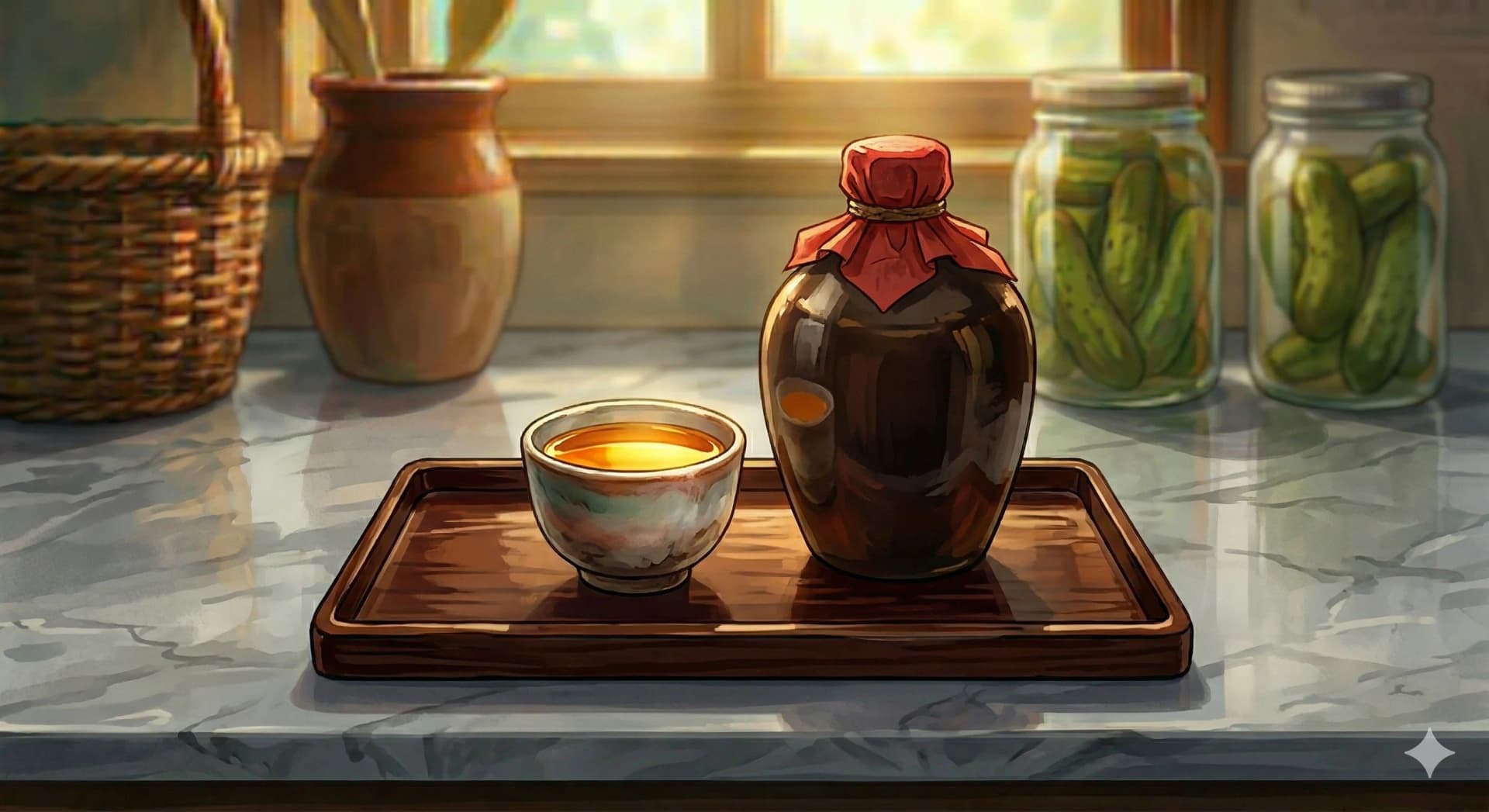
Shaoxing Wine
Also known as: Shao Hsing Wine, Chinese Rice Wine, Huangjiu
Shaoxing wine is a fermented rice wine from Shaoxing, Zhejiang province — one of the most important flavoring agents in Chinese cooking.
Amber-colored with a complex, slightly sweet and nutty flavor, it is used in marinades, braises, stir-fries, and red-cooked dishes to add depth and round out sharp or fishy notes.
There is no perfect substitute: dry sherry comes closest in a pinch, but Shaoxing wine has a character of its own.
Key facts at a glance:
- Fermented rice wine from Zhejiang province — over two thousand years of production history
- Amber-colored with sweet, nutty flavor — adds depth and rounds out sharp or fishy notes
- Aged in earthenware urns — sometimes for decades in traditional production
- No perfect substitute — dry sherry comes closest but lacks Shaoxing's distinctive character
- 14–18% alcohol content — contributes to flavor extraction and preservation in cooking
Flavor Profile
Origin
Shaoxing, Zhejiang, China
Traditional Medicine Perspectives
Traditional Chinese Medicine
In TCM, Shaoxing wine (Huang Jiu) is considered warm and sweet. It is used as a menstruum to carry medicinal herbs into the body and to activate their effects. Many TCM herbal formulas specify wine-processed (jiu zhi) herbs, where herbs are stir-fried with wine to enhance their warming and activating properties. Externally, rice wine is used to treat cold-damp conditions and improve circulation.
Modern Scientific Research
Shaoxing wine contains organic acids, esters, and amino acids produced during fermentation.
The alcohol content (typically 14–18%) contributes to flavor extraction and preservation in cooking.
Fermented grain beverages have been studied for their prebiotic compounds and organic acids, though the health effects of cooking wine as a culinary ingredient are less researched than those of fermented foods consumed directly.
Cultural History
Shaoxing wine has been produced in Zhejiang province for over two thousand years. The city of Shaoxing has a history intertwined with wine — its water, drawn from ancient Jian Lake, was considered essential to the wine's character.
Traditional Shaoxing wine is aged in earthenware urns, sometimes for decades.
'Nu er hong' (daughter's red wine) is a tradition where wine is buried at a daughter's birth and opened at her wedding.
Culinary Uses
Add to marinades for meat and seafood to tenderize and reduce gamey or fishy flavors. Use in stir-fry sauces, braising liquids, and red-cooked dishes.
Deglaze a hot wok with it for an aromatic burst. Use in clay pot dishes and dim sum preparations.
Deglazing a hot wok with Shaoxing wine produces an aromatic burst that elevates any stir-fry.
Pair naturally with soy sauce, ginger, star anise, and fermented black beans.
Preparation Methods
Use at room temperature. Add to hot woks or pans — the alcohol cooks off quickly and leaves the flavor behind.
For marinades, combine with soy sauce and aromatics.
The culinary grade (often labeled 'cooking wine') is saltier than drinking-grade Shaoxing — adjust salt in the dish accordingly.
Traditional Dishes
- Drunken chicken
- Red-braised pork (hong shao rou)
- Lion's head meatballs
- Dongpo pork
- Steamed crab
Recipes Using Shaoxing Wine
- Niu Rou Yang Cong Jiaozi (Beef and Onion Dumplings)
- Bai Qie Ji (White Cut Chicken)
- La Zi Ji (Chongqing Spicy Chicken)
- Guo Tie (Potstickers)
- Ginger Scallion Beef
- Jiao Hua Ji (Beggar's Chicken)
- Xia Ren Chao Dan (Stir-Fried Shrimp with Eggs)
- Black Pepper Beef (黑椒牛柳)
- Dan Dan Noodles (担担面)
- Steamed Spare Ribs with Black Bean Sauce (豉汁蒸排骨)
- Beijing Shredded Pork (Jing Jiang Rou Si / 京酱肉丝)
- Dang Gui Ji Tang (Dang Gui Chicken Soup)
- General Tso's Chicken (左宗棠鸡)
- Beef in Black Bean Sauce (豉汁牛肉)
- Sheng Jian Bao (Pan-Fried Soup Dumplings)
- Bitter Melon with Egg
- Xi Hong Shi Chao Dan (Tomato Egg Stir-Fry)
- Suan Rong Zheng Xia (Cantonese Steamed Shrimp with Garlic)
- Yu Tou Dou Fu Tang (Fish Head Tofu Soup)
- Chicken Feet (鳳爪)
- Singapore Noodles (星洲炒米)
- Zi Ran Yang Rou (Cumin Lamb)
- Chinese Tea Eggs (茶叶蛋)
- Shrimp and Broccoli in Brown Sauce (虾仁西兰花)
- Lu Dan (Soy Braised Eggs)
- Mongolian Beef (蒙古牛肉)
- Wonton Soup (馄饨汤)
- Sesame Beef (芝麻牛肉)
- Xia Ren Chao Fan (Shrimp Fried Rice)
- Black Bean Chicken
- Kou Shui Ji (Sichuan Mouthwatering Chicken)
- Braised Chicken with Lily Buds and Mushrooms (Jin Zhen Yun Er Ji)
- Gan Bian Si Ji Dou (Dry-Fried Green Beans)
- Shi Zi Tou (Lion's Head Meatballs)
- Gong Bao Ji Ding (Kung Pao Chicken)
- Hong Shao Rou (Red Braised Pork Belly)
- Beef Tendon Noodle Soup (牛筋面)
- Dao Xiao Mian (Knife-Cut Noodles, 刀削面)
- Taiwanese Beef Noodle Soup (紅燒牛肉麵)
- Gan Chao Niu He (Beef Chow Fun)
- Shui Zhu Yu (Sichuan Boiled Fish)
- Bao Zai Fan (Claypot Rice)
- Hong Shao Yu (Red Braised Fish)
- Kao Fu (Shanghai Braised Gluten)
- Dou Chi Zheng Yu (Steamed Fish with Black Bean Sauce)
- Hui Guo Rou (Twice Cooked Pork)
Comments
Share your thoughts on this ingredient.
Sign in to comment0 Comments