Traditional Chinese Medicine · China
Chicken Feet (鳳爪)
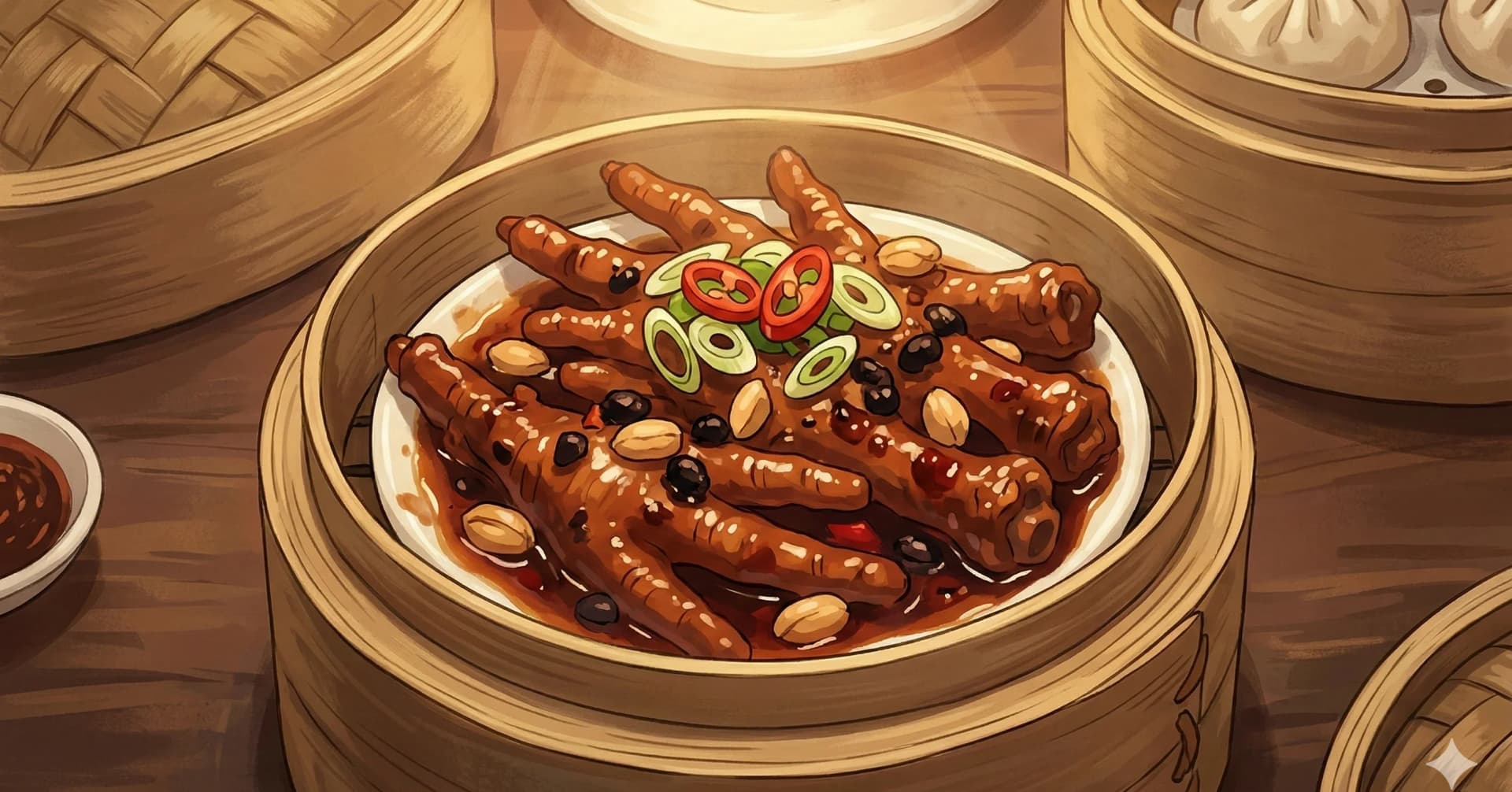
Dim sum chicken feet parboiled, deep-fried for puffy texture, braised in black bean sauce with star anise and peanuts, then steamed
Chicken feet is one of the most iconic dishes on a dim sum menu, and it is the one that separates the curious eaters from the cautious ones. The feet arrive in a small steamer basket, dark and glossy from their black bean sauce, puffy and wrinkled from their journey through four separate cooking stages, with peanuts that have soaked up the sauce and a few slices of chili pepper on top.
The texture is the point. Chicken feet are almost entirely skin, cartilage, and tendons over small bones. There is no muscle meat to speak of. What you eat is the collagen-rich skin, which after being parboiled, deep-fried, shocked in ice water, braised, and steamed becomes soft, gelatinous, and almost impossibly tender. The deep-frying step is what creates the puffy, wrinkled texture: the hot oil blisters the skin, and the subsequent ice bath causes it to contract and wrinkle. This wrinkling creates pockets that absorb the braising sauce.
Eating chicken feet is a technique in itself. You bite off a toe, work the skin and tendons off the bone with your teeth, and set the bone aside. It is not fast food. It is a slow, tactile, rewarding kind of eating, the kind that requires a pot of tea and no particular hurry. The collagen in chicken feet is the same substance that gives bone broth its body, and in traditional Chinese medicine, chicken feet are considered nourishing to the skin, joints, and connective tissue.
At a Glance
Yield
4 servings
Prep
40 minutes
Cook
80 minutes
Total
120 minutes
Difficulty
Involved
Ingredients
Braise Ingredients
- 1.25 lbschicken feet, 570g
- 1 ozfermented black beans, rinsed and soaked
- 3garlic cloves, chunked
- 9ginger slices
- 1scallion stalk
- 1 ozshallot, halved
- 2star anise
- 3/4 cupspeanuts, rinsed and soaked (optional)
- 3whole chili peppers
- 1 tbsphoney, for parboiling
- 1 tbspShaoxing wine, for parboiling
- 12 ozcooking oil, for deep-frying
- 3 cupswater, for braising
Sauce Ingredients
- 1 tbspblack bean sauce
- 2 tbspoyster sauce
- 2 tbspsoy sauce
- 1 tbspShaoxing wine
- 1/2 tbspdark soy sauce
- 2 tbspsugar
- 1 tspsalt
- 1 tbsphoisin sauce
- 1 tspchili sauce
Method
- 1
Parboil chicken feet: start with cold water, add ginger, scallion, honey, Shaoxing wine. Bring to boil, reduce to medium-low 15 min. Transfer to ice water bath.
- 2
Trim all nails with kitchen shears (do this after parboiling so skin stays stretched).
- 3
Mix sauce: black bean sauce, oyster sauce, soy sauce, Shaoxing wine, dark soy sauce, sugar, salt, hoisin sauce, chili sauce.
- 4
Deep-fry at 175°C (350°F) until golden brown. Cover to contain splatter. Transfer immediately to ice water bath to shock.
- 5
Cut each foot in half through the palm.
- 6
Braise: fry ginger, garlic, scallion, chili, shallots, star anise, black beans in oil. Add sauce, fry 45 sec. Add chicken feet and peanuts. Add water, bring to boil, reduce to medium-low. Braise 45 min.
- 7
Optional: arrange in a heat-safe bowl, top with red bell pepper slivers and black beans. Steam 15-20 min for authentic dim sum texture.
Key Ingredient Benefits
Chicken feet: One of the richest dietary sources of collagen on the planet. A chicken foot is almost entirely skin, cartilage, tendon, and tiny bones with no meat in the Western sense. The long braise converts that collagen into gelatin, which is what gives the finished dish its lip-smacking, almost glossy mouthfeel. Studies on collagen peptides suggest possible benefits for joint comfort and skin elasticity, though evidence is still developing and most clinical work uses higher concentrations than home cooking provides.
Fermented black beans (douchi): Soybeans fermented with salt and Aspergillus mold for months. They are the defining seasoning of Cantonese seafood and braise cookery, contributing a concentrated, almost cheese-like umami that lasts through long cooking. The same beans appear in steamed spare ribs and clams in black bean sauce.
Garlic and ginger: Used in significant quantity, both as aromatic base and as flavor balance for the rich, gelatinous feet. The organosulfur compounds in garlic (allicin) and the gingerols in ginger contribute both flavor and the traditional Chinese-medicine idea of "balancing" rich, fatty foods.
Star anise: Contributes anethole, the same compound found in fennel and licorice, which gives the braise its warm, slightly sweet aromatic backbone. Star anise is also the natural source of shikimic acid, the starting material for the antiviral drug oseltamivir (though eating star anise itself does not produce antiviral effects).
Peanuts: Roasted skin-on peanuts are the classic textural contrast — small crunchy nuggets scattered through the soft, gelatinous feet. They contribute protein, healthy monounsaturated fats, and resveratrol, the same antioxidant found in red wine.
Why This Works
The signature puffy, wrinkled texture of dim sum chicken feet comes from a specific three-step process: parboil, deep-fry, ice bath. Deep frying the parboiled feet causes the moisture trapped under the skin to flash to steam, blistering the surface into thousands of tiny bubbles. The immediate plunge into ice water shocks the puffed skin, which contracts rapidly but cannot return to its original shape, locking in the wrinkled, honeycomb-like texture. That texture is what catches and holds the sauce.
The long braise is what tenderizes the feet into something edible. Chicken feet are almost entirely collagen, the structural protein in connective tissue, which is tough and rubbery when raw or briefly cooked. Sustained low heat (a true gentle simmer, not a boil) converts collagen into gelatin, which gives the finished dish its soft, almost melting mouthfeel. The braising liquid itself becomes rich and slightly viscous from the dissolved gelatin.
Fermented black beans bloom slowly. A brief sauté in oil at the start releases their volatile aromatics. The long braise then integrates their umami into every crevice of the wrinkled skin. The same principle drives the sauce in steamed spare ribs — black beans need time to give their best.
The final steam (if you do this step) is what dim sum kitchens use to hold and reheat. After braising, the feet rest in their sauce for hours or overnight; a quick steam reheats them while the gelatinized sauce re-emulsifies into the puffy skin. This is also why chicken feet served at dim sum almost always taste better than versions eaten the moment they finish cooking.
Substitutions & Variations
Skipping the deep fry: Some home versions skip the dramatic fry-and-shock and go straight to braising after parboiling. The feet will be tender and flavorful but will lack the signature wrinkled, puffy skin texture. The result is more like a Cantonese braised foot than a dim sum one.
Oven shortcut for the puff: Brush parboiled feet with oil and bake at 220°C (425°F) for 18 to 22 minutes until the skin blisters and dries out. Then proceed with the ice bath. This avoids the mess of deep frying but produces slightly less dramatic puffing.
Spice level: The classic dim sum version is mild. For Sichuan-style heat, add a tablespoon of doubanjiang (chili bean paste) to the braising sauce and 3 to 4 whole dried chilies. Reduce the sugar slightly to compensate.
Peanuts: Raw peanuts can be added at the start of the braise so they soften completely and become almost custardy. Roasted peanuts added at the end stay crunchy and provide textural contrast. Both versions are traditional.
Star anise: Five-spice powder (just a small pinch) substitutes the warm aromatic note. Cassia bark or a small piece of cinnamon stick can stand in.
Fermented black beans: Jarred Lee Kum Kee black bean garlic sauce works in a pinch but produces a saltier, less nuanced result. Use 2 to 3 tablespoons in place of the whole beans and reduce added soy sauce.
Bone-in chicken thighs as a stand-in: Not a true substitute (the dish is about the texture of feet, not the flavor of chicken), but the braising sauce works well for thighs and produces an excellent everyday dish.
Serving Suggestions
Fung zao is a dim sum classic, ordered alongside other small plates like siu mai, har gow, steamed spare ribs, and turnip cake. At a yum cha breakfast, each small bamboo steamer of chicken feet feeds two or three people as one item among many.
At home, serve as a shared appetizer or side dish before a larger meal. Set out toothpicks for the smaller bones and a stack of napkins, as the dish is finger food and the gelatinous sauce gets on everything. A bowl of steamed jasmine rice alongside is welcome for catching the rich black bean sauce.
Pair with hot Chinese tea (pu-erh, jasmine, or oolong) — the traditional dim sum drink. Cold light beer (Tsingtao, Asahi) also works well, the carbonation cutting through the rich gelatin. Avoid wines, which clash with the funk of the fermented black beans.
For a casual home dinner, serve over rice with a simple stir-fried green like gai lan or bok choy. The vegetable's fresh, bitter edge balances the unctuous feet.
Storage & Reheating
Refrigerator: Chicken feet store beautifully for up to 4 days in their braising sauce. The flavor genuinely improves overnight as the sauce penetrates further into the wrinkled skin. The braising liquid will gel solid in the cold, which is a sign of properly-extracted gelatin.
Reheating: Steaming is the best method — 8 to 10 minutes in a bamboo steamer (or any covered steamer) restores the puffy texture and re-melts the gelatin into the sauce. Microwaving works in a pinch but can make spots of the skin slightly rubbery from uneven heating.
Make-ahead: The full dish is designed to be made ahead. Many dim sum kitchens braise chicken feet a day in advance and re-steam them to order. Plan for at least 4 hours of total cooking time spread across two days for the best results.
Freezing: Freezes well for up to 2 months in an airtight container, fully submerged in their braising sauce. Thaw overnight in the refrigerator and reheat by steaming.
Sauce reuse: The gelatinous braising liquid is excellent and should not be discarded. Use it as a starter for the next batch (add more soy sauce, sugar, and aromatics to refresh), or stir a spoonful into a simple rice or noodle dish for instant depth.
Cultural Notes
Chicken feet, known in Cantonese as fung zao (鳳爪, "phoenix claws") and in Mandarin as fèng zhuǎ, are one of the most iconic dim sum items in southern Chinese cuisine. The poetic naming — feet renamed as phoenix claws — is a classic example of Cantonese culinary euphemism, in which less appetizing names are dressed up to enhance the dining experience. The same convention turns chicken kidneys into "dragon kidneys" and pork tongue into "phoenix tongue."
The dish is part of the cha lou (茶樓, tea house) tradition that became the foundation of modern dim sum culture in 19th-century Guangzhou and Hong Kong. Yum cha (飲茶, "drinking tea"), the practice of eating small dishes alongside oolong or pu-erh, evolved from a way for laborers and merchants to gather socially into one of the most distinctive eating traditions in the world. Chicken feet have been on yum cha carts for over a century and remain among the most-ordered items.
The Cantonese approach to chicken feet — the three-step parboil/fry/shock process — is widely considered the gold standard. Other regional Chinese cuisines also prepare feet but with different techniques: Sichuan versions (shǔ jiāo fèng zhuǎ) lean heavily on chili and Sichuan peppercorn; northern Chinese versions are often pickled or served cold as a beer snack; Taiwanese versions can be deep-fried and dressed in black vinegar and chili.
Chicken feet have also become one of China's largest agricultural export products. The United States, which historically does not eat them, exports an enormous quantity of chicken feet to China and Hong Kong each year. This is part of a broader pattern where parts of the animal that are prized in one cuisine and discarded in another create lopsided trade flows — a culinary footnote to globalization.
Nutrition Facts
Calories: 456kcal (23%)|Total Carbohydrates: 20.6g (7%)|Protein: 30.8g (62%)|Total Fat: 27.2g (35%)|Saturated Fat: 6.9g (35%)|Cholesterol: 120mg (40%)|Sodium: 1842mg (80%)|Dietary Fiber: 1.5g (5%)|Total Sugars: 13.4g
You Might Also Like
Ratings & Comments
Ratings & Comments
Ratings
Share your thoughts on this recipe.
Sign in to rate and comment