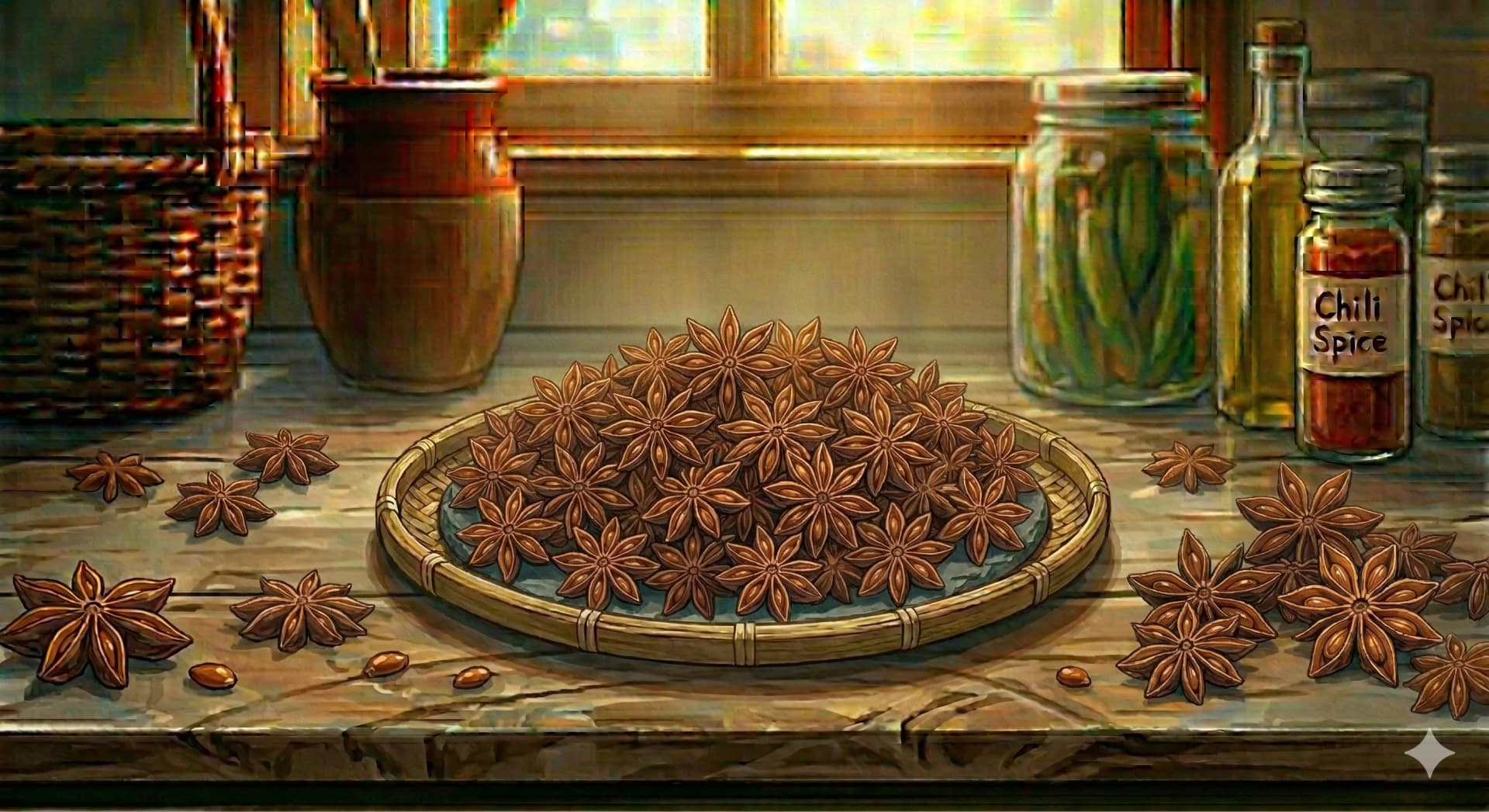
Star Anise
Also known as: Ba Jiao, Chinese Star Anise, Illicium verum, Eight Corners
Star anise is a star-shaped spice from a small evergreen tree native to southern China and northern Vietnam. Its bold, sweet, licorice-like aroma comes from anethole — the same compound that gives anise seed and fennel their characteristic flavor, though star anise is more potent and more complex than either.
It is one of the fundamental spices of Chinese cooking and a key component of five-spice powder.
Key facts at a glance:
- Star-shaped spice — from an evergreen tree native to southern China and northern Vietnam
- Anethole — the compound responsible for its bold, sweet, licorice-like aroma
- Key component of five-spice powder — one of the fundamental spices of Chinese cooking
- Ba jiao (eight corners) — Chinese name references its distinctive shape
- Source of shikimic acid — the primary precursor for Tamiflu production in the early 2000s
Flavor Profile
Origin
Southern China, Northern Vietnam, Guangxi, Yunnan
Traditional Medicine Perspectives
Traditional Chinese Medicine
Star anise (Ba Jiao Hui Xiang) is classified as warm and acrid in TCM, associated with the Kidney, Liver, and Spleen meridians. It is used to warm the Kidney Yang, regulate Qi, and relieve pain. It is prescribed for cold-type abdominal pain, hernia, and digestive complaints caused by cold patterns. As a carminative, it relieves gas, bloating, and nausea.
Modern Scientific Research
Anethole, the primary bioactive compound in star anise, shows antimicrobial, antifungal, and anti-inflammatory properties in research.
Star anise is rich in shikimic acid, the precursor to the antiviral drug oseltamivir (Tamiflu), though therapeutic doses are far beyond culinary use.
Research also suggests antioxidant activity and potential antispasmodic effects relevant to its traditional digestive use.
Cultural History
Star anise (ba jiao, meaning 'eight corners') has been used in Chinese cooking and medicine for over three thousand years. It is native to a small region of southern China and northern Vietnam and was unknown in the West until trade routes opened in the 17th century.
It became essential to French and Spanish liqueur production (anisette, pastis) and was a key ingredient in the global production of Tamiflu (oseltamivir) in the early 2000s, when shikimic acid extracted from star anise was the primary precursor.
In Chinese cooking, it is used whole in braises, red-cooked dishes, and master stocks.
Culinary Uses
Add whole pods to braises, red-cooked meats, and master stocks. Essential in pho broth, where it contributes the characteristic warm sweetness.
Use in spiced poaching liquids for chicken and eggs. Add to mulled wine and spiced desserts.
Remove before serving — the texture is unpleasant to eat whole.
Preparation Methods
Use whole in long-cooked dishes and remove before serving. Lightly toast in a dry pan before adding to a dish to deepen flavor.
For five-spice powder, grind after toasting.
Store in an airtight container — star anise retains flavor well when kept whole.
Traditional Dishes
- Red-braised pork (hong shao rou)
- Vietnamese pho broth
- Master stock (lu shui)
- Soy sauce eggs
- Spiced duck
Recipes Using Star Anise
- Boat Noodles (ก๋วยเตี๋ยวเรือ)
- Beef Brisket Soup (清湯牛腩)
- Chicken Chettinad
- Jiao Hua Ji (Beggar's Chicken)
- Braised Pork Leg on Rice (Khao Kha Moo / ข้าวขาหมู)
- Beef Rendang (Rendang Daging)
- Chicken Rendang (Rendang Ayam)
- Dan Dan Noodles (担担面)
- Chicken Pho (Phở Gà)
- Five-Spice Roast Chicken
- Chicken Feet (鳳爪)
- Soy Sauce Chicken
- Lu Dan (Soy Braised Eggs)
- Peking Duck
- Beef Pho (Phở Bò)
- Malaysian Mutton Soup (Sup Kambing)
- Braised Pig's Feet (Jokbal / 족발)
- Hong Shao Rou (Red Braised Pork Belly)
- Tea-Smoked Duck
- Beef Tendon Noodle Soup (牛筋面)
- Dao Xiao Mian (Knife-Cut Noodles, 刀削面)
- Lanzhou Beef Noodle Soup (兰州牛肉面)
- Taiwanese Beef Noodle Soup (紅燒牛肉麵)
- Jiaozi (Pork and Chive Dumplings)
- Kao Fu (Shanghai Braised Gluten)
- Bak Kut Teh (Pork Bone Tea)
Comments
Share your thoughts on this ingredient.
Sign in to comment0 Comments