Chinese Cuisine
Kao Fu (Shanghai Braised Gluten)
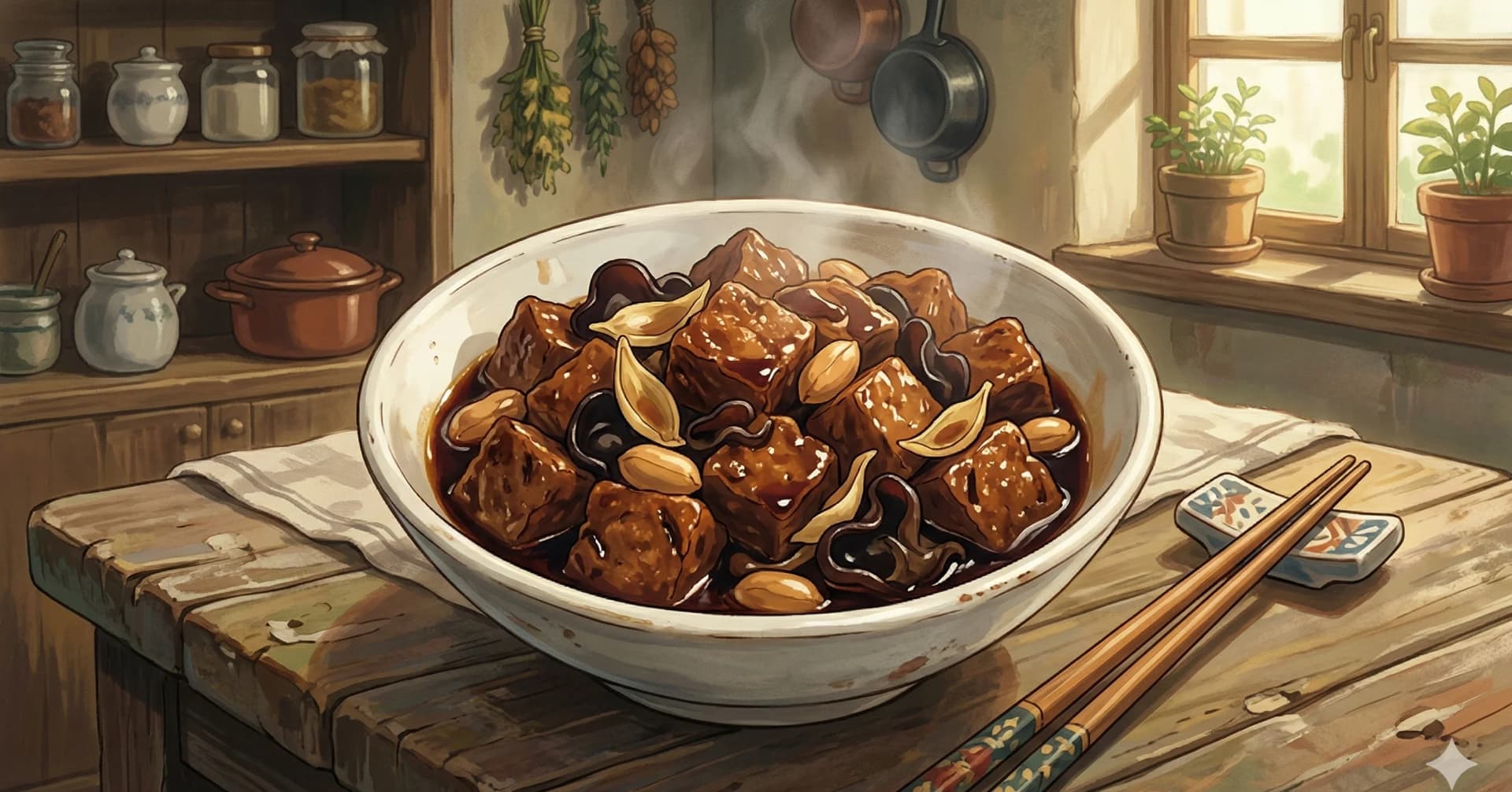
Spongy wheat gluten braised with wood ear mushrooms, lily buds, and peanuts in a sweet-savory sauce
Kao fu has a texture that surprises anyone encountering it for the first time: spongy, almost bread-like cubes of wheat gluten that have absorbed a dark, sweet-savory braising liquid until they are saturated with flavor. Squeeze one between your chopsticks and it springs back, then yields when you bite into it, releasing a rush of concentrated soy, sugar, and the earthy depth of dried mushrooms. It is unlike anything in Western cooking, and it is one of Shanghai's most celebrated cold dishes.
This dish has deep roots in Buddhist vegetarian cooking, or su cai, where wheat gluten (mian jin) has been used as a protein source for centuries. The version that emerged in Shanghai became a staple of the city's cold appetizer culture, served alongside smoked fish, pickled vegetables, and drunken chicken at the start of a meal. It is always served cold or at room temperature, which allows its complex flavors to come through more clearly than they would hot.
The combination of ingredients is specific and important: wood ear mushrooms for their delicate crunch, dried lily buds for a slightly floral, chewy sweetness, and peanuts for richness and texture. Together with the gluten, they create a dish that is texturally varied and deeply satisfying.
The practical key is properly preparing the fried gluten puffs. They must be soaked and squeezed to remove their frying oil, then torn or cut into pieces. This step ensures they can absorb the braising liquid like sponges. Skip it, and they will remain oily and resist the sauce.
At a Glance
Yield
6 servings
Prep
30 minutes
Cook
30 minutes
Total
60 minutes
Difficulty
Medium
Ingredients
- 5½ ozfried wheat gluten puffs (you mian jin)
- ½ ozdried wood ear mushrooms
- ¾ ozdried lily buds (jin zhen, golden needles)
- 2 ozraw peanuts (skin on)
- 1 tbspvegetable oil
- 3 slicesfresh ginger
- 1¼ cupwater
- 3 tbsplight soy sauce
- 1 tbspdark soy sauce
- 2½ tbsprock sugar (or 20 g granulated sugar)
- 1 tbspShaoxing wine
- 1 wholestar anise
- 1 tspsesame oil
Method
- 1
Soak the fried gluten puffs in a large bowl of hot water for 15 minutes. They will absorb water and become soft. Squeeze each one firmly between your palms to expel the water and residual frying oil. Repeat the soaking and squeezing once more with fresh water. Tear or cut the puffs into bite-sized pieces, about 2 cm.
- 2
Soak the dried wood ear mushrooms in warm water for 20 minutes, until they are fully rehydrated, soft, and expanded. Trim away any hard, gritty stems. Tear large pieces into smaller, bite-sized portions.
- 3
Soak the dried lily buds in warm water for 15 minutes. Trim off the hard knot at one end of each bud. If any buds are very long, cut them in half.
- 4
Place the raw peanuts in a small pot of cold water. Bring to a boil and cook for 15 minutes, until the peanuts are tender but still have some bite. Drain and set aside.
- 5
Heat a wok over medium heat. Add the vegetable oil and ginger slices. Let the ginger sizzle gently for 30 seconds, until fragrant.
- 6
Add the squeezed gluten pieces to the wok. Stir-fry for 2 minutes, allowing the surface to lightly brown and develop a bit of texture.
- 7
Add the wood ear mushrooms and lily buds. Toss together for 1 minute.
- 8
Pour in the water, light soy sauce, dark soy sauce, rock sugar, Shaoxing wine, and star anise. Stir to combine and dissolve the sugar.
- 9
Bring to a boil, then reduce the heat to medium-low. Let the mixture simmer gently, uncovered, for about 20 minutes. Stir occasionally to ensure even absorption.
- 10
The gluten pieces will gradually darken and plump as they absorb the braising liquid. The sauce should reduce by more than half, becoming thick and glossy. If it reduces too quickly, lower the heat and add a splash of water.
- 11
Add the cooked peanuts during the last 5 minutes of braising. Stir them in gently.
- 12
When the sauce is thick enough to coat each piece and there is very little free liquid in the wok, remove from heat.
- 13
Discard the star anise and ginger slices. Drizzle with sesame oil and stir to combine.
- 14
Transfer to a serving dish and let the kao fu cool to room temperature. Refrigerate for at least 1 hour before serving. The flavors intensify significantly when cold.
- 15
Serve cold or at room temperature as a cold appetizer.
Key Ingredient Benefits
Wheat gluten (seitan) is a concentrated plant protein, containing roughly 75 g of protein per 100 g in its dried form. It is not suitable for those with celiac disease or gluten sensitivity. For those who can tolerate it, it has been a protein staple in Chinese Buddhist vegetarian cooking for over a thousand years.
Dried lily buds are the unopened flowers of daylilies, traditionally used in Chinese medicine for their calming properties. Some research suggests they contain compounds with mild sedative effects, and they have been traditionally recommended for improving sleep quality.
Wood ear mushrooms are rich in iron and dietary fiber. Research suggests they may have anticoagulant properties, and they have been traditionally used in Chinese medicine for blood circulation support.
Why This Works
Wheat gluten puffs have a cellular, sponge-like structure created by deep-frying. Soaking and squeezing removes the frying oil and collapses the internal air pockets, creating a dense, absorbent matrix that can take in braising liquid with remarkable efficiency. By the end of cooking, each piece is saturated with sauce, which is why kao fu delivers such concentrated flavor despite being made from a relatively bland starting ingredient.
The combination of light and dark soy sauce creates both flavor and color. Light soy sauce provides the primary saltiness and savory depth, while dark soy sauce adds the characteristic deep brown color and a touch of sweetness from its added molasses or caramel.
Rock sugar dissolves more slowly than granulated sugar, which is actually an advantage in braising. It allows the sweetness to build gradually and produces a cleaner, less cloying result. It also contributes to the sauce's gloss.
The dish is served cold because the flavors are more distinct and balanced at lower temperatures. Warm, the sweetness can seem cloying; cold, it is tempered and elegant.
Substitutions & Variations
- Fried gluten puffs: If unavailable, fresh baked wheat gluten (kao fu) can be found in some Chinese markets. Cut into cubes and proceed without the soaking step.
- Lily buds: If unavailable, omit them rather than substitute. Their flavor is unique, and the dish will still be delicious without them, just slightly less complex.
- Wood ear mushrooms: Fresh or dried shiitake mushrooms can substitute, though the texture contrast will be different.
- Peanuts: Edamame or fried tofu puffs are alternatives. Some versions include bamboo shoots for additional crunch.
- Vegan: Use vegetarian oyster sauce in place of regular oyster sauce if your recipe includes it. This version as written is already vegan.
Serving Suggestions
Kao fu is traditionally served as part of a cold appetizer spread at the beginning of a Shanghai-style meal. It pairs well with other cold dishes: smoked fish, marinated jellyfish, or dressed tofu skin. It also works as a side dish alongside congee, or as a component in a rice bowl topped with other braised items. In a Western context, it can serve as an unusual and flavorful appetizer or snack.
Storage & Reheating
This dish is specifically designed to be made ahead. Store in an airtight container in the refrigerator for up to 1 week. The flavor improves over the first 2 to 3 days as the sauce continues to penetrate the gluten and the ingredients meld. Serve cold or at room temperature. If you prefer it warm, reheat gently in a small pot with a splash of water. Freezing is possible for up to 2 months, though the wood ear mushrooms may soften slightly.
Cultural Notes
Si xi kao fu (四喜烤麩, "four-joys braised wheat gluten") is the Shanghainese cold appetizer of spongy wheat gluten (kao fu) braised with wood ear mushrooms, dried shiitake, lily buds (jin zhen), and peanuts in a sweet-savory sauce of soy sauce, sugar, Shaoxing wine, and aromatic spices, then chilled and served at room temperature as part of the traditional Shanghainese cold-dish lineup that opens a formal meal. The dish belongs to the broader Shanghai leng cai (cold dish) tradition and is one of the most strongly Shanghainese vegetarian preparations, served at homes across the city during Lunar New Year and at Shanghai restaurants worldwide as a permanent menu fixture.
The signature ingredient is kao fu, a spongy form of wheat gluten that begins as raw seitan (the protein extracted from wheat flour by washing out the starch), is then leavened with yeast and steamed until it has the porous, almost bread-like structure that defines the form. The spongy texture is critical to the dish: the kao fu acts like a sponge for the braising liquid, absorbing the sweet-soy sauce into its many tiny air pockets and releasing it in the mouth when chewed. The cooked kao fu is tender, slightly elastic, and dramatically more flavorful than the same volume of plain seitan.
The technique tears the kao fu into rough bite-sized pieces (cutting with a knife is discouraged since the torn surfaces absorb sauce better), pan-fries the pieces briefly to color the surface, then braises everything together for thirty to forty minutes in the sweet-soy sauce until the mushrooms and lily buds soften and the kao fu turns dark mahogany. The dish is removed from the heat, allowed to cool to room temperature, and traditionally served from a small glass or ceramic bowl as part of a cold-dish lineup that also includes drunken chicken (zui-ji), smoked fish, sweet-and-sour radish, and other Shanghai cold appetizers. The dish keeps well in the refrigerator for several days and improves slightly as the flavors meld.
Nutrition Facts
Calories: 221kcal (11%)|Total Carbohydrates: 17.1g (6%)|Protein: 9.4g (19%)|Total Fat: 13.3g (17%)|Saturated Fat: 1.9g (10%)|Cholesterol: 0mg (0%)|Sodium: 559mg (24%)|Dietary Fiber: 3.2g (11%)|Total Sugars: 6g
You Might Also Like
Ratings & Comments
Ratings & Comments
Ratings
Share your thoughts on this recipe.
Sign in to rate and comment