Malaysian Cuisine
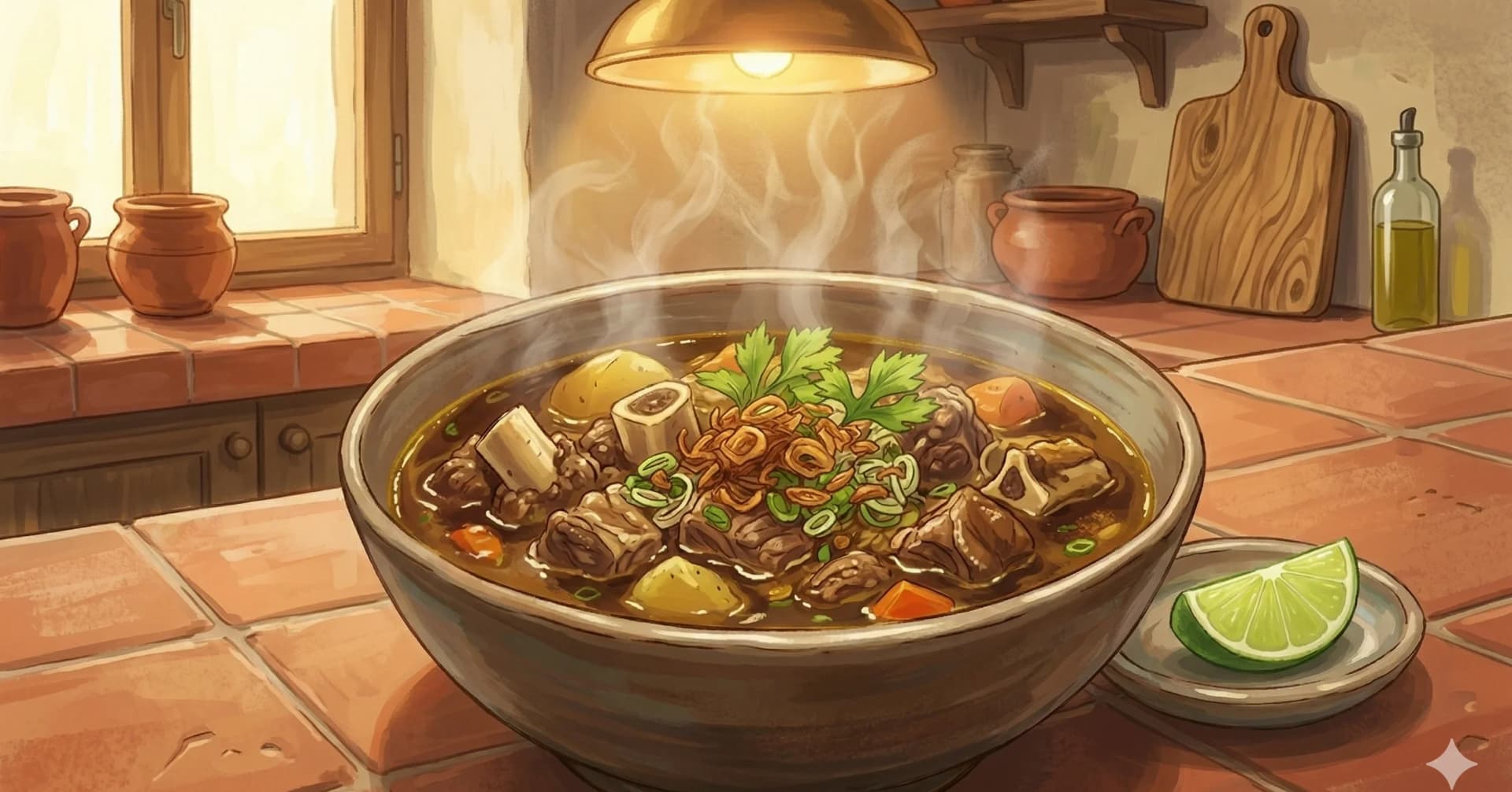
Malaysian Mutton Soup (Sup Kambing)
A deeply spiced Malaysian mutton soup simmered with cinnamon, cardamom, and star anise until the broth turns golden and the meat falls from the bone
Sup kambing is the kind of soup that announces itself long before you reach the stall. The scent of cinnamon, cardamom, and star anise carries through humid night air, drawing people toward the Mamak hawker carts that line the streets of Kuala Lumpur and Penang after dark. It is one of those dishes that straddles cultural boundaries so completely that claiming a single origin feels beside the point. The spice work is unmistakably South Indian in character, brought to the Malay Peninsula by Muslim Tamil traders and settlers, but the soup itself has no direct equivalent on the subcontinent. It is something that emerged in the meeting of Indian spice traditions and Malay cooking sensibilities, claimed equally by Mamak stall owners and Malay home cooks.
The approach is straightforward. You build a fragrant broth by simmering bone-in mutton with whole spices and aromatics until the meat is tender enough to pull apart with a spoon. The bones release their collagen slowly, turning the broth silky without any thickener. Celery, tomato, and a scattering of spring onions add freshness to what is otherwise a deeply warming, cold-weather bowl. A squeeze of lime at the table lifts everything.
Sup kambing shares a family resemblance with other slow-simmered meat soups across the region. Bak kut teh takes pork ribs through a similar long simmer with a different spice palette, while bo kho does comparable work with beef in a Vietnamese kitchen. The Indonesian rawon darkens its beef broth with keluak nuts but follows the same patient logic. If you enjoy any of those, this soup will feel like familiar territory.
At a Glance
Yield
6 servings
Prep
30 minutes
Cook
2 hours
Total
2 hours 30 minutes
Difficulty
Medium
Ingredients
Spice Blend Ingredients
- 3 wholestar anise
- 5green cardamom pods, lightly crushed
- 1cassia cinnamon stick (about 8 cm)
- 4 wholecloves
- 1 tspfennel seeds
- 1 tspcumin seeds
- 1 tspcoriander seeds
- 1 tspblack peppercorns
Soup Ingredients
- 2 tbspneutral cooking oil
- 6medium shallots (about 80 g), peeled and sliced
- 6 clovesgarlic (about 20 g), peeled and lightly smashed
- ⅓ cupfresh ginger (about a 5 cm knob), peeled and sliced into coins
- 2 stalkslemongrass, use the bottom 15 cm only, outer layers removed, lightly bruised with the flat of a knife
- 2¼ lbbone-in mutton or goat (shoulder, leg, or ribs), cut into 5 cm pieces
- 2 qtwater
- 2medium tomatoes (about 200 g), cut into wedges
- 2 stalkscelery (about 100 g), cut into 3 cm lengths, leaves reserved for garnish
- 1medium carrot (about 100 g), peeled and cut into 2 cm rounds, for a heartier soup (optional)
- 1 tbspfish sauce or light soy sauce
- 1⅔ tspsalt, plus more to taste
- 1¼ tspgranulated sugar
To Serve
- 3spring onions, sliced into thin rounds
- —A handful of fresh cilantro, roughly chopped
- 1 ozfried shallot crisps
- 2limes, cut into wedges
- —Sliced bird's eye chilies in light soy sauce (as a condiment)
- —Crusty bread, steamed rice, or [roti jala](/recipes/roti-jala)
Method
- 1
Combine the star anise, cardamom, cinnamon stick, cloves, fennel seeds, cumin seeds, coriander seeds, and black peppercorns in a dry skillet or small pot over medium heat. Toast, shaking the pan occasionally, until the spices are fragrant and the cumin seeds have darkened a shade, about 2 to 3 minutes. The kitchen will smell warm, resinous, and faintly sweet. Transfer to a small bowl or a piece of cheesecloth tied into a bundle for easy removal later.
- 2
Bring a large pot of water to a rolling boil. Add the mutton pieces and let the water return to a boil. You will see a thick raft of grey-brown foam rise to the surface. Boil for 2 minutes, then drain the meat and rinse each piece under cool running water, rubbing gently to remove any scum or blood residue. This blanching step produces a cleaner, more transparent broth. Set the mutton aside.
- 3
Return the pot to medium-high heat and add the cooking oil. When it shimmers, add the sliced shallots and cook, stirring frequently, until they soften and turn translucent at the edges, about 3 minutes. Add the smashed garlic and ginger coins, and stir for another minute until the garlic is fragrant but not browned. Drop in the bruised lemongrass stalks.
- 4
Add the blanched mutton to the pot and stir to coat the pieces with the aromatics. Pour in the 2 litres of water. Add the toasted spices (loose or in the cheesecloth bundle). Raise the heat to high and bring the liquid to a boil. As it comes up, skim any foam that gathers on the surface with a ladle or fine-mesh strainer.
- 5
Once the broth reaches a full boil, reduce the heat to low so the surface barely trembles with gentle, lazy bubbles. Partially cover the pot. Simmer for 1 hour 30 minutes, checking occasionally to make sure the simmer stays gentle and the liquid level has not dropped below the meat. Add hot water if needed.
- 6
After 1 hour 30 minutes, test a piece of mutton. A fork should slide through the meat with little resistance, and the flesh should pull away from the bone easily. If it still feels firm, continue simmering in 15-minute intervals. Mutton from older animals may need up to 2 hours total.
- 7
Add the tomato wedges, celery pieces, and carrot rounds (if using). Simmer uncovered for 10 to 15 minutes, until the tomatoes have softened and begun to break down slightly and the celery is tender but still holds a gentle bite.
- 8
Season the broth with the fish sauce, salt, and sugar. Taste carefully. The broth should be savory and warmly spiced with a clean, slightly sweet finish. Adjust with more salt for depth, a touch more sugar to round any sharpness, or a splash of fish sauce for umami. Remove and discard the lemongrass stalks and the whole spices (or lift out the cheesecloth bundle).
- 9
Ladle the soup and mutton pieces into deep bowls. Scatter generously with sliced spring onions, chopped cilantro, reserved celery leaves, and a pinch of fried shallot crisps. Serve immediately with lime wedges on the side and a small dish of sliced bird's eye chilies in soy sauce. A squeeze of lime just before eating brightens the broth considerably. Crusty bread, steamed rice, or [roti jala](/recipes/roti-jala) are all welcome alongside.
Key Ingredient Benefits
Mutton and goat: These terms are often used interchangeably in Southeast Asian cooking, though technically mutton refers to sheep over one year old, while goat (kambing) is the more traditional meat in Malaysian contexts. Goat has a slightly gamer flavor and is leaner than lamb. Both work well here. The bone-in cut is important: shoulder, leg, and ribs all contain the connective tissue that enriches the broth. Per 100 g of cooked meat, goat provides roughly 27 g of protein and is notably lower in fat than beef or lamb.
Star anise: Each pod contains anethole, the same compound responsible for the licorice-like flavor in fennel and anise seed. In Chinese and Southeast Asian medicine, star anise has been used traditionally for digestive support. It appears in the five-spice blends used in bak kut teh and pairs naturally with cinnamon and cloves. See the star anise ingredient guide.
Cardamom: Green cardamom contributes a complex, almost floral warmth that distinguishes Malaysian and Indian-influenced broths from their East Asian counterparts. The pods contain cineole and terpinyl acetate, volatile compounds that dissipate at high heat, which is why they are added whole and early so they can infuse gently over the long simmer. See the cardamom ingredient guide.
Cinnamon: Cassia cinnamon is the variety most commonly available in Southeast Asia, and it provides a bolder, more robust warmth than true (Ceylon) cinnamon. It contains cinnamaldehyde, which preliminary research has associated with blood sugar regulation, though dietary amounts are far below any therapeutic threshold. See the cinnamon ingredient guide.
Cumin and fennel seeds: These two spices provide an earthy, slightly sweet base note that anchors the more dramatic aromatics. Cumin is carminative, meaning it has traditionally been used to aid digestion and reduce bloating. Fennel contributes a gentle anise-like sweetness that complements the star anise without overwhelming it. See the cumin and fennel ingredient guides.
Why This Works
The blanching step removes blood proteins, bone marrow residue, and impurities that would otherwise cloud the broth and leave a metallic undertone. By starting with clean meat, the long simmer can focus on extracting flavor and gelatin rather than fighting off muddiness. This is the same principle behind the clear broths in bak kut teh and Vietnamese pho.
Toasting the whole spices before adding them to the broth activates volatile aromatic compounds that are otherwise locked inside the seed hulls and bark. Heat causes the essential oils, particularly anethole in star anise, cinnamaldehyde in cinnamon, and cineole in cardamom, to migrate to the surface, where they dissolve more readily into the simmering liquid. Pre-ground spices would cloud the broth and release their flavor in an uncontrolled burst. Whole spices provide a slower, more sustained release over the two-hour simmer.
Bone-in mutton is essential, not optional. The connective tissue and marrow in the bones convert to gelatin during the long simmer, giving the broth a body and mouthfeel that boneless meat simply cannot provide. You can feel the difference on your lips: a properly simmered sup kambing broth has a slight tackiness that signals richness. This is the same collagen-to-gelatin conversion that gives yukgaejang its silky depth and makes rawon so satisfying.
The late addition of tomatoes and celery preserves their texture and freshness. Tomatoes added at the start would dissolve entirely and make the broth acidic. Added in the final 15 minutes, they soften just enough to release a gentle sweetness while keeping some structure.
Substitutions & Variations
Protein: Lamb shoulder or lamb shanks are the most accessible substitute and will produce a milder-flavored broth. Bone-in beef shin works if mutton is entirely unavailable, though the character of the soup changes. For a quicker cook, use boneless mutton or goat leg cut into 3 cm cubes and reduce the simmering time to about 1 hour.
Spices: If you cannot source all the whole spices individually, a good-quality sup kambing spice packet (available at most Malaysian or Southeast Asian grocery stores) can replace the whole spice blend. Use one 25 to 30 g packet. The trade-off is less control over the balance and a slightly muddier broth, but the convenience is real.
Lemongrass: If unavailable, omit it rather than substituting. Its role here is subtle background brightness. A strip of lemon zest (about 5 cm, added with the spices and removed before serving) provides a faint citrus note, though it is not the same.
Vegetables: Potatoes (waxy varieties, cut into 2 cm cubes) are a common addition in some Mamak stall versions. Add them alongside the carrots. Daikon radish, cut into half-moons, appears in some home-style variations. Leeks can replace or supplement the celery.
Heat: The base recipe is warmly spiced but not hot. For more fire, add 2 to 3 dried chilies to the toasting step or stir a spoonful of sambal into your individual bowl. Some Mamak stalls serve sup kambing with a fiery red chili paste on the side.
Pressure cooker: Complete steps 1 through 4 on the stovetop. Transfer everything to a pressure cooker and cook on high pressure for 35 to 40 minutes with natural release. Add the tomatoes, celery, and carrots after releasing pressure, and simmer on saute mode for 10 minutes.
Slow cooker: Complete steps 1 through 4 on the stovetop, then transfer to a slow cooker. Cook on low for 6 to 8 hours or high for 3 to 4 hours. Add the vegetables in the final 30 minutes.
Serving Suggestions
Sup kambing is a complete meal with bread for dipping. Crusty white bread is the most common companion at Mamak stalls, torn into pieces and used to soak up the broth. Roti jala, the lacy net-like crepes from the Malay kitchen, are the more refined pairing and turn the soup into something elegant. Steamed jasmine rice also works, particularly if you want to stretch the meal.
For a Malaysian spread, serve sup kambing alongside nasi lemak, where the richness of coconut rice complements the broth's warmth. A plate of satay or a bowl of soto ayam creates a generous table for a gathering. The soup also pairs naturally with other long-simmered meat broths if you want to build a tasting menu of sorts: bak kut teh for its herbal pork broth, bo kho for its Vietnamese lemongrass-and-star-anise beef stew, or yukgaejang for its fiery Korean shredded beef soup. Each takes a different cultural path through the same fundamental idea of coaxing flavor from bones and spice over low heat.
Keep the condiments simple. Lime wedges, sliced chilies in soy sauce, and a bowl of fried shallots are all you need at the table. The soup is rich and complex enough that it does not benefit from piling on additional flavors.
Storage & Reheating
Advance preparation: Like most long-simmered soups, sup kambing improves overnight. The spices continue to infuse as the broth cools, and the gelatin sets into a wobbly, savory jelly that melts back into silk when reheated. Making it a day ahead is strongly recommended.
Refrigerator: Store in an airtight container for up to 4 days. A thin layer of fat will solidify on the surface when chilled. This is normal and helps preserve the soup. It melts back into the broth on reheating. Keep any fried shallots and fresh herbs separate and add them only when serving.
Reheating: Warm gently on the stovetop over medium-low heat, stirring occasionally. Add a splash of hot water if the broth has thickened or reduced too much. Avoid a rolling boil, which can cause the meat to dry out and the vegetables to fall apart. Microwave reheating works in short intervals, stirring between each.
Freezing: Sup kambing freezes well for up to 3 months. For best results, freeze the broth and meat without the vegetables (celery and tomatoes become mushy on thawing). Portion into individual containers for easy reheating. Thaw overnight in the refrigerator, then reheat on the stovetop and add fresh vegetables for the final simmer.
Cultural Notes
Sup kambing, literally "goat soup" or "mutton soup" in Malay (the meat is typically mutton rather than goat), belongs to the Indian-Muslim (mamak) tradition that has shaped much of Malaysian street food. The heavy spice profile (cinnamon, cardamom, star anise, cloves, fennel) shows the dish's roots in the broader South Indian and Pakistani-Afghan mutton-soup traditions brought to Malaysia by Tamil-Muslim immigrants in the late 19th and early 20th centuries. Within Malaysia, the dish has evolved into a distinctively Malaysian form, separate from its Indian-subcontinent ancestors but recognizably connected to them.
The dish is reliably present at Malaysian mamak restaurants, sold from breakfast through late-night supper. In the broader Malay culinary world, sup kambing also appears at Malay wedding feasts and Hari Raya open-house tables, where it serves as a hearty, warming complement to drier celebration foods like chicken rendang and satay. Its reputation as a restorative, body-warming food has parallels with Korean samgyetang, Chinese bak kut teh, and many other Asian boyangsik-style preparations.
Regional and cultural variations within Malaysia are notable. Mamak sup kambing leans toward heavier spicing and a clear broth. Malay Johor sup kambing uses more coconut milk and a slightly sweeter profile. The famous Restoran Yusoof Dan Zakhir in Kuala Lumpur's central business district, founded in 1944, is widely regarded as one of the most authoritative mamak sup kambing destinations in the country. The dish is also strongly tied to Malaysian late-night street eating culture: after football matches, after-cinema gatherings, post-prayer Ramadan suppers, and 3 AM weekend wind-downs, sup kambing is one of the dishes most reliably available at mamak stalls when other restaurants have long closed.
Nutrition Facts
Calories: 624kcal (31%)|Total Carbohydrates: 37.5g (14%)|Protein: 47g (94%)|Total Fat: 33.2g (43%)|Saturated Fat: 10.1g (51%)|Cholesterol: 150mg (50%)|Sodium: 933mg (41%)|Dietary Fiber: 7.9g (28%)|Total Sugars: 9g
You Might Also Like


Ratings & Comments
Ratings & Comments
Ratings
Share your thoughts on this recipe.
Sign in to rate and comment