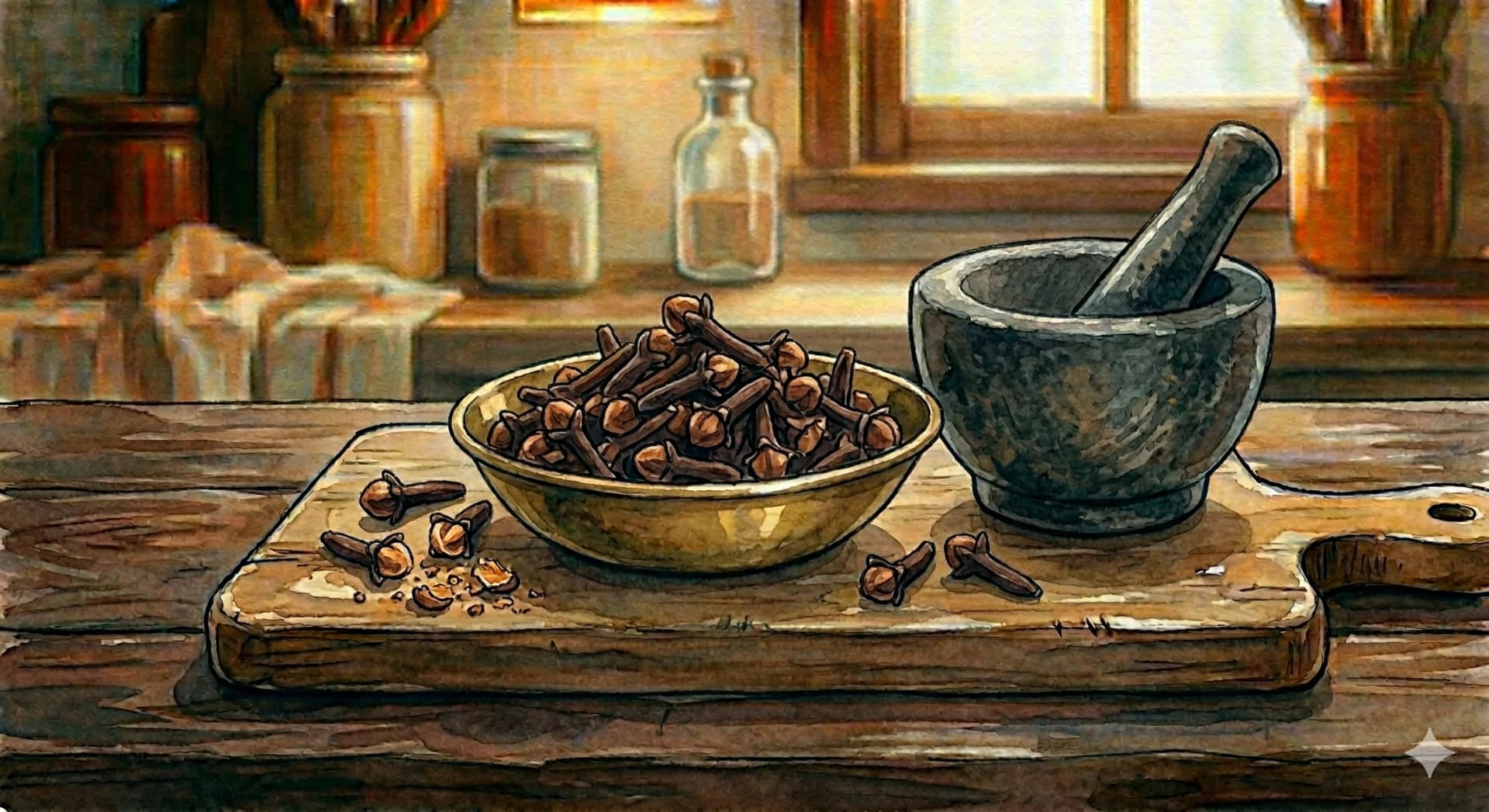
Cloves
Also known as: Laung, Syzygium aromaticum, Clou de girofle
Cloves are the dried flower buds of a tropical tree native to the Maluku Islands in eastern Indonesia. One of the most intensely aromatic spices in the world, their flavor is dominated by eugenol — a phenolic compound with analgesic, antiseptic, and anti-inflammatory properties that forms the basis of many traditional dental preparations worldwide. Cloves have been prized in trade for over two millennia and were among the spices that motivated European exploration in the 15th and 16th centuries.
Key facts at a glance:
- Cloves are the dried — Flower buds of a tropical tree native to the Maluku Islands in eastern Indonesia.
- Cloves have been prized — In trade for over two millennia and were among the spices that motivated European exploration in the 15th and 16th centuries.
Flavor Profile
Origin
Maluku Islands (Indonesia), Zanzibar, Madagascar, Sri Lanka
Traditional Medicine Perspectives
Ayurveda
Cloves (Lavanga) are classified as pungent, bitter, and warming in Ayurveda. They are used to stimulate digestive fire, treat nausea and vomiting, relieve tooth pain, and as an expectorant for respiratory conditions. They are considered anti-Kapha and stimulating — Ayurvedic texts warn against excessive use in Pitta-dominant constitutions due to their strong heating nature.
Traditional Chinese Medicine
Cloves (Ding Xiang) are classified as acrid and warm in TCM, entering the Kidney, Spleen, and Stomach meridians. They are used to warm the middle burner, descend rebellious Qi (stopping hiccups and vomiting), and warm the Kidney to treat cold patterns including impotence and frequent urination. Clove oil is widely used for toothache.
Modern Scientific Research
Eugenol, cloves' primary compound (comprising 72-90% of the essential oil), is well-documented as an analgesic, antiseptic, and anti-inflammatory agent. It works as a COX-2 inhibitor — the same mechanism as ibuprofen.
Clinical research confirms clove's efficacy as a topical anesthetic for dental pain. Research also shows strong antimicrobial activity against a broad range of bacteria and fungi. Clove extract shows blood sugar lowering effects in animal models.
Cultural History
Cloves have been found on the Indonesian islands of the Maluku archipelago — their only native habitat — for over four thousand years. Archaeological evidence suggests clove use in Syria around 1700 BCE, indicating ancient spice trade routes. The clove islands were so valuable that wars were fought over them — the Banda Islands massacre of **1621 **by the Dutch East India Company was driven entirely by the desire to monopolize nutmeg and clove production.
Culinary Uses
Cloves are used whole or ground. Whole cloves are used in long-cooked dishes — biryanis, braises, mulled wine — and removed before serving. Ground clove is used in garam masala, pumpkin spice, Worcestershire sauce, and baked goods. Its intensity means a little goes very far — one or two cloves is often sufficient for an entire dish.
Preparation Methods
Use whole cloves in spiced rice and braises, removing before serving. For ground clove, use sparingly — it overwhelms easily. Toast whole cloves briefly before grinding to develop flavor. Clove-infused oil (add 2 to 3 cloves to warm oil, remove when fragrant) can be used as a finishing touch.
Traditional Dishes
- Biryani
- Garam masala
- Mulled wine
- Pumpkin pie spice
- Indonesian rendang
Recipes Using Cloves
- Chicken Chettinad
- Turmeric Coconut Chicken (Gulai Ayam)
- Slow-Cooked Duck (Dum Ki Batakh)
- Raw-Layered Biryani (Kachi Biryani)
- Spiced Minced Mutton (Mutton Keema)
- Beef Rendang (Rendang Daging)
- Chicken Rendang (Rendang Ayam)
- Lamb & Chicken Duo (Lehm e Murgan)
- Massaman Curry (Gaeng Massaman)
- Chana Masala
- Chicken Pho (Phở Gà)
- Maharashtrian Spiced Rice (Masale Bhaat)
- Egg Curry (Anda Curry)
- Vegetable Ishtu
- Goan Dried Fish Curry (Gaadh Muzh)
- Coconut Sweet Rice (Narali Bhaat)
- Bengal Gram with Coconut (Cholar Dal Narkel Diye)
- Pot-Braised Lamb Korma (Handi Gosht Korma)
- Wedang Jahe (Indonesian Ginger Tea)
- Roast Suckling Pig (Asada de Leitão)
- Beef Pho (Phở Bò)
- Malaysian Mutton Soup (Sup Kambing)
- Broth-Cooked Pilaf (Yakhni Pulao)
- Masala Chai
- Hyderabadi Biryani
- Bak Kut Teh (Pork Bone Tea)
- Coriander Chicken Korma (Murgh Dhaniwal Korma)
- Spiced Bone Broth
Comments
Share your thoughts on this ingredient.
Sign in to comment0 Comments