Kashmiri · Indian Cuisine
Coriander Chicken Korma (Murgh Dhaniwal Korma)
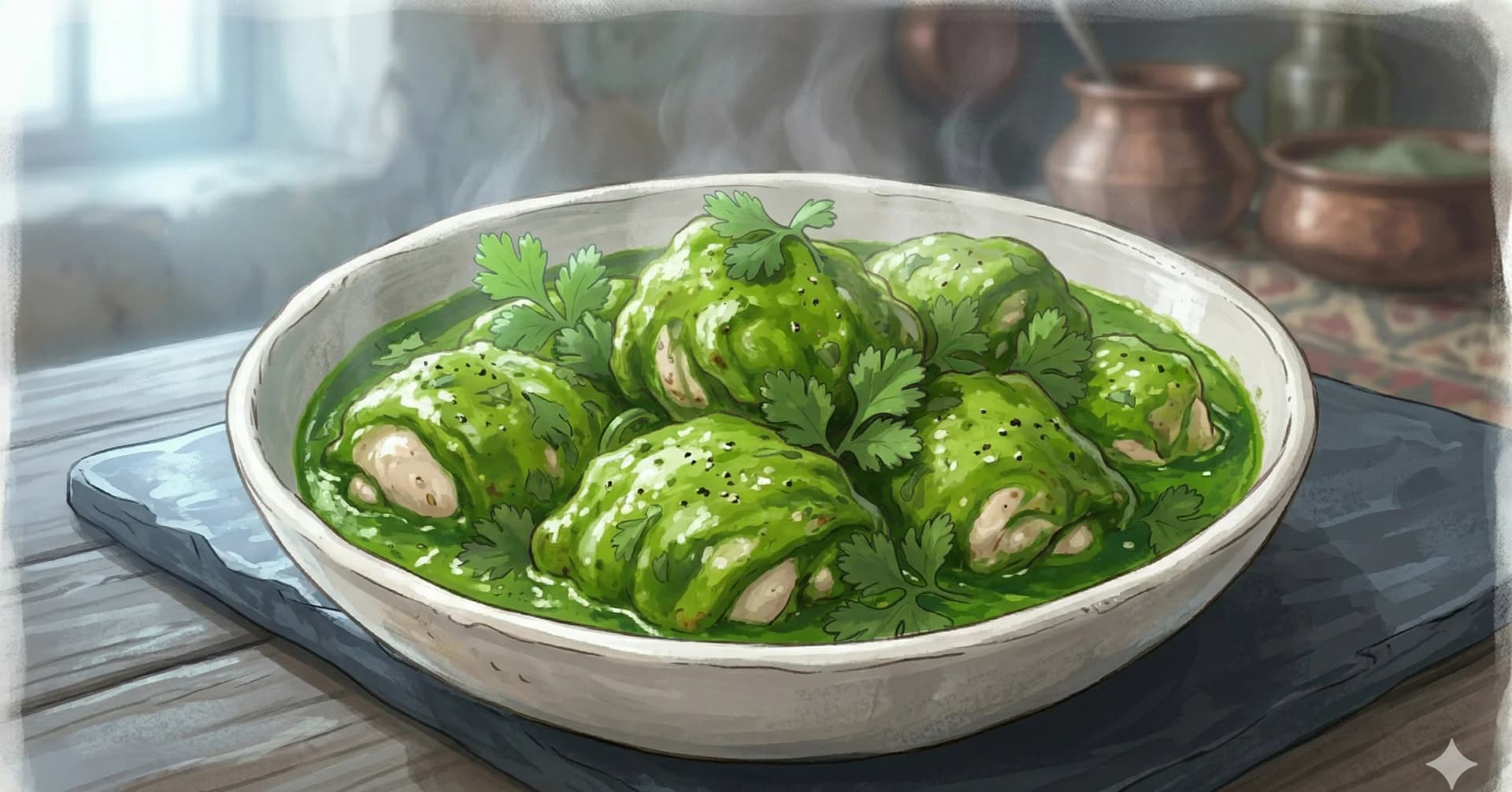
Kashmiri chicken korma in a vivid green coriander and spinach gravy
The Wazwan — Kashmir's great feast — is a procession of meat dishes, each with its own personality, its own technique, its own claim on the diner's attention. Murgh Dhaniwal Korma sits within this tradition but is unusual: it is green, emphatically and visibly herbaceous, in a culinary canon that more often reaches for red chilli and saffron.
"Dhaniwal" means coriander-scented, and this name undersells it. The dish is built on a paste of blanched spinach, fresh green coriander and green chillies: a thick, vivid puree that turns the gravy a deep, saturated green. The spinach provides body and a mild, iron-earthy base; the coriander is insistent, bright, almost grassy. Together they create a sauce that smells like a kitchen garden at its most generous.
The architecture of this korma is layered. First, the green paste is cooked down in a lagan (the wide, deep vessel used in Wazwan cooking) until it deepens and concentrates. Then a paste of browned cashews and poppy seeds joins it, adding richness and a subtle nuttiness. Finally, a curd gravy thickened with besan and seasoned with shahi jeera arrives, pulling the dish into the korma register: rounded, slightly tangy, deeply cooked.
Chicken is seared first and added back in toward the end, finishing gently in the gravy so it stays yielding. Pounded coriander seeds, added at this point, reintroduce a fresher, more textural coriander note that echoes but doesn't repeat the paste.
This is a dish for a serious occasion. It rewards the effort.
At a Glance
Yield
6–8 servings
Prep
45 minutes
Cook
1 hour
Total
1 hour 45 minutes
Difficulty
Involved
Ingredients
- 4½ lbboneless chicken, cut into large pieces
- ⅔ cupghee
- 1½ tbspcloves
- 3½ lbspinach, blanched and squeezed dry
- 23½ cupfresh coriander, roughly chopped
- 1¼ cupgreen chillies
- ½ cupwhole dried red chillies
- 7 ozcashew nuts, fried to golden brown
- 2½ tbsppoppy seeds (khus khus), soaked 30 minutes
- 2¼ lbcurd (yogurt), full-fat and whisked smooth
- 5½ cupbesan (chickpea flour)
- 3½ ozsemolina
- ¾ ozshahi jeera (royal caraway)
- 1¾ ozjeera (cumin) powder
- 2⅔ cupdhania (coriander) powder
- —Salt to taste
- ½ cupoil
- 3¾ tbspcoriander seeds, lightly pounded
Method
- 1
Make the green paste. Blanch the spinach in boiling salted water for 60 seconds, then drain and refresh in cold water. Squeeze firmly to remove as much liquid as possible — a wet paste will not cook properly. Blend the spinach with the coriander leaves and green chillies to a smooth, thick paste. Set aside.
- 2
Fry and set aside the red chillies. Fry the whole red chillies briefly in a little oil until they darken and puff. Set aside to add back later for color and warmth.
- 3
Make the cashew-poppy paste. Fry the cashews in oil until deeply golden. Drain. Drain the soaked poppy seeds. Blend cashews and poppy seeds together with a little water to make a smooth, thick paste.
- 4
Make the curd gravy. Whisk together the curd, besan, semolina, shahi jeera, jeera powder, coriander powder, and salt. Add enough water to make a pourable but thick gravy. Set aside.
- 5
Sear the chicken. Heat the ghee in a lagan or wide, heavy pot over high heat. Add the cloves and let them bloom for 30 seconds. Add the chicken pieces in batches and sear on all sides until golden. Remove the chicken and set aside.
- 6
Cook the green paste. Add the oil to the same lagan. Add the green paste and cook over medium heat, stirring frequently, for 12–15 minutes. The paste will darken, concentrate, and begin to leave the sides of the pan. This step is critical — undercooked green paste will taste raw and vegetal.
- 7
Add the nut paste. Stir in the cashew-poppy paste. Cook together with the green paste for 5 minutes, stirring.
- 8
Add curd gravy. Pour in the curd gravy, stirring continuously to prevent lumps. The besan will thicken the sauce as it cooks. Simmer over medium heat for 10–12 minutes, stirring regularly.
- 9
Add chicken and finish. Add the seared chicken pieces and pounded coriander seeds. Stir everything together gently. Cook over low heat until the chicken is fully cooked through, about 12–15 minutes. Taste for salt. Serve from the lagan.
Key Ingredient Benefits
Cashew nuts: In Kashmiri and Mughal-influenced Indian cooking, cashews have long served as a sauce thickener and richness provider. Their fat content (mostly oleic acid) emulsifies into sauces and provides a natural creaminess. Poppy seeds, similarly, contribute body when ground.
Besan (chickpea flour): High in plant protein and a good source of folate. It is one of the oldest thickening agents in Indian cooking, used in both sweet and savory applications. In savory kormas, it absorbs fat and provides a slightly nutty flavor.
Fresh coriander: Used in very large quantities here, nearly half a kilogram. Traditional Ayurvedic texts associate coriander with cooling and digestive properties. Some research explores its antioxidant phenols, though these effects in the context of cooked food are not firmly established.
Poppy seeds: The white khus-khus variety (not the same as those used to produce opium) are a common thickening agent in North Indian cooking. They are high in healthy fats and lend a quiet nuttiness when blended into pastes.
Why This Works
Blanching and squeezing the spinach before pasting is essential: raw spinach contains 90% water, and adding it directly to the pan would produce a watery, diluted paste that never concentrates properly. Blanching sets the color and removes bulk water, allowing the paste to cook down to a dense, flavorful base.
Besan in the curd gravy serves as both a stabilizer and a thickener. It prevents the yogurt from splitting under sustained heat and gives the gravy body without requiring cream or heavy reduction. Semolina adds a subtle graininess and absorbs fat, contributing to the finished sauce's richness.
Searing the chicken first, then removing it and finishing in the sauce, ensures the exterior has color and texture without the risk of overcooking during the long sauce-building process.
Substitutions & Variations
- Green paste base: If fresh coriander is limited, increase spinach and add a large bunch of fresh mint for a different but compatible herbal note.
- Cashews: Blanched almonds can replace cashews in the nut paste, with a slightly different but still pleasant result.
- Poppy seeds: If unavailable, a small amount of soaked melon seeds or additional cashew provides similar thickening.
- Whole chicken with bone: Can be used; increase cooking time in the final step to 20–25 minutes.
- Semolina in gravy: Can be omitted; replace with an additional 50 g of besan.
Serving Suggestions
- Served with Kashmiri pulao or plain steamed rice in a Wazwan setting.
- Works equally well with naan or a simple flatbread.
- A small plate of sliced raw onion and lemon wedges alongside cuts through the richness.
- Best served in a communal pot at the table — this is party food, not a quiet weeknight dish.
Storage & Reheating
Store cooled korma in the refrigerator for up to 2 days. The green color will deepen overnight. Reheat gently over low heat with a splash of water, stirring occasionally. The besan-based gravy can thicken substantially on cooling; loosen it before reheating. Freezes adequately for up to 1 month; thaw overnight in the refrigerator before reheating.
Cultural Notes
Murgh dhaniwal korma (मुर्ग धनिवाल कोरमा, "chicken cilantro korma") is the Kashmiri Muslim chicken preparation built on a generous quantity of fresh cilantro ground into a paste, combined with whisked yogurt, ginger paste, fennel powder, and Kashmiri red chili to form a gravy that finishes a pale green color. The dish is among the Wazwan-adjacent chicken preparations of the Kashmiri Muslim home kitchen and one of the dishes that appears at Kashmiri Muslim weddings, family feasts, and the small Kashmiri Muslim restaurants of Srinagar and the surrounding valley towns.
The dish's green color and cilantro-forward flavor distinguish it from the broader korma tradition. Most Indian kormas are built on cashew or almond pastes that finish the gravy in pale cream colors (see murgh-korma for the Mughlai version), with cilantro added only as a garnish at the end. The dhaniwal korma reverses this, treating cilantro as the primary aromatic and structural ingredient rather than as a finishing herb. The result is a curry that tastes uncommonly fresh and herbaceous, distinct from the richer almond-forward kormas of the Mughlai tradition and the chili-forward preparations of Hyderabad and Punjab.
The technique grinds the cilantro into a working paste rather than chopping it as a garnish. A generous bunch of fresh cilantro (stems and leaves together) is ground with green chilies, ginger, and a small amount of water into a smooth bright green paste. Chicken pieces (bone-in, skin-off, cut into curry sizes) are browned briefly in ghee, removed, and set aside. The cilantro paste is added to the ghee and cooked over medium heat for five or six minutes until the raw vegetable smell dissipates and the paste darkens slightly. Whisked yogurt is added off the heat to prevent splitting, then fennel powder, dried ginger powder, Kashmiri red chili, and salt. The chicken is returned to the pot with a small amount of water, and the curry simmers covered for twenty-five to thirty minutes until the chicken is tender and the gravy thickens. The dish is served with plain steamed rice or with Kashmiri modur pulao.
Nutrition Facts
Calories: 805kcal (40%)|Total Carbohydrates: 45.4g (17%)|Protein: 71.9g (144%)|Total Fat: 37g (47%)|Saturated Fat: 13.5g (68%)|Cholesterol: 185mg (62%)|Sodium: 1127mg (49%)|Dietary Fiber: 8.3g (30%)|Total Sugars: 9.4g
You Might Also Like
Ratings & Comments
Ratings & Comments
Ratings
Share your thoughts on this recipe.
Sign in to rate and comment