Awadhi · Indian Cuisine
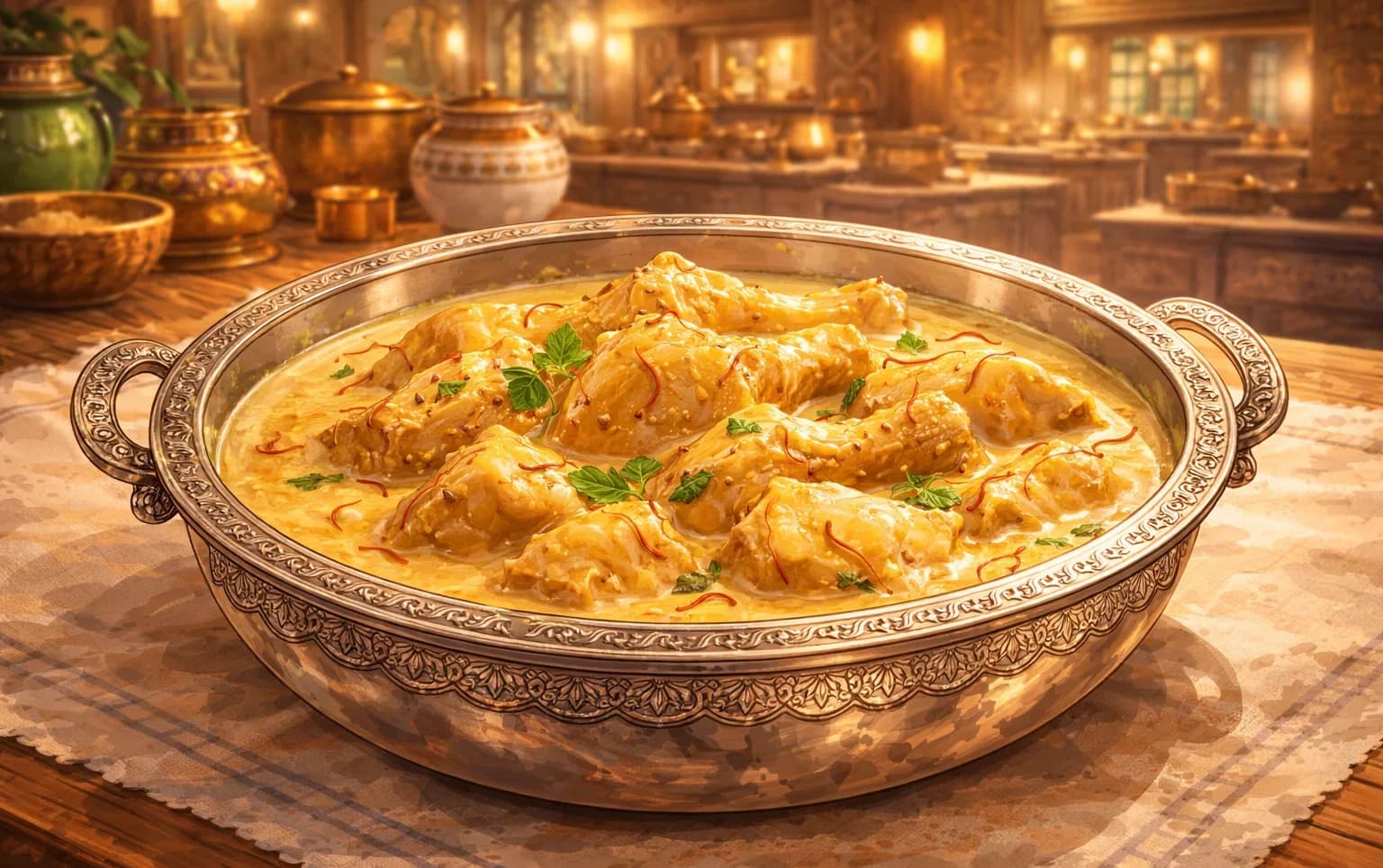
Chicken Korma
Mughal gold — chicken braised in saffron, cashew, and kewra
A korma should not announce itself. It should arrive at the table with quiet confidence — a pale golden sauce, barely shimmering under a thread of saffron, carrying within it a layered complexity that reveals itself slowly with each spoonful. This is the aesthetic of Awadhi cooking: restraint in colour, depth in flavour, refinement in every technique.
The word korma comes from the Urdu qorma, derived from a Turkic word meaning to braise. The Mughal court cooks who refined this technique in Lucknow and Agra understood braising as a philosophy: long contact between protein and a complex sauce in a closed environment, at gentle heat, building flavour through time rather than high heat. The result is chicken so tender it releases from the bone without effort, suspended in a sauce that has been building layers for an hour.
What distinguishes Awadhi korma from its cousins in other regions is the cashew paste. Ground raw cashews, stirred into the cooking sauce, bring a body and sweetness that coconut milk cannot replicate — more subtle, less tropical, more aligned with the floral notes of kewra and the metallic warmth of saffron. The yogurt in the sauce is added in stages, never all at once, and allowed to incorporate fully between additions — a technique that prevents curdling and builds the sauce's silky structure gradually.
The finishing touches are non-negotiable: kewra water (distilled pandanus blossom) and saffron steeped in warm milk. Both are added at the very end so their volatile aromatics remain intact. They are what lift the korma from deeply good to extraordinary, adding a top register of fragrance that floats above the richness of the sauce below.
The single most useful insight: don't rush the onion browning. Deep golden onions — almost at the edge of caramelisation — are the flavour foundation for everything that follows.
At a Glance
Yield
Serves 4–5
Prep
25 minutes
Cook
55 minutes
Total
1 hour 20 minutes
Difficulty
Medium
Ingredients
- 2¼ lbchicken, bone-in pieces (a mix of thighs and drumsticks)
- 7 ozonion (about 2 medium onions), thinly sliced
- 3⅓ tbspghee
- 2 tbspginger-garlic paste
- 3½ ozyogurt, beaten smooth
- 1⅔ tspsalt
- ¼ ozgreen cardamom (about 4–5 pods)
- ½ tspwhole cloves (about 4–5 cloves)
- ⅓ tspcinnamon (about 1 short stick)
- 1⅔ tspmace (about 2 blades)
- 3¾ tbspred chilli powder
- 1¾ tbspcoriander powder
- 1⅞ tspturmeric
- 1 tbspgaram masala
- 1¾ ozraw cashews
- —Warm water for soaking
- 2 tbspcream
- ¼ ozsaffron (a generous pinch), steeped in 3 tablespoons warm milk
- 2 tspkewra water
Method
- 1
Make the cashew paste. Soak the cashews (50 g) in warm water for 20 minutes until softened. Drain and blend with 3–4 tablespoons of fresh water to a completely smooth, white paste. Set aside.
- 2
Brown the onions. In a wide, heavy pot, melt the ghee (3½ tablespoons) over medium-high heat. Add the sliced onions with a pinch of salt (2 teaspoons). Cook, stirring regularly, for 18–22 minutes until the onions are deep golden-brown — not pale or merely soft, but genuinely caramelised, with a sweet, nutty aroma. Patience here pays dividends in every subsequent step. Remove half the onions and set aside for garnishing.
- 3
Build the base. Add the whole spices (cardamom (4–5 pods), cloves (4–5 cloves), cinnamon (1 short stick), mace (2 blades)) to the remaining onions in the pot. Stir for 60 seconds until fragrant. Add the ginger-garlic paste (2 tablespoons) and cook, stirring constantly, for 2–3 minutes until the raw smell disappears and the paste turns lightly golden.
- 4
Add the chicken (1 kg). Increase heat to medium-high. Add the chicken pieces and cook, turning, for 6–8 minutes until lightly coloured on all sides. The skin should show some golden patches.
- 5
Add yogurt (100 g) in stages. Reduce the heat to medium. Add the beaten yogurt in three additions — add one-third, stir vigorously and cook until it is fully incorporated into the sauce and stops looking white and separate (about 2–3 minutes), then add the next third. Repeat with the final addition. This gradual approach prevents the yogurt from splitting and builds a smooth, integrated sauce.
- 6
Spice and simmer. Add the red chilli powder (4 teaspoons), coriander powder (2 teaspoons), and turmeric (1 teaspoon). Stir well and cook for 3–4 minutes, stirring regularly, until the spices are well incorporated and the ghee begins to separate around the edges of the sauce. Add the cashew paste and stir through. Add 150 ml of warm water, bring to a gentle simmer, then cover and cook over low heat for 20–25 minutes until the chicken is cooked through and tender.
- 7
Finish. Remove the lid, stir in the garam masala (2 teaspoons) and cream (2 tablespoons). Simmer uncovered for 5 minutes to thicken slightly. Remove from heat. Stir in the kewra water (2 teaspoons) and saffron (3 g) milk. Taste for salt.
- 8
Serve garnished with the reserved fried onions.
Key Ingredient Benefits
Kewra water is distilled from the male flowers of Pandanus odoratissimus, the screwpine. It carries a floral, slightly waxy, almost fruity fragrance unlike any other aromatic in South Asian cooking. There is no real substitute; rosewater is sometimes offered as an alternative but it produces a noticeably different, more floral result. In Mughal and Awadhi cooking, kewra appears consistently in white and pale-gold sauces where it was considered the appropriate counterpart to saffron.
Saffron (Crocus sativus) has been used across Persian, Mughal, and Ayurvedic traditions as a tonic and a mood-supportive spice. Its principal pigment-active compound, crocin, has been studied for antioxidant activity in laboratory work, and a 2013 meta-analysis by Hausenblas and colleagues in the Journal of Integrative Medicine pooled five randomized trials and found saffron supplementation improved symptoms in adults with major depressive disorder. Dietary doses from cooking are small and the practical effect at culinary amounts is modest, but the research base is real; culinarily, its value here is the fragrance and the distinctive golden-amber color it imparts.
Mace (javitri) is the lacy red aril of the nutmeg kernel. Its flavor is similar to nutmeg but more delicate, warmer, and less resinous. In Unani medicine it was traditionally used as a digestive tonic and warming spice, and it appears repeatedly in Mughal-era recipes for its ability to add warm depth to rich meat and poultry dishes without overwhelming them.
Ghee is the cooking fat of choice in Awadhi cuisine, used not merely as a neutral fat but as a flavor-active ingredient. The milk solids have been removed, raising its smoke point and eliminating the risk of burning at the temperatures needed to properly brown onions. In Ayurvedic tradition, ghee is considered sattvic and beneficial to digestion; nutritionally, it carries the same fat-soluble vitamins (A, D, E, K) as butter in concentrated form.
Why This Works
The staged addition of yogurt is the most important technique in this recipe. Yogurt's milk proteins are prone to breaking (curdling) when exposed to sudden high heat or acidity, which produces an unappetising grainy sauce. By adding it in three portions, stirring each portion until fully emulsified before adding the next, you give the proteins time to disperse through the hot fat rather than clumping together. The result is a sauce with the yogurt's tang and body without any textural compromise.
Cashew paste does something that no other South Indian thickener replicates exactly. Almonds add depth but are slightly coarse; coconut milk adds sweetness but also a distinct tropical note that shifts the dish away from Awadhi territory. Cashew paste has a mild, buttery sweetness and a very fine texture when fully blended — it thickens the sauce without dominating the flavour, letting the spices and kewra come through clearly.
Keeping both kewra water and saffron off the heat at the final step is the same calculation as adding fresh herbs at the end of a European braise: the compounds that make them special are too volatile to survive boiling. Added cold to a hot but not boiling sauce, they bloom gently, leaving their fragrance intact and present in every spoonful.
Substitutions & Variations
Chicken to lamb: Use bone-in lamb shoulder or neck pieces. Extend the simmering time to 50–60 minutes. The korma will be richer and more complex.
Ghee to butter: Full-fat unsalted butter can replace ghee in a pinch. The flavour will be similar but slightly more dairy-forward.
No kewra: Omit rather than substitute. The korma will be slightly less aromatic but still excellent.
Lighter version: Replace cream with 2 tablespoons of extra beaten yogurt stirred in at the end. The sauce will be slightly less rich but still smooth and creamy.
Serving Suggestions
Murgh korma belongs with bread that can carry its sauce: warm tandoor-baked naan, buttery paratha, or roomali roti. Plain steamed basmati provides a cleaner canvas if you prefer rice. Alongside, a crisp sliced onion salad with lemon juice and fresh mint, and a cooling cucumber raita. At a formal Awadhi table, korma would be served as one of several dishes — alongside a biryani or pilaf, a dal, and pickles — but at home it is fully satisfying as the centrepiece of a simpler meal.
Storage & Reheating
Murgh korma keeps well in the refrigerator for up to 3 days — the flavour deepens noticeably on the second day as the spices continue to meld. Reheat gently in a covered pan over low heat, adding a small splash of water if the sauce has thickened. Do not boil vigorously on reheating, as this can cause the cashew paste to separate slightly. The korma freezes well for up to 1 month; defrost overnight in the refrigerator. If the sauce looks broken after thawing, stir over low heat while adding a tablespoon of cream — it will come back together.
Cultural Notes
Murgh korma (मुर्ग कोरमा) is the Mughlai chicken preparation built on a yogurt-based gravy enriched with ground cashews or almonds, fried onions, ginger-garlic, and the Mughlai aromatic spice mix of green cardamom, cinnamon, cloves, and mace. The dish is among the most widely recognized Mughlai meat preparations and a dish that traveled from the Mughal court kitchens of Delhi, Agra, and Lucknow into the home cooking and restaurant traditions of north India, the diaspora, and the broader Indian restaurant tradition worldwide.
The Mughlai culinary lineage gives the dish its character. The Mughal emperors (1526-1857) maintained royal kitchens that combined Persian, Central Asian, and indigenous Indian techniques, developing the gravy-based meat preparations that became the signature of Mughlai cuisine: yogurt as the base liquid, nut pastes (almond, cashew, or pistachio) for thickening and richness, fried onions for sweetness and color, and the aromatic spice mix of green cardamom, cinnamon, cloves, mace, and nutmeg that gives Mughlai gravies their distinctive perfume. The word korma itself derives from the Turkish kavurma (a method of braising meat in its own juices), and the Mughlai korma represents the Persianized-Indian elaboration of this Turkish technique into a rich nut-thickened gravy. Pushpesh Pant's India: The Cookbook (Phaidon, 2010) traces the korma family through the Mughlai, Awadhi, and Hyderabadi variants.
The technique distinguishes a true korma from the broader curry tradition. Chicken pieces are marinated in yogurt, ginger-garlic, and salt for an hour. Sliced onions are deep-fried until dark golden and ground into a smooth paste with the cashew or almond paste and a small amount of water. The marinated chicken is sautéed in ghee until lightly colored, then the onion-nut paste is added with the aromatic spice mix (whole green cardamom, cinnamon stick, cloves, mace blade) and a small amount of water. The pot is covered and cooked over low heat for twenty-five to thirty minutes: no high-heat browning, no boiling, no rapid reduction. The korma cooks gently to preserve the yogurt's tang and the nut paste's silkiness. The dish is finished off the heat with a small amount of cream or thickened yogurt and served with naan, sheermal, or basmati rice.
Nutrition Facts
Calories: 566kcal (28%)|Total Carbohydrates: 20g (7%)|Protein: 49g (98%)|Total Fat: 32g (41%)|Saturated Fat: 11.9g (60%)|Cholesterol: 220mg (73%)|Sodium: 1169mg (51%)|Dietary Fiber: 5.3g (19%)|Total Sugars: 4.8g
You Might Also Like
Ratings & Comments
Ratings & Comments
Ratings
Share your thoughts on this recipe.
Sign in to rate and comment