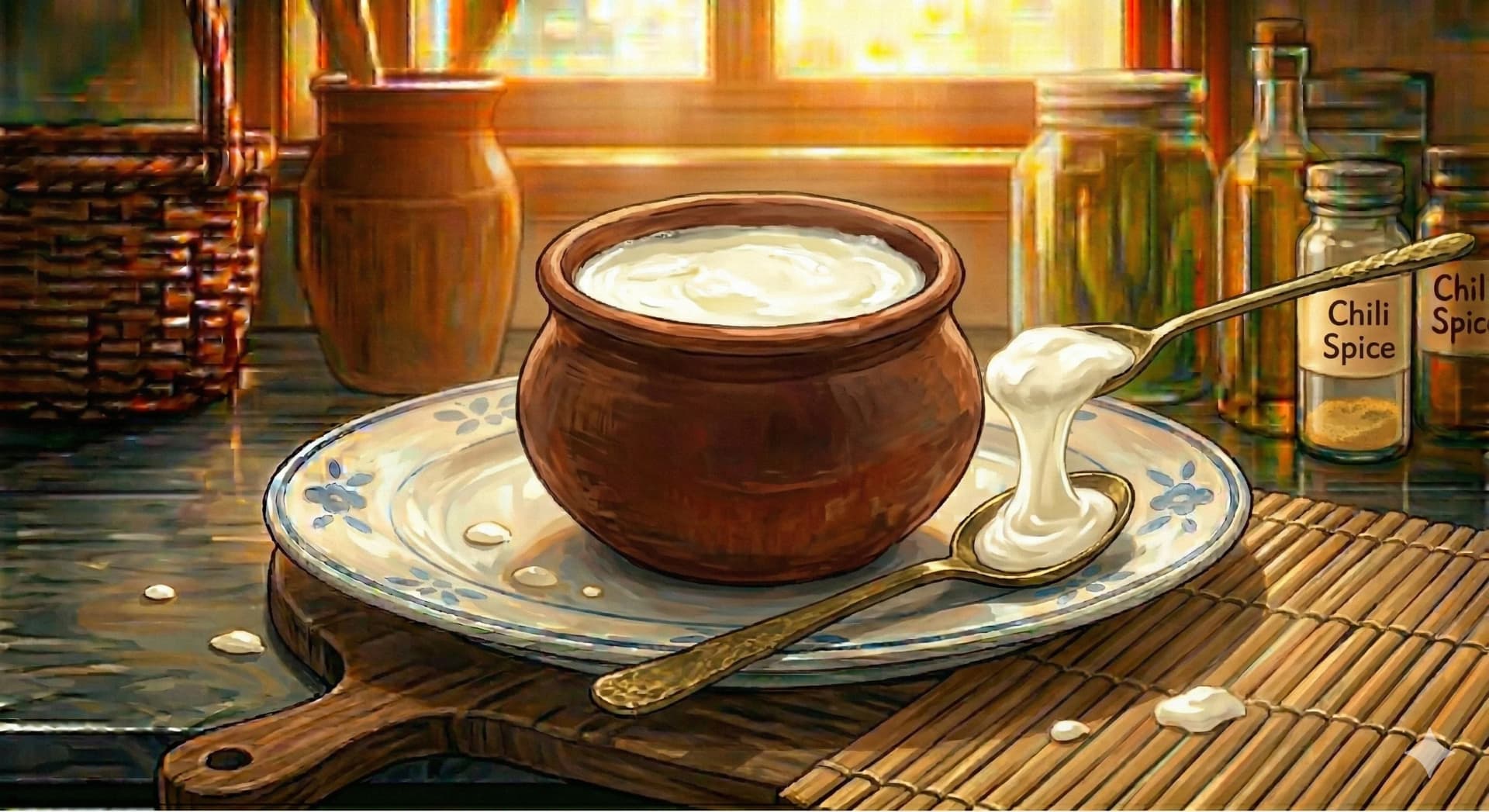
Yogurt
Also known as: Dahi, Curd, Doi (Bengali), Thayir (Tamil), Mosaru (Kannada)
Yogurt, known across the Indian subcontinent as dahi or curd, is one of the oldest and most universally consumed fermented foods in the world. Made by inoculating warm milk with live bacterial cultures (primarily Lactobacillus delbrueckii subsp. bulgaricus and Streptococcus thermophilus), it transforms within hours into a thick, tangy, slightly gelatinous mass.
Indian dahi differs meaningfully from the commercial yogurt dominant in Western markets: it is typically set in the vessel it will be served in, producing a firmer, more cohesive texture, and its flavor reflects a fuller-spectrum fermentation with a more complex sourness that deepens the longer it sits.
In Indian cooking, curd is not a condiment or a side dish. It is a cooking medium, a marinade base, a sauce component, a digestive, a cooling agent, and a meal in itself. Few other single ingredients occupy as many simultaneous roles across a cuisine.
Freshly set dahi is mild, lightly sweet, and gentle. Older dahi, left for a day or two past its peak, becomes noticeably sour and is then destined for cooking, where its acidity acts as a tenderizer in meat marinades and as the primary flavoring agent in dishes like kadhi.
The distinction between fresh and sour curd is something every Indian cook tracks intuitively. Fresh curd goes to the table. Sour curd goes into the pot. Nothing is wasted.
Key facts at a glance:
- Known as dahi or curd — one of the oldest fermented foods, at least 5,000 years of history
- Not a condiment but a cooking medium — simultaneously serves as marinade, sauce, digestive, and meal
- Indian dahi differs from commercial yogurt — fuller fermentation, more complex sourness
- Fresh vs. sour curd distinction — fresh goes to the table, sour goes into the pot
- Matka dahi — set in unglazed earthen pots, considered superior in texture and taste
- Supports gut microbiome diversity — live bacterial cultures with well-documented probiotic effects
Flavor Profile
Origin
Indian Subcontinent, Central Asia, Middle East
Traditional Medicine Perspectives
Ayurveda:
Dahi occupies a nuanced position in Ayurvedic dietetics. Fresh, sweet curd (nava takra) is considered nourishing, heavy, and building, good for those who are thin or depleted and beneficial for digestion in small quantities. Sour, aged curd, however, is considered heating (ushna) and can aggravate Pitta and Kapha doshas when consumed in excess. Ayurvedic texts contain consistent advice against eating curd at night, as its heavy and mucus-generating qualities are thought to impair the body's overnight cleansing processes. Buttermilk (diluted, spiced curd or the liquid from churned curd), by contrast, is considered lighter and more digestively supportive, especially when seasoned with cumin, ginger, and curry leaves.
Traditional Chinese Medicine:
Fermented dairy products are less central to classical Chinese medical thought, which historically had less access to dairy, but soured milk products consumed in Central Asia share broad characteristics with TCM's understanding of foods that tonify the middle burner and support gut function without generating excessive dampness.
Modern Scientific Research
Yogurt is one of the most studied fermented foods in nutritional science. Its live bacterial cultures have been shown in multiple clinical studies to support gut microbiome diversity, improve lactose tolerance (the fermentation process breaks down much of the lactose), and reduce the duration of antibiotic-associated diarrhea.
The protein in yogurt is partially pre-digested by bacterial enzymes, making it more bioavailable than equivalent protein in fresh milk. Calcium in yogurt is also well-absorbed, partly due to the acidic environment created by fermentation.
Research into traditional Indian dahi specifically is less extensive than into commercial probiotics, but studies examining home-fermented dairy products have found a broader diversity of bacterial strains compared to industrial yogurt, which typically contains only the two legally required starter cultures.
The earthen pot setting method appears to support this diversity further. Hung curd (chakka), dahi that has been strained through cloth until very thick, functions similarly to Greek yogurt and is used in Indian cooking for shrikhand, a sweet dessert from Maharashtra and Gujarat made by mixing strained curd with sugar, saffron, and cardamom.
Cultural History
The fermentation of milk into curd is so ancient in South Asia that it appears in Vedic literature, where it was offered in religious rituals and described as one of the five products of the cow (panchagavya). Archaeological evidence suggests that dairy fermentation in the Indian subcontinent dates back at least 5,000 years, predating most written records.
Dahi has been a daily staple for millennia not because of any culinary theory but because of necessity: fermentation was the most reliable way to preserve milk in a hot climate before refrigeration.
The practice of setting curd in unglazed earthen pots (matka) persists in many households and street food stalls across India. The porous clay allows for slight evaporation, keeping the curd cool and imparting a subtle mineral quality to its flavor. This traditional method produces matka dahi, which many consider superior to refrigerator-set curd in both texture and taste.
The cultural specificity of dahi extends to ritual: in Hindu tradition, it is considered auspicious and is often offered to guests before important journeys, mixed with sugar as mishri dahi, a gesture of goodwill and blessing.
In South India, curd rice (thayir sadam in Tamil, mosaranna in Kannada) is not merely a dish but a daily closing ritual. It is the last item served in a traditional meal, eaten to cool the digestive system after a heavily spiced sequence of courses. For millions of South Indians, no meal is complete without it. The dish is deeply tied to identity and comfort: it appears at temple offerings, in school tiffin boxes, at hospital bedsides, and at family funerals alike.
Culinary Uses
Curd functions as a tenderizing marinade in Indian meat cookery: the lactic acid in yogurt gently denatures surface proteins, allowing spices to penetrate more deeply and producing juicier, more flavorful results after cooking. Tandoori chicken, seekh kebabs, and biryani meat all begin with a yogurt-based marinade.
In vegetarian cooking, the same principle applies when marinating paneer or vegetables before grilling.
As a cooking medium, curd is added to gravies and kormas, where it is incorporated in stages, stirred constantly to prevent curdling, and cooked down into a thick, slightly tangy sauce base.
Kadhi, a dish of yogurt cooked with chickpea flour into a soupy sauce with fried dumplings (pakoras), demonstrates curd as a primary ingredient rather than an accent. In raita, the curd is left raw and seasoned with cumin, salt, coriander, and vegetables, serving as a cooling, textural contrast to hot, spiced main dishes.
Preparation Methods
To set dahi at home, warm whole milk to approximately 43 to 45 degrees Celsius (just warm enough that a finger dipped in holds comfortably for 10 seconds). Add 1 to 2 teaspoons of live active curd from a previous batch (or plain commercial yogurt with live cultures) per 500 ml of milk.
Stir gently to distribute. Pour into a ceramic or earthen vessel, cover with a lid or cloth, and leave undisturbed in a warm spot for 6 to 8 hours (longer in winter, shorter in summer). Do not jostle or move the vessel during setting. Once set, refrigerate. Save a small portion to inoculate the next batch. The culture is self-perpetuating indefinitely.
For hung curd (chakka), pour set dahi into a cheesecloth-lined strainer and suspend over a bowl in the refrigerator for 4 to 8 hours. The resulting thick curd can be used as a base for shrikhand or as a substitute for cream cheese in savory preparations.
Traditional Dishes
- Raita
- Lassi (Sweet and Salted)
- Kadhi Pakora
- Biryani (marinade)
- Shrikhand
- Dahi Vada
- Curd Rice (Thayir Sadam)
- Tandoori Chicken (marinade)
- Mishri Dahi
- Dahi Puri
- Boondi Raita
- Matka Dahi
- Mor Kuzhambu
Comments
Share your thoughts on this ingredient.
Sign in to comment0 Comments