Andhra · Indian Cuisine
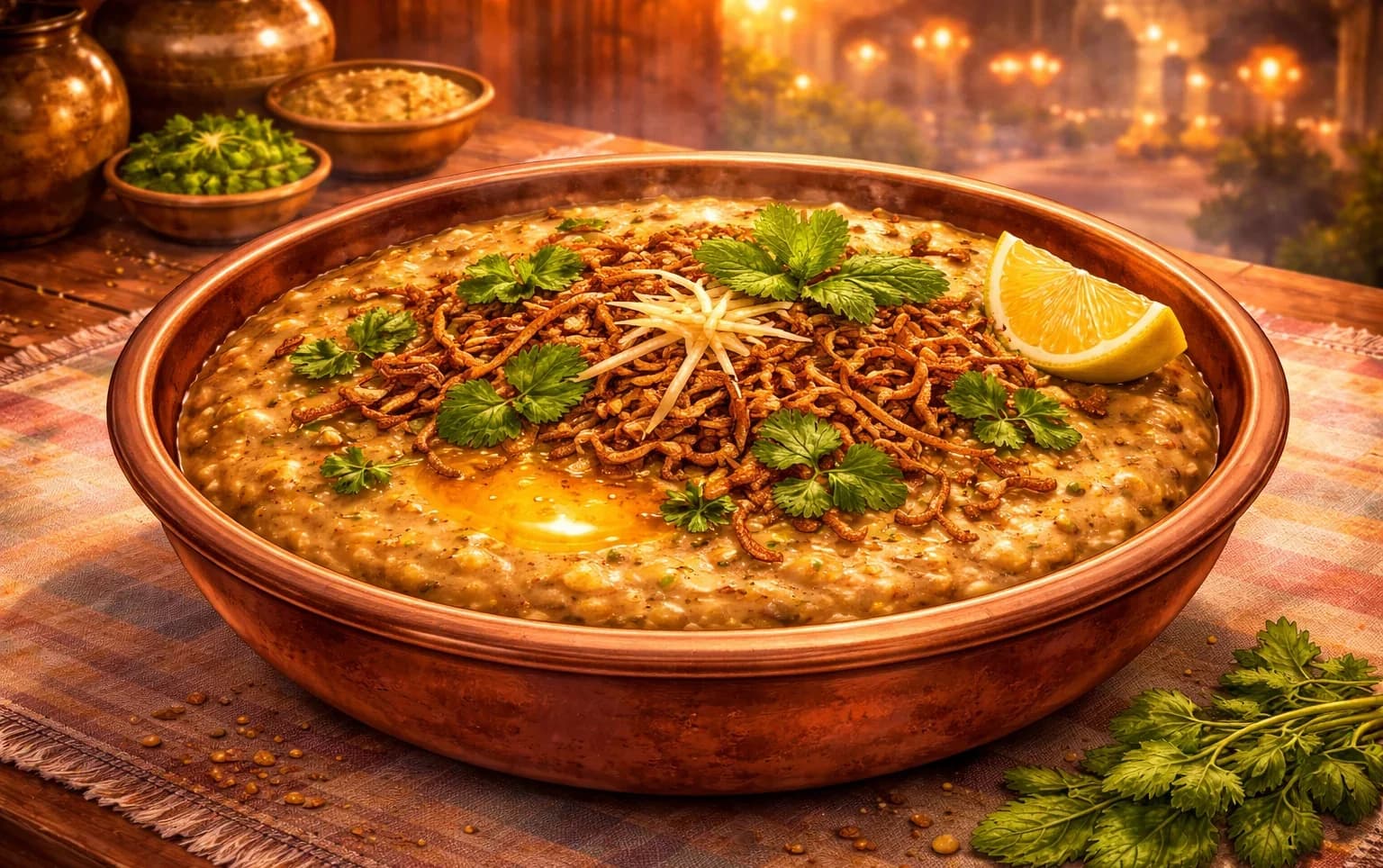
Slow-Cooked Meat & Wheat (Haleem)
Slow-pounded wheat and mutton, a porridge of extraordinary depth
Haleem defies easy description to anyone who hasn't eaten it. It is simultaneously a porridge, a stew, and a slow-cooked braise, a dish where the boundaries between meat and grain dissolve entirely through hours of cooking and continuous stirring. The result is something silky and dense, deeply spiced, with a complexity that seems to accumulate with every bite rather than announce itself at once.
The dish has roots in Arabic harees, a simple wheat and meat porridge that travelled to the Indian subcontinent with Arab and Persian traders and evolved dramatically in the Hyderabadi Nizam's kitchens. In Hyderabad, the relatively austere original was transformed: five different lentils were added for depth and body, an arsenal of spices was introduced, and the bhunai technique — continuous stirring and working of the mixture over high heat — was developed to create the characteristic smooth, almost creamy texture that distinguishes Hyderabadi haleem from all other versions.
It remains the most important dish of Ramadan in Hyderabad. The slow cooking (traditionally overnight, tended in enormous cauldrons) fills the pre-dawn air with cardamom and slow-rendered mutton. Breaking the fast with haleem is not just eating. It is a sensory reunion with something ancient.
At home, haleem demands patience rather than skill. The overnight soaking of wheat and lentils is non-negotiable. The bhunai — the vigorous stirring and pounding of the combined meat and grain mixture — is the technique that separates a great haleem from a mediocre one. Keep stirring. The mixture will resist at first, then gradually relent, the fibres breaking down and the grains melting into the meat until you can no longer tell which is which.
The garnishes are not optional. Fried onions, fresh ginger cut in thin matchsticks, coriander, mint, a wedge of lemon, and a spoon of ghee are structural elements, providing crunch, brightness, and richness that balance the deep earthiness of the haleem beneath.
At a Glance
Yield
Serves 6
Prep
20 minutes (plus overnight soaking)
Cook
3 hours
Total
3 hours 20 minutes (plus overnight)
Difficulty
Involved
Ingredients
- 1 lbmutton, bone-in pieces
- 3½ ozwhole wheat kernels (*gehu*), soaked overnight
- 1¾ ozchana dal (split chickpea lentil), soaked overnight
- 1¾ ozmasoor dal (red lentil), soaked overnight
- 1¾ ozmoong dal (split mung), soaked overnight
- 1¾ ozurad dal (split black lentil), soaked overnight
- 2 tbspginger-garlic paste
- 3¾ tbspred chilli powder
- 1¼ tbspturmeric powder
- 1 tbspgaram masala
- ¼ ozcaraway seeds / shahi jeera
- 1⅛ tspmace (about 1 blade, ground)
- 3½ ozyogurt, beaten
- 1⅔ tspfine salt
- 3⅓ tbspghee
- 3½ ozonion (about 1 large onion), thinly sliced and deep-fried until deep golden
- 2⅔ cupfresh coriander, chopped
- 1¾ cupfresh mint leaves, chopped
- 1¼ tbsplemon juice
- —Fried onions
- —Fresh ginger, cut into fine matchsticks
- —Fresh coriander and mint
- —Lemon wedge
- —Spoon of ghee
Method
- 1
Soak overnight. The evening before, soak the whole wheat kernels (100 g) in a large bowl of cold water. In a separate bowl, combine all four lentils and soak together. Both need at least 8 hours to fully hydrate and soften.
- 2
Cook the mutton (500 g). Drain the lentils and wheat. Place the mutton pieces in a large heavy pot with the ginger-garlic paste (2 tablespoons), red chilli powder (4 teaspoons), turmeric (2 teaspoons), caraway seeds (¾ teaspoon), mace (1 blade, ground), yogurt (100 g), and salt (2 teaspoons). Add just enough water to cover the mutton (about 500 ml). Bring to a boil, skim any foam that rises, then reduce to a steady simmer. Cook, partially covered, for 60–75 minutes until the mutton is completely tender and falling from the bone. Remove the mutton pieces and set aside to cool slightly. Reserve the cooking liquid in the pot.
- 3
Shred the meat. Once the mutton is cool enough to handle, pull it from the bones and shred the meat into coarse fibres using two forks or your fingers. Discard the bones. Set the shredded meat aside.
- 4
Cook the wheat and lentils. Add the soaked, drained wheat and lentils to the mutton cooking liquid in the pot. Add another 500 ml of water. Bring to a boil, then reduce to a gentle simmer. Cook, stirring occasionally, for 60–75 minutes until both the wheat and lentils are completely, thoroughly soft — the wheat grains should crush easily between your fingers and the lentils should have dissolved into the liquid. The mixture should look thick and porridge-like.
- 5
Combine and bhuno. Add the shredded mutton to the wheat and lentil pot. Using a heavy wooden spoon or a traditional wooden masher, begin working the mixture over medium-high heat — stirring, pressing, and folding continuously. This is the bhunai: you are breaking down the wheat fibres, blending the meat into the grain, and developing both texture and flavour. Continue for 20–30 minutes, adding small amounts of water if the mixture threatens to stick. The haleem is ready when it has become a smooth, dense, cohesive mass that holds its shape for a moment when you pull the spoon through it before slowly settling.
- 6
Final seasoning. Taste for salt and spice. Stir in the garam masala (2 teaspoons) and most of the chopped coriander (50 g) and mint (30 g). Add the lemon juice (1½ tablespoons) and stir through.
- 7
Serve. Spoon the haleem into wide shallow bowls. Make a small well in the centre of each bowl and drop in a teaspoon of ghee (3½ tablespoons) — it will pool and glisten. Pile on the fried onions, scatter fresh coriander, mint, and ginger matchsticks, and serve with a lemon wedge and extra chilli on the side.
Key Ingredient Benefits
Whole wheat provides a slow-digesting carbohydrate base with bran and germ intact. In Unani medicine, wheat cooked with meat (harees) was traditionally prescribed as a restorative food for convalescence — considered strengthening and easy on the digestive system when softened through long cooking. Research suggests whole grains are associated with improved glycaemic response compared to refined grains, and their fibre supports a healthy gut microbiome.
Chana dal is particularly high in plant protein and fibre. As part of a mixed lentil preparation like haleem, it contributes to a complete amino acid profile alongside the animal protein from the mutton. In Ayurveda, chana dal is considered grounding and protein-rich, traditionally used in preparations for sustained energy.
Mutton as the protein base in haleem is historically significant. It was deliberately chosen over chicken for its higher fat content and stronger flavour, both of which are necessary to support the robust grain base. The slow cooking converts the collagen-rich cuts used in haleem into gelatin, which contributes to the dish's characteristic silky mouthfeel.
Turmeric (haldi) is used throughout Hyderabadi and South Indian cooking as a foundational spice. Research suggests its active compound curcumin has anti-inflammatory properties in laboratory settings; Ayurveda traditionally uses turmeric as an antiseptic and tonic. Its culinary role here is primarily as a warm, earthy base note and a provider of the golden hue in the meat cooking liquid.
Why This Works
The multi-lentil blend is not arbitrary. Each dal contributes differently: chana dal adds body and a slightly nutty, firm texture; masoor dal dissolves quickly into the base liquid, adding creaminess; moong dal is mild and clean; urad dal contributes a subtle viscosity and richness. Together they build a layered foundation for the wheat and mutton to meld into.
The bhunai technique is the soul of this dish. Continuous stirring over heat serves multiple purposes: it accelerates the breakdown of the wheat grain fibres; it develops a slight toasted quality as the mixture makes momentary contact with the hot base of the pot; and it creates an emulsification of sorts as the mutton fat integrates with the softened grain starch. The mixture becomes greater than the sum of its parts precisely because of this mechanical work.
Garam masala added only at the end (not during the long cook) is a deliberate choice. Many of garam masala's most fragrant compounds, particularly from cardamom and cloves, are highly volatile and would cook off entirely during hours of simmering. Adding them at the finish means their fragrance reaches the bowl intact, providing a bright, sharp top note over the deep, slow base.
Substitutions & Variations
Mutton to beef: Beef shin or short rib works beautifully — the higher collagen content produces an even silkier result. Extend cooking time by 30–45 minutes.
Single lentil: If you don't have all four lentils, a blend of chana dal and masoor dal alone (50 g each) produces a very good result.
Vegetarian version: Replace mutton with 300 g of extra chana dal and 200 g of paneer. Reduce cooking time significantly. The texture and depth will be different, but the dish is still compelling.
Spice level: The recipe as written is medium-hot. Reduce red chilli powder to 10 g for a milder version, or increase to 25 g for the heat level of a proper Hyderabadi restaurant.
Serving Suggestions
Haleem is a complete meal and needs very little beside it. In Hyderabad it is often served with sheermal — a rich, saffron-tinged bread — or plain bakarkhani flatbread for dipping and scooping. A cold drink of nariyal pani (coconut water) or plain chilled buttermilk provides relief from the heat and richness. If serving as part of a larger spread, pair with a simple green salad dressed only in lemon juice to balance the density of the haleem.
Storage & Reheating
Haleem keeps extremely well, as the long cooking makes it essentially a stable, slow-cooked preparation. Refrigerate in a sealed container for up to 4 days. It thickens considerably as it cools — reheat in a heavy pot with a splash of water (2–3 tablespoons per cup of haleem), stirring continuously over medium heat until loosened and heated through. Haleem freezes well for up to 2 months; defrost overnight in the refrigerator and reheat as above.
Cultural Notes
Haleem (हलीम, ہلیم) is the Hyderabadi slow-cooked porridge of mutton (or beef in the original Arab-influenced versions) cooked with broken wheat, lentils, ginger-garlic, fried onions, and Hyderabadi spices over six to eight hours until the meat and grain break down into a thick uniform porridge with the texture of a savory hot cereal. The dish has an Arab origin in the medieval Levantine harees (a similar wheat-and-meat porridge that travelled through the Islamic world from the Abbasid Caliphate onward), and it became central to Hyderabadi Muslim Ramadan cooking, where the dish is prepared in massive cauldrons by neighborhood specialists and served at iftar (the breaking of the daily fast at sunset). Hyderabadi haleem received a Geographical Indication tag in 2010 for its distinctive Hyderabadi preparation.
The Hyderabadi Ramadan context is the cultural anchor. During the month of Ramadan (the Islamic month of fasting, when observant Muslims abstain from food and water from dawn until sunset), the iftar meal at sunset becomes a central social and religious event. Hyderabad's Old City neighborhoods (around Charminar, Pathergatti, and the historic Mughal-Nizami quarters) produce haleem from large copper cauldrons that simmer through the day and serve the dish to long queues of customers who collect their portions in steel tiffin containers to break their fast at home or at the mosque. The most documented Hyderabadi haleem makers (Pista House at Charminar, Sarvi at Banjara Hills, and several smaller neighborhood operations) have built reputations across generations, with the dish becoming as much a Hyderabadi cultural marker as the city's biryani.
The technique requires hours of slow cooking and a final pounding step. Bone-in mutton is simmered with broken wheat (dalia, soaked overnight), split chickpeas (chana dal), urad dal, moong dal, ginger-garlic paste, sliced onions, Hyderabadi whole spices (cinnamon, cardamom, cloves, black pepper, mace), turmeric, and salt in water for four to five hours over low heat until the meat falls off the bone and the grain softens completely. The bones are removed, and the mixture is pounded with a wooden masher (the gada) until the meat fibers and the grain integrate into a uniform smooth porridge (this pounding step distinguishes haleem from related grain-and-meat dishes that leave the textures distinct). The pounded mixture is returned to low heat for another hour, with periodic stirring and the addition of small amounts of water to maintain the right consistency. The dish is finished with a tempering (tadka) of ghee, fried sliced onions, fried cashews, and a generous scatter of fresh mint and cilantro. The dish is served hot with sliced lime, fried onion garnish, fresh ginger juliennes, and a small piece of cooked egg, and eaten with naan or roomali roti for scooping.
Nutrition Facts
Calories: 380kcal (19%)|Total Carbohydrates: 19.2g (7%)|Protein: 23.4g (47%)|Total Fat: 22.9g (29%)|Saturated Fat: 10.4g (52%)|Cholesterol: 76mg (25%)|Sodium: 190mg (8%)|Dietary Fiber: 4.6g (16%)|Total Sugars: 2.4g
You Might Also Like

Ratings & Comments
Ratings & Comments
Ratings
Share your thoughts on this recipe.
Sign in to rate and comment