Bengali · Indian Cuisine
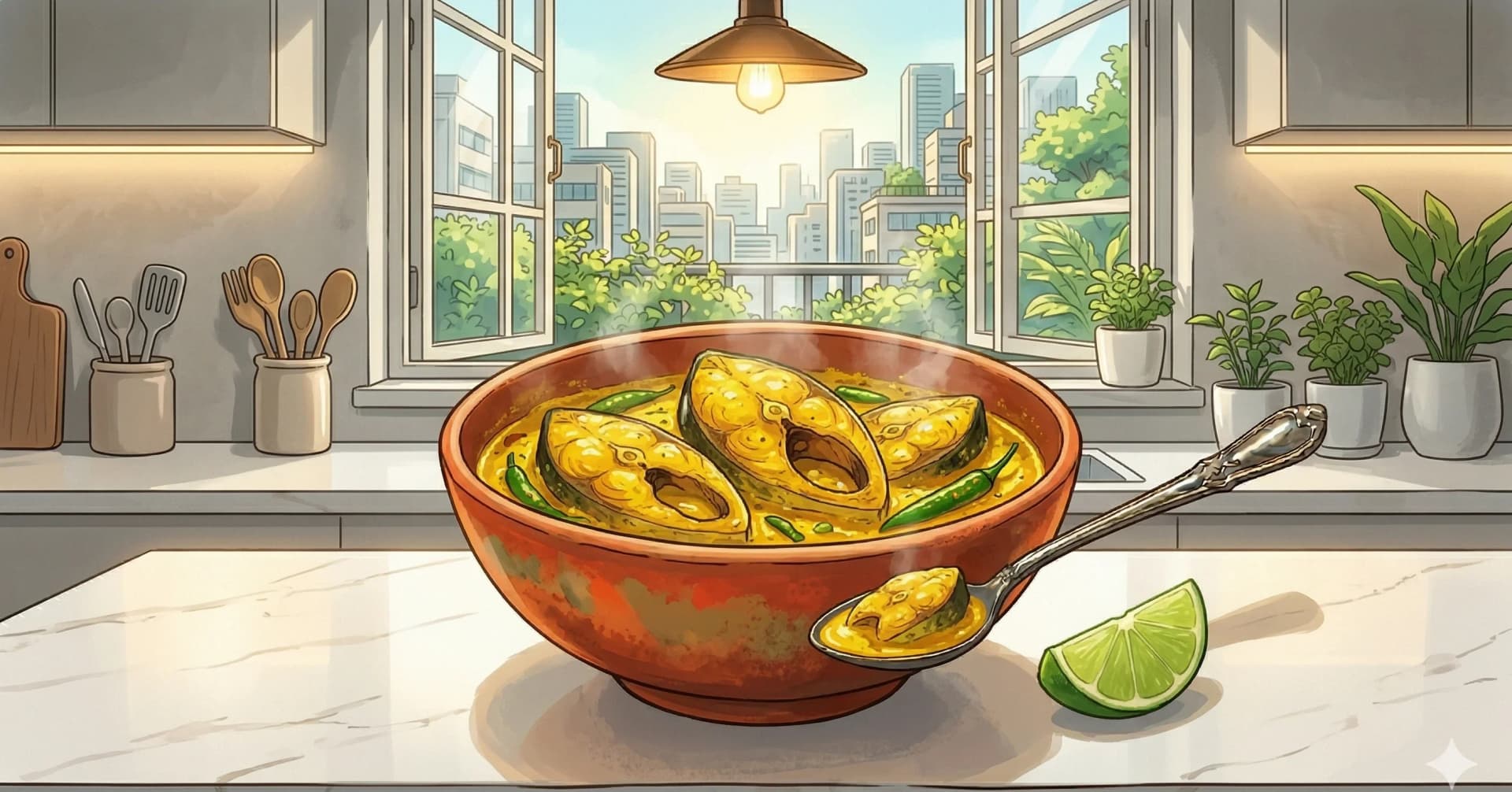
Hilsa in Mustard Sauce (Sorshe Ilish)
Hilsa steamed in sharp mustard — Bengal's most beloved dish
Ask any Bengali to name the most important fish in existence and the answer is immediate: ilish. The hilsa. A silver, oil-rich fish from the rivers of Bengal and Bangladesh, prized to the point of reverence, its arrival in the market in the monsoon season met with something close to celebration. Sorshe ilish — hilsa cooked with mustard — is the preparation that most completely expresses what makes this fish extraordinary.
The dish is built around two things: the particular fat content of hilsa and the sharp, almost aggressive flavour of freshly ground Bengali mustard. Hilsa is one of the fattiest freshwater fish in South Asia. Its flesh is deeply flavoured, slightly oily, and holds its texture through cooking in a way that leaner fish cannot. This fat is essential. It enriches the mustard sauce, softening the mustard's bite while the mustard simultaneously cuts through the fish's richness. They moderate each other, and the result is a balance that neither could achieve alone.
The mustard paste is made from both yellow and black mustard seeds ground with green chillies and a little water. The combination of seeds is deliberate: yellow mustard gives a milder, nuttier base; black mustard seeds are sharper and more pungent. Ground together, the paste has both heat and depth. Poppy seeds (posto) are a signature Bengali addition. Their subtle nuttiness rounds and softens the mustard without masking it, adding a faint creaminess to the sauce.
Mustard oil is the cooking medium, and it must be used raw — heated briefly to its smoking point to lose its sharpness, then used throughout the dish and added again at the finish as a raw drizzle. That final teaspoon of raw mustard oil poured over the cooked fish is not garnish. It is the aromatic finish that defines Bengali fish cooking.
A practical note: if hilsa is unavailable, this recipe will produce a compelling dish with mackerel or herring. Both have the oiliness the recipe requires. But seek hilsa if you can find it.
At a Glance
Yield
Serves 4
Prep
20 minutes (plus 15 minutes marinating)
Cook
25 minutes
Total
1 hour
Difficulty
Medium
Ingredients
Spice Paste Ingredients
- ⅓ cupyellow mustard seeds
- 3¼ tbspblack mustard seeds
- 3½ tbsppoppy seeds (*posto*)
- 3¼ tbspgreen chillies (about 4 chillies), roughly chopped
- ¼ ozcoconut, finely grated
- 1 ozyogurt, beaten
- 1¾ tbspred chilli powder
Tempering Ingredients
- 3⅓ tbspmustard oil
- ⅔ tspnigella seeds (*kalonji / kalo jeera*), about ¾ teaspoon
- 2⅓ tspsugar
- —Additional 2 ml raw mustard oil, for finishing
- —Additional green chillies, slit, for cooking
- ⅞ tspfine salt (total seasoning, adjusted to taste)
Method
- 1
Marinate the fish. Pat the hilsa (1 kg) steaks dry. In a bowl, mix the turmeric (2 teaspoons) and salt (1 teaspoon) together and rub gently over each steak, coating all surfaces. Allow to marinate for at least 15 minutes while you make the paste.
- 2
Make the mustard-poppy paste. Combine the yellow mustard (50 ml) seeds (50 g), black mustard seeds (30 g), and poppy seeds (30 g) in a small bowl. Add cold water to just cover and soak for 10 minutes to soften slightly — this helps the blending. Drain and transfer to a blender or grinding stone with the green chillies (4 chillies). Add 3–4 tablespoons of water and grind to a smooth paste. This takes time and patience; stop and scrape down the sides repeatedly. The paste should be fine, slightly creamy, and quite pungent when smelled up close. Add the grated coconut (2 tablespoons), yogurt (30 g), and red chilli powder (2 teaspoons) to the ground paste and mix well. Taste for sharpness — it should be bold and direct.
- 3
Heat the mustard oil. Pour the mustard oil into a wide, flat pan and heat over high heat until it just begins to smoke. You will see the first wisps of white smoke and the colour will lighten slightly. Remove from heat and allow to cool for 1–2 minutes. This step removes the raw bitterness of the oil and is essential in Bengali cooking. Return to medium heat.
- 4
Temper the oil. Add the nigella seeds (2 g) to the cooled, heated mustard oil. They will sputter and pop within seconds, releasing a sharp, onion-like fragrance. Allow them to spit for 30 seconds.
- 5
Add the paste and fish. Pour the mustard-poppy paste into the pan and stir for 2–3 minutes until the paste becomes fragrant and darkens very slightly. Add the marinated hilsa steaks in a single layer. Tuck the slit green chillies between the steaks. Add 100–125 ml of water around the edges of the pan to create a shallow cooking liquid. Add the sugar (2 teaspoons) and remaining salt (5 g).
- 6
Steam-cook. Cover the pan tightly with a lid. Reduce heat to low and cook for 12–15 minutes. The fish should be cooked entirely by the gentle steam trapped under the lid. Do not turn the steaks, as hilsa is delicate and breaks easily. After 12 minutes, check by pressing the thickest steak gently. It should feel firm and flake at the edges.
- 7
Finish. Remove the lid. Drizzle the raw mustard oil over the surface of the fish and sauce. Tilt the pan gently to incorporate. Serve immediately, directly from the pan if possible.
Key Ingredient Benefits
Hilsa / Ilish (Tenualosa ilisha) is one of the richest dietary sources of omega-3 fatty acids among South Asian fish. Research consistently associates omega-3 intake with cardiovascular and neurological health; hilsa's fat profile includes significant EPA and DHA. In Bengali food culture, hilsa is also associated with the rainy season and river ecology. Its migration from the Bay of Bengal into freshwater rivers to spawn is what gives monsoon-season hilsa its peak fat content and flavour.
Mustard seeds contain glucosinolates, the same class of compounds found in other brassicas, as well as selenium and omega-3 alpha-linolenic acid. In Ayurveda, mustard is considered warming and stimulating. In Unani medicine it was traditionally used as a circulatory and digestive stimulant. The paste form used here maximises the release of myrosinase, the enzyme that converts glucosinolates into their active forms.
Mustard oil is high in monounsaturated and polyunsaturated fats, with a ratio of omega-6 to omega-3 fatty acids considered more favourable than many other cooking oils. It contains erucic acid, which at very high dietary concentrations has been associated with adverse effects in animal studies; however, the amounts used in normal cooking are well within safe ranges, and mustard oil has been a daily cooking fat for populations in Bengal and North India for centuries. Research on erucic acid at dietary cooking levels does not indicate concern.
Nigella seeds (Nigella sativa, called kalonji in Hindi or kalo jeera in Bengali) have a long history of use in Unani and Islamic medicine. Research suggests they contain thymoquinone, a compound with anti-inflammatory properties in laboratory studies. In cooking, their primary contribution is a sharp, slightly onion-like fragrance that is the signature temper of Bengali fish preparations.
Why This Works
The combination of two mustard seeds is not incidental. Yellow mustard is ground more easily and produces the creamy base of the paste; black mustard is harder, sharper, and more pungent. Ground together, the paste has a two-register sharpness — the immediate heat of the black seeds and the rounder, more sustained heat of the yellow. Neither alone produces the same result.
Poppy seeds dissolve into the paste and contribute a faint, milky creaminess that keeps the mustard from being simply aggressive. This is a characteristic Bengali technique — adding posto to sharp preparations to provide balance without diminishing the central sharpness. The effect is subtle but noticeable; a version without poppy seeds tastes harsher and less integrated.
Covering the pan and cooking on low heat is a steam-cook technique (bhapa) that is fundamental to Bengali fish cooking. Delicate, fatty fish like hilsa do not benefit from high-heat frying or vigorous simmering. The fat renders out and the flesh breaks down. Gentle steam, trapped under a lid, cooks the fish evenly from all sides simultaneously while keeping every drop of fat inside the flesh where it belongs. The result is a steak that is fully cooked but still moist and barely holding together.
Substitutions & Variations
No hilsa: Mackerel or thick-cut herring steaks are the closest substitutes. Both have the oil content the recipe requires. Avoid lean white fish (sea bass, cod), which will taste flat and dry in this preparation.
Mustard paste shortcuts: Prepared Bengali mustard paste (kasundi) or high-quality whole-grain Dijon mustard can substitute in an emergency, mixed with water and a little poppy seed paste (ground poppy seeds blended with water). The flavour will be different but recognisable.
No poppy seeds: Increase the coconut quantity slightly or add a teaspoon of cashew paste. The texture will be slightly different but the overall effect is similar.
Spice level: The recipe is medium-hot. Reduce green chillies to 2 for a milder version; increase to 6–8 for the heat level of a Kolkata fish market preparation.
Serving Suggestions
Sorshe ilish is always served with plain boiled or steamed white rice. The starchy plainness of the rice is the correct foil for the sharp, oily sauce. In Bengal, this would be long-grain gobindobhog or tulaipanji rice; regular long-grain white rice or basmati is fine at home. The sauce should pool around the rice and be eaten together. No accompaniment is needed or wanted. Sorshe ilish demands undivided attention. A simple sliced tomato with salt and mustard oil on the side is all the salad this meal requires.
Storage & Reheating
Sorshe ilish is best eaten the day it is made. Hilsa's delicate, fatty flesh does not hold well over multiple days. Leftovers can be kept in the refrigerator for 1 day and reheated very gently in a covered pan over the lowest possible heat, adding a tablespoon of water to prevent sticking. Do not reheat vigorously. The fish will break apart. Sorshe ilish does not freeze well; the mustard paste separates and the fish texture degrades significantly.
Cultural Notes
Shorshe ilish (সর্ষে ইলিশ, "mustard hilsa") is the Bengali fish preparation in which fillets of hilsa (the prized oily silver fish Tenualosa ilisha that migrates up the Ganges and Padma rivers during the monsoon) are gently steamed or cooked in a sauce of ground yellow and black mustard seeds, mustard oil, green chilies, and turmeric. The dish is one of the most strongly Bengali of all Bengali preparations and the dish that Bengali food writers consistently identify as the central culinary symbol of Bengali identity, alongside maccher jhol (everyday fish curry) and chingri-malai-curry.
The hilsa fish is the cultural anchor that makes the dish what it is. The species is highly seasonal in Bengal, with the main fishing season running from July through September during the monsoon flood when the fish migrate upriver from the Bay of Bengal to spawn. The fish has hundreds of fine forked bones throughout its flesh, which Bengali diners learn to work through with chopsticks and fingers from childhood, and the oily rich flesh has a distinctive flavor that mustard-based sauces complement uncommonly well. Bengali households mark the monsoon season by the arrival of fresh hilsa at the fish markets of Kolkata, Dhaka, and the smaller towns along the rivers, and the dish appears at family lunches and festival meals during the season.
The technique builds the mustard sauce as the central element. Yellow and black mustard seeds are soaked in water for thirty minutes to soften, then ground to a fine paste with a small amount of water, green chilies, and a pinch of salt. The freshness of the grind matters: stored ground mustard turns bitter and loses its character within hours. The hilsa fillets are placed in a heatproof bowl, smeared with the mustard paste, sprinkled with turmeric and salt, and drizzled with raw pungent mustard oil. The bowl is then steamed in a covered pot for ten to twelve minutes, or cooked in a covered pan over low heat for fifteen minutes, until the fish is just cooked through and the mustard paste has formed a coating sauce. The dish is served with plain rice and is the prestige fish offering at Bengali weddings and Durga Puja festival meals. The Bengali food writer Pritha Sen and the late Chitrita Banerji have both written extensively about the dish's place in Bengali culinary identity.
Nutrition Facts
Calories: 618kcal (31%)|Total Carbohydrates: 7.7g (3%)|Protein: 40.2g (80%)|Total Fat: 50.4g (65%)|Saturated Fat: 10.6g (53%)|Cholesterol: 115mg (38%)|Sodium: 2589mg (113%)|Dietary Fiber: 4.2g (15%)|Total Sugars: 3.8g
You Might Also Like
Ratings & Comments
Ratings & Comments
Ratings
Share your thoughts on this recipe.
Sign in to rate and comment