Bengali · Indian Cuisine
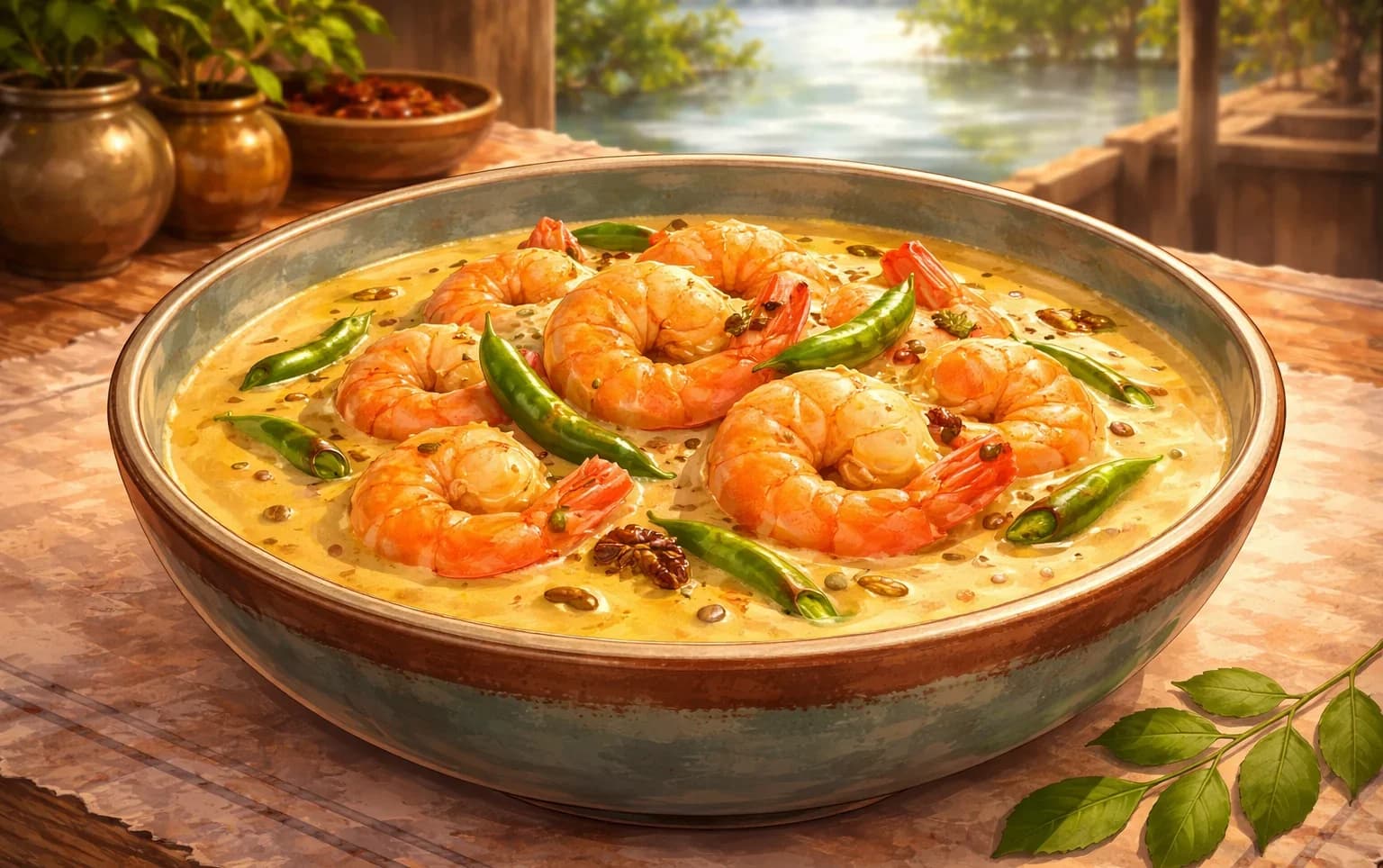
Prawns in Coconut Cream (Chingri Malai Curry)
Tiger prawns in golden coconut — the pride of the Bengali table
The name is pleasingly misleading. Malai in Hindi most commonly means cream — the thick layer that rises from buffalo milk — and so chingri malai curry sounds, at first hearing, like prawns in a cream sauce. But Bengali chingri malai curry contains no cream at all. Malai here is a corruption of Malai as in Malay, a nod to the Malay and Burmese coconut-cooking traditions that influenced Bengal's coastal cuisine. What you get is coconut milk: pale, fragrant, slightly sweet, and surprisingly complex when built over the right spiced base.
This is a dish of celebrated restraint. The spice level is deliberately gentle. This is not a fiery curry but an aromatic, nuanced one, where the sweetness of tiger prawns meets the sweetness of coconut milk against a background of cardamom, cinnamon, and bay. The mustard oil brings sharpness and body. A small amount of sugar near the finish rounds the sauce and balances the slight bitterness of the mustard oil, pulling everything into harmony.
The prawns must be large — tiger prawns or similar — and ideally left in their shells through part of the cooking. The shells contribute a deep, sweet seafood stock to the sauce that peeled prawns simply cannot. If you have access to fresh prawns with heads, even better: the heads, briefly fried in oil at the start, build an umami base that raises the entire dish.
Chingri malai curry is a celebration dish in Bengal, prepared for pujas, weddings, and important guests. It is elegant enough to justify the description while requiring no unusual technique. The most common mistake is overcooking the prawns: they need only minutes in the sauce, and overcooked tiger prawns become rubbery in seconds. Watch the tails. When they curl into a tight C, the prawns are done. A loose C still has a few seconds to go.
At a Glance
Yield
Serves 4
Prep
20 minutes
Cook
30 minutes
Total
50 minutes
Difficulty
Medium
Ingredients
- 2¼ lbtiger prawns, shell-on or peeled (about 12–16 large prawns), deveined
- 1¼ tbspturmeric
- 1⅔ tspsalt (total for dish, divided)
- 1¼ cupfull-fat coconut milk
- 7 ozonion (about 2 medium onions), finely chopped
- 2 tbspginger paste
- 2 tbspgarlic paste
- 1¾ oztomato (about 1 small tomato), finely chopped
- 3¼ tbspgreen chillies (about 4 chillies), slit lengthways
- 1¾ tbspred chilli powder
- 1¼ tbspturmeric
- 2⅓ tspsugar
- ¼ ozgreen cardamom (about 3–4 pods, lightly crushed)
- ⅓ tspcinnamon (about 1 short stick)
- ½ tspwhole cloves (about 3–4 cloves)
- ¼ ozbay leaves (about 2 leaves)
- 3⅓ tbspmustard oil
- 2 tspghee
Method
- 1
Marinate the prawns. Toss the prawns with 1 teaspoon of turmeric (2 teaspoons) and ½ teaspoon of salt (10 g). Mix gently and set aside while you prepare the sauce.
- 2
Heat the mustard oil (50 ml). Heat the mustard oil in a wide, heavy pan or karahi over high heat until it smokes lightly. The colour will lighten and a few wisps of white smoke will appear. Remove from heat and allow to cool for 1 minute. Return to medium-high heat. This smoking step is standard in Bengali cooking and removes the raw sharpness of the oil.
- 3
Fry the prawns briefly. Add the marinated prawns to the hot oil in a single layer. Fry for 60–90 seconds per side, just until they turn pink on the outside. Do not fully cook them here; they should still be translucent at the centre. Remove and set aside. This step seals the surface of the prawns and adds a slight caramelised sweetness.
- 4
Build the sauce base. In the same pan with the remaining oil, add the bay leaves (2 leaves), cardamom (3–4 pods, lightly crushed), cinnamon (1 short stick), and cloves (3–4 cloves). They will sputter and release their fragrance in about 30 seconds. Add the finely chopped onion (2 medium onions) and a pinch of salt. Cook over medium heat, stirring regularly, for 12–15 minutes until the onions are soft and turning golden. Add the ginger paste (2 tablespoons) and garlic paste (2 tablespoons) and cook for 3 minutes, stirring constantly, until the raw smell disappears.
- 5
Add tomato (1 small tomato) and spices. Add the chopped tomato and cook for 3–4 minutes until softened and beginning to break down. Add the red chilli powder (2 teaspoons) and remaining turmeric (2 teaspoons). Stir through and cook for 2 minutes until the spices are fragrant and the oil begins to separate around the edges.
- 6
Add the coconut milk. Pour in the coconut milk gradually, stirring as you pour. Bring to a gentle simmer. Do not boil vigorously, as coconut milk can split. Add the slit green chillies (4 chillies), sugar (2 teaspoons), and remaining salt. Simmer for 5 minutes, stirring occasionally, until the sauce has thickened slightly and the coconut milk flavour has mellowed and integrated.
- 7
Return the prawns. Add the partly cooked prawns to the sauce. Stir gently to coat them in the sauce. Cover and cook for 4–5 minutes over low-medium heat until the prawns are fully cooked through. The flesh should be white and opaque throughout and the tails curled into a C shape.
- 8
Finish. Add the ghee (2 teaspoons) and stir through. Taste for salt and sugar balance. Serve immediately. Prawns continue to cook in residual heat.
Key Ingredient Benefits
Tiger prawns (Penaeus monodon) are an excellent source of lean protein and iodine, with relatively low fat compared to other animal proteins. They contain selenium and vitamin B12. In Ayurveda, seafood is traditionally considered appropriate for individuals with a vata constitution, where its protein and fat content is thought to be grounding. Research on dietary shellfish is generally positive in the context of cardiovascular health, though individuals with shellfish allergies should obviously avoid this dish.
Coconut milk is high in medium-chain triglycerides (MCTs), particularly lauric acid. Research on MCTs suggests they are metabolised differently from long-chain fats, though the implications for health at the amounts used in cooking are still being studied. In Ayurveda, coconut is considered cooling and building. Its culinary role here is as a base that simultaneously adds sweetness, body, and a creamy texture to the sauce without the dairy-richness of actual cream.
Mustard oil (see also Sorshe Ilish notes) brings a distinctively sharp, penetrating flavour that is unique to Bengali and North Indian cooking. The heating and smoking step is standard practice. It not only removes bitterness but also changes the chemical structure of some of the erucic acid compounds, producing a more refined flavour.
Ginger and garlic together are used as a foundational flavour base across most Bengali meat and fish preparations. In Ayurveda, ginger (adrak) is considered warming and stimulating to digestion; garlic is traditionally associated with circulatory support in both Unani and Ayurvedic systems. Research suggests both contain compounds associated with anti-inflammatory activity, though dietary amounts are modest.
Why This Works
The double-cooking of the prawns — a brief initial fry followed by a gentle finish in the sauce — is a deliberate technique. The initial fry creates a Maillard reaction on the prawn surface, developing a sweet, caramelised exterior that adds flavour depth to the sauce when the prawns are returned to it. The gentle finish in the sauce allows the prawns to reach the centre without overcooking the exterior. The sauce moderates the heat and keeps the cooking environment gentler than direct pan heat.
Sugar is not an afterthought in this recipe. Bengali cooking, across its fish and meat preparations, often incorporates a small amount of sugar. Not enough to make the dish sweet, but enough to round the sharp edges of mustard oil and chilli, and to bring the inherent sweetness of coconut milk into focus. Without it, the sauce can taste slightly unresolved. With it, the flavours settle and balance.
Ghee added at the end is a finishing technique rather than a cooking fat here. Its milk solids and butter-notes add richness and a final aromatic note — a tiny bridge between the coconut milk's sweetness and the mustard oil's sharpness. Two teaspoons is all it takes.
Substitutions & Variations
Tiger prawns to smaller prawns: Use the same weight; reduce the final cooking time to 2–3 minutes as smaller prawns cook very quickly.
Tiger prawns to lobster: A cleaned, halved small lobster is a luxurious alternative, treated identically. Increase final cooking time to 6–8 minutes.
Coconut milk consistency: For a thicker sauce, use only 200 ml of full-fat coconut milk. For a more brothy, lighter preparation, add up to 400 ml and adjust salt and sugar to taste.
Ginger-garlic paste: If you don't have ready paste, finely grate equal quantities of fresh ginger and garlic and use the same total weight. The flavour will be slightly sharper and more immediate.
Serving Suggestions
Serve over plain, steamed white rice — gobindobhog if available, otherwise regular long-grain white rice. The sauce should be absorbed into the rice as you eat. In a Bengali meal, chingri malai curry might be one of three or four fish and vegetable preparations served alongside plain rice, dal, and fried vegetables. As a solo centrepiece at home, it needs only the rice and perhaps a simple dal or fried aubergine alongside. Warm parathas or luchis (fried puffed bread) are another excellent accompaniment for a more festive serving.
Storage & Reheating
Like all prawn dishes, chingri malai curry is best eaten fresh. Prawns become rubbery when reheated. The residual heat of the sauce will continue cooking them even after the pan is off the stove. If storing leftovers, refrigerate promptly and consume within 24 hours. To reheat, warm the sauce separately first over low heat, then add the prawns and heat only until warmed through, no more than 2–3 minutes. Do not boil. The curry does not freeze well.
Cultural Notes
Chingri malai curry (চিংড়ি মালাই কারি, "prawn cream curry") is the Bengali coconut-milk prawn curry that occupies the position of the prestige seafood dish in Bengali home cooking, alongside sorshe-ilish. The dish uses large king prawns (galda chingri, the freshwater giant river prawn from the Sundarbans and other Bengal river systems) cooked in a rich gravy of thick coconut milk, ghee, ginger, green chilies, and a Bengali whole-spice mix of green cardamom, cinnamon, cloves, and bay leaf. The dish is distinctly Bengali in its restraint: no onion, no garlic in the traditional recipe, no aggressive masala. The prawns and the coconut milk are the central flavor elements and the spicing supports rather than dominates.
The dish's name and history connect it to colonial-era Bengali trade with Southeast Asia. The word malai in the dish name has been etymologically connected by some Bengali food historians to the Malay archipelago, suggesting that the dish may have originated through Bengali sailor and merchant contact with Malayan and Indonesian coconut-milk cookery during the colonial period. Other Bengali sources read malai simply as the Bengali word for cream (as in malai cream of milk), making the dish "creamy prawn curry" without the geographic implication. Both readings circulate in Bengali food writing, and the dish itself has been documented in Bengali cookbooks since at least the early twentieth century.
The technique is fundamentally restrained. The prawns (shells removed but tails left intact, deveined, marinated briefly in turmeric and salt) are lightly pan-fried in mustard oil or ghee for a minute per side, just until they turn pink, then removed. The gravy is built from ghee tempered with whole green cardamom, cinnamon, cloves, and bay leaf, then grated ginger and slit green chilies are added, then a small amount of turmeric, kashmiri red chili powder, and ground cumin. Thin coconut milk thins the gravy, the prawns are returned for a brief simmer, and the dish is finished with thick coconut milk added off the heat and a small sprinkle of sugar (Bengali cooking includes sugar more openly than other Indian regional cuisines). The pairing with plain rice or luchi (Bengali puffed bread) is the canonical home meal, and the dish appears at Bengali wedding banquets and Durga Puja celebrations as one of the showcase items of the formal multi-course menu.
Nutrition Facts
Calories: 544kcal (27%)|Total Carbohydrates: 21g (8%)|Protein: 54g (108%)|Total Fat: 29g (37%)|Saturated Fat: 18.1g (91%)|Cholesterol: 406mg (135%)|Sodium: 1286mg (56%)|Dietary Fiber: 5.4g (19%)|Total Sugars: 8.2g
You Might Also Like

Ratings & Comments
Ratings & Comments
Ratings
Share your thoughts on this recipe.
Sign in to rate and comment