Awadhi · Indian Cuisine
Gobi Mussallam
A whole cauliflower braised in Mughal gold
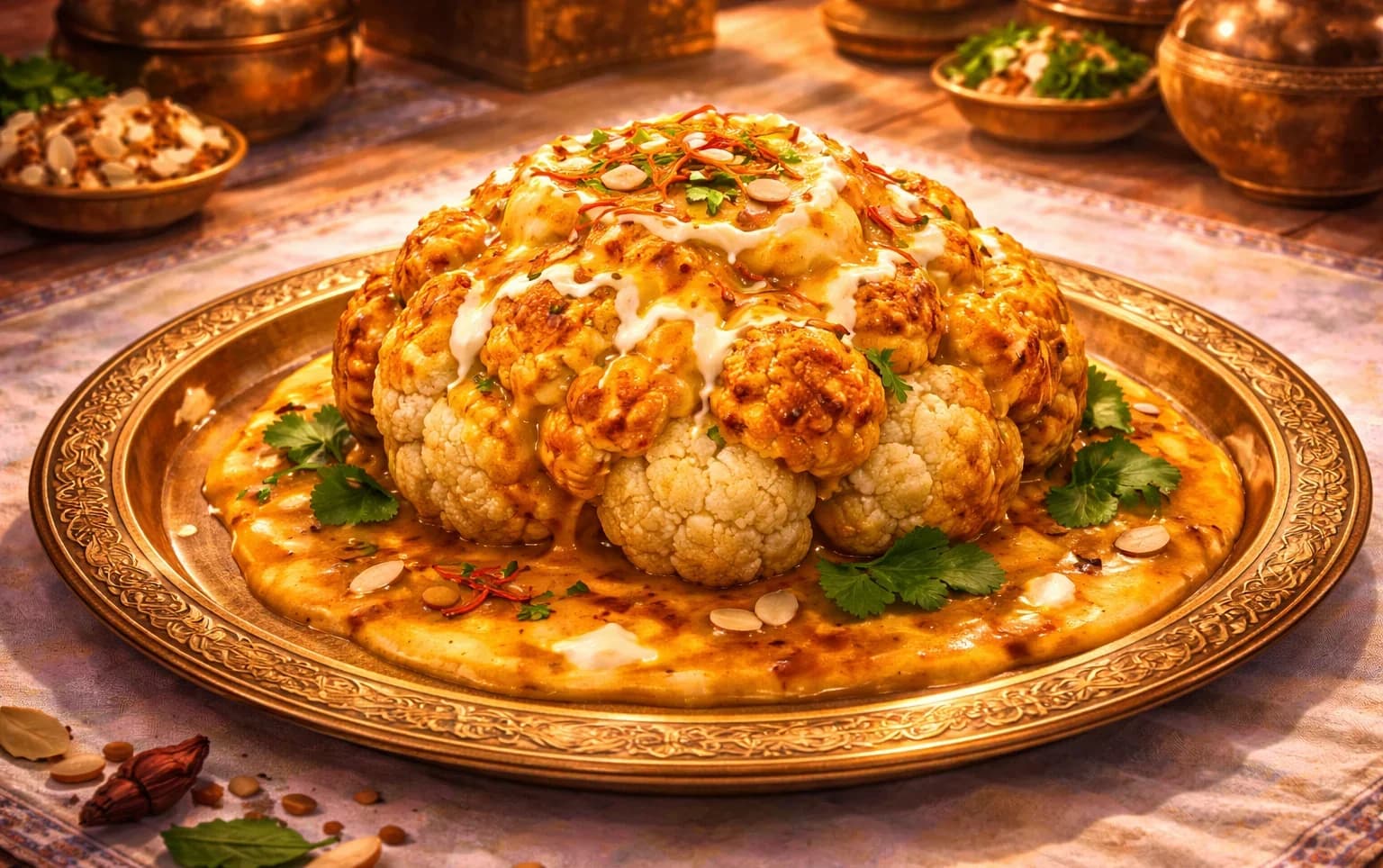
There is something almost theatrical about gobhi mussallam. You carry a whole cauliflower to the table — not cut, not broken, but entire — sitting in a pool of pale golden sauce, its surface coloured deep amber from the braising liquid, its white interior just visible where the outer florets have parted. The dish stops conversation. Then you cut into it and the sauce pours in through the cut surface, and conversation resumes around the question of why cauliflower has never arrived at anyone's table like this before.
Mussallam means whole — the same word appears in murgh mussallam (whole chicken) — and it reflects a Mughal aesthetic of presenting an ingredient as a single unified entity rather than cut into pieces. In Awadhi vegetarian cooking, which has its own sophisticated canon alongside the more famous meat dishes of Lucknow, the cauliflower became the natural vegetarian candidate for this treatment. Its dense, compact structure can withstand braising. Its mild flavour absorbs the korma sauce without resistance. Its dramatic spherical form makes the presentation genuinely remarkable.
The sauce is the same architecture as a murgh korma: deep golden fried onions, cashew paste for body, yogurt added in stages, saffron and kewra at the finish. The cauliflower is parboiled first to give it a head start, then added to the simmering sauce whole and braised until the sauce has penetrated the outer layers and turned the entire head a deep, gorgeous amber.
The practical key is to score the cauliflower before parboiling — radial cuts from the base to about halfway up the head allow the sauce to reach the interior rather than merely coating the surface. After braising, the cut surfaces will have absorbed the korma's colour and fragrance all the way through.
At a Glance
Yield
Serves 4
Prep
20 minutes
Cook
50 minutes
Total
1 hour 10 minutes
Difficulty
Medium
Ingredients
- 2¼ lbwhole cauliflower, outer leaves removed (about 1 large head), stem trimmed flat
- 7 ozonion (about 2 medium onions), thinly sliced
- 3⅓ tbspghee
- 2 tbspginger-garlic paste
- 3½ ozyogurt, beaten smooth
- 1¾ oztomato (about 1 small tomato), finely chopped
- 1⅔ tspsalt
- 3¾ tbspred chilli powder
- 1¾ tbspcoriander powder
- 1⅞ tspturmeric
- 1 tbspgaram masala
- 1¾ ozraw cashews
- —Warm water for soaking
- 2 tbspcream
- ¼ ozsaffron (a generous pinch), steeped in 3 tablespoons warm milk
- 2 tspkewra water
Method
- 1
Prepare the cauliflower. With a small sharp knife, make 4–6 radial scores from the base of the cauliflower about halfway up the head. These cuts should be roughly 1 cm deep and evenly spaced around the circumference. This allows the cooking sauce to penetrate into the interior. Bring a large pot of salted water to a boil. Carefully lower the whole cauliflower (1 large head) in head-first and parboil for 8–10 minutes until it is just tender when a skewer is inserted into the thickest part — it should feel resistance but not be hard. Drain and allow to cool slightly, upside down, so any excess water drains from the scores.
- 2
Make the cashew paste. While the cauliflower parboils, soak the cashews (50 g) in warm water for 15–20 minutes. Drain and blend with 3–4 tablespoons of fresh water to a completely smooth, pale paste. Set aside.
- 3
Brown the onions. In a wide, heavy pot large enough to hold the whole cauliflower with a lid on top, melt the ghee (3½ tablespoons) over medium-high heat. Add the sliced onions with a pinch of salt (2 teaspoons) and cook, stirring regularly, for 18–22 minutes until deep golden-brown and sweet-smelling. Remove a small amount and set aside for garnishing.
- 4
Build the sauce. Add the ginger-garlic paste (2 tablespoons) and cook for 2–3 minutes until the raw smell disappears. Add the chopped tomato (1 small tomato) and cook for 3–4 minutes until softened and the mixture begins to dry out. Add the red chilli powder (4 teaspoons), coriander powder (2 teaspoons), and turmeric (1 teaspoon); stir for 1 minute. Add the beaten yogurt (100 g) in three additions, stirring until each addition is fully incorporated before adding the next. Add the cashew paste and stir through. Add 200 ml of warm water and bring to a gentle simmer. Cook for 5 minutes until the sauce is smooth and fragrant.
- 5
Braise the cauliflower. Gently lower the parboiled cauliflower, score-side down, into the sauce. The sauce should come about halfway up the sides of the cauliflower — add a little more water if needed. Spoon sauce generously over the top of the cauliflower. Cover with a lid and braise over low heat for 20–25 minutes, spooning sauce over the cauliflower every 5–6 minutes, until the cauliflower is completely tender and has taken on the deep amber colour of the sauce on its outer surfaces.
- 6
Finish. Stir the cream (2 tablespoons) into the sauce around the cauliflower. Remove from heat. Drizzle the saffron (3 g) milk over the cauliflower and add the kewra water (2 teaspoons) to the sauce. Stir gently. Taste for salt.
- 7
Serve whole — carry the pot to the table if possible, or transfer the whole cauliflower carefully to a serving dish and pour the sauce around it. Garnish with the reserved fried onions and a thread of cream if desired.
Key Ingredient Benefits
Cauliflower (Brassica oleracea) belongs to the brassica family alongside broccoli, cabbage, and Brussels sprouts. Research suggests cruciferous vegetables are associated with various protective effects through their glucosinolate compounds, which are converted in the body to active forms. In the Indian culinary tradition, cauliflower is considered a cool-season vegetable, associated with the transition from summer to winter and at its best in the cooler months.
Cashews (Anacardium occidentale) contain monounsaturated fats, magnesium, and plant-based iron. In Mughal cooking they were imported from coastal trade routes as a premium ingredient, used primarily as a sauce thickener in their ground paste form. Research suggests tree nuts in general are associated with improved cardiovascular markers in observational studies; the amounts used here as a sauce base are modest.
Saffron (Crocus sativus) is produced in significant quantity in Indian Kashmir (Pampore) and has been used in Ayurvedic and Unani medicine for centuries as a tonic. Research suggests its crocin compounds may be associated with antioxidant and mood-supporting effects. Culinarily, it is the single most distinctive element of the Mughal-Awadhi finishing palette — its honeyed, metallic fragrance is unmistakable.
Ghee lends more than flavour in this recipe — its higher smoke point compared to butter or neutral oil allows the onions to caramelise properly without burning. In Ayurveda, ghee is considered agni-deepak — supporting the digestive fire — and is traditionally used in preparations for both daily cooking and ceremonial feasts.
Why This Works
The parboiling step is structural. Raw cauliflower placed directly into a sauce and braised would need far longer cooking to become tender — by which point the exterior would have disintegrated and the sauce would have over-reduced. Parboiling to 60–70% tenderness means the subsequent braising time in the sauce can be short enough to preserve the cauliflower's form while still allowing the sauce to penetrate and flavour the interior.
Scoring the base serves a counterintuitive purpose: rather than weakening the cauliflower's structure, the scored channels allow the sauce to wick upward through capillary action as the cauliflower braises. The outer surfaces colour deeply while the channels carry colour and fragrance toward the interior. A whole cauliflower without scoring would remain white inside even after prolonged braising.
The tomato addition — unusual in a korma — provides a subtle acid that brightens the sauce and prevents the cashew paste from making it feel excessively rich. The tomato cooks down completely and becomes invisible in the final sauce, present only as a slight sharpness that keeps the palate engaged. In traditional Awadhi korma this might be replaced by a small amount of tamarind or dried plum; tomato is the accessible modern equivalent.
Substitutions & Variations
No whole cauliflower: Large cauliflower steaks, cut from a whole head through the centre, can be cooked in the same sauce. Reduce braising time to 12–15 minutes and turn the steaks halfway through.
Vegan version: Replace ghee with coconut oil or a neutral vegetable oil. Replace yogurt with unsweetened coconut yogurt. Replace cream with full-fat coconut milk. The sauce character will shift but remains beautiful.
Leaner sauce: The cream is optional — the cashew paste already provides richness. Omit for a slightly lighter but still full-flavoured result.
Richer presentation: Top the finished dish with a scattering of toasted slivered almonds or a spoonful of fried cashews for additional texture.
Serving Suggestions
Gobhi mussallam is a centrepiece — it should be the focus, not a side dish. Serve with warm, pillowy naan, butter-enriched paratha, or plain basmati rice to absorb the sauce. A cool mint-cucumber raita on the side cuts through the richness beautifully. A dal such as dal makhani or a simple yellow moong dal alongside provides protein balance. If serving at a dinner party, bring the pot to the table and cut the cauliflower there — the cut revealing the amber interior is the moment the dish fully announces itself.
Storage & Reheating
Leftover gobhi mussallam keeps in the refrigerator for up to 3 days. The cauliflower will continue to absorb the sauce and become more intensely flavoured — some argue the second day is better than the first. To reheat, place in a covered pot over low heat with a splash of water, warming gently without vigorous boiling. The cauliflower may soften further; this is fine — the flavour will be excellent. Freezing is not recommended as the cauliflower texture degrades significantly on thawing.
Cultural Notes
Gobhi mussallam (गोभी मुसल्लम, "whole cauliflower") is the Mughlai-era vegetarian preparation of a whole par-boiled cauliflower stuffed with a filling of crumbled paneer, ground cashews, raisins, and Mughlai spices, then slow-cooked in a rich yogurt-and-almond-paste gravy until the cauliflower absorbs the gravy and serves as a whole carved centerpiece comparable to the meat murgh mussallam (whole stuffed chicken in the same gravy style). The dish is among the most prestigious of the Mughlai vegetarian banquet preparations and appears at Hindu wedding feasts, vegetarian Mughlai restaurant menus, and the elaborate vegetarian thalis of north Indian fine dining.
The mussallam category in Mughlai cuisine refers to whole stuffed and slow-cooked preparations. The Mughal court tradition developed murgh mussallam (whole stuffed chicken cooked in a rich gravy) as a showpiece banquet dish, and the vegetarian gobhi mussallam was developed by the same court chefs for Hindu courtiers and for the vegetarian feast occasions that the imperial court hosted. The Awadhi rakabdar and bawarchi tradition documented in court culinary records described both dishes as banquet-grade preparations that required the lengthy stuffing, par-boiling, and slow gravy-cooking work that distinguished them from the simpler everyday vegetable curries. The dish remains a feast preparation rather than an everyday dish even today, kept for occasions where the dramatic whole-cauliflower presentation matches the formality of the meal.
The technique builds the dish in three stages: par-cook the cauliflower, prepare the stuffing, and finish in the gravy. A medium cauliflower head is trimmed and par-boiled in salted water for eight minutes until just barely tender. A stuffing is mixed from crumbled paneer, ground cashews, chopped almonds, raisins, ground coriander, ground cumin, green cardamom, mace, ginger paste, green chili, salt, and a small amount of cream. The stuffing is pressed into the gaps between the cauliflower florets and into the central core where the par-boiling has loosened the structure. A gravy is prepared separately from sliced onion deep-fried into birista and ground with soaked almonds into a smooth paste, combined with whisked yogurt, Mughlai spices (green cardamom, mace, white pepper, a small amount of Kashmiri red chili), ginger-garlic paste, and a small amount of water. The stuffed cauliflower is placed gently into the gravy in a wide heavy pot, the gravy spooned over the top to coat, and the pot covered and cooked over low heat for forty-five minutes. The whole cauliflower is transferred to a serving platter, the gravy poured around it, and the dish is garnished with chopped cilantro, slivered almonds, and a sprinkle of cream for the banquet presentation.
Nutrition Facts
Calories: 262kcal (13%)|Total Carbohydrates: 25.3g (9%)|Protein: 9.3g (19%)|Total Fat: 16.1g (21%)|Saturated Fat: 7.1g (36%)|Cholesterol: 27mg (9%)|Sodium: 170mg (7%)|Dietary Fiber: 6.6g (24%)|Total Sugars: 9.4g
You Might Also Like
Ratings & Comments
Ratings & Comments
Ratings
Share your thoughts on this recipe.
Sign in to rate and comment