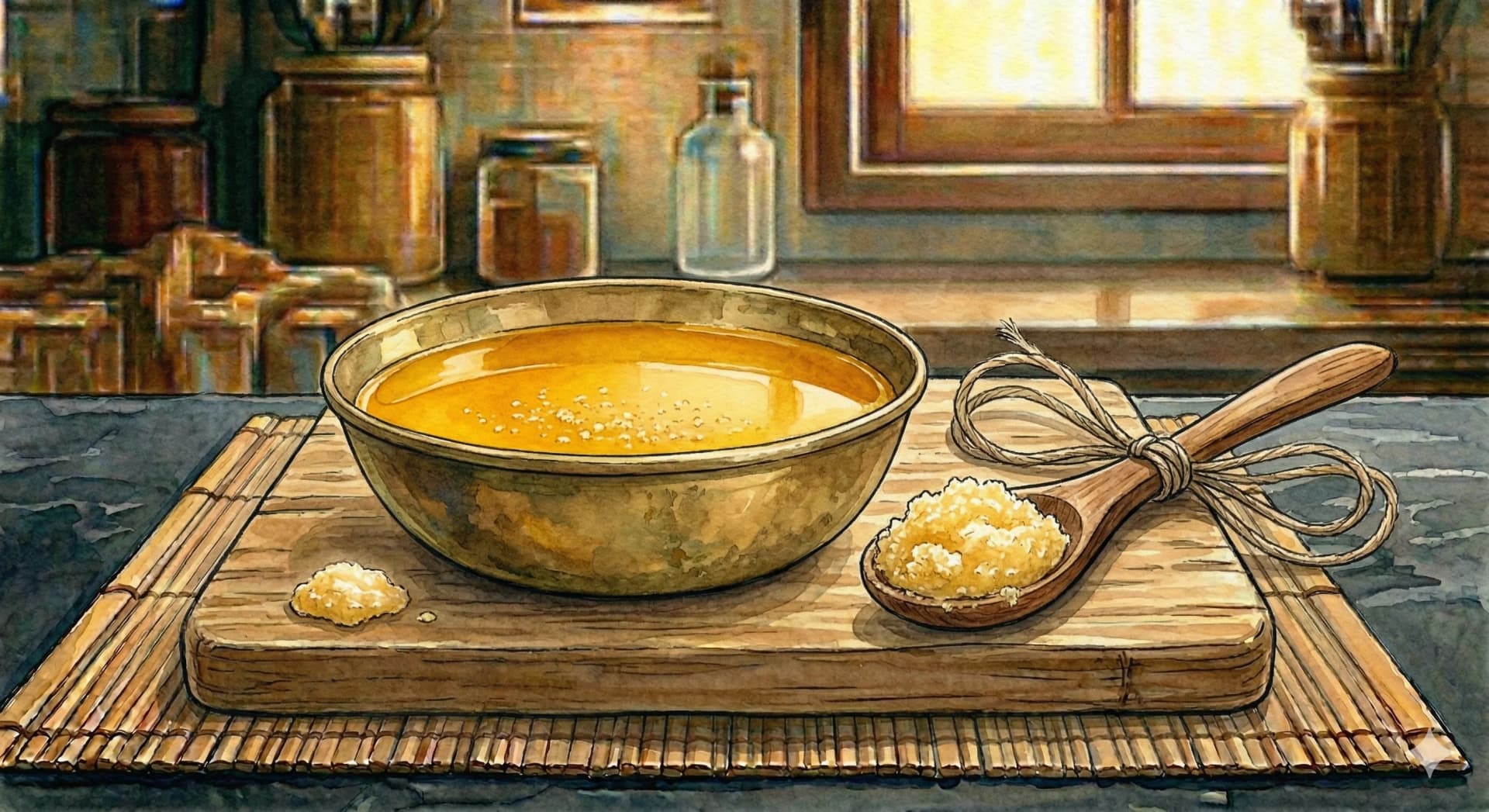
Ghee
Also known as: Clarified Butter, Smen, Samna, Butter Oil
Ghee is butter that has been slowly heated until all water evaporates and the milk solids are separated and removed, leaving pure butterfat. The process of clarification concentrates flavors while removing the components — lactose and casein — that most people with dairy sensitivities react to.
The result is a golden, shelf-stable fat with a high smoke point, a rich nutty flavor, and a medicinal history that spans thousands of years across multiple civilizations.
Key facts at a glance:
- Pure butterfat — water evaporated, milk solids removed
- High smoke point — 485°F / 250°C, suitable for high-heat cooking
- Dairy-sensitive friendly — lactose and casein removed during clarification
- Shelf-stable — stores at room temperature for months
- Sacred history — appears in the Rigveda as a ritual substance
Flavor Profile
Origin
South Asia, India, Middle East, North Africa
Traditional Medicine Perspectives
Ayurveda
Ghee (Ghrita) holds the highest position among all fats in Ayurvedic medicine. It is considered the finest carrier (anupana) for medicinal herbs — capable of carrying active compounds across the gut lining and into the body's deeper tissues. Unlike heavy fats that suppress digestive fire, ghee is said to kindle agni while simultaneously nourishing. It is used to lubricate joints, nourish the nervous system, support memory, and build Ojas (vital essence).
Modern Scientific Research
Ghee is high in butyric acid, a short-chain fatty acid that serves as the primary energy source for colonocytes (gut lining cells) and shows anti-inflammatory effects in the gut.
Research indicates that ghee's saturated fat content is predominantly shorter-chain fats that are metabolized differently from the long-chain saturates in most animal fats.
Some studies suggest that ghee, consumed in traditional quantities as part of a varied diet, does not raise cardiovascular risk the way industrially processed fats do.
Its lactose and casein removal makes it suitable for many with dairy sensitivities.
Cultural History
Ghee appears in the Rigveda (one of Hinduism's oldest texts) as a sacred substance used in fire rituals. It has been central to Ayurvedic medicine since the system's earliest texts, used both as a cooking fat and as a vehicle for medicinal herbs.
Throughout South Asia, ghee prepared at home from cultured butter is considered fundamentally different from commercially produced ghee — the process of making it is considered an act of care for the household.
Culinary Uses
Ghee is used everywhere butter would be used, with the added advantage of a higher smoke point (485°F / 250°C) that makes it suitable for high-heat cooking.
It forms the foundation of South Asian cooking — tadkas (spice blooms) begin with ghee.
It is stirred into khichdi, dal, and rice. In French cooking, clarified butter serves the same function in sautéing delicate proteins.
Preparation Methods
To make ghee: melt unsalted butter in a heavy saucepan over medium-low heat. Simmer until foam rises, then subsides, and the milk solids at the bottom turn golden and the fat runs clear — about 20 to 30 minutes.
Strain through cheesecloth into a jar. Store at room temperature for months.
Traditional Dishes
Recipes Using Ghee
- Honeycomb Milk Cake (Ghevar)
- Coconut-Jaggery Pudding (Ada Pradaman)
- Flaky Fried Pastry (Balushahi)
- Sesame-Crusted Rice Cookies (Anarsas)
- Prawns in Coconut Cream (Chingri Malai Curry)
- Slow-Cooked Duck (Dum Ki Batakh)
- Bread Pudding Dessert (Double Ka Meetha)
- Hyderabadi Lamb Korma
- Parsi Cream Puff Pastry (Malai Nu Khaja)
- Jeera Pulao
- Fritters in Yogurt Curry (Kadhi Pakora)
- Gobi Mussallam
- Hyderabadi Royal Chicken (Murgh Nizami)
- Raw-Layered Biryani (Kachi Biryani)
- Slow-Roasted Rabbit (Khargosh Ka Mokul)
- Khichdi
- Sohan Papdi
- Spiced Meat & Rice (Meat Chawal)
- Malabar Paratha
- Lentil Flour Pudding (Moong Dal Halwa)
- Palak Paneer
- Maharashtrian Spiced Rice (Masale Bhaat)
- Rajasthani Red Meat Curry (Laal Maans)
- Fried Fish, Delhi-Style (Kaanta Gali Machli)
- Slow-Baked Squash (Lagan Ka Tinda)
- Slow-Cooked Bitter Melon (Dum Ke Kareley)
- Ginger-Spiced Pilaf (Syun Pulao)
- Slow-Cooked Mushrooms (Dum Ke Khumbh)
- Maharashtrian Plain Dal (Varan)
- Slow-Cooked Quail, Green Spices (Dum Ka Bateyr Hara Masala)
- Goan Dried Fish Curry (Gaadh Muzh)
- Bengal Gram with Coconut (Cholar Dal Narkel Diye)
- Chicken Korma
- Roast Suckling Pig (Asada de Leitão)
- Spiced Chickpea Flatbread (Missi Roti)
- Mughlai Chicken Stew (Murgh Ka Soweta)
- Parsi Layered Custard (Lady Kenny)
- Bengali Fried Flatbread (Luchi)
- Slow-Cooked Vegetables (Dum Ki Subziyan)
- Sour Kidney & Liver Curry (Khatti Gurda Kaleji)
- Puffed Rice-Flour Cookies (Batero)
- Slow-Cooked Meat & Wheat (Haleem)
- Mughlai Royal Pilaf (Shahjhani Pulao)
- Punjabi Wheat Flour Fudge (Pinni)
- Golden Mughlai Curry (Kundan Kaliyan)
- Hyderabadi Biryani
- Coriander Chicken Korma (Murgh Dhaniwal Korma)
Comments
Share your thoughts on this ingredient.
Sign in to comment0 Comments