Indian Cuisine
Mughlai Royal Pilaf (Shahjhani Pulao)
Mughal-style layered chicken and saffron rice sealed in dum
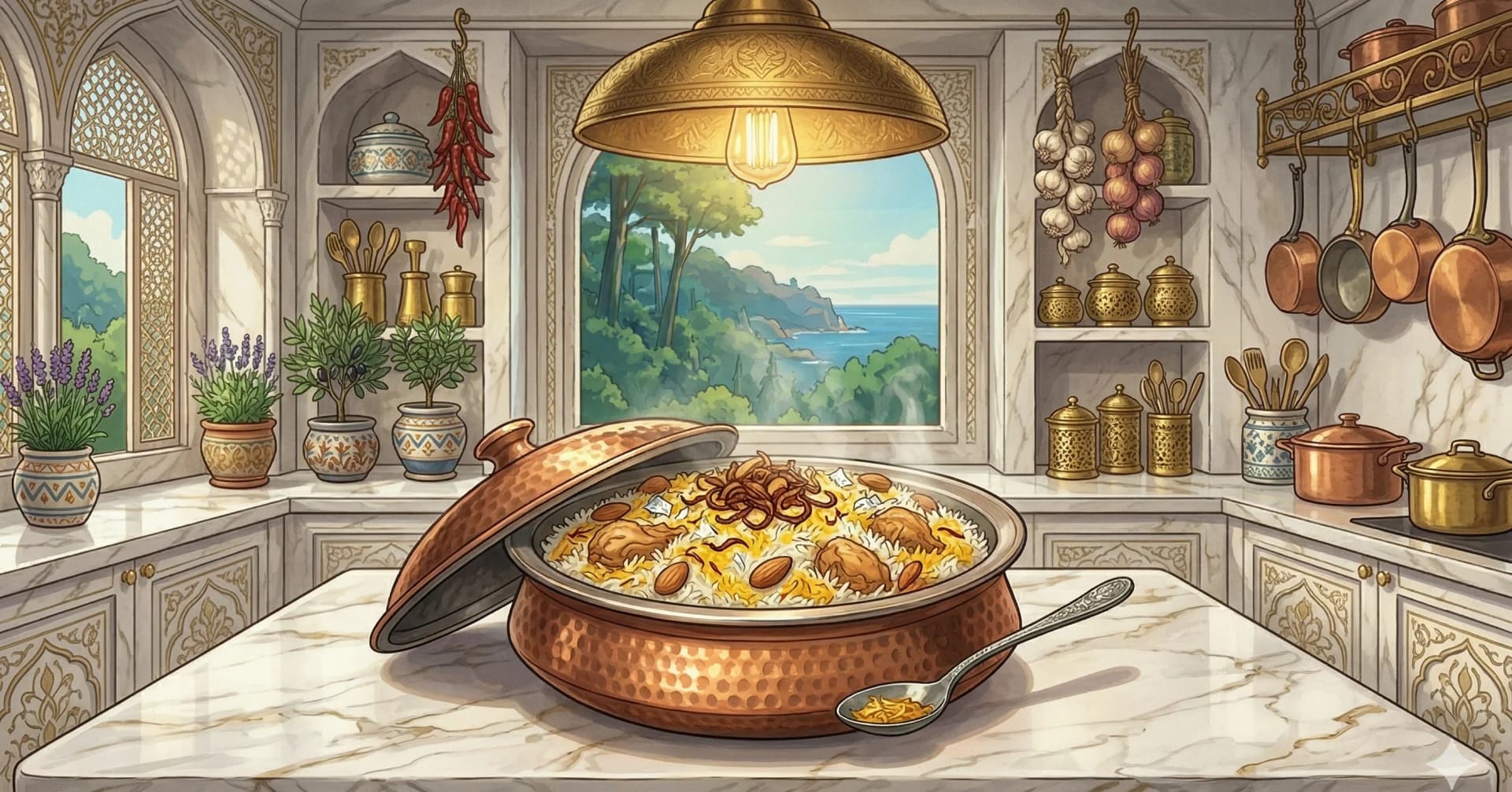
The name Shahjhani places this dish in the Mughal court tradition: Shah Jahan, the emperor who commissioned the Taj Mahal, ruled from Agra and Delhi in the 17th century, and the cuisine of his court represents the apex of what was to become the North Indian culinary tradition. Shahjhani pulao is a layered preparation, somewhere between a pulao and a biryani in character. The rice and chicken are cooked separately and then layered, rather than cooked together from the start, and the whole pot is sealed with dough and finished on slow dum heat.
The technique is methodical but not difficult. The chicken is sautéed with aromatics and cooked until almost done, then layered in a pot with three-quarter-cooked basmati rice. Between the layers, yoghurt and cream are added at intervals, the saffron water is poured over the top, and the pot is sealed with a dough lid (or heavy foil) and left on a very low flame for 45 minutes. During this dum time, the steam circulates within the sealed pot, completing the cooking of the rice, infusing it with the chicken's flavour, and distributing the saffron colour through the top layer.
The garnish (blanched whole almonds and silver vark) is the visual signature of Mughal court cooking. The silver leaf is purely decorative; the almonds add both crunch and a visual richness that communicates the dish's occasion-food status. Shahjhani pulao is for celebrations, significant gatherings, and special meals.
At a Glance
Yield
Serves 6–8
Prep
40 minutes
Cook
1 hour 45 minutes
Total
2 hours 25 minutes
Difficulty
Involved
Ingredients
Chicken Ingredients
- ¾ lbwhole chicken, jointed into 8 pieces (or bone-in thigh and leg pieces)
- 3½ ozonions (about ½–1 onion), finely sliced
- 1¾ tbspfresh ginger, shredded / finely grated
- 1¼ tbspgarlic, finely chopped
- ¼ ozgreen cardamom pods, lightly crushed
- 1⅛ tspcoriander seeds, lightly toasted
- ½ tspwhole cloves
- 1⅛ tspsalt
- 2⅓ tbspghee
- —A pinch of saffron, dissolved in 3 tablespoons warm water
Rice Ingredients
- 6 ozbasmati rice
- 1½ cuplight meat stock (chicken stock)
- 3½ ozonions (about ½–1 onion), thinly sliced (for frying)
- ¼ ozgreen cardamom pods (about 8–9 pods)
- ¼ ozblack cardamom pods (about 2 pods)
- ⅓ tspcinnamon stick (about 3 cm)
- ½ tspwhole cloves
- 1 tbspghee
- ⅔ tspsalt
Method
- 1
Brown the chicken (350 g). Heat the ghee (35 g) in a wide, heavy-based pot. Add the onions (100 g), ginger (10 g), and garlic (7 g). Sauté over medium-high heat until the onions turn lightly golden — about 8 minutes. Add the chicken pieces, salt (1¼ teaspoons), and lightly crushed whole spices (cardamom, coriander (2 g), cloves (1 g)). Cook over medium heat, turning the chicken occasionally, and sprinkling a tablespoon of water at a time if the pot becomes dry, for 20–25 minutes until the chicken is evenly golden brown on all sides and cooked almost all the way through. Add 375 ml of water and cook until the meat is almost tender and most of the liquid has evaporated. The chicken should be coated in a thick, fragrant paste. Remove from heat. **Prepare the rice:**
- 2
Rinse and soak. Rinse the basmati in cold water and soak for 5 minutes. Drain.
- 3
Par-cook the rice. Heat the ghee (17 g) in a separate pot. Sauté the sliced onions (100 g) until light golden. Add the rice and whole spices (green cardamom, black cardamom, cinnamon, cloves (1 g)). Stir gently for 2 minutes. Add the stock and salt (4 g). Bring to a boil, then reduce and cook, covered, until three-quarters done — about 12 minutes. The rice should still have a slight firm core. Remove from heat, drain any excess liquid. **Assemble and dum:**
- 4
Grease the degchi or pot. Lightly grease the base and sides of a large, wide pot (degchi) with ghee.
- 5
Layer the preparation. Build the layers in this order: - Layer 1: Half the beaten yoghurt, spread over the bottom - Layer 2: Half the three-quarter-cooked rice (one-quarter of the total rice) - Layer 3: Half the cooked chicken pieces - Layer 4: Another quarter of the rice - Layer 5: Half the cream (85 ml) - Layer 6: Another quarter of the rice - Layer 7: Remaining chicken - Layer 8: Remaining yoghurt and rice - Layer 9: Remaining cream, poured over the top - Sprinkle the saffron water over the very top layer
- 6
Seal and dum. Roll the whole wheat dough into a thin rope and press it around the rim of the pot, creating a seal. Press the lid firmly into the dough to seal completely. Alternatively, cover very tightly with heavy foil, pressing the edges to seal. Place over the lowest possible heat and cook for 45 minutes. The dough seal should feel set and the pot should be releasing minimal steam from any gaps.
- 7
Serve. Remove from heat. Break the dough seal at the table for dramatic effect. Using a wide flat spatula, serve from one corner, scooping down through all the layers to include rice, chicken, and the layers of yoghurt and cream that have combined during dum cooking. Garnish each serving with blanched almonds (17 g) and, if using, a small piece of silver leaf placed gently on top.
Key Ingredient Benefits
Saffron (Crocus sativus stigmas) used here as a finishing element provides not just colour but the characteristic Mughal court flavour profile. The combination of saffron's floral-honey warmth with cardamom and clove is the olfactory signature of the Mughal kitchen. Research has noted potential antidepressant effects in saffron preparations (attributed to safranal and crocin), though these have been studied primarily in concentrated supplement form rather than culinary use.
Cream and yoghurt together in the same preparation create two different textural and flavour contributions. Yoghurt's lactic acid provides a gentle tang that cuts the richness; cream provides fat-based richness without acidity. Distributed between rice and chicken layers during dum, the combination produces a braising medium that is both rich and balanced.
Blanched almonds (Prunus dulcis) are a Mughal court garnish with both visual and flavour significance. Almonds are high in vitamin E, monounsaturated fats, and magnesium. In Unani medicine, almonds are considered muqawwi al-dimagh (strengthening for the brain and nervous system) and appear frequently in Mughal court preparations alongside other cooling and strengthening ingredients.
Why This Works
The dum technique (cooking in a sealed vessel) is the defining feature of this dish and the reason the layering matters. In the sealed pot, steam circulates under pressure that remains slightly higher than atmospheric, cooking the three-quarter-done rice to completion while simultaneously infusing it with the aromatic steam rising from the chicken layer below. The yoghurt and cream, distributed between the layers, melt and flow downward during cooking, basting the chicken and enriching the rice from below.
Par-cooking the rice to three-quarters done before assembling is critical. If the rice is undercooked at assembly, the dum time will not be long enough to cook it through; if it is fully cooked, the dum will over-cook it to a soft, broken texture. Three-quarter done (still with a slight firmness at the centre) is the right starting point for a 45-minute dum.
The dough seal is more than ceremonial: it creates a genuinely airtight environment inside the pot that cannot be replicated by a lid alone. The dough hardens around the rim as the pot heats, and the steam pressure inside builds slightly, raising the effective cooking temperature. The moment of opening at the table, breaking the dough seal, is the theatrical climax of serving a dum preparation.
Substitutions & Variations
Without dough seal: Use heavy foil pressed tightly over the top of the pot, then the lid on top, weighted with something heavy. This creates a reasonable approximation of the dough seal's airtight environment.
Simpler assembly: For a less formal occasion, combine the chicken and three-quarter-cooked rice in a single layer rather than alternating layers. The dum technique and timing remain the same.
Using ghee throughout: Replace both ghee and oil with all ghee for a richer, more historically accurate Mughal preparation.
Serving Suggestions
Shahjhani pulao is a celebration dish. Serve it at the table in the pot, breaking the seal in front of your guests. It requires no accompaniment beyond a bowl of plain raita, some pickled onions, and a plate of thinly sliced cucumber. The silver leaf is applied at the table, not in the kitchen. Handle it with a dry fingertip or a pair of chopsticks, as it adheres immediately to anything it touches. This is a dish for Eid, for weddings, for the table at which you want guests to remember the meal.
Storage & Reheating
Refrigerate for up to 2 days. The cream and yoghurt layers will have completely integrated by the next day, and the rice will be slightly more moist. Reheat covered in an oven at 160°C for 20 minutes, or in a pot over very low heat with a splash of water, covered. Does not freeze well.
Cultural Notes
Shahjahani pulao (शाहजहांनी पुलाव, "Shah Jahan's pulao") is the Mughal court rice preparation named for the seventeenth-century emperor Shah Jahan (1592-1666), best known for building the Taj Mahal, the Red Fort, and Shahjahanabad (Old Delhi). The dish belongs to the broader Mughlai court cookery that developed in the Persian-influenced kitchens of the Mughal emperors and is documented in court cookbooks of the period, including the Nuskha-e-Shahjahani, a Persian-language cookery manuscript attributed to the imperial kitchens of Shah Jahan's court. The dish carries the flavor signatures associated with Mughlai luxury cooking: saffron, almonds, raisins, cream, and the layered application of whole and ground spices that distinguishes the tradition.
The technical foundation is the yakhni (broth) cooking method shared with yakhni-pulao and other royal pulaos. A meat broth (typically goat or lamb) is built with whole spices, then the rice is cooked directly in the strained broth so the grains take on the meat flavor throughout. The Shahjahani version distinguishes itself with the rich additions: a generous amount of saffron-infused milk and ghee, blanched almonds and pistachios (sometimes fried briefly in ghee until just toasted), golden raisins, and a final scatter of edible silver leaf (chandi ka varak) for ceremonial presentation. The meat itself is sometimes browned in advance and arranged on top of the pulao as a garnish rather than mixed throughout, producing a layered presentation suited to formal banquet serving.
The cultural setting for shahjahani pulao is the formal Mughlai banquet, the wedding feast in north Indian Muslim families, and the higher-end Mughlai restaurant menu in Delhi, Lucknow, and Hyderabad. The dish appears at restaurants like Karim's in Delhi (founded 1913 by descendants of the Mughal court cooks who claim direct lineage to the imperial kitchens) and at the Awadhi-themed restaurants of Lucknow that specialize in the dishes documented in the Nuskha-e-Shahjahani and related period cookery manuscripts. The dish carries cultural weight as a recreation of the imperial court banquet tradition rather than as everyday cooking, and home cooks reserve it for very special occasions or for entertaining where its visual elaborateness and ingredient cost are part of the gift to the guests.
Nutrition Facts
Calories: 272kcal (14%)|Total Carbohydrates: 21g (8%)|Protein: 12.6g (25%)|Total Fat: 14.8g (19%)|Saturated Fat: 6.9g (35%)|Cholesterol: 63mg (21%)|Sodium: 1418mg (62%)|Dietary Fiber: 1g (4%)|Total Sugars: 1.9g
You Might Also Like
Ratings & Comments
Ratings & Comments
Ratings
Share your thoughts on this recipe.
Sign in to rate and comment