Dum · Indian Cuisine
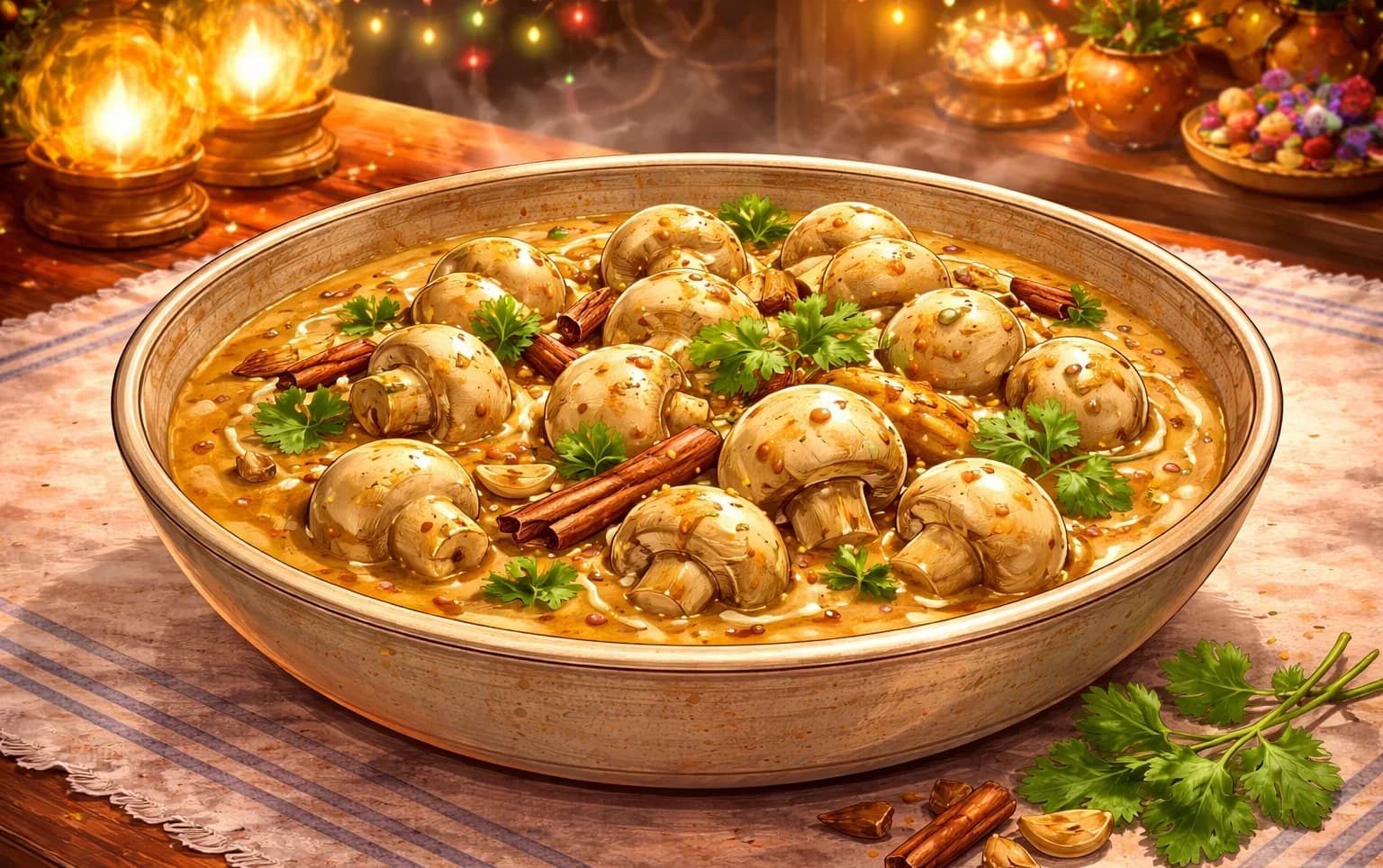
Slow-Cooked Mushrooms (Dum Ke Khumbh)
Button mushrooms sealed and slow-cooked in a spiced yogurt and brown onion marinade
The dum technique was developed to cook without losing. In a sealed pot, moisture and volatile aromatics cannot escape. They recirculate, building intensity until the lid is finally lifted and the full depth of what has been happening inside arrives at once.
Applied to mushrooms, this means something remarkable. Button mushrooms are porous and relatively neutral — they take on whatever environment surrounds them with enthusiasm. Marinated in a paste of Kashmiri chilli, yogurt, brown onion, ginger, garlic, and warm whole spices, then sealed and cooked on a slow fire with charcoal on the lid, they emerge transformed: deeply flavoured, glossy, holding the marinade in a way that only dum cooking can produce.
The Kashmiri chilli paste gives the sauce its colour — a deep brick red, with far less heat than its appearance suggests. Brown onion paste provides the savoury base. The combination of mace and nutmeg brings the whole thing into the realm of a proper Indian korma, though one that arrives on the table far more quickly than any meat-based version.
This is a weeknight-adaptable version of a dish that originated in a much more elaborate kitchen. The result, even at home without charcoal, is a dish that earns its place at any table.
At a Glance
Yield
Serves 4
Prep
15 minutes
Cook
35 minutes
Total
50 minutes
Difficulty
Easy
Ingredients
- 2¼ lbbutton mushrooms, wiped clean (leave whole if small; halve if large)
- ½ cupKashmiri red chilli paste (or 3 tablespoons Kashmiri chilli powder mixed with water)
- 3¾ tbspcoriander powder
- 3¼ tbspginger paste
- ¼ cupgarlic paste
- 1 tbspfine salt
- 2 tbsplime juice (about 1½ limes)
- ½ cuprefined oil
- 3½ ozbrown onion paste (onions sliced and fried until deep golden (about ½–1 onion), then blended)
- ¾ lbthick yogurt, whisked smooth
- 1⅛ tspmace powder
- 1⅓ tspnutmeg powder
- 1¾ tbspgreen cardamom powder
- ⅔ cupghee
Method
- 1
Make the marinade. In a large bowl, combine the Kashmiri chilli paste (50 g), coriander powder (4 teaspoons), ginger paste (50 g), garlic paste (60 g), salt (4 teaspoons), lime juice (1½ limes), oil, brown onion paste (100 g), and whisked yogurt (300 g). Mix well. Add the mace (½ teaspoon), nutmeg (½ teaspoon), and half the cardamom powder (2 teaspoons). Stir to a uniform paste.
- 2
Marinate. Add the mushrooms and toss to coat completely. Leave for 15 minutes at room temperature.
- 3
Sauté first. Heat the ghee (150 g) in a heavy pot or degh over medium heat. Add the marinated mushrooms along with all the marinade. Cook, stirring gently, until the mixture comes to a boil and the yogurt is no longer raw — about 8–10 minutes.
- 4
Seal and cook dum-style. Reduce the heat to very low. Place a piece of foil over the pot, then press the lid on tightly to create a seal. Place the pot on a heat diffuser if available. Cook for 20–25 minutes without lifting the lid.
- 5
Finish. Remove from heat. Carefully lift the lid away from you to avoid the steam. Sprinkle the remaining cardamom powder over the mushrooms and stir gently. Taste and adjust salt.
- 6
Serve immediately with khamiri roti, naan, or pilaf rice.
Key Ingredient Benefits
Button mushrooms are one of the more nutrient-dense fungi in common use — a good source of B vitamins (particularly niacin and B12 in some varieties) and selenium. In Indian cooking they are relative newcomers to the traditional pantry, having grown in popularity through the twentieth century as cultivation became widespread. Their mild flavour makes them among the most versatile of mushrooms for absorbing marinades.
Mace and nutmeg come from the same fruit (Myristica fragrans) — mace is the lacy outer covering of the nutmeg seed. In Mughal-influenced Indian cooking, the two are often used together as they provide complementary notes: nutmeg is warm and slightly sweet, mace is more delicate and floral. In Unani medicine, both are considered warming spices traditionally used to support digestion.
Why This Works
Kashmiri chilli paste provides intense colour with relatively moderate heat. The long, dried Kashmiri chilli is prized specifically for its ability to stain sauces deep red without the burning capsaicin levels of hotter varieties. This makes it ideal for dishes where you want visual drama without overwhelming heat.
The yogurt and brown onion base is a structural pair: yogurt provides acid and protein that thicken and stabilise the sauce as it heats, while the brown onion paste adds caramelised depth and body. Together they create a sauce that coats rather than pools.
Sealing mushrooms in a dum vessel solves a specific problem: mushrooms release a large amount of liquid when cooked in the open, which can make sauces watery and diluted. In a sealed environment, this liquid stays in the pot and continues to cook into the sauce, concentrating flavour rather than escaping.
Substitutions & Variations
Other mushrooms: Portobello or cremini mushrooms work beautifully here. Halve or quarter to an appropriate size. Oyster mushrooms also work but soften quickly; reduce the dum cooking time to 12 minutes.
No brown onion paste: Fry 2 large onions until very dark golden, cool, and blend with a tablespoon of water. Or use store-bought fried onions (birista), though the paste won't be as smooth.
Charcoal finish: For an authentic smoky dum flavour, place a small piece of lit charcoal in a heat-proof bowl inside the pot, drizzle with a little ghee to create smoke, and seal immediately. This adds a layer of complexity that is difficult to replicate any other way.
Serving Suggestions
Serve directly from the pot at the table for the full theatrical effect — lifting the lid releases a cloud of fragrant steam. Accompany with khamiri roti, roomali roti, or a simple pilaf. A cool raita alongside the rich, spiced mushrooms is welcome. As part of a vegetarian spread, this works as the centrepiece dish.
Storage & Reheating
Keeps refrigerated for up to 3 days. Reheat gently over low heat with a splash of water to loosen the sauce. The mushrooms continue to absorb the marinade as they sit, and the dish is arguably better the next day.
Cultural Notes
Dum ke khumbh (दम के खुम्ब, "mushrooms cooked dum") is the Awadhi vegetarian preparation of mushrooms slow-cooked in a sealed pot with yogurt, fried onion paste, cashew paste, and the Awadhi aromatic spice mix of green cardamom, mace, and saffron. The dish is among the Awadhi vegetarian adaptations of the dum technique that the royal kitchen developed for the Hindu courtiers and the vegetarian banquet menus that the Nawabs hosted for visiting dignitaries and on Hindu religious occasions.
The Awadhi vegetarian tradition is often overlooked in summaries of the court cuisine. Although the Awadhi court was Muslim and centered its banquets on lamb, chicken, and the rare game-bird preparations, the rakabdar chefs also developed an elaborate vegetarian repertoire that mirrored the meat dishes in technique and seasoning. Vegetable dum preparations applied the same sealed-pot slow cook used for meat kormas, with vegetables (mushrooms, okra, bitter gourd, mixed roots) replacing the lamb or chicken in otherwise identical yogurt-and-nut-paste gravies. The result is a vegetarian dish that tastes recognizably Awadhi in its aromatic profile, distinct from the more chili-forward vegetarian traditions of Punjab and the south.
The technique substitutes mushrooms for the meat in a standard Awadhi korma. Button or cremini mushrooms (or a mix of mushroom varieties for textural depth) are cleaned and halved or quartered depending on size. Onions are deep-fried into dark golden birista and ground with soaked cashews into a smooth paste. Mushrooms are sautéed briefly in ghee in a heavy handi until they release some moisture and the edges color. Yogurt is whisked smooth with the cashew-onion paste, Awadhi spices (green cardamom, mace, white pepper, a small amount of Kashmiri red chili), and ginger-garlic paste, then added to the handi with the mushrooms. The handi is sealed with a dough closure and cooked over low heat for thirty to forty minutes (mushrooms cook faster than meat so the dum time is shorter). The dish is finished with a drizzle of cream and a scatter of cilantro, and served with sheermal, rumali roti, or basmati pulao.
Nutrition Facts
Calories: 454kcal (23%)|Total Carbohydrates: 21.3g (8%)|Protein: 11.8g (24%)|Total Fat: 38.4g (49%)|Saturated Fat: 17.3g (87%)|Cholesterol: 67mg (22%)|Sodium: 215mg (9%)|Dietary Fiber: 3.5g (13%)|Total Sugars: 9.9g
You Might Also Like
Ratings & Comments
Ratings & Comments
Ratings
Share your thoughts on this recipe.
Sign in to rate and comment