Dum · Indian Cuisine
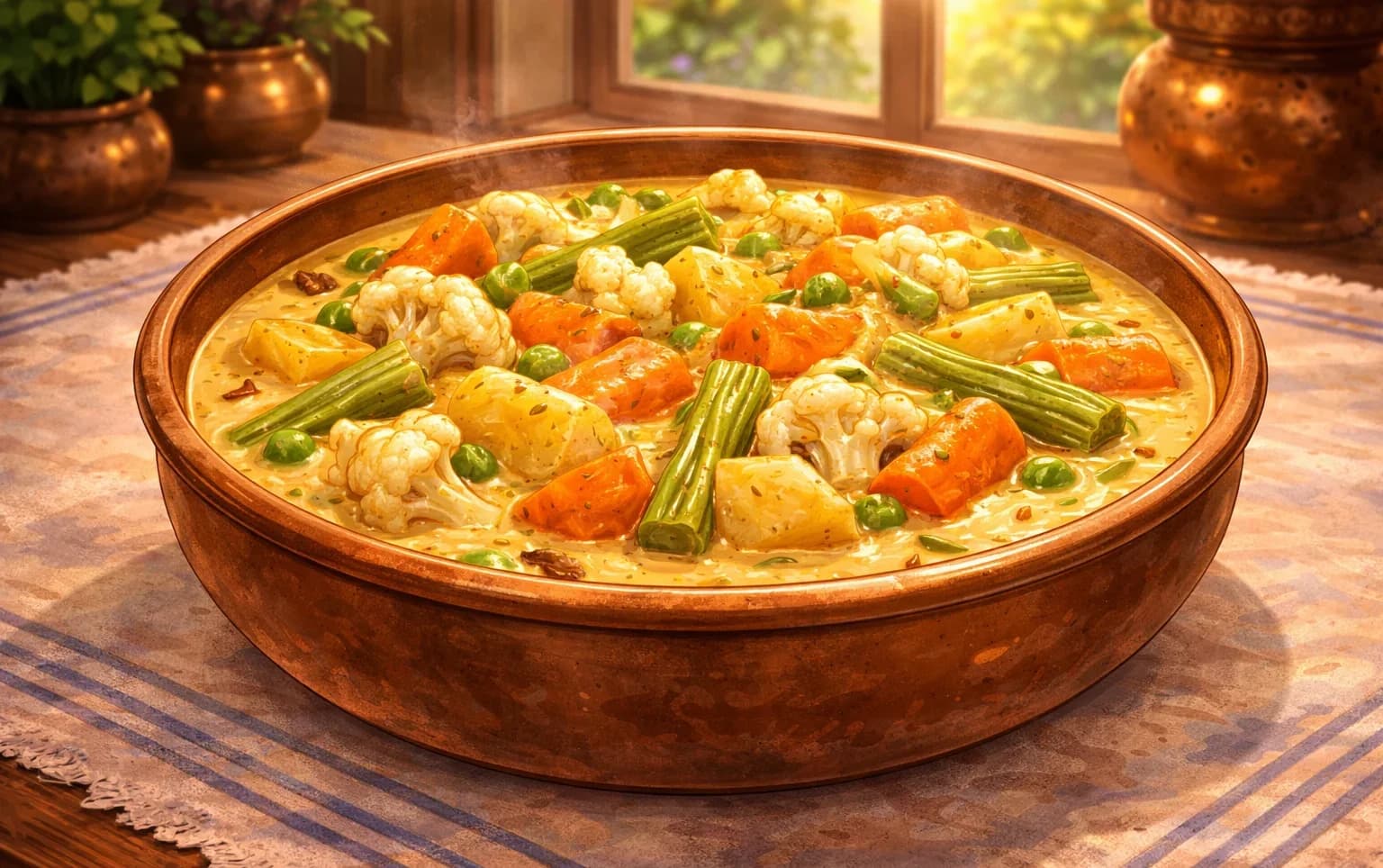
Slow-Cooked Vegetables (Dum Ki Subziyan)
A medley of blanched seasonal vegetables braised together in a spiced yogurt gravy
The logic of dum ki subziyan is the logic of a good cook who respects ingredients: each vegetable is blanched separately to its own correct degree of doneness before anything else happens. Carrots, potatoes, and pumpkin at different times; cauliflower briefly; drumsticks longer. Only then are they brought together in the gravy and given a final, unified heat.
This sequencing (which adds steps but saves flavour) is the difference between a mixed vegetable dish that tastes muddy and one that arrives at the table with each element still distinct, still itself, inside a shared sauce.
The gravy is built on a cumin-tempered base of onion, ginger, and garlic, enriched with yogurt and vegetable stock that has been spiced with coriander, Kashmiri chilli, and turmeric. The mustard oil finish — a separate tempering of the blanched vegetables in a very hot pan — adds a sharp, peppery quality that cuts through the yogurt's sweetness. Black pepper at the end closes the whole thing with a clean note of heat.
This is North Indian vegetable cooking at its most considered — a dish that takes more time than a simple sabzi but rewards that time with an evenness and coherence that is difficult to achieve any other way.
At a Glance
Yield
Serves 4–6
Prep
30 minutes
Cook
40 minutes
Total
1 hour 10 minutes
Difficulty
Medium
Ingredients
- 3½ ozcarrots (about 1½–2 carrots), peeled and cut into 5 cm × 1 cm batons
- 3½ ozpotatoes (about ½–1 potato), peeled and cut into 5 cm × 1 cm batons
- 3½ ozpumpkin, peeled and cut into 5 cm × 1 cm batons
- 3½ ozcauliflower, cut into medium florets
- 3½ ozdrumsticks (moringa pods), strung and cut into 5 cm pieces
- 1¾ ozgreen peas, fresh or frozen
- 3⅓ tbspmustard oil
- 3⅓ tbspghee
- 1 tspcumin seeds
- 5½ ozonions (about 1 onion), finely sliced
- 2 tspginger paste
- 1 tbspgarlic paste
- ½ lbfull-fat yogurt, whisked smooth
- 2¾ tspcoriander powder
- 2½ tspKashmiri chilli powder
- ¾ tspturmeric powder
- 2½ cupvegetable stock
- 1⅔ tspfine salt
- ⅞ tspblack pepper, freshly ground
Method
- 1
Blanch the vegetables separately. Bring a large pot of salted water to a boil. Blanch each vegetable for the times below, then immediately drain and plunge into a bowl of iced water to stop the cooking. Drain again before use. - Carrots (100 g): 3 minutes - Potatoes (100 g): 3 minutes - Pumpkin (100 g): 2 minutes - Cauliflower (100 g): 1 minute - Drumsticks (100 g): 10 minutes - Green peas (50 g): 2 minutes (or thaw from frozen)
- 2
Make the spiced yogurt. In a bowl, whisk together the yogurt, coriander powder (1 teaspoon), Kashmiri chilli powder (1 teaspoon), and turmeric (½ teaspoon) until completely smooth and uniform in colour.
- 3
Build the gravy. Melt the ghee (50 g) in a handi or heavy pot over medium heat. Add the cumin seeds (½ teaspoon) and let them sizzle for 30 seconds. Add the sliced onions (150 g) and cook, stirring, for 10–12 minutes until light golden. Add the ginger (10 g) and garlic paste (15 g), stir for 2 minutes until the raw smell has gone.
- 4
Cook the yogurt. Remove the pot from the heat momentarily, add the spiced yogurt in one go, and stir immediately. Return to medium heat and cook, stirring frequently, for 8–10 minutes until the yogurt is fully cooked and fat appears at the edges of the pan.
- 5
Add stock. Pour in the vegetable stock (600 ml) and salt (2 teaspoons). Bring to a boil, then reduce to a gentle simmer.
- 6
Temper the vegetables. Heat the mustard oil (50 ml) in a separate kadhai until it begins to smoke. Add all the blanched vegetables and stir-fry over high heat for 2–3 minutes until they are coated in the hot, peppery oil.
- 7
Bring together. Add the tempered vegetables to the simmering gravy. Bring back to a boil, then reduce heat and simmer for 8–10 minutes, stirring occasionally, until the gravy is a thick sauce consistency that coats the vegetables. Sprinkle over the black pepper (2 g), stir well, and adjust seasoning.
- 8
Serve immediately with roti or plain steamed rice.
Key Ingredient Benefits
Drumsticks (moringa, sehjan) are pods from Moringa oleifera, one of the most nutritionally dense food plants in South Asian cooking. The pods themselves are fibrous but flavourful; they are not eaten whole but scraped to extract the inner flesh and seeds. Moringa leaves, not used here, are even richer in nutrients. The plant has been studied for its potential antioxidant and anti-inflammatory properties.
Mustard oil (sarson ka tel) has a sharp, pungent quality when cold that transforms entirely when heated to smoking point. The harsh edge softens and a rounded, slightly nutty character emerges. In Ayurvedic tradition, mustard oil is considered warming and is associated with improving circulation. It is the defining fat of North and East Indian cooking.
Why This Works
Blanching each vegetable to a different time, then shocking in ice water, gives precise control that a single-pot cook cannot. Each vegetable arrives at the final dish at its own correct doneness rather than at the average — some overcooked, some undercooked — which is the fate of most mixed vegetable preparations.
Tempering the blanched vegetables in very hot mustard oil just before adding them to the gravy serves two purposes. It adds a layer of flavour from the mustard oil's volatile compounds (which are strongest at high heat). It also very briefly re-crisps the outside of the blanched vegetables, creating slight resistance before they soften again in the gravy — a textural detail that makes the final dish more interesting.
Black pepper at the end (not cooked into the base) preserves its sharpness and provides a clean, immediate finish that balances the rich yogurt gravy.
Substitutions & Variations
Vegetable swaps: French beans, broccoli, or baby corn can replace any of the vegetables listed. Each should be blanched to its own appropriate time and shocked.
No drumsticks: Drumsticks are worth sourcing from Indian grocery stores — their flavour, once you know it, is irreplaceable. But green beans or halved courgette work as stand-ins.
Without mustard oil: Use neutral oil for the vegetable tempering. The dish will lack the pungent note but remains balanced.
Serving Suggestions
Serve with plain chapattis or a simple steamed basmati. This dish works as a vegetarian centrepiece or as a side alongside a dal and rice meal. A plain yogurt raita and some pickled onions round out the table.
Storage & Reheating
Keeps refrigerated for 2 days. Reheat gently on the stovetop with a little water to loosen. The vegetables soften further on standing — this is pleasant rather than problematic. Not suitable for freezing.
Cultural Notes
Dum ki subziyan (दम की सब्ज़ियाँ, "vegetables cooked dum") is the Awadhi vegetarian preparation of mixed vegetables (cauliflower, carrots, peas, potatoes, beans, paneer cubes) slow-cooked together in a sealed pot with yogurt, fried onion paste, cashew paste, and the Awadhi aromatic spice mix. The dish is the vegetarian counterpart to the meat-based handi gosht korma and appears at Awadhi vegetarian banquet menus, Hindu festival meals, and the home cooking of Lucknow and the broader Uttar Pradesh region.
The dish reflects the Awadhi tradition of treating vegetables with the same culinary respect given to meats. Where many regional Indian cuisines treat mixed vegetable preparations as humble everyday food, the Awadhi rakabdar (banquet specialist) chefs developed dedicated mixed-vegetable dum preparations that applied the same slow-cooked sealed-pot technique used for the prestigious meat kormas. The choice of vegetables for the dish was deliberate, balancing color, texture, and flavor: cauliflower for its mild absorbent quality, carrots for sweetness and color, peas for fresh green notes, potatoes for starchy bulk, paneer for protein and richness. The gravy is identical in technique to the meat versions, giving the vegetarian guest a dish that holds its own beside the meat preparations on the same banquet table.
The technique requires staged cooking to handle the different vegetable cook times. Cauliflower florets, sliced carrots, potatoes, and beans are blanched briefly in salted boiling water and shocked in cold water to stop the cooking and set their color. Onions are sliced thinly and deep-fried into dark golden birista, then ground with soaked cashews into a smooth paste. Yogurt is whisked smooth with the cashew-onion paste, Awadhi spices (green cardamom, mace, white pepper, a small amount of Kashmiri red chili), and ginger-garlic paste. Ghee is heated in a heavy handi, the blanched vegetables are added with peas and paneer cubes, and the yogurt-onion gravy is poured over. The handi is sealed with a dough closure and cooked over low heat for twenty-five to thirty minutes (vegetables need less time than meat dum preparations). The dish is finished with a drizzle of cream, a scatter of cilantro, and a small pinch of garam masala, and served with sheermal, rumali roti, or basmati pulao.
Nutrition Facts
Calories: 163kcal (8%)|Total Carbohydrates: 14.4g (5%)|Protein: 3.7g (7%)|Total Fat: 10.8g (14%)|Saturated Fat: 4.5g (23%)|Cholesterol: 18mg (6%)|Sodium: 554mg (24%)|Dietary Fiber: 2.7g (10%)|Total Sugars: 5.2g
You Might Also Like
Ratings & Comments
Ratings & Comments
Ratings
Share your thoughts on this recipe.
Sign in to rate and comment