Indian Cuisine
Punjabi Wheat Flour Fudge (Pinni)
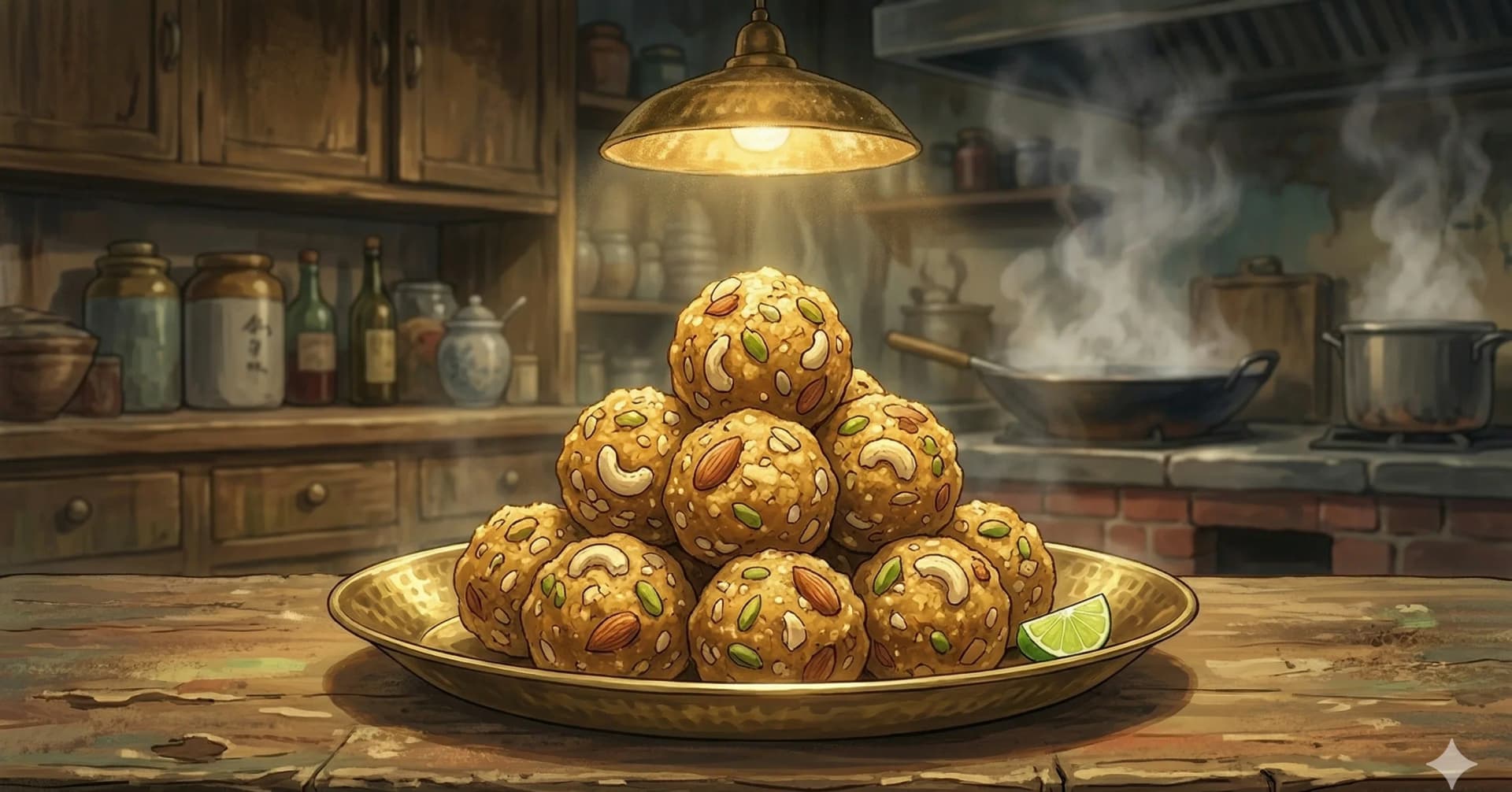
Punjabi Winter Wheat Flour Balls with Boora, Ghee, and Crushed Nuts
In the winter months across Punjab, when the cold settles in and the mustard fields turn yellow, kitchens fill with the smell of wheat flour roasting in ghee. Pinni is the slow patient work of a cold morning: flour stirred continuously in a wide lagan, the pale yellow gradually deepening to gold, the raw floury smell transforming over an hour into something warm and nutty, almost hazelnut-like, with the characteristic sweetness of ghee at the edges.
Pinni is a laddoo by another name, a ball of sweetened, spiced, roasted flour and fat, but it has its own character, distinct from the besan laddoo and the boondi laddoo that share the category. Where besan laddoo has a crumbling, sandy texture from gram flour, pinni is denser and more substantial, the whole wheat flour giving it a slight chew, a gentle earthiness, a specific nourishing quality that is especially well suited to cold weather. In traditional Punjabi households, pinni is made in quantity at the beginning of winter and kept in a sealed container that is opened daily: two per person, with morning chai or warm milk, as the cold months' daily sweet.
The boora, desi khand or raw unrefined sugar in powdered form, is what gives pinni its flavour. It is not as assertive as jaggery and not as neutral as refined sugar; it has a faint molasses note, a warmth, a complexity that persists in the background of every bite. If you can find it at an Indian grocery store, use it. If not, powdered jaggery is the closest substitute.
The nuts go in crushed, not finely ground, large enough to provide distinct pockets of crunch and flavour within the soft, yielding ball. This is winter food, meant to be satisfying.
At a Glance
Yield
30–35 balls
Prep
15 minutes
Cook
55–65 minutes
Total
1 hour 20 minutes (plus cooling time)
Difficulty
Easy
Ingredients
Method
- 1
Roast the flour. Place a wide, heavy-bottomed pan, a lagan or a large kadhai, over very low heat. Add all the ghee and let it melt and heat. Add the whole wheat flour and stir to coat with the ghee. Begin roasting, stirring almost continuously, over very low heat.
- 2
Continue roasting until golden and fragrant. Continue roasting, stirring frequently to prevent the bottom from burning, for 45–60 minutes. The flour will slowly deepen in colour from pale yellow to a warm, even golden-brown. The raw flour smell will progressively give way to a toasted, nutty fragrance. When the flour looks golden and smells deeply roasted with no raw element remaining, and when you can see the ghee beginning to separate at the edges, the roasting is complete. Do not rush this by increasing the heat. Low and slow is essential.
- 3
Remove from heat and add boora and cardamom. Take the pan off the flame. Add the boora and cardamom powder. Mix thoroughly while the mixture is still hot. The heat of the flour will slightly melt the boora and everything will come together into a warm, cohesive mass.
- 4
Add the crushed nuts. Add the roughly crushed almonds, cashew pieces, and pistachio. Add any remaining melted ghee from the pan at this point. Mix well until all the nuts are distributed through the flour mixture.
- 5
Cool slightly. Allow the mixture to cool until it is warm enough to handle comfortably but not so cool that it has set firm, about 15–20 minutes. The mixture should hold together when pressed.
- 6
Shape into balls. With slightly greased palms, take portions of the warm mixture (about 2 tablespoons each) and press firmly between your palms to compact, then roll into a smooth ball. Press firmly. If the ball doesn't hold together, the mixture may have cooled too much; warm briefly in the pan or add a small teaspoon of melted ghee.
- 7
Cool completely. Set the shaped pinni on a tray to cool completely at room temperature, about 30 minutes. They will firm up as they cool.
Key Ingredient Benefits
Whole wheat flour (atta) distinguishes pinni from laddoos made from refined flour or gram flour. The bran in whole wheat flour contributes fibre, B vitamins, and a more complex, nutty flavour. In Punjabi tradition, pinni made from whole wheat is specifically associated with winter nourishment. The high calorie density from ghee and the warming quality of the wheat make it suited to cold weather.
Boora (desi khand) is an unrefined raw cane sugar processed to a powder. Unlike white sugar, it retains some of the molasses and mineral content of the sugar cane. Its flavour is gentler than jaggery but more complex than refined sugar: a warm, slightly caramel note. It is the traditional sweetener for pinni and contributes to both flavour and the characteristic texture.
Ghee is present in very substantial quantity, 500 g to 1 kg of flour, a 1:2 ratio. This is not restrained cooking. Pinni is a winter sweet calibrated for cold weather, physical work, and celebration. In Ayurvedic tradition, ghee is considered warming and nourishing, particularly appropriate in the cold season. This is a sweet eaten in moderation, one or two per day, as tradition intended.
Almonds, cashews, and pistachio provide contrasting textures and make the pinni a more substantial, more nutritionally complete preparation. Almonds in particular are associated in Ayurvedic tradition with strengthening and nourishment in winter.
Why This Works
The extended roasting of whole wheat flour in ghee is both the flavour-generating and moisture-removing step. Wheat flour contains approximately 14% moisture; this must be driven off before the flour can reach the temperatures necessary for Maillard reactions to occur. The first 20–30 minutes of roasting are essentially drying. The flour smells raw and the colour barely changes. Only once the moisture is gone does the colour begin to shift and the complex, toasted aromas emerge.
Boora is added off the heat rather than during frying because its natural moisture content would cause spattering, and its sugars would caramelise unevenly against the hot pan. Added to the hot but off-flame flour, it warms through evenly, partially melts, and binds with the ghee-coated flour particles to produce a cohesive mixture.
The consistency of the mixture at the shaping stage is critical. Too warm and the balls will not hold shape firmly. Too cool and the mixture has solidified and cannot be pressed together. The 15–20 minute cooling window produces the optimal plasticity.
Substitutions & Variations
- Powdered jaggery instead of boora: A close substitute, with a more assertive, slightly darker molasses note. The pinni will be slightly darker in colour.
- Dates: Add 50 g of finely chopped dried dates to the mixture with the nuts for additional sweetness and a caramel undertone.
- Dry fruits: Raisins, dried figs, and dried apricots (chopped small) can all be incorporated with the nuts.
- Less ghee: Reduce to 350 g ghee for a firmer, drier pinni. The mixture will need more pressing force when shaping.
- With gond (edible gum): Traditional winter pinni sometimes includes fried edible gum (gond) for additional warming properties. Fry the gum pearls in ghee until they puff, then crush and mix in with the nuts.
Serving Suggestions
Pinni is a standalone winter sweet, eaten with morning chai or warm milk. Two per person per day is traditional in Punjabi households during the cold months. They are served at Lohri (the Punjabi harvest festival), at weddings held in the winter season, and given as gifts between households. Store in a large glass or ceramic container with a tight lid. The container is opened every morning and the pinni distributed. No plating or accompaniment is required; this is food for the cold, eaten from the hand.
Storage & Reheating
Pinni keeps extremely well, up to 3–4 weeks at cool room temperature in an airtight container, and up to 2 months in the refrigerator. The ghee and sugar act as preservatives. Bring refrigerated pinni to room temperature before eating. Cold pinni is firm and the ghee muted. Do not reheat. They are best at room temperature, slightly firm, holding their shape cleanly.
Cultural Notes
Pinni (ਪਿੰਨੀ) is the Punjabi winter sweet of whole wheat flour or chickpea flour slowly roasted in a generous quantity of ghee until deep golden and intensely aromatic, then mixed with jaggery (or sugar), chopped almonds, cashews, pistachios, and edible gum (gond, the resin of acacia trees), and shaped into round balls or pressed into a tray and cut into squares. The dish is a Punjabi winter staple, eaten through the cold months from November to February for the warming, calorie-dense, nourishment that the combination of ghee, whole grain, nuts, and edible gum provides.
The seasonal context defines the dish's cultural role. Punjab in winter is cold (temperatures regularly drop near freezing in the Punjab plain), and the traditional Punjabi food culture developed seasonal preparations that respond to the cold: the warming makki di roti aur sarson da saag combination, the bajre ki khichdi of winter, the kadha warm milk-and-jaggery drink, and the ghee-and-nut-rich sweets that anchor the winter pantry. Pinni is one of the central winter sweets of this tradition, with the gond (edible acacia gum) considered in Ayurvedic tradition to be a warming and joint-strengthening ingredient suited to cold weather. The sweet is given particular importance during winter pregnancies and to new mothers in the postpartum period (a Punjabi tradition called the jaccha care), where the ghee, gum, and nut content is thought to support recovery and lactation.
The technique relies on patient slow roasting of the flour. A generous quantity of ghee (sometimes equal in weight to the flour) is melted in a heavy kadai, and edible gum pieces (gond) are fried first until they puff and turn pale (this is a quick step, about ninety seconds, after which the gum pieces are removed and reserved). Whole wheat flour (or chickpea flour for the variant) is added to the same ghee and roasted over low heat for thirty to forty minutes, with constant stirring, until the flour turns deep golden brown and the smell shifts from raw to nutty-toasted. The pot is removed from the heat, the puffed gum pieces are crushed lightly and returned to the flour, along with chopped almonds, cashews, pistachios, and small amounts of dry coconut and poppy seeds. Powdered jaggery is added when the flour mixture has cooled slightly (jaggery added to too-hot mixture turns sticky). Cardamom powder is added for the aromatic finish. The mixture is shaped while still warm into round balls (about the size of a walnut) or pressed into a tray and cut into squares. The dish keeps for several weeks in an airtight tin.
Nutrition Facts
Calories: 698kcal (35%)|Total Carbohydrates: 80.3g (29%)|Protein: 11.2g (22%)|Total Fat: 39.6g (51%)|Saturated Fat: 20.3g (102%)|Cholesterol: 80mg (27%)|Sodium: 3mg (0%)|Dietary Fiber: 8.8g (31%)|Total Sugars: 32.1g
You Might Also Like
Ratings & Comments
Ratings & Comments
Ratings
Share your thoughts on this recipe.
Sign in to rate and comment