Indian Cuisine
Bread Pudding Dessert (Double Ka Meetha)
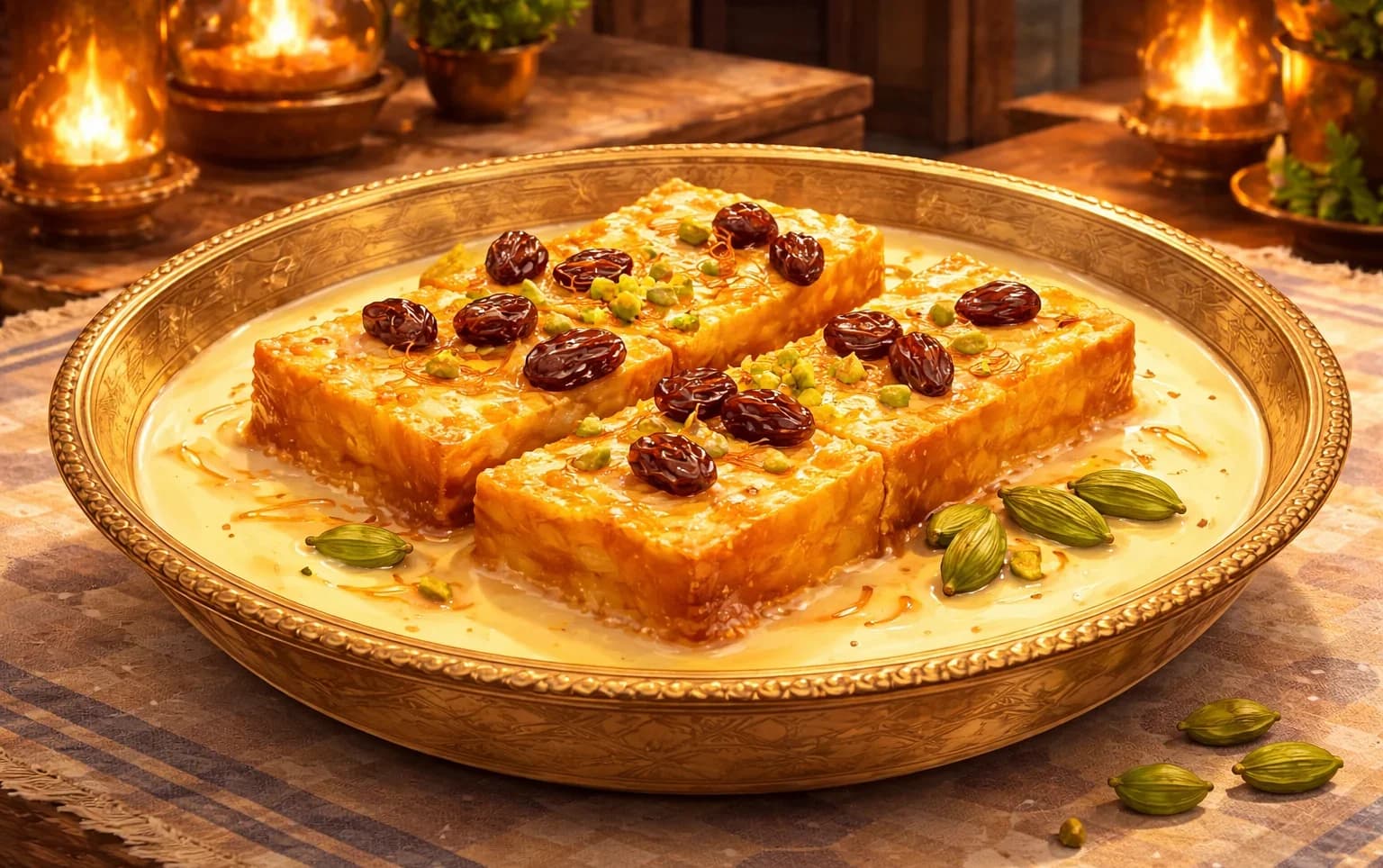
Hyderabadi Saffron Bread Pudding Baked Until Golden
The name arrives with a small piece of social history. In Hyderabad's everyday Dakhni Urdu, bread has long been called "double roti" (leavened, risen, doubled in size, distinguishing it from the unleavened flatbreads that are the staple further north). Double ka meetha, then, is simply the sweet made from double roti, and it is one of the great Hyderabadi desserts, as old as the Nizam's kitchens and still served at weddings and iftaar tables across the city.
The technique is essentially a layered bread pudding, but richer and more elaborate than the Western version. Bread slices, trimmed of their crusts, are fried in ghee until deeply golden on both sides. The frying is not optional: it transforms the bread's starch and gives the finished pudding a structure that baked or simply soaked bread cannot provide. These fried slices are then submerged in thickened milk, milk that has been reduced by half with crumbled khoya cooked through it, perfumed with saffron roasted and dissolved, with cardamom and nutmeg stirred in. The soaked bread goes into a greased oven dish, the thick sugar syrup is poured over, raisins are scattered, and the dish goes into the oven until the top surface is a deep, caramelised gold.
What emerges is a pudding of layers. The top surface is almost candied, the surface sugars darkened by oven heat. Below it, the bread has absorbed the milk and syrup completely, becoming soft and yielding. And through every layer runs the warmth of saffron, cardamom, and the concentrated richness of khoya-thickened milk.
This is celebratory food. Rich, aromatic, designed for occasions.
At a Glance
Yield
Serves 8–10
Prep
20 minutes
Cook
50 minutes
Total
1 hour 15 minutes
Difficulty
Medium
Ingredients
Method
- 1
Prepare the saffron. Place the saffron threads in a small dry pan over the lowest heat for 30–60 seconds until just warmed and fragrant. This toasting loosens the aromatic compounds. Crush between your fingers into a fine powder. Dissolve in 2 tablespoons of warm milk and set aside.
- 2
Thicken the milk. Pour the milk into a wide, heavy-bottomed pan. Bring to a full boil over medium heat, then reduce to a gentle simmer. Add the crumbled khoya and stir to incorporate. Continue cooking, stirring frequently to prevent scorching, until the milk and khoya have reduced together to approximately half the original volume: thick, creamy, pourable. This takes 20–25 minutes.
- 3
Add aromatics. Stir the dissolved saffron, nutmeg powder, and cardamom powder into the thickened milk. Taste. It should be warmly aromatic, with saffron and cardamom clearly present, and slightly sweet from the khoya. Remove from heat.
- 4
Fry the bread. Heat the ghee in a wide, flat pan over medium heat. Fry the trimmed bread slices in batches, turning once, until deeply golden-brown on both sides. The bread should be the colour of autumn leaves. Not pale gold, but deep amber. Remove and set aside.
- 5
Soak the bread. Place the fried bread slices in the warm thickened milk and allow to soak for 15 minutes, turning gently midway. The bread will absorb the milk and become soft throughout. Handle gently; the soaked bread is fragile.
- 6
Make the sugar syrup. Combine the sugar and 200 ml of water in a pan. Bring to a boil, stirring until the sugar dissolves. Continue cooking until you have a thick syrup. Set aside.
- 7
Assemble. Grease an oven-proof dish. Gently transfer the soaked bread slices into the dish in overlapping layers. Pour the thick sugar syrup evenly over the bread. Scatter the raisins over the surface.
- 8
Bake. Preheat the oven to 180°C. Bake for 15–20 minutes until the top surface is golden-brown and slightly caramelised. For a more deeply coloured top, turn on the grill (broiler) for the final 2–3 minutes.
- 9
Serve warm or at room temperature.
Key Ingredient Benefits
Khoya (mawa) is concentrated whole milk: milk simmered until roughly 80% of its water has evaporated, leaving behind concentrated milk solids, fat, and lactose. The intensity of dairy flavour it brings is impossible to replicate by simply reducing fresh milk further. In Hyderabadi cooking it's a standard enriching ingredient in both sweet and savoury preparations.
Saffron is the aromatic signature of Hyderabadi cooking, a Mughal inheritance that persists in the city's sweets and rice dishes. Its primary pigment crocin has been studied for potential neuroprotective and antioxidant properties. In cooking its function is purely aromatic: warm, slightly honeyed, and unlike anything else.
Ghee for frying gives the bread a flavour that oil simply can't match. Its residual milk solids also contribute to the bread's caramelisation. This is a rich, calorie-dense celebration sweet; small portions are traditional.
Raisins swell during baking, absorbing some of the surrounding syrup and turning jammy. They provide both texture and concentrated sweetness against the rich pudding.
Why This Works
Frying the bread in ghee before soaking is the step that distinguishes double ka meetha from ordinary bread pudding. Raw bread soaked directly in milk turns soft and uniformly mushy, collapsing without structure. Fried bread has a set exterior that absorbs milk more slowly and evenly, so the soaked slices are yielding throughout but still hold together when sliced and served.
Reducing the milk with khoya concentrates milk solids and fat in a way that plain reduction can't replicate. Reduced milk is sweet and thick, but khoya adds a flavour intensity and creaminess that comes from fully dried milk solids. The combination is what gives the pudding its characteristic richness.
Toasting the saffron before dissolving it isn't decorative. Dry heat makes saffron's primary pigment (crocin) more soluble and converts some of the less aromatic precursors into their active forms, releasing more colour and fragrance into the milk.
Substitutions & Variations
- Without khoya: Reduce the milk by two-thirds instead of half for a very concentrated milk base. Add 2 tablespoons of cream to approximate some of khoya's richness.
- With condensed milk: Replace khoya and sugar with one tin of condensed milk, reducing the additional sugar accordingly. Produces a sweeter, slightly different result.
- With nuts: Scatter slivered blanched almonds over the top along with the raisins for additional texture and a more elaborate garnish.
- Without baking: The pudding can be finished on the stovetop. Once assembled in the dish, cover and cook over very low heat for 10 minutes. The top won't caramelise but the pudding will be warm and set.
Serving Suggestions
Double ka meetha is served warm or at room temperature, in small portions. At Hyderabadi weddings it appears at the end of the feast alongside other sweets such as qubani ka meetha (dried apricot dessert). At Ramadan iftaar, it is among the most anticipated sweets on the table. Serve in the baking dish at the table, scooping into individual bowls. A small scoop of vanilla ice cream alongside is a contemporary pairing that works well: the cold against the warm, fragrant pudding is a pleasant contrast.
Storage & Reheating
Store covered in the refrigerator for up to 3 days. The pudding absorbs remaining syrup and becomes denser after refrigeration. Reheat in a moderate oven (160°C) for 15 minutes, or microwave portions in 30-second bursts. Add a splash of warm milk if the pudding seems too dry after refrigeration. The baked top will not re-caramelise after reheating but the flavour remains excellent.
Cultural Notes
Double ka meetha (डबल का मीठा, "sweet of the leavened bread") is the Hyderabadi bread pudding made from slices of leavened white bread (the double roti of the Hyderabadi vocabulary: double because the bread rises and doubles in volume compared to the unleavened single roti of the flatbread tradition) deep-fried in ghee until crisp and golden, then soaked in a saffron-and-cardamom-scented sugar syrup and topped with thickened sweetened milk (rabri), chopped almonds, pistachios, and edible silver leaf. The dish is among the iconic Hyderabadi wedding and Eid sweets and appears at every Hyderabadi Muslim wedding feast, Eid al-Fitr celebration, and major family gathering.
The dish's character reflects the Hyderabadi adaptation of Persian-Arab bread-pudding traditions. Bread-based desserts have a long history across the Persian-Arab culinary world (the Iranian sheer berenj, the Levantine aish el saraya, the broader Middle Eastern umm ali) where leavened bread or flatbread is soaked in milk or cream and sugar to produce a rich dessert. The technique traveled to Hyderabad through the Persian-influenced Nizami court cuisine and the broader Arab cultural exchanges that shaped Hyderabadi food. The Hyderabadi variant distinguishes itself by the two-step preparation (fry the bread first to develop crispness and color, then soak in syrup), the use of saffron and cardamom for the aromatic finish, and the topping of rabri (the Indian thickened reduced milk that adds richness without the Mediterranean cream).
The technique requires careful frying and the right syrup consistency. Slices of leavened white bread (the rectangular sliced bread of Indian bakeries) are trimmed of crusts and cut into triangles or squares. Ghee is heated in a wide kadai to about 170°C, and the bread is fried in batches until both sides are deep golden and crisp (about ninety seconds per side, depending on the bread). A sugar syrup is prepared in a separate pot, cooked to a one-string consistency with crushed green cardamom and a generous pinch of saffron infused in warm milk. The fried bread is dipped briefly in the warm syrup (about thirty seconds per piece, just enough to absorb syrup without becoming soggy) and arranged in a serving dish. Rabri (made separately by simmering whole milk for an hour until reduced and thickened, sweetened lightly with sugar, and flavored with cardamom) is poured over the syrup-soaked bread. The dish is topped with chopped almonds, pistachios, and small squares of edible silver leaf (varak), and served warm or at room temperature.
Nutrition Facts
Calories: 627kcal (31%)|Total Carbohydrates: 90g (33%)|Protein: 15g (30%)|Total Fat: 24g (31%)|Saturated Fat: 14g (70%)|Cholesterol: 72mg (24%)|Sodium: 348mg (15%)|Dietary Fiber: 1.8g (6%)|Total Sugars: 65.8g
You Might Also Like
Ratings & Comments
Ratings & Comments
Ratings
Share your thoughts on this recipe.
Sign in to rate and comment