Indian Cuisine
Sesame-Crusted Rice Cookies (Anarsas)
Maharashtrian Three-Day Soaked Rice and Sugar Rounds with Poppy Seed Crust
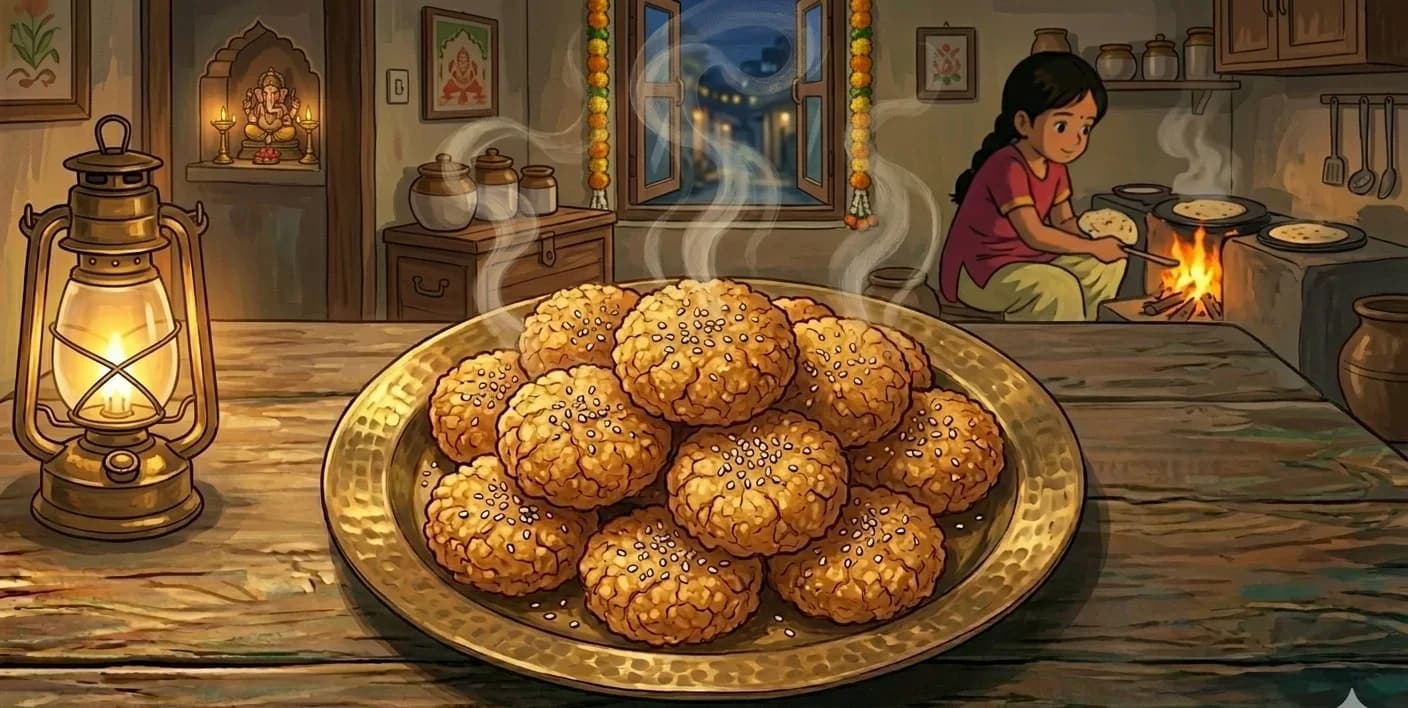
Anarsas are Diwali food, made once a year, in late October or November, when the festival preparation begins and the kitchen smells of ghee and toasted poppy seeds. They require three days of rice soaking and two to three hours of active work, and the result is a sweet unlike any other in the Maharashtrian repertoire: thin, slightly translucent at the edges where the dough stretches thin, with a surface of pale grey poppy seeds that toast against the ghee, and an interior that is dense and almost cookie-like, with a clean, milky sweetness from the sugar ground directly into the soaked rice.
The process is patient by design. The rice soaks for three days, the water changed each day. This extended soak develops the starch in a specific way that produces a flour unlike freshly milled rice flour when the drained and dried rice is ground. The ground rice and powdered sugar are mixed together without liquid, pressed firmly into a container, and left to rest for two or three hours while the natural moisture in the ground rice hydrates the sugar and the mixture becomes cohesive. Only a very small amount of milk is added during kneading, barely enough to bind, because the sugar's own moisture-drawing properties will have done most of the work during the rest.
The shaping is done on a poppy-seed scattered plastic sheet. Each portion is pressed out thin, nearly paper-thin, with the poppy seeds adhering to both sides. They are then shallow-fried seeds-side up in a small amount of ghee in a thick-bottomed pan, on low-medium heat, until the bottom is golden and the surface begins to show a fine mesh pattern from the dough setting.
The finished anarsas keep for weeks in an airtight container. They belong to the category of Indian sweets whose purpose is as much preservation as immediate consumption, made in large batches at festival time to last through the weeks of Diwali visiting and gifting.
At a Glance
Yield
Approximately 50 pieces
Prep
3 days soaking plus 2–3 hours active
Cook
45 minutes
Total
3 days plus 5 hours active and rest
Difficulty
Involved
Ingredients
Method
- 1
Day 1–3: Soak the rice. Wash the rice thoroughly. Cover with cold water and leave to soak for 3 full days, changing the water once each day. The rice will swell and soften considerably.
- 2
Dry and grind. Drain the soaked rice completely. Spread on a thick, clean cloth and pat dry, absorbing as much surface moisture as possible. Allow to air-dry further until no visible moisture remains on the grains. Grind to a smooth, very fine powder. Use a dry grinder, working in batches. The powder should be finer than commercial rice flour. Set aside.
- 3
Mix rice and sugar. In a large bowl, combine the ground rice flour and the powdered sugar. Mix thoroughly until completely uniform. No liquid is added at this stage.
- 4
Press and rest. Press the mixture firmly and evenly into the bowl, or into a separate flat container. Cover with a damp cloth and leave to rest for 2–3 hours. During this rest, the sugar draws moisture from the ground rice and the mixture becomes slightly cohesive.
- 5
Knead with minimal milk. After resting, knead the mixture gently. It should be starting to come together. Sprinkle very small amounts of milk, a teaspoon at a time, and knead between each addition. Add only what is needed to produce a smooth, stiff dough that holds together without crumbling. The dough must not be soft or pliable. It should be dense and firm. Too much milk will make the dough sticky and the anarsas will not hold their shape.
- 6
Keep covered. Divide the dough into approximately 50 small portions. Keep covered with a moist cloth at all times to prevent drying out.
- 7
Shape on poppy seeds. Sprinkle a generous layer of poppy seeds on a clean plastic sheet. Take one portion of dough and place it on the poppy seeds. Press it out with damp fingers to a thin round, as thin as possible, 2–3 mm, approximately 6 cm in diameter. The poppy seeds will adhere to the underside. Sprinkle more poppy seeds on top and press gently so they stick.
- 8
Fry. Heat 4 tablespoons of ghee in a thick-bottomed heavy pan over low-medium heat. Place the shaped anarsas seed-side up in the ghee. Do not flip. Fry over low-medium heat for 4–5 minutes until the underside is golden and the upper surface begins to show a fine mesh or lacy pattern as the dough sets. The anarsas should be cooked in the ghee from the bottom only. No flipping. Add more ghee between batches as needed.
- 9
Drain and cool. Remove with a slotted spoon and drain on paper. Allow to cool completely.
- 10
Store in airtight container.
Key Ingredient Benefits
Three-day-soaked rice flour has undergone partial starch modification during the extended soak. This produces a flour that behaves differently from standard rice flour, binding more readily and producing a thinner, more pliable dough. This is consistent across multiple traditional Indian sweet recipes that specifically require this preparation method.
Powdered sugar is specified rather than jaggery or cane sugar because its fine, even particle size allows it to blend smoothly and uniformly with the rice flour and draw moisture evenly through the mixture during the rest. Coarser sugars would leave uneven pockets of sweetness and would not produce the same cohesive dough.
Poppy seeds (khus khus) are the characteristic crust of anarsas. White poppy seeds are traditional in Maharashtra; they have a mild, slightly nutty flavour. Poppy seeds are a source of calcium and contain small amounts of morphine alkaloids, though at culinary quantities these are not physiologically significant.
Ghee at this quantity (600 g) is the frying medium, and only a portion is absorbed. The one-sided frying technique means the anarsas absorb less than fully submerged frying would require. Ghee's composition (primarily saturated fat, with fat-soluble vitamins) makes it a stable frying medium at the low-medium temperatures used here.
Why This Works
The three-day soaking of rice changes its starch structure through partial enzymatic activity, producing a flour that is finer and binds more readily when mixed with sugar than freshly milled rice flour would. The extended soak also increases the rice's moisture content; when the drained rice is ground, this residual moisture helps the flour bind with the sugar during the rest period without added liquid.
Mixing the rice flour with powdered sugar without liquid first, then resting, allows the sugar to draw moisture from the flour through osmosis and begin dissolving in it, producing natural binding without added water or milk. This produces a dough that is dry and firm enough to be pressed very thin without sticking or tearing, which is essential for the characteristic thinness of anarsas.
The one-sided frying (bottom only, seeds-side up) is what creates the distinctive surface mesh pattern. As the ghee heats the underside and the dough begins to set, moisture within the dough converts to steam and rises toward the seeds-side. Unable to escape through the setting, sealed underside, it creates small pressure bubbles at the surface that produce the characteristic mesh or lacy pattern.
Substitutions & Variations
- Sesame seeds instead of poppy seeds: Some Konkan and Goan versions use sesame (til) rather than poppy seeds for the crust. Produces a more strongly flavoured, nuttier result.
- With jaggery: Replace powdered sugar with finely powdered jaggery. The anarsas will be darker, more molasses-flavoured, and slightly less sweet than the sugar version.
- Goan poee version: Similar to anarsas but with slight variations in ratio and technique; Goa's Diwali sweet tradition includes a closely related preparation.
Serving Suggestions
Anarsas are Diwali sweets, arranged in tins and boxes for gifting, set out on plates for visiting relatives, eaten with morning tea in the days after Diwali. They are rarely served at a meal; they are snacking food and gifting food. Two or three per person is typical. No accompaniment is needed. They are best at room temperature, when the poppy seed crust has fully set and the interior has its characteristic dense, clean sweetness.
Storage & Reheating
Anarsas keep exceptionally well, up to 2–3 weeks in an airtight container at room temperature. The dry, sugar-dense interior and the ghee-coated exterior resist moisture absorption and staleness. In humid conditions, store with a silica gel packet in the container. Do not refrigerate. Reheating is not appropriate or necessary.
Cultural Notes
Anarsa (अनारसा, plural anarse or anarsas) is the Maharashtrian Diwali sweet made from fermented rice flour mixed with jaggery into a soft dough, shaped into small flat disks, coated with white poppy seeds (khus khus), and deep-fried in ghee until the surface puffs and develops a golden crackled texture. The dish is among the canonical sweets of the Maharashtrian faral (the Diwali sweets and snacks tradition that families prepare and exchange during the five-day festival), and it has a reputation as one of the trickier sweets to make well because the fermentation, dough consistency, and frying temperature all need to align.
The Diwali sweets tradition is the cultural anchor. Diwali (the autumn festival of lights celebrated across India over five days in October-November) is the central festival of the Maharashtrian household calendar, and the faral (the sweets and savory snacks specifically prepared for Diwali) anchors the festival's culinary identity. Each Maharashtrian family prepares a fixed set of faral items in the week before Diwali: anarse (this dish), karanji (the sweet-stuffed half-moons documented in karanji), chakli (savory spiral fried snacks), chivda (savory poha mixture), shankarpali (small fried diamond-shaped sweets), and ladu (sweet balls). The faral is exchanged among family, neighbors, and friends in small decorated tins, and the act of giving and receiving is as central to Diwali as the lighting of diya lamps.
The technique is famous for being demanding. Raw rice is soaked for three days, with the water changed daily. The soaked rice is drained, spread on cloth to surface-dry, and ground into a fine flour. Jaggery is melted with a small amount of ghee, cooled slightly, and mixed with the rice flour to form a soft sticky dough. The dough is rested for at least four days (some traditional recipes call for a week of fermentation) in a warm dry place, during which time the dough develops a fermented tang and a slightly stretchy quality that makes the frying work. Small portions are flattened between palms greased with ghee into disks about two inches across. One side of each disk is pressed firmly into a plate of white poppy seeds so the seeds stick. Ghee is heated in a deep kadai to about 160°C, and the disks are slid in (poppy-seed side down) and fried until the surface puffs and develops a golden crackled texture. The disks are removed, drained, and cooled before storage in an airtight tin.
Nutrition Facts
Calories: 743kcal (37%)|Total Carbohydrates: 112g (41%)|Protein: 5g (10%)|Total Fat: 31g (40%)|Saturated Fat: 18.8g (94%)|Cholesterol: 77mg (26%)|Sodium: 5mg (0%)|Dietary Fiber: 1.1g (4%)|Total Sugars: 60.1g
You Might Also Like
Ratings & Comments
Ratings & Comments
Ratings
Share your thoughts on this recipe.
Sign in to rate and comment