Indian Cuisine
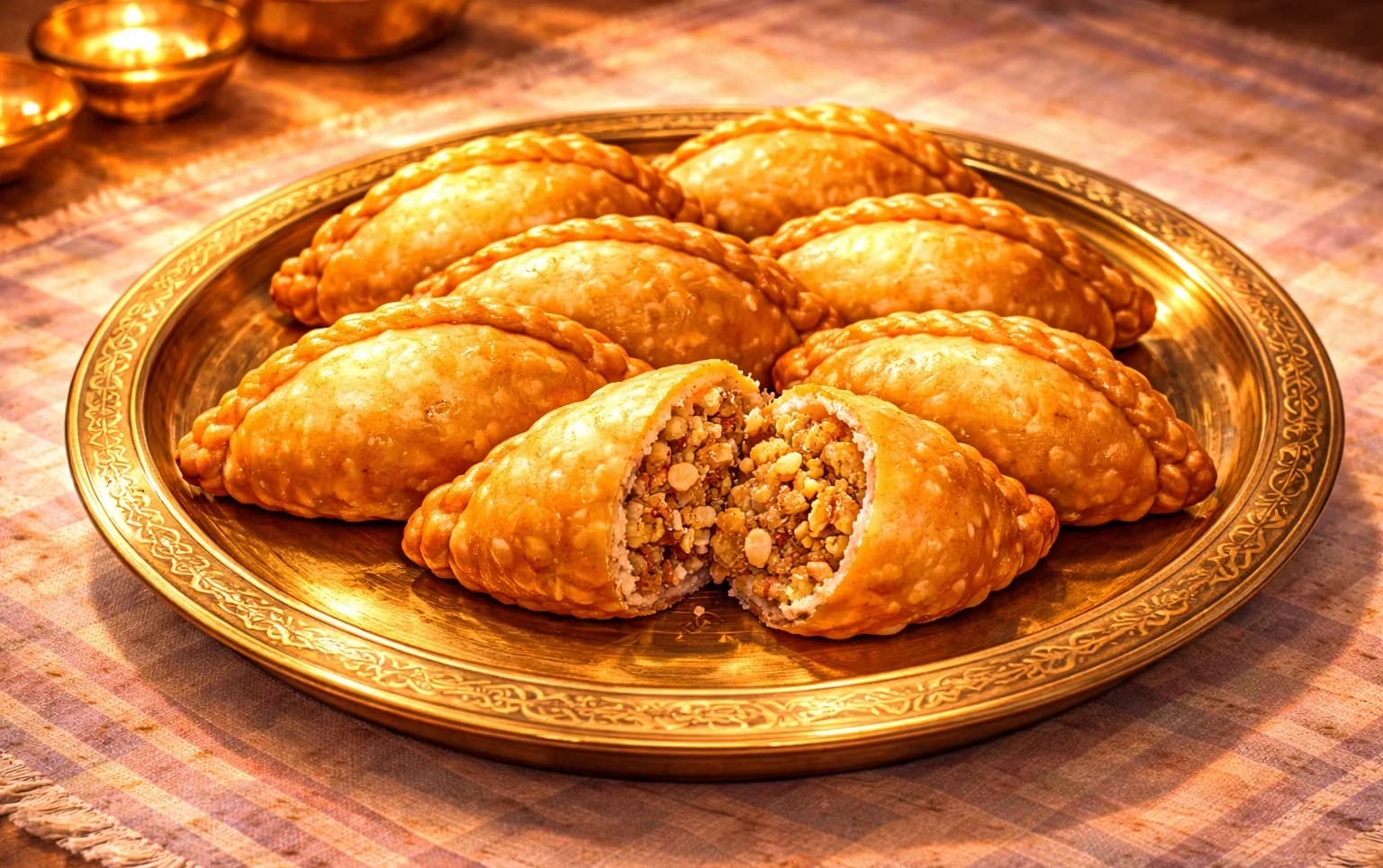
Sweet Stuffed Pastry (Karanji)
Maharashtrian Deep-Fried Crescent Pastry with Sweetened Khoya
Karanji is known by other names across India (gujiya in the north, kajjikayalu in Andhra, nevri in coastal Goa) but in Maharashtra it is karanji, and it belongs unmistakably to Diwali and Holi. The festival seasons bring out the karanjis in every household, made in large batches over an afternoon, fried in sequence, piled high on a tray, and handed out to the neighbours and relatives who call.
The pastry begins with the simplest possible enriched dough: flour rubbed with ghee until it resembles coarse breadcrumbs, then brought together with water into a soft, smooth dough that rests while the filling is prepared. The ghee-rubbing is the critical step. It coats the flour particles with fat, inhibiting gluten development and producing a dough that will be short and slightly crumbly in the finished pastry rather than tough and chewy. This technique, called moyen in English and moin in Marathi, is common to enriched pastries across Indian cooking.
The filling is khoya, fried briefly in a dry pan until it changes colour and loses its raw dairy smell, then mixed with sugar while still hot. The frying transforms the khoya: it takes on a faint caramelisation, a nuttier flavour, a slightly firmer texture, and the hot khoya dissolves the sugar into it as they cool together. Nothing else is needed in the filling beyond this, though some families add cardamom powder, dried coconut, or crushed nuts.
Each round of dough is filled with a generous spoonful of this mixture, sealed with a little water, and twisted decoratively along the crimped edge. That twist is the visual signature of a karanji, distinguishing it from a simple folded pasty. A few toothpick pricks through the surface prevent excessive puffing during frying. Then into the hot oil until golden.
At a Glance
Yield
20–22 karanjis
Prep
30 minutes (plus 30-minute dough rest)
Cook
45 minutes
Total
1 hour 45 minutes
Difficulty
Medium
Ingredients
- 4 cupall-purpose flour (maida)
- ⅓ cupghee (for rubbing into the flour)
- —Water, as needed (approximately 180–200 ml)
- 1 lbfresh khoya (mawa), crumbled
- 1⅛ cupsugar
- —Oil, for deep frying
Method
- 1
Make the dough. Sift the flour into a wide bowl. Add the ghee and rub it into the flour with your fingertips, working steadily, until the mixture resembles coarse breadcrumbs with no large pieces of unincorporated ghee. Every particle of flour should be coated with fat. Gradually add water, a tablespoon at a time, mixing and kneading gently after each addition. Stop adding water when the dough just comes together into a smooth, soft ball. It should not be sticky. Knead very briefly. Cover with a damp cloth and rest for 30 minutes.
- 2
Prepare the khoya filling. Place the crumbled khoya in a dry, non-stick pan over low heat. Stir continuously as the khoya heats and begins to melt and cook. Continue frying over low heat, stirring without stopping, for 8–10 minutes until the khoya changes colour from pale ivory to a warm, slightly golden hue, and smells distinctly nutty and caramelised rather than raw and dairy. Remove from heat immediately.
- 3
Add sugar. While the fried khoya is still hot, add the sugar and stir vigorously. The heat of the khoya will melt and dissolve the sugar. Continue stirring until the sugar is fully incorporated. Allow the filling to cool to room temperature. It will firm up slightly as it cools. Taste and adjust sugar if needed. The filling should be sweet but not cloying.
- 4
Divide and roll. Divide the rested dough into lime-sized balls (approximately 20–22 pieces). On a lightly floured surface, roll each ball into a round disc approximately 10–12 cm in diameter and 2 mm thick, like a small puri.
- 5
Fill and seal. Place a generous tablespoon of khoya filling in the centre of each round, leaving a border of approximately 1.5 cm around the edge. Dip your finger in water and moisten the edge of the entire round. Fold the disc in half over the filling to form a half-moon. Press the edges firmly together to seal, then fold and twist the sealed edge decoratively, pinching and twisting at close intervals to create the characteristic karanji edge. Press firmly to seal.
- 6
Prick. Use a toothpick to make 4–5 fine pricks through the surface of each sealed karanji. This prevents excessive puffing during frying.
- 7
Fry. Heat oil in a deep pan over medium heat. When the oil is at the right temperature (a small piece of dough should sizzle and rise to the surface within 2–3 seconds), lower 3–4 karanjis at a time. Fry over medium heat, turning occasionally, for 6–8 minutes until the pastry is a deep, even golden-brown on all sides. The frying should be unhurried. High heat produces pale, underdone interiors.
- 8
Drain. Remove with a slotted spoon and drain on paper. Allow to cool completely before storing.
Key Ingredient Benefits
Khoya (mawa) is concentrated whole milk, approximately 80% of its water removed by sustained simmering. Dense, slightly granular, intensely dairy. Fresh khoya from a sweet shop or made at home gives the best results. The frying step here deliberately transforms the khoya's flavour and reduces its moisture further.
Ghee in the pastry is what produces the distinctive texture. Butter or oil would change the flavour and texture; only ghee provides the right balance of fat content, smoke point, and dairy character for traditional karanji pastry.
Sugar is added to the filling off the heat to prevent caramelisation. The residual heat of the fried khoya is sufficient to dissolve and incorporate the sugar without cooking it further.
Why This Works
The moyen technique (rubbing ghee into flour before adding water) produces a short, crumbly pastry because the fat coats the flour proteins and physically prevents them from hydrating and forming gluten strands. Gluten requires water and kneading; fat-coated flour resists both. The result is a dough cohesive enough to roll and fill but tender and slightly flaky when fried, rather than tough and chewy.
Frying the khoya before mixing with sugar serves two purposes. First, it removes excess moisture from the raw khoya, giving you a drier filling that won't make the pastry soggy during frying. Second, it develops Maillard compounds (the same caramelisation chemistry that browns bread and roasts meat), giving the filling a nutty, complex flavour that raw or simply sweetened khoya lacks.
Pricking the pastry surface prevents the kind of dramatic puffing that would burst the sealed edge and expose the filling to the oil. A few small holes allow the steam generated inside the pastry during frying to escape in a controlled way, maintaining the karanji's shape.
Substitutions & Variations
- With nuts: Add 50 g of finely chopped almonds, cashews, or pistachios and 1 tsp of cardamom powder to the khoya filling.
- With desiccated coconut: Mix 50 g of toasted desiccated coconut into the filling for additional texture and flavour.
- Gujiya style (North Indian): The filling for North Indian gujiya typically includes khoya, desiccated coconut, powdered sugar, and mixed nuts with cardamom. The pastry technique is identical.
- With semolina pastry: Some recipes use a fine semolina (sooji) dough in place of maida, which produces a slightly crispier, grainier shell.
- Deep frying in ghee: Traditional karanji is fried in ghee for a distinctly richer flavour. Oil is more common in modern households for cost reasons; ghee produces a markedly superior result.
Serving Suggestions
Karanji is festival food, set out on a plate at Diwali or Holi, shared between households in cloth-lined boxes, eaten casually as visitors arrive. Two or three per person is typical. They are self-sufficient. The pastry, filling, and frying together constitute a complete experience, requiring no accompaniment. Eat at room temperature. Fresh and warm from the oil is most wonderful, but they remain very good for several days.
Storage & Reheating
Store in an airtight container at room temperature for up to 10–12 days. The pastry dries and crisps slightly over time, which many find more pleasant than the very fresh texture. Do not refrigerate. The cold introduces moisture and softens the pastry. Brief warming in a low oven (150°C, 8 minutes) restores some of the freshness. Reheating in a microwave softens the pastry and is not recommended.
Cultural Notes
Karanji (करंजी) is the Maharashtrian deep-fried sweet pastry of a wheat-flour dough wrapped around a sweet filling of grated coconut, jaggery (or sugar), chopped nuts, cardamom, and poppy seeds, then folded into a half-moon shape with crimped edges and deep-fried in ghee until golden. The dish is the central sweet of the Maharashtrian Diwali festival (the Hindu festival of lights, held in October or November), where it appears alongside chakli, chivda, shankarpali, and other Maharashtrian Diwali sweets and snacks as part of the elaborate festival food preparations.
The dish has parallels across the broader Indian sweet tradition. The Hindi-speaking north India calls a similar preparation gujiya, the Bengali version is called gujhia or pediya, the South Indian version is kajjikayalu in Telugu or somasi in Tamil. All share the basic format (sweet filling wrapped in a fried pastry shell), but the Maharashtrian karanji is distinguished by its specific use of poppy seeds in the filling, the coconut as the primary filling ingredient, and the crimped edge sealing technique that produces the dish's signature visual identity.
The technique starts with the filling and finishes with the assembly. Grated fresh coconut is sautéed briefly in ghee to drive off moisture, then mixed with jaggery (or powdered sugar), chopped cashews, chopped almonds, poppy seeds, cardamom powder, and a small amount of nutmeg. The mixture cools slightly and is shaped into small flat ovals. The wheat-flour dough (made with all-purpose flour, a small amount of ghee for tenderness, and water) is divided into small balls, each rolled into a thin three-inch round. A filling oval is placed on one side of the round, the dough is folded over into a half-moon, and the curved edge is crimped or pressed shut with a fork or a special crimping tool. The shaped karanji is fried at moderate heat for three to four minutes per side until both surfaces turn deep golden. The dish drains briefly and is served at room temperature, packaged in airtight tins for Diwali distribution to neighbors, relatives, and family friends. The dish keeps for two to three weeks in airtight storage, making it one of the standard items of the Diwali sweet box (Diwali pharaal) that Maharashtrian families prepare in large batches during the days before the festival.
Nutrition Facts
Calories: 493kcal (25%)|Total Carbohydrates: 66.4g (24%)|Protein: 10.9g (22%)|Total Fat: 21.1g (27%)|Saturated Fat: 9g (45%)|Cholesterol: 42mg (14%)|Sodium: 24mg (1%)|Dietary Fiber: 1.2g (4%)|Total Sugars: 32g
You Might Also Like
Ratings & Comments
Ratings & Comments
Ratings
Share your thoughts on this recipe.
Sign in to rate and comment