Dum · Indian Cuisine
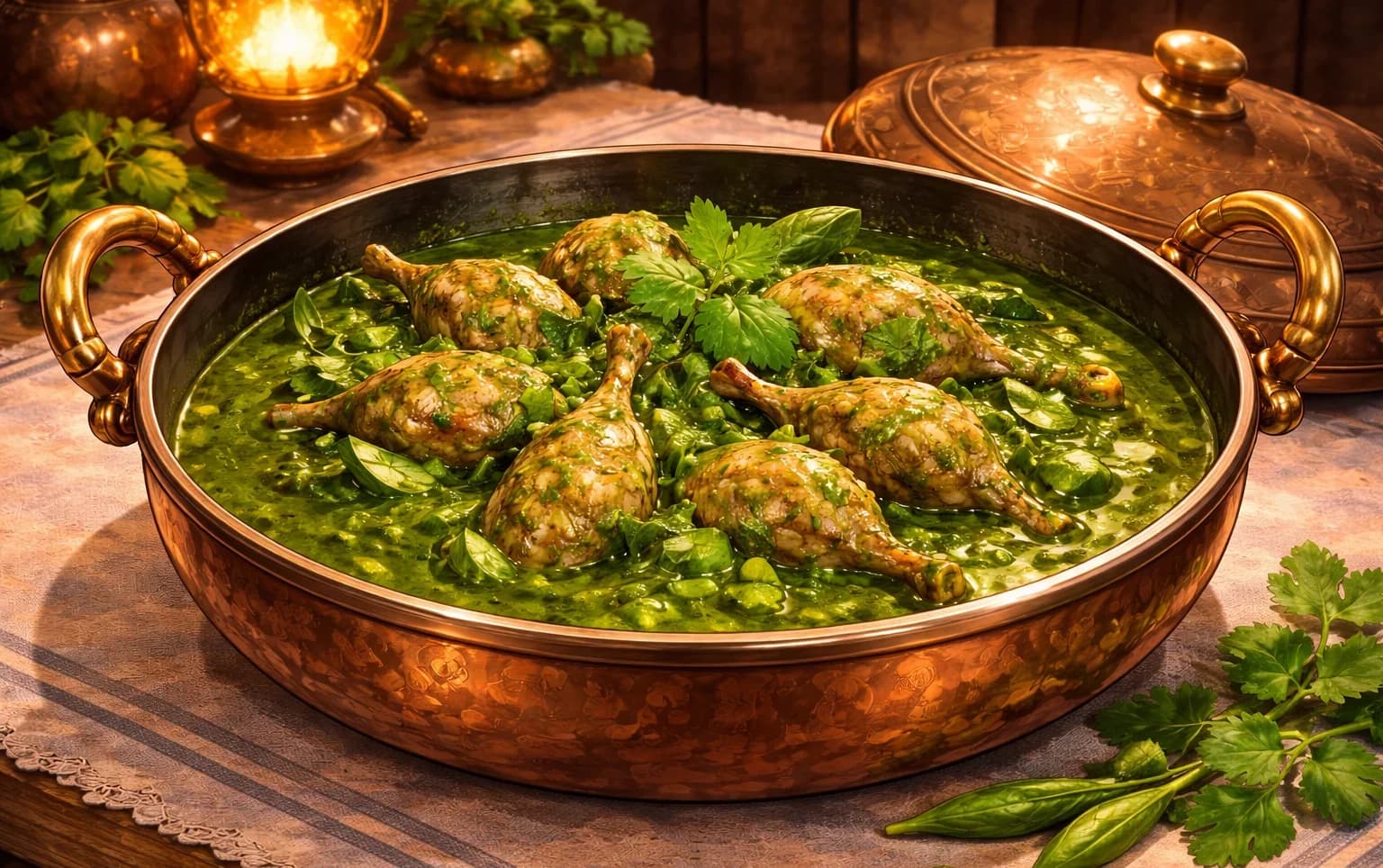
Slow-Cooked Quail, Green Spices (Dum Ka Bateyr Hara Masala)
Quail in a vivid green herb-spinach sauce, finished on dum
Quail is a bird that demands both care and confidence. Its flesh is finer than chicken, darker than most expect, and it cooks through so quickly that the margin between perfectly done and overdone is measured in minutes. The solution the old Mughal kitchens found was elegant: get the bird halfway cooked through a high-heat method (in this case, a tandoori marinade) and then finish it buried in sauce, sealed in a vessel, with heat coming from above and below. By the time the dum is done, the quail has absorbed everything around it without giving anything up.
The hara masala — the green masala — is built in layers. It starts with the crack of whole red and green chillies in hot oil, moves through the warmth of kalonji and fennel seeds, then builds on a base of onion tomato masala deepened with roasted tomatoes and lifted with pickled onion. The spinach puree comes in at the end, near the fresh coriander and mint, which is why the green stays so vivid. Cooked spinach loses its color to heat. Added late, it keeps the brilliance and the slight grassiness that makes hara masala what it is.
Pickled onions in a Mughal preparation might seem out of place, but they do important work: their sharpness cuts through the richness of ghee and the earthiness of spinach, giving the sauce an acidity that isn't just sour but fermented and complex.
Quail is an old bird in Indian court cooking, prized for the delicacy of its meat and its association with shikar — the royal hunt. To cook it on dum is to treat it with the respect it deserves: slowly, carefully, sealed inside an aromatic that protects and perfumes it until it is ready.
At a Glance
Yield
4–5 servings
Prep
30 minutes + marination time
Cook
40 minutes
Total
~1 hour 15 minutes
Difficulty
Medium
Ingredients
- 3½ lbquails (cleaned, spatchcocked or halved)
- ¾ lbonion tomato masala (cooked base of caramelized onion and tomato) (about 2 onions)
- 3½ oztandoori marinade (yoghurt-based with spices and chilli)
- ½ cupfresh ginger, finely chopped
- 3¼ tbspwhole green chillies
- ½ cupgarlic, finely chopped
- 1 tbspsalt
- 5½ ozspinach puree (blanched and blended)
- 1 ozpickled onions
- 5½ ozroasted tomatoes (oven-roasted or tawa-charred) (about 1–1½ tomatoes)
- 1 tspgaram masala
- 1½ tspblack onion seeds (kalonji)
- 1 tspfennel seeds
- 1 tspwhole dry red chillies
- 2 tsplemon juice
- ½ cupghee
- 1 cupfresh coriander, roughly chopped
- ⅔ cupfresh mint leaves, whole
- ½ cuprefined oil
Method
- 1
Marinate the cleaned quails (1.6 kg) in the tandoori marinade (100 g), turning to coat thoroughly. Leave for at least 1 hour, or overnight in the refrigerator. Before cooking, bring to room temperature for 20 minutes.
- 2
Cook the marinated quails in a hot tandoor, under a grill, or in a very hot oven (240°C) until half done — the surface should be colored and fragrant, the flesh still slightly pink inside. This takes about 10 to 12 minutes. Set aside.
- 3
Heat the refined oil (100 ml) in a wide, heavy pan over medium-high heat. Add the whole green chillies (20 g) and whole dry red chillies (2 g). Let them blister for 30 seconds — you'll hear a sharp sizzle and the oil will turn faintly red. Add the kalonji and fennel seeds (2 g); they'll pop within 10 to 15 seconds.
- 4
Add the chopped ginger (50 g). Fry for 1 minute, stirring, then add the chopped garlic (50 g). Cook together for another minute until the raw smell gives way to something golden and warm.
- 5
Add the onion (5 g) tomato masala (300 g). Stir and cook for 2 minutes, letting it fry in the oil rather than just warm through.
- 6
Add the garam masala (3 g), pickled onions (30 g), and roasted tomatoes (150 g). Stir to combine.
- 7
Add the half-cooked quails to the pan. Stir gently to coat each bird in the masala. Cook over medium heat for 5 to 6 minutes, turning once, until the quails are fully cooked through and the juices run clear.
- 8
Remove the pan from heat briefly. Add the spinach puree (150 g), salt (20 g), and chopped coriander (20 g). Stir to incorporate. Return to low heat for 2 minutes. The spinach will warm through and tighten the sauce without losing its color.
- 9
Add the whole mint leaves (10 g), lemon juice (10 ml), and ghee (100 g). Fold gently. The ghee should pool slightly rather than fully emulsify, giving the sauce a glossy richness. Taste and adjust salt and lemon.
- 10
Serve immediately.
Key Ingredient Benefits
Quail: One of the leanest game birds, quail is relatively high in protein and lower in saturated fat compared to chicken thighs. It is a good source of iron, B12, and zinc. Traditional Unani medicine considered quail meat strengthening and easily digestible. The small bones are a natural marker of doneness — they pull cleanly from cooked flesh.
Spinach: Rich in iron, folate, and vitamin K. The oxalic acid in spinach binds some iron, reducing its bioavailability — pairing with a source of vitamin C (the lemon juice in this dish) helps offset this. Blanching before pureeing reduces oxalate content somewhat.
Kalonji (black onion seeds / Nigella sativa): One of the most studied seeds in traditional medicine across South Asian, Middle Eastern, and Islamic traditions. Active compound thymoquinone has shown antioxidant and anti-inflammatory activity in laboratory studies. Used in small quantities here primarily for flavor — earthy, faintly peppery, with a slight bitterness that works beautifully with spinach.
Ghee: Clarified butter with milk solids removed. Has a high smoke point (~250°C). In Ayurvedic tradition, ghee is considered a vehicle that carries the qualities of herbs and spices deep into tissues. In modern terms, it contributes fat-soluble vitamin A and K2. Use in moderate quantities as part of a varied diet.
Fennel seeds: Mild and slightly sweet, fennel aids digestion and is often used to settle the stomach after rich meals. Traditional Ayurvedic classification considers it tridoshic — balancing to all body types.
Why This Works
Half-cooking the quail by high heat before the dum is the key to managing such a delicate bird. A fully raw quail in a sealed vessel would require either too long in the dum (resulting in dry, shredded meat) or too high a heat (which ruins the sauce). By bringing it most of the way through a direct heat method first, the dum step becomes purely a finishing and flavor-absorption stage.
The sequence of whole spices in oil (chilli first, then seeds, then fresh aromatics) is deliberate. Each ingredient has a different bloom time. Chillies release their color and mild heat fastest; fennel and kalonji seeds open up their volatile oils quickly but can burn if left too long; ginger and garlic need more sustained heat to cook through. Adding them in sequence rather than together gives each its proper moment.
Spinach puree added off the direct flame, then returned to low heat, is a classic technique for preserving the vivid green color. Prolonged high heat turns spinach dull and khaki. Brief contact with residual heat is enough to cook out any raw edge.
Pickled onions provide fermented acidity — more rounded and less sharp than lemon juice alone — which lifts the whole dish without tipping it toward sourness. Combined with lemon juice at the finish, the dish achieves a brightness that balances the depth of ghee and roasted spices.
Substitutions & Variations
- Quail substitution: Poussin (young chicken) or bone-in chicken pieces work. Adjust cooking time upward — chicken thighs will need an additional 10 to 15 minutes in the final cooking stage.
- Tandoori marinade: If making from scratch, combine yoghurt, ginger-garlic paste, Kashmiri chilli, cumin, garam masala, and a little oil.
- Spinach puree: Blanch 200 g fresh spinach leaves in boiling water for 2 minutes, refresh in cold water, squeeze dry, and blend smooth.
- Pickled onions: Slice red onions thin and soak in lime juice with salt and a pinch of sugar for 30 minutes. This is a quick approximation.
- Richer sauce: Stir in 2 tablespoons of cream at the finish alongside the ghee for a richer, more restaurant-style result.
Serving Suggestions
Serve with roomali roti — its thinness and suppleness are a natural counterpoint to the robust, herb-laden sauce. Naan also works. A bowl of plain yoghurt on the side allows guests to cool the heat of the chillies at will. Thin cucumber raita or sliced raw onion dressed with lemon and salt adds a clean, crisp element to the plate.
Storage & Reheating
Store cooled quail and sauce in a sealed container in the refrigerator for up to 2 days. The green color of the sauce will deepen overnight. It will taste just as good, though the color will be less vivid. Reheat gently in a covered pan over low heat with a splash of water, or in an oven at 160°C for 15 minutes. The quail should reach an internal temperature of 75°C before serving. This dish does not freeze well — spinach-based sauces lose texture and color on thawing.
Cultural Notes
Dum ka bateyr hara masala (दम का बटेर हरा मसाला, "dum quail with green masala") is the Awadhi preparation of quail slow-cooked in a sealed pot with a bright green masala paste of fresh cilantro, mint, green chili, ginger, garlic, and small amounts of Awadhi aromatic spices. The dish belongs to the Awadhi game-bird tradition that flourished at the court of the Nawabs of Awadh, whose hunting parties brought back quail, partridge, and other small game birds for the rakabdar (banquet specialist) chefs to elaborate into court banquet dishes.
The Awadhi game-bird tradition reflects the broader pre-colonial Indian hunting culture. Quail (bateyr) was hunted across the plains of north India for centuries, both for sport and for the table, and the small flavorful birds appeared at the tables of nobility and at the seasonal hunting camps that ruling families maintained in the cooler months. The Nawabs of Awadh maintained dedicated game-bird preparations as part of their elaborate banquet menus, treating each game bird (duck, quail, partridge, sandgrouse) as deserving its own dedicated recipe rather than a generic poultry preparation. The green masala treatment for quail specifically uses fresh herbs as the dominant flavoring rather than the yogurt-and-nut-paste base of the chicken and lamb kormas, producing a brighter herbaceous dish that suits the leaner gamier flavor of the small bird.
The technique adapts the dum method to the smaller quail and the fresh-herb-forward gravy. Whole quail (typically four to six birds for a family preparation) are cleaned, patted dry, and rubbed with salt, turmeric, and a small amount of ginger-garlic paste. A green masala paste is ground from a generous bunch of fresh cilantro (stems and leaves), fresh mint leaves, green chilies, ginger, garlic, cumin, and a small amount of yogurt to form a thick smooth bright green paste. The quail are sautéed briefly in ghee in a heavy handi until lightly colored on all sides, then the green masala paste is added with a small amount of water. The handi is sealed with a dough closure and cooked over low coals for forty-five minutes until the quail is tender. The dish is finished with a small drizzle of cream and a scatter of additional fresh cilantro, and served with sheermal, naan, or basmati pulao.
Nutrition Facts
Calories: 895kcal (45%)|Total Carbohydrates: 13g (5%)|Protein: 66g (132%)|Total Fat: 64g (82%)|Saturated Fat: 20.5g (102%)|Cholesterol: 277mg (92%)|Sodium: 1812mg (79%)|Dietary Fiber: 2.9g (10%)|Total Sugars: 4.3g
You Might Also Like


Ratings & Comments
Ratings & Comments
Ratings
Share your thoughts on this recipe.
Sign in to rate and comment