Kashmiri · Indian Cuisine
Goan Dried Fish Curry (Gaadh Muzh)
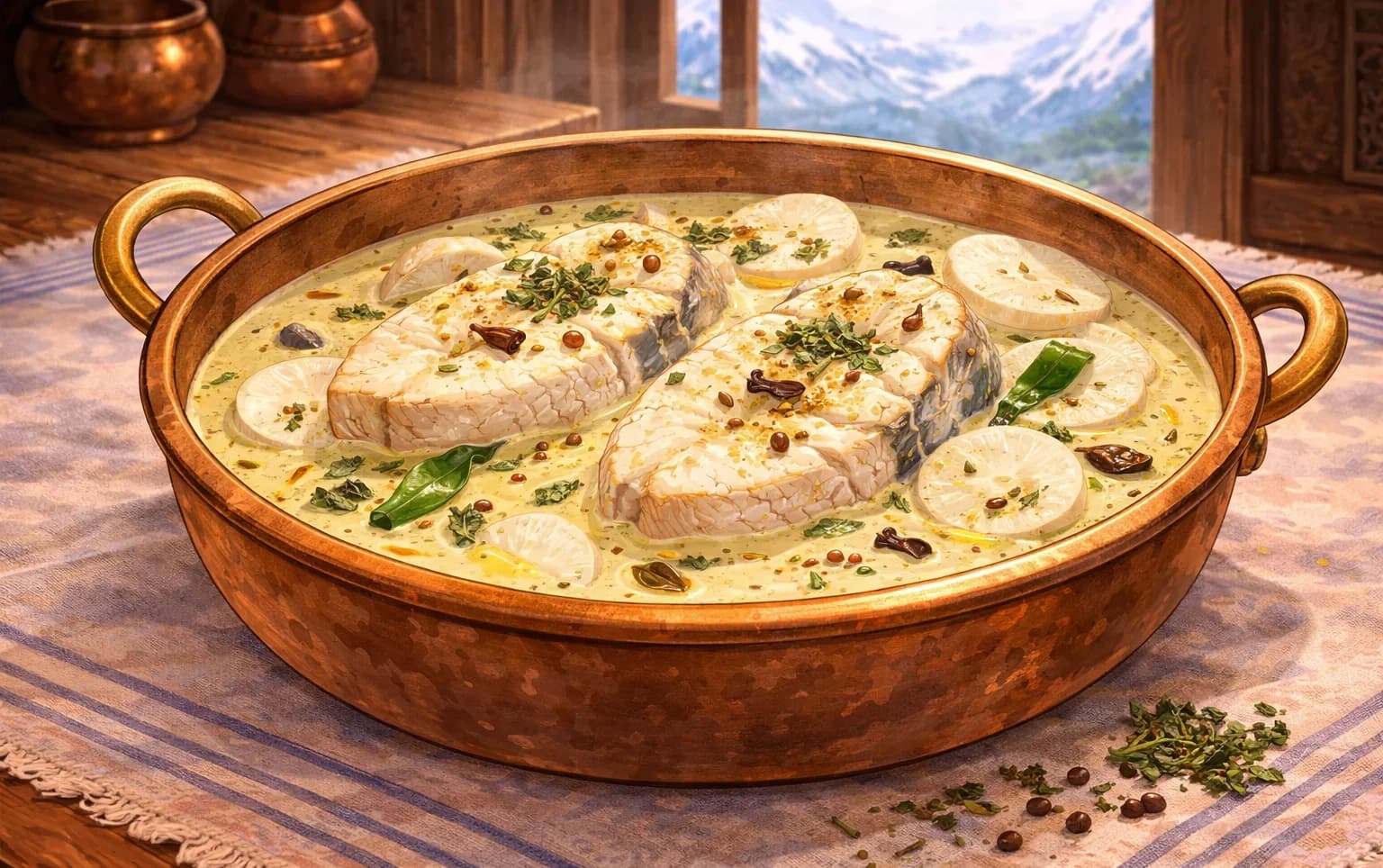
Kashmiri freshwater fish and crispy radish in spiced yogurt sauce
In the Kashmir Valley, where the Jhelum and its tributaries run cold and fast, freshwater fish has been a steady part of the diet for centuries. Gaadh Muzh ("gaadh" being the Kashmiri word for fish, "muzh" for radish) is one of those recipes that makes an argument through restraint. Two humble things: a flaking river fish and a crisp-fried radish. Yogurt to bind them. And the warm, anise-forward perfume that defines Kashmiri cooking.
The radish is the element that surprises. Mooli, sliced and deep-fried until the cut edges are coppery and the interior turns sweet and concentrated, loses its raw sharpness entirely. It becomes something starchier, denser, a foil in both texture and flavor to the tender fish. Frying it first is not optional; it is the technique that earns this dish its character.
The sauce is built in a single pan from whole spices bloomed in ghee, with yogurt stirred in early and cooked down unhurriedly. Kashmiri cooking applies heat to yogurt differently from the way North Indian curries do: there is less scrambling to avoid curdling, more patience, a willingness to let the yogurt reduce and color slightly before the fish arrives. The aniseed powder and dry ginger are the signature aromatics here, identifying this dish immediately as belonging to the valley.
Dry mint at the end is not a garnish. It is the final spice, crumbled in just before serving, its dusty coolness cutting through the richness of the ghee and the tang of the yogurt. Shahi jeera (royal caraway) adds one last layer of warmth.
Serve this with plain rice, cooked simply so the sauce has somewhere to settle.
At a Glance
Yield
4 servings
Prep
20 minutes
Cook
40 minutes
Total
1 hour
Difficulty
Medium
Ingredients
- 1 lbfreshwater fish, cleaned and cut into pieces
- ¾ lbradish (mooli) (about 4–4½ radishes), cut into 1.5 cm dice
- ¼ ozblack cardamom (about 2 pods)
- ¼ ozgreen cardamom (about 6–8 pods)
- 1 tspcloves (about 6–8)
- 1¼ tspcinnamon sticks
- ⅓ cupghee
- 2 tspaniseed (saunf) powder
- 1⅓ tspdry ginger powder (sonth)
- ¾ lbfull-fat yogurt, whisked smooth
- ½ ozfried onion paste
- ½ tspsalt, or to taste
- 2 tbspdried mint leaves
- ¼ ozshahi jeera (royal caraway / black cumin)
- 3 tbspgarlic, peeled and roughly chopped
Method
- 1
Fry the radish. Heat oil in a deep pan or kadhai to 170°C. Add the diced radish in batches — do not crowd. Fry until the edges are golden and the cubes feel firm and slightly crisped, about 5–7 minutes per batch. Drain on a rack or paper and set aside. The radish should hold its shape but have lost its raw bite.
- 2
Build the sauce. In a wide, heavy pan, warm the ghee over medium heat. Add the black cardamom (2 pods), green cardamom (6–8 pods), cloves (6–8), and cinnamon. Let them sputter and bloom for 30–40 seconds — the ghee will become fragrant and slightly darkened around the spices. Add the whisked yogurt and fried onion paste. Stir immediately to combine. Season with salt. Cook over medium heat, stirring frequently, for 7–8 minutes. The yogurt will bubble, thin out, then begin to thicken. Let it do so.
- 3
Add the dry aromatics and garlic. Stir in the aniseed powder and dry ginger powder. Add the chopped garlic. Cook for another 3–4 minutes, stirring, until the garlic is softened and the raw smell has left.
- 4
Add radish and fish. Gently add the fried radish to the sauce, then lay in the fish pieces. Reduce the heat to low. Cover loosely and cook until the fish is tender and just cooked through, about 8–12 minutes depending on the thickness of the pieces. Turn the fish once, carefully — freshwater fish is delicate.
- 5
Finish. Crumble the dried mint leaves into the pan. Add the shahi jeera. Stir gently, taste for salt, and serve immediately over plain rice.
Key Ingredient Benefits
Freshwater fish: River fish (rohu, catla, trout) are all traditional in Kashmir. Their flesh is lean and mild, which is why the sauce does the flavor work. Saltwater fish can be substituted but will have a firmer, less delicate texture.
Sonth (dry ginger powder): Used extensively in Kashmiri cooking in place of or alongside fresh ginger. Traditional medicine in the region has long associated dry ginger with digestive warmth; some research suggests ginger compounds may support healthy digestion, though the body of evidence varies.
Shahi jeera: Black cumin, smaller, darker, and more aromatic than regular cumin. It appears at the end of many Kashmiri preparations as a finishing spice. Its flavor is resinous and slightly earthy, quite unlike standard jeera.
Aniseed powder: The characteristic Kashmiri spice. Used in both meat and fish preparations. Distinct from star anise; this is ground European anise seed (Pimpinella anisum) or fennel, depending on the regional interpretation.
Why This Works
Frying the radish before braising it is the structural key. Raw radish in a wet sauce would turn watery and soft, muddying the sauce and losing all contrast. Frying drives off moisture, concentrates the radish's sweetness, and gives it a surface that can hold the sauce without dissolving into it.
Cooking yogurt in ghee (rather than adding it to a water-based liquid) allows it to reduce and mellow without curdling sharply. The fat from the ghee coats the protein in the yogurt, moderating its behavior over heat. Starting with whisked, room-temperature yogurt helps further.
Aniseed powder and dry ginger powder together are the canonical Kashmiri flavor pair. Unlike fresh ginger, sonth has a warmer, more resinous quality; unlike whole fennel, ground aniseed dissolves into the sauce and becomes part of its base rather than a textural element.
Substitutions & Variations
- Fish: Trout is the most authentically Kashmiri choice; rohu or catla work well too. Firm saltwater fish like seabass or barramundi can stand in if necessary.
- Yogurt: Full-fat is important here. Low-fat yogurt will split more easily and produce a thinner sauce.
- Ghee: Can be replaced with mustard oil for a more pungent, traditional result. Heat mustard oil to smoking point first, then let it cool slightly before using.
- Fried onion paste: Make by frying thin onion slices in oil until deeply brown, then blending with a splash of water. Bottled fried onions work as an approximation.
Serving Suggestions
- Serve over long-grain white rice, cooked plain with no salt, no oil. The sauce is rich and well-seasoned enough to carry the rice.
- A small bowl of sliced raw radish alongside brings a crisp, cool contrast.
- In a Kashmiri meal, this might appear alongside a haak preparation and dal, with rice as the constant.
Storage & Reheating
Store cooled leftovers in an airtight container in the refrigerator for up to 2 days. Fish continues to cook in residual heat and will firm slightly on reheating — warm gently over low heat with a splash of water to loosen the sauce. Do not boil. The dish does not freeze well; the fish texture suffers significantly.
Cultural Notes
Gaadh-muzh (गाड़-मुझ, "fish-radish") is the Kashmiri Pandit preparation of fish (typically freshwater carp, rohu, or trout from the Jhelum river and the lakes of the valley) cooked with radish (muzh in Kashmiri) in a yogurt or asafoetida-anchored gravy seasoned with Kashmiri red chili, fennel, and dried ginger. The dish is among the classic Pandit fish preparations and reflects the Pandit kitchen's distinctive ingredient pairings: fish (a Brahmin protein where permitted by community variant) paired with the cooling pungency of fresh radish, anchored by the Pandit signature triad of fennel, dried ginger, and asafoetida.
The Pandit fish tradition is documented in Kashmiri cookbook scholarship. While many Brahmin communities across India are strictly vegetarian, Kashmiri Pandits historically permitted fish and lamb (alongside the daily vegetables and rice), reasoning that the cold mountain climate of the valley required protein and warming foods that pure vegetarianism could not provide. Krishna Prasad Dar's Kashmiri Cooking (1970) describes the Pandit attitude as a regional adaptation of broader Brahmin practice, not a deviation from it. Fish dishes appear at Pandit feasts, weddings, and the religious meals that mark Hindu holidays in the valley, often paired with rice and a yogurt preparation.
The technique follows the Pandit aromatic logic. Fish steaks (cut about an inch thick) are seasoned with salt and turmeric and rested briefly. Mustard oil is heated until just smoking, cooled, then used to fry the fish steaks for two or three minutes per side until lightly golden. The fish is removed, and in the same oil asafoetida is briefly bloomed, followed by Kashmiri red chili powder, fennel powder, dried ginger powder, and a small amount of water to form a paste. Sliced radish is added with whisked yogurt and additional water to form the gravy. The gravy is brought to a simmer, the fried fish returned to the pot, and the dish cooks gently for ten to twelve minutes until the radish softens and the gravy thickens slightly. The dish is served with plain steamed rice and a side green vegetable like haak.
Nutrition Facts
Calories: 269kcal (13%)|Total Carbohydrates: 5.5g (2%)|Protein: 28g (56%)|Total Fat: 15.1g (19%)|Saturated Fat: 8.6g (43%)|Cholesterol: 99mg (33%)|Sodium: 111mg (5%)|Dietary Fiber: 0.2g (1%)|Total Sugars: 3.7g
You Might Also Like


Ratings & Comments
Ratings & Comments
Ratings
Share your thoughts on this recipe.
Sign in to rate and comment