Kashmiri · Indian Cuisine
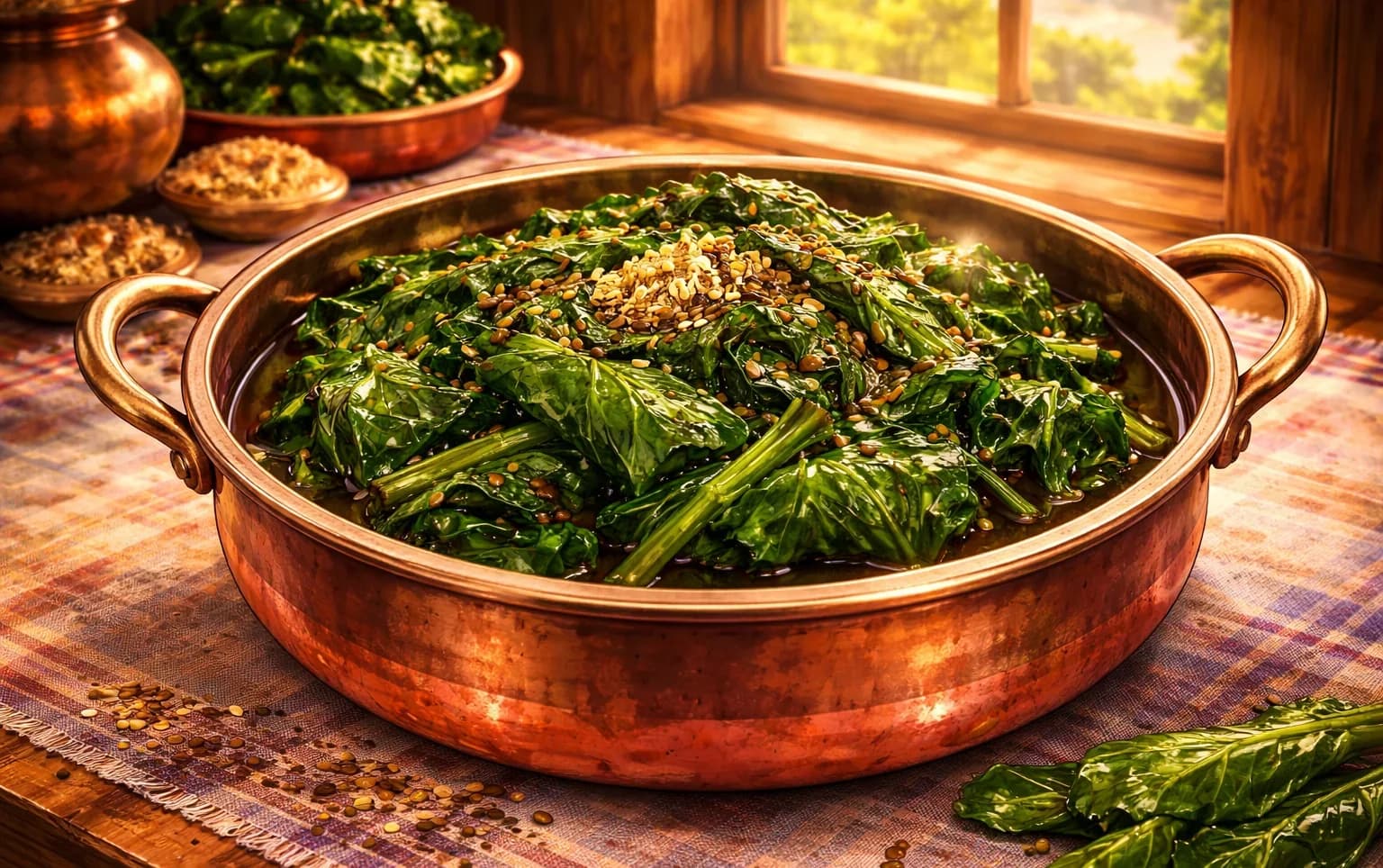
Kashmiri Collard Greens (Haak)
The foundational Kashmiri Pandit greens — saag cooked in mustard oil with asafoetida
If there is one dish that defines the Kashmiri Pandit table, it is haak. Not the elaborate meat preparations that the valley is known for outside. This. A pot of greens, a measure of mustard oil, asafoetida, and heat. The simplicity is not poverty; it is philosophy.
Kashmiri Pandit cooking has its own distinct grammar. It uses no onion and no garlic — not by necessity, but by tradition and, for many, by religious observance. The flavors are built instead through the bite of mustard oil, the powerful, allium-adjacent warmth of asafoetida, the earthiness of fennel and fenugreek, and the clean, slightly bitter note of the greens themselves. Within those constraints, this cuisine developed an extraordinary depth.
Haak refers specifically to Kashmiri saag: a broad-leafed green that grows through much of the year in the valley, botanically close to collard greens or a loose-leafed kale. The leaves are large, dark, and slightly waxy. Outside Kashmir, collard greens are the closest match, though mustard greens, kale, or turnip tops each capture a different register of the original.
The technique is deceptively simple: you heat mustard oil until it smokes, temper it with heeng and spices, add the greens and a good amount of water, and let the whole thing simmer low and long until the greens are completely surrendered, soft, silky, dark. A small pinch of sugar at the end rounds out the bitterness. Suchh bari, the dried lentil dumplings added mid-cook, absorb the mustardy broth and provide the only textural contrast.
Haak is served over rice, always. The broth is part of the dish; leave enough liquid to pool around the rice when you plate it.
At a Glance
Yield
4 servings
Prep
10 minutes
Cook
30 minutes
Total
40 minutes
Difficulty
Easy
Ingredients
- 1 lbhaak (Kashmiri saag / collard greens), tough stems removed, leaves torn
- 3⅓ tbspmustard oil
- ⅓ tspheeng (asafoetida)
- 2¾ tspred chilli powder
- 2½ tspgreen chilli, finely chopped
- 1¼ tspsugar
- 2½ tspsaunf (fennel seeds)
- ½ tspmethi dana (fenugreek seeds)
- 1¾ tbspcoriander powder
- ¼ ozsuchh bari (dried lentil dumplings)
- ¾ tspsonth (dry ginger powder)
- ¾ tspturmeric powder
- 1¼ tbspginger paste
- 1¾ cupwater
Method
- 1
Heat the oil. Pour the mustard oil into a heavy pot — ideally one with a lid. Heat over high flame until the oil begins to smoke. This is not optional; smoking the mustard oil mellows its sharp raw quality and is fundamental to the flavor of haak. Let it smoke for a full 15–20 seconds, then lower the heat slightly.
- 2
Temper the spices. Add the heeng directly to the hot oil — it will foam and sizzle immediately, filling the kitchen with its sulfurous, almost savory smell. Quickly follow with the fennel seeds, fenugreek seeds, and chopped green chillies. Stir for 20–30 seconds.
- 3
Add masalas and ginger. Add the ginger paste, red chilli powder, coriander powder, sonth, and turmeric. Stir briskly for 30 seconds — the paste will sputter in the hot oil. Work quickly.
- 4
Add greens and water. Add the haak leaves in batches if needed — they will wilt quickly. Pour in 400 ml water. Stir everything together, bring to a boil, then reduce heat to medium-low. Add the suchh bari at this point if using.
- 5
Simmer. Cover and simmer for 20 minutes, or until the greens are completely tender and have turned a deep, dark olive-green. The broth should be savory and slightly pungent with mustard oil. Taste for salt.
- 6
Finish with sugar. Add the sugar and stir through. Cook uncovered for another 2–3 minutes. The sugar is not for sweetness — it rounds the bitterness of the greens and the sharpness of the mustard oil. Remove from heat and serve hot with plain rice.
Key Ingredient Benefits
Haak / collard greens: Dark leafy greens are among the most nutrient-dense vegetables grown, with significant amounts of vitamins K, C, and folate. They have been a staple food in Kashmir through harsh winters. Collard greens contain compounds that support liver enzyme function in some preliminary research, though traditional use simply recognizes them as deeply nourishing.
Mustard oil: Cold-pressed mustard oil is high in erucic acid, which has historically been a subject of nutritional research. It is widely consumed across North and South Asia. In small amounts as a cooking medium, it is considered a traditional and culturally appropriate fat for this region.
Heeng (asafoetida): Used across South Asian vegetarian cooking as an onion-garlic substitute. It is a resin derived from the Ferula plant. Some traditional Ayurvedic texts associate it with digestive support, and some preliminary research explores its anti-spasmodic properties. It is used here first and foremost for flavor.
Suchh bari: Dried dumplings made from ground urad or moong dal, sun-dried. They add protein and an earthy, fermented note to the broth. A Kashmiri pantry staple.
Why This Works
Smoking the mustard oil is a technical transformation, not theater. Raw mustard oil contains allyl isothiocyanate, the compound responsible for its sharp, nose-clearing pungency. Heating to smoking point drives off much of this volatile compound, leaving behind a mellower, rounder oil that still tastes distinctly of itself but no longer dominates.
Asafoetida in hot oil performs a similar substitution trick to what onion and garlic would do in other cuisines: it brings a savory, allium-adjacent depth that reads as "base" to the palate, giving the dish a foundation even without aromatics in the conventional sense.
Long braising in water, rather than dry-cooking, extracts the bitterness from the greens gently and transfers it to the broth, which then becomes the seasoning liquid for the dish itself. The greens and their broth are inseparable.
Substitutions & Variations
- Greens: Collard greens are the most faithful substitute outside Kashmir. Turnip greens, mustard greens, or a mix of kale and spinach each produce a different result but all work within the dish's logic.
- Mustard oil: If mustard oil is unavailable, use a neutral oil with a teaspoon of cold mustard oil added at the end for fragrance. The flavor will not be the same.
- Suchh bari: Omit if unavailable; the dish is complete without them. Some cooks add a handful of moong dal directly to the pot for body.
- Green chilli: Increase for more heat, or replace with a split whole dried red chilli.
Serving Suggestions
- Haak is served over rice, always. The broth should be allowed to pool into the rice as you eat.
- In a traditional Kashmiri Pandit meal, haak sits alongside a lentil preparation and perhaps a yogurt dish.
- Do not serve with bread — this is a rice dish, without exception in its home context.
Storage & Reheating
Haak improves with time. Store covered in the refrigerator for up to 3 days — the flavors deepen overnight. Reheat in the pot over low heat, adding a small splash of water if the liquid has reduced. The greens will continue to soften; this is fine. The dish can also be eaten at room temperature over hot rice.
Cultural Notes
Haak (हाक) is the everyday Kashmiri preparation of leafy greens (collard greens, kale, mustard greens, or the local Kashmiri variety called haakh saag) cooked simply with mustard oil, salt, asafoetida, and green chilies until the leaves wilt and tenderize while keeping a fresh bright green color. The dish is the foundational vegetable preparation of Kashmiri Hindu (Pandit) home cooking and appears at virtually every Kashmiri Pandit meal as the daily green vegetable accompaniment to plain steamed rice.
The Pandit identity is foundational to the dish's character. Kashmiri Pandit cuisine (the food of the Hindu Brahmin community of Kashmir) historically excludes onion and garlic, following the broader Brahmin dietary practice that classifies these alliums as tamasic (clouding to the mind). Instead, the Pandit kitchen builds flavor with asafoetida (a pungent resin called hing that approximates onion-garlic complexity without the same energetics), fennel seeds, dried ginger powder (saunth), and Kashmiri red chili powder. Haak is one of the clearest expressions of this aromatic philosophy: a green vegetable cooked with no allium base, instead anchored by mustard oil, asafoetida, and green chili. Krishna Prasad Dar's Kashmiri Cooking (1970) treats haak as the Pandit kitchen's daily anchor.
The technique is intentionally simple. The greens are washed thoroughly, stems separated from leaves (stems take longer to cook), and added to a pot with a small amount of pre-heated mustard oil (the oil is heated until just smoking, then cooled briefly so the raw mustard sharpness mellows). Asafoetida and slit green chilies are added, then the greens with a small amount of water and salt. The pot is covered and the greens cook for ten to fifteen minutes until just tender, with the water mostly evaporated. The dish is served immediately with steamed rice and a Pandit dal or a yogurt-based preparation like kashmiri-dum-aloo. The dish appears at every Kashmiri Pandit family meal and at Pandit weddings, family gatherings, and religious feasts as the constant green presence among the meat and rice dishes.
Nutrition Facts
Calories: 104kcal (5%)|Total Carbohydrates: 9.4g (3%)|Protein: 3.8g (8%)|Total Fat: 7g (9%)|Saturated Fat: 0.9g (5%)|Cholesterol: 0mg (0%)|Sodium: 38mg (2%)|Dietary Fiber: 4.6g (16%)|Total Sugars: 2g
You Might Also Like

Ratings & Comments
Ratings & Comments
Ratings
Share your thoughts on this recipe.
Sign in to rate and comment