Indian Cuisine
Sohan Papdi
North India's Gossamer Flaked Gram Flour Sweet
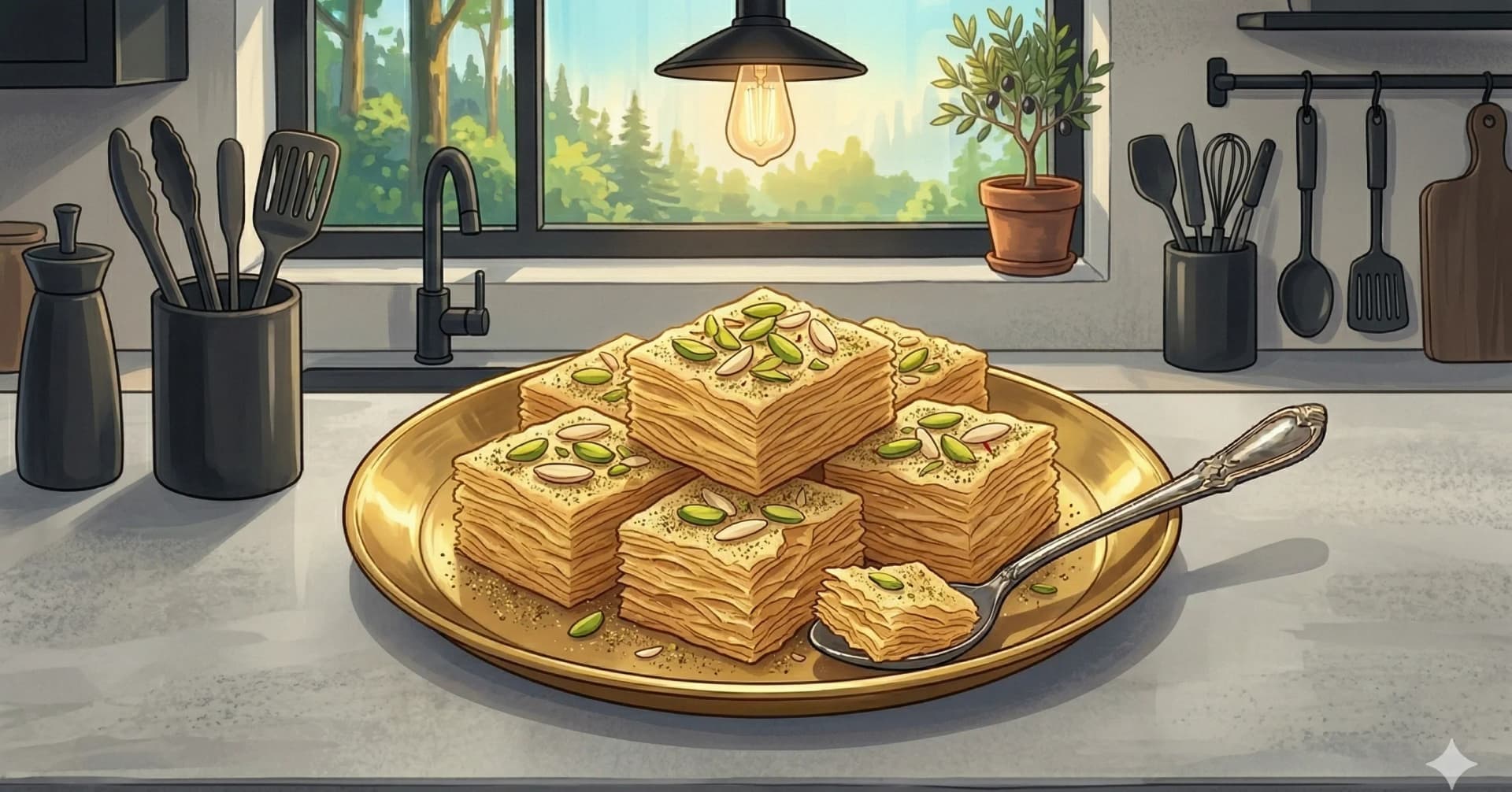
Sohan papdi is the sweet that most people know from its distinctive yellow rectangular box, sold at festivals and gifted between households at Diwali. Eating it is unlike anything else in the Indian sweet repertoire: you lift a piece and it disintegrates almost immediately on contact with your fingers, the thread-like flakes separating and collapsing into a gossamer pile that melts on the tongue before you have quite registered the texture. It is simultaneously airy and rich, papery and warm, with the clean toasted-besan flavour and a sweetness that is present but not cloying.
The making of sohan papdi is an exercise in temperature, timing, and physical effort. The technique is this: besan and flour are roasted in ghee until golden, a familiar, careful process. Then a sugar syrup cooked to a very specific concentration (2.5-thread, approximately 118–120°C) is poured all at once into the warm flour mixture. A small amount of milk is added. And then the beating begins.
With a large fork or a pair of forks, the still-warm mixture must be beaten vigorously and continuously, pulling it apart and folding it back, pulling and folding, until the mass transforms. What begins as a dense, sticky paste gradually aerates and separates into the characteristic thread-like flakes that give sohan papdi its name and its texture. This beating must happen while the mixture is still warm enough to be workable. Once it cools below a certain temperature, it sets and no further pulling will produce threads.
Speed and confidence are required. Have your greased surface ready, your rolling pin ready, your cardamom seeds ready. Once the flakes form, move immediately.
At a Glance
Yield
800 g–1 kg (approximately 25–30 serving pieces)
Prep
15 minutes
Cook
35–40 minutes
Total
1 hour (plus 30 minutes cooling)
Difficulty
Involved
Ingredients
Method
- 1
Roast the flour. Combine the gram flour and plain flour. Heat the ghee in a wide, heavy-bottomed pan over low-medium heat. Add the flour mixture and roast, stirring continuously, until it turns light golden, slightly deeper than blonde, with a nutty fragrance that has no raw element remaining. This takes approximately 15–20 minutes on a careful low flame. Do not let it brown too deeply. Transfer to a separate wide, flat-bottomed bowl and allow to cool slightly, stirring occasionally so it does not stick together as it cools. The mixture should be warm, not hot, when the syrup is added.
- 2
Make the sugar syrup. While the flour cools, combine the sugar and water in a clean pan. Bring to a boil over medium heat, stirring until the sugar dissolves. Stop stirring and cook until the syrup reaches 2.5-thread consistency: when a drop is pulled between thumb and forefinger it forms a firm thread that breaks, with a slight stickiness beyond the clean two-thread. This is approximately 118–120°C on a candy thermometer. Be precise. Syrup cooked too far will produce a brittle, hard result; undercooked syrup will not produce threads when beaten.
- 3
Add syrup and milk to flour mixture. Pour the entire quantity of hot syrup all at once into the warm roasted flour mixture. Add the milk immediately. Stir briefly to combine.
- 4
Beat into flakes - this is the critical step. Using a large fork, a pair of forks, or two wooden spoons, begin beating the mixture vigorously. Work quickly and with full effort: pull the mixture apart, fold it back, pull again, constantly aerating and separating. As you beat, the mass will begin to change. From dense and sticky, it will slowly become lighter, more fibrous, and thread-like. Continue beating for 5–8 minutes until the mixture has transformed into gossamer, thread-like flakes that are light and separate and no longer sticky. This requires genuine effort and must be done while the mixture is still warm.
- 5
Transfer immediately. Without pausing, transfer the beaten mixture onto a greased marble surface, baking sheet, or tray. Using a lightly greased rolling pin or your hands, gently roll or press to a thickness of approximately 2–3 cm. Work gently. Pressing too hard will compact the flakes and undo the aeration.
- 6
Add cardamom seeds. Sprinkle the crushed cardamom seeds over the surface immediately and press down very gently so they adhere.
- 7
Cool and cut. Allow to cool completely at room temperature, about 30 minutes. Cut into squares using a sharp knife.
Key Ingredient Benefits
Gram flour (besan) is made from dried, split chickpeas. It is naturally gluten-free and provides plant-based protein and fibre. Roasting besan deeply before use removes any raw legume bitterness and develops the nutty, complex flavour that is the backbone of sohan papdi. The combination of besan and plain flour (maida) in equal proportions balances the besan's strong flavour with the more neutral plain flour, producing a less assertive final flavour.
Ghee at this quantity (250 g to 400 g of combined flour) is the fat that coats the flour particles and keeps the thread structure from compacting too densely. It also contributes the characteristic richness that makes sohan papdi simultaneously light and satisfying. The high fat content, combined with the high sugar content, makes this a festival sweet, calorie-dense by design, eaten in small pieces as an occasional indulgence.
Cardamom seeds are specified rather than cardamom powder. The whole seeds provide an aromatic burst when you bite into one, a clean, resinous note that is qualitatively different from the more diffuse fragrance of powder mixed through the sweet.
Why This Works
The transformation from dense paste to gossamer flakes is a physical process of aeration through mechanical work. When hot sugar syrup is added to the warm roasted flour-ghee mixture, it creates a supersaturated sugar solution coating the roasted flour particles. As you beat the mixture, you are pulling these sugar-coated strands apart and creating thin, air-filled laminations between them. As the mixture cools slightly during beating, the sugar crystallises in these thin strands, setting them in their separated, thread-like form.
Syrup concentration is critical because it determines the crystallisation behaviour. Too dilute (below 2.5-thread) and the sugar won't crystallise into stable threads; the mixture will remain sticky and dense. Too concentrated (above 3-thread) and the sugar crystallises too hard and fast, producing a brittle result that breaks rather than threads.
The milk addition may seem incidental but it serves two purposes: it provides a small amount of additional moisture that moderates the crystallisation speed, and its fat content helps keep the flakes from sticking together as they form.
Substitutions & Variations
- With saffron: Dissolve a generous pinch of saffron in the milk before adding to the flour-syrup mixture for a golden-hued, fragrant sohan papdi.
- With rose water: A few drops added to the milk give a gentle floral note traditional in some North Indian versions.
- Kaju sohan papdi: Press a few cashew pieces gently into the surface along with the cardamom seeds before the mixture sets.
- Without besan: A version made from all plain flour (maida) is slightly less assertively flavoured but has the same thread-like texture. Some prefer the milder result.
Serving Suggestions
Sohan papdi is a standalone festival sweet, served in small squares. The traditional occasion is Diwali, when sohan papdi boxes are among the most commonly gifted sweets across North and Central India. It is served at room temperature with masala chai. The warmth of the tea and the dry, papery sweetness of the sohan papdi are a natural pairing. Serve in two or three pieces; it is satisfying in small quantities.
Storage & Reheating
Store in an airtight container at room temperature for up to 2 weeks. The thread-like structure, once set, is stable at room temperature. The high sugar concentration inhibits moisture absorption, and the ghee prevents staleness. In humid climates, the sweet can become slightly sticky; if this happens, open the container and allow to air for an hour. Do not refrigerate (moisture in the refrigerator dissolves the threads). Do not reheat.
Cultural Notes
Sohan papdi (सोहन पापड़ी, also called patisa in some regions) is the North Indian flaky sweet of chickpea flour and refined flour roasted in ghee, mixed with thick sugar syrup, and worked while warm by repeatedly stretching and folding the mixture until it develops a fine flaky thread-like structure that resembles a soft cotton-like texture when pressed into squares. The dish is one of the canonical Diwali and wedding sweets across north India, distributed in colorful tins and exchanged among families during the festival season. The dish's distinctive flaky texture distinguishes it from the dense ladoo and barfi families that dominate the broader North Indian sweet tradition.
The dish's history reflects the Persian-Indian sweet exchange. The pulling-and-folding technique used to produce sohan papdi's flaky structure has parallels in the broader Persian and Central Asian sweet traditions: the Iranian pashmak (literally "wool"), the Turkish pişmaniye, and the Chinese dragon's beard candy all use similar repeated-pulling techniques to create thread-like sweet textures. The technique traveled to India through the Mughal and Persian court culinary exchanges, and the Indian variant developed its own distinctive form using chickpea flour and ghee as the base ingredients rather than the Persian-Turkish base of sesame and sugar. The name sohan comes from the Persian sahan (a flat dish used for serving sweets), and papdi in the North Indian sweet vocabulary refers to flaky thin-layered preparations.
The technique requires speed and the right working temperature. Chickpea flour and refined flour are mixed in roughly equal proportions and sifted together. Ghee is melted in a heavy kadai and the flour mixture is added and roasted over low heat with constant stirring for ten to fifteen minutes until deep golden and intensely aromatic. The flour-ghee mixture is removed from the heat and set aside. A sugar syrup is prepared in a separate pot, cooked to the hard-ball stage (the syrup forms a hard ball when dropped into cold water, around 121°C). The hot syrup is poured into the warm roasted flour and mixed quickly to form a sticky thick mass. The mass is turned onto a clean greased surface and worked while still warm: repeatedly stretched into long strands, folded back together, and stretched again. After many repetitions (about twenty minutes of work) the mass develops a fine thread-like internal structure. The hot mass is pressed into a greased tray, smoothed flat, and the surface is sprinkled with sliced almonds and pistachios. After cooling, the slab is cut into squares with a sharp knife.
Nutrition Facts
Calories: 195kcal (10%)|Total Carbohydrates: 27.3g (10%)|Protein: 2.2g (4%)|Total Fat: 8.8g (11%)|Saturated Fat: 5.2g (26%)|Cholesterol: 21mg (7%)|Sodium: 5mg (0%)|Dietary Fiber: 0.9g (3%)|Total Sugars: 19.1g
You Might Also Like
Ratings & Comments
Ratings & Comments
Ratings
Share your thoughts on this recipe.
Sign in to rate and comment