Rajasthani · Indian Cuisine
Rajasthani Red Meat Curry (Laal Maans)
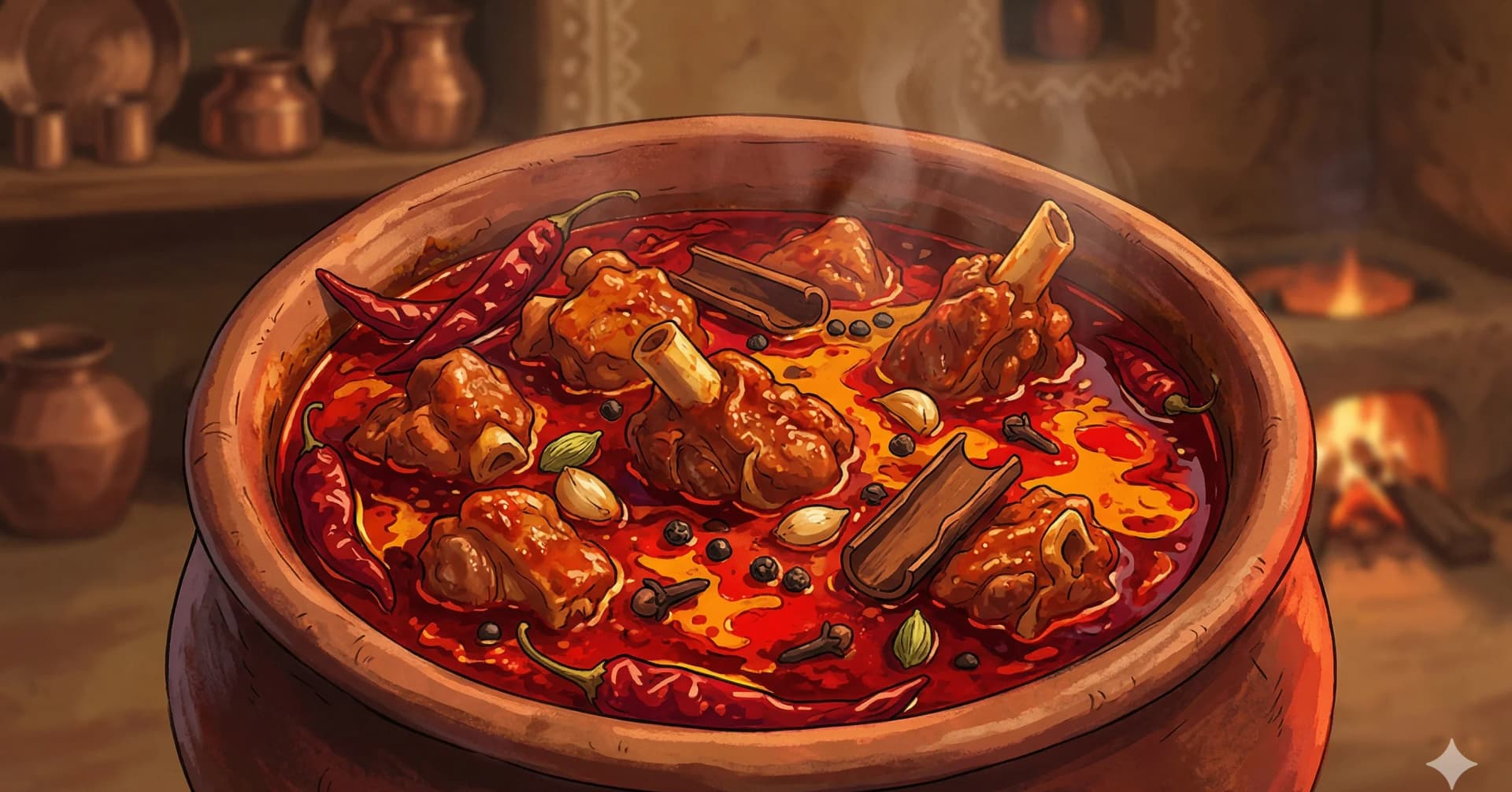
Rajasthani red lamb curry with Mathania chillies and ghee
Laal maans means "red meat," and it is the most iconic dish in Rajasthani cooking, and one of the most uncompromising. This is not a dish calibrated for mild palates or weeknight casualness. It is fiery, deeply flavoured, and emphatically red. The colour comes from Mathania chillies, a variety grown in the Jodhpur district that produces both colour and heat at a level no other chilli quite replicates.
The Mathania chilli is what makes laal maans what it is. Named for the village of Mathania near Jodhpur, it is large, dark red, and both hot and deeply flavourful, producing a smoky, almost sweet depth underneath its considerable heat. Dried and reconstituted, it contributes a different quality of red than Kashmiri chilli (which is mild and colour-focused) or ordinary hot chilli powder. If Mathania chillies are unavailable, the nearest approximation combines the colour of Kashmiri with the heat of a more pungent variety. See substitutions.
The technique here follows the bhunao principle: the lamb is marinated in yoghurt and chilli, then repeatedly dried out in the cooking pot over high heat, the process building a deep, sticky masala coating on the meat before water is added for the final braise. The onions are crushed after frying, another traditional Rajasthani technique that creates a denser, more clinging gravy than uncrushed onion-based masalas.
The coal-smoking finish at the end (burning a piece of natural charcoal with cloves and ghee and sealing the smoke into the pot with a lid) is a traditional way to add a final layer of wood-smoke character. This dhungar technique appears across several North Indian and Pakistani meat preparations and transforms the finished dish in a way that no other technique can replicate at home.
At a Glance
Yield
Serves 6–8
Prep
30 minutes (plus 2 hours marinating)
Cook
1 hour 45 minutes
Total
4 hours 15 minutes
Difficulty
Involved
Ingredients
- 1½ lbbone-in lamb (mix of barrah/chops/rack and boti/shoulder pieces)
- 3½ ozplain yoghurt, beaten
- 3¼ tbspMathania chilli paste (or substitute; see notes)
- 2½ tspwhole dried red chillies (about 5–6)
- 3¾ tbspcoriander powder
- 1⅛ tspsalt (plus a pinch for marinating)
- 2¼ tbspginger-garlic paste (combined)
- 2¼ tbspfresh garlic, roughly chopped
- ¼ cupghee
- ⅓ tspcinnamon stick (about 3 cm)
- ½ tspwhole cloves (about 3–4), plus extra for dhungar
- ¼ ozbay leaf (1 leaf)
- ¼ ozblack cardamom pods (about 1–2 pods)
- 4½ ozonions (about ½–1 onion), finely chopped
- ⅓ cuptomato purée (canned, not diluted paste)
- ¼ tspclove powder (a pinch)
- —Natural charcoal and additional ghee for dhungar (coal smoking)
Method
- 1
Marinate the lamb. Combine the lamb with half the yoghurt (100 g), half the ginger-garlic paste (33 g), half the Mathania chilli paste (50 g), and a pinch of salt (7 g). Mix well and leave to marinate for at least 2 hours, preferably overnight in the refrigerator.
- 2
Prepare the chilli paste. If using whole dried Mathania chillies: soak 12–15 large dried chillies in warm water for 30 minutes, drain, and blend with a tablespoon of water to a smooth paste. Set aside.
- 3
Bloom the spices. Heat the ghee (65 g) in a large, heavy-based pot over medium-high heat. Add the cinnamon, bay leaf (1 g), and black cardamom. Stir for 30 seconds. Do not add the cloves (3–4) yet. They go in with the dhungar at the end.
- 4
Fry and crush the onions (130 g). Add the chopped onions and fry over medium-high heat, stirring frequently, for 12–15 minutes until deep golden brown. Add the chopped garlic (13 g) and stir for 2 minutes. Now, crush the onions. Using a heavy spoon or potato masher, press down on the fried onions in the pan, adding 2–3 tablespoons of hot water to help, mashing until roughly crushed. This creates a denser masala base than leaving the onions whole.
- 5
First bhunao. Add the marinated lamb with all its marinade to the pot. Stir well. Over medium-high heat, cook uncovered, stirring regularly, until all the marinade moisture has completely evaporated, about 15–18 minutes. The meat should be clinging with dry, sticky masala.
- 6
Add remaining chilli, paste, coriander, yoghurt. Add the remaining Mathania chilli paste, remaining ginger-garlic paste, coriander powder (6 teaspoons), and remaining yoghurt. Stir well. Again cook until this moisture is completely reduced and the meat is coated in thick, dry masala, another 10–12 minutes.
- 7
Braise. Add 400–500 ml of hot water. Stir well, scraping the base of the pot. Bring to a boil, then reduce to a strong simmer. Cook, partially covered, for 30–35 minutes until the lamb is approximately three-quarters cooked, just beginning to yield but still with some resistance.
- 8
Remove the lamb, finish the gravy. Remove the lamb pieces to a plate. Add the tomato purée (100 ml) to the gravy and cook over medium heat for 5–6 minutes until it integrates and the gravy deepens in colour. Return the lamb to the pot, stir, and cook for a further 10 minutes until fully cooked through. Add the clove powder (0.5 g). Taste and adjust salt. The oil (ghee) should be visible and pooling on the surface.
- 9
Dhungar (coal smoking). Have a small piece of natural charcoal ready. Using tongs, hold it directly over a gas flame until it glows red-hot (about 5 minutes). Place a small heatproof cup or a piece of foil formed into a cup in the centre of the pot, among the lamb. Place the glowing charcoal in the cup. Add 2–3 cloves and pour 1 teaspoon of ghee over the charcoal. It will immediately begin to smoke. Cover the pot tightly with its lid and leave for 2–3 minutes to trap the smoke. Remove the charcoal cup and lid. Serve immediately.
Key Ingredient Benefits
Mathania chilli (Capsicum annuum var., grown near Jodhpur) is one of India's most regionally specific ingredients. Its unique combination of heat, colour, and fruity depth comes from the specific soil and climate of the region. Like other red chillies, it is high in capsaicin (responsible for heat) and carotenoids (responsible for the deep red colour). Research suggests capsaicin may be associated with improved metabolism and has anti-inflammatory properties, though individual tolerance varies considerably.
Ghee is used here rather than oil for both culinary and cultural reasons. Ghee's higher smoke point makes it suitable for the extended high-heat bhunao that this recipe requires. Culturally, ghee is the cooking fat of festival and celebration cooking in Rajasthan. Its rich, slightly nutty flavour is part of what gives laal maans its particular character. In Ayurvedic tradition, ghee is considered sattvic and is used in meat preparations where it is thought to help balance the rajasic (activating) quality of meat and chilli.
Lamb provides both the protein base and, critically, the fat that makes this dish what it is. The bone-in cuts (chops and shoulder) render collagen and bone marrow into the braising liquid during cooking, which creates the body and lip-coating quality of the finished gravy. A boneless version would be leaner and thinner.
Why This Works
The two-stage bhunao (drying out the marinade, then drying out the second addition) builds a masala of extraordinary depth. Each evaporation cycle concentrates the spice compounds, the onion, and the Maillard products from the high-heat cooking, creating layers of flavour that a single wet braise cannot achieve. By the time water is added for the actual braise, the meat is already deeply seasoned throughout.
Removing the lamb partway through and adding the tomato purée to the gravy without the meat is a technique to prevent the tomato's acidity from toughening the lamb proteins. Acid does the same work as overcooking, seizing the muscle fibres. Adding the tomato while the meat is out, then returning the meat for a short final cook, gives the gravy its tomato character without compromising the lamb's tenderness.
The dhungar (coal smoking) works because smoke is oil-soluble: the fat that has rendered from the ghee and lamb into the gravy readily absorbs the volatile phenolic compounds in wood smoke. The result is not a prominent smoky flavour but a background fragrance that rounds and deepens the overall character of the dish in a way that is very difficult to articulate but immediately recognisable when present.
Substitutions & Variations
Mathania chilli substitute: Combine 2 tablespoons of Kashmiri chilli paste (for colour) with 1 teaspoon of hot chilli powder (for heat). The flavour won't be identical but the visual result is close.
Without dhungar: Skip the coal-smoking if equipment or ingredients are unavailable. The dish is still excellent. Do not attempt to simulate with liquid smoke. It tastes artificial in a preparation this traditional.
Mutton: Old mutton (not lamb) is the traditional choice in Rajasthani cooking and produces even deeper flavour. Increase the braise to 55–65 minutes.
Leaner version: Reduce ghee to 2 tablespoons and use neutral oil for the remaining fat. The dish will be less rich but still very good.
Serving Suggestions
Laal maans is served with bajra (millet) roti or regular whole-wheat roti in Rajasthani tradition. The dry, slightly dense bread is the right vehicle for the fiery, ghee-rich gravy. Plain boiled rice is also excellent alongside. A bowl of cooling raita (yoghurt with cucumber and roasted cumin) is essential to balance the heat. This is not a mild dish, and the contrast is part of the experience. A raw kachumber salad on the side provides textural freshness. This is a dish for a significant occasion: it represents the full depth of Rajasthani meat cookery in one preparation.
Storage & Reheating
Laal maans keeps well for 3 days in the refrigerator. The ghee will solidify on cooling; skim or stir back in depending on preference. Reheat gently over low heat, adding a splash of water if needed. The flavours deepen considerably by day two. Freezes well for up to 1 month.
Cultural Notes
Laal maans (लाल मांस, "red meat") is the Rajasthani Marwari preparation of mutton or lamb cooked in a fiery red gravy of yogurt, mathania red chilies, ginger-garlic, garam masala, and mustard oil. The dish derives its deep red color from the Mathania chili (the long pointed chili variety grown near the village of Mathania in the Jodhpur district of Rajasthan), which is prized for its color and aroma alongside a heat level lower than its bright color would suggest. The dish belongs to the Rajput hunting and warrior tradition of Rajasthan and is one of the dishes most strongly associated with the Marwari and Rajput culinary identity.
The Rajput culinary lineage is the dish's cultural anchor. The Rajput clans of Rajasthan were a warrior caste whose hunting culture brought wild boar, deer, partridge, and other game to the kitchen, and their cooking developed alongside the dry desert climate and the long campaigns of medieval Rajput military history. The preferred cooking fats were mustard oil and ghee, the preferred souring agent was yogurt (water was scarce in the desert), and the spicing favored Mathania chili for color and aroma. Laal maans was traditionally cooked over open wood fires in the hunting camps and at the courts of the Rajput rulers (the rajas and maharajas of the various Rajput princely states: Jodhpur, Jaipur, Udaipur, Bikaner, Jaisalmer). The dish remains a signature of Rajasthani restaurants in Jaipur, Jodhpur, and the diaspora, often paired with the wheat bati and lentil dal that form the Rajasthani staple meal.
The technique builds the gravy on whisked yogurt and the Mathania chili paste. Mathania chilies (about fifteen to twenty for a kilo of meat, deseeded for the milder version or whole for the traditional heat) are soaked in hot water for thirty minutes, then ground with garlic, ginger, cumin, and a small amount of water into a smooth paste. Mustard oil is heated until just smoking in a heavy kadai, cooled briefly, then used to brown sliced onions until dark golden. Bone-in lamb is added and seared, then the chili paste, whisked yogurt, ground coriander, salt, and a small amount of water. The pot is covered and cooked over low heat for about ninety minutes until the lamb is tender and the gravy reduces to a thick rich red consistency. The dish is finished with a smoke-tempering (dhungar): a small piece of red-hot charcoal is placed in a small bowl on top of the cooked dish, a teaspoon of ghee is poured on the coal, and the pot is covered for a minute to capture the smoke.
Nutrition Facts
Calories: 290kcal (14%)|Total Carbohydrates: 5.1g (2%)|Protein: 18.7g (37%)|Total Fat: 21.1g (27%)|Saturated Fat: 10.3g (52%)|Cholesterol: 78mg (26%)|Sodium: 157mg (7%)|Dietary Fiber: 0.6g (2%)|Total Sugars: 2g
You Might Also Like
Ratings & Comments
Ratings & Comments
Ratings
Share your thoughts on this recipe.
Sign in to rate and comment