Chinese Cuisine
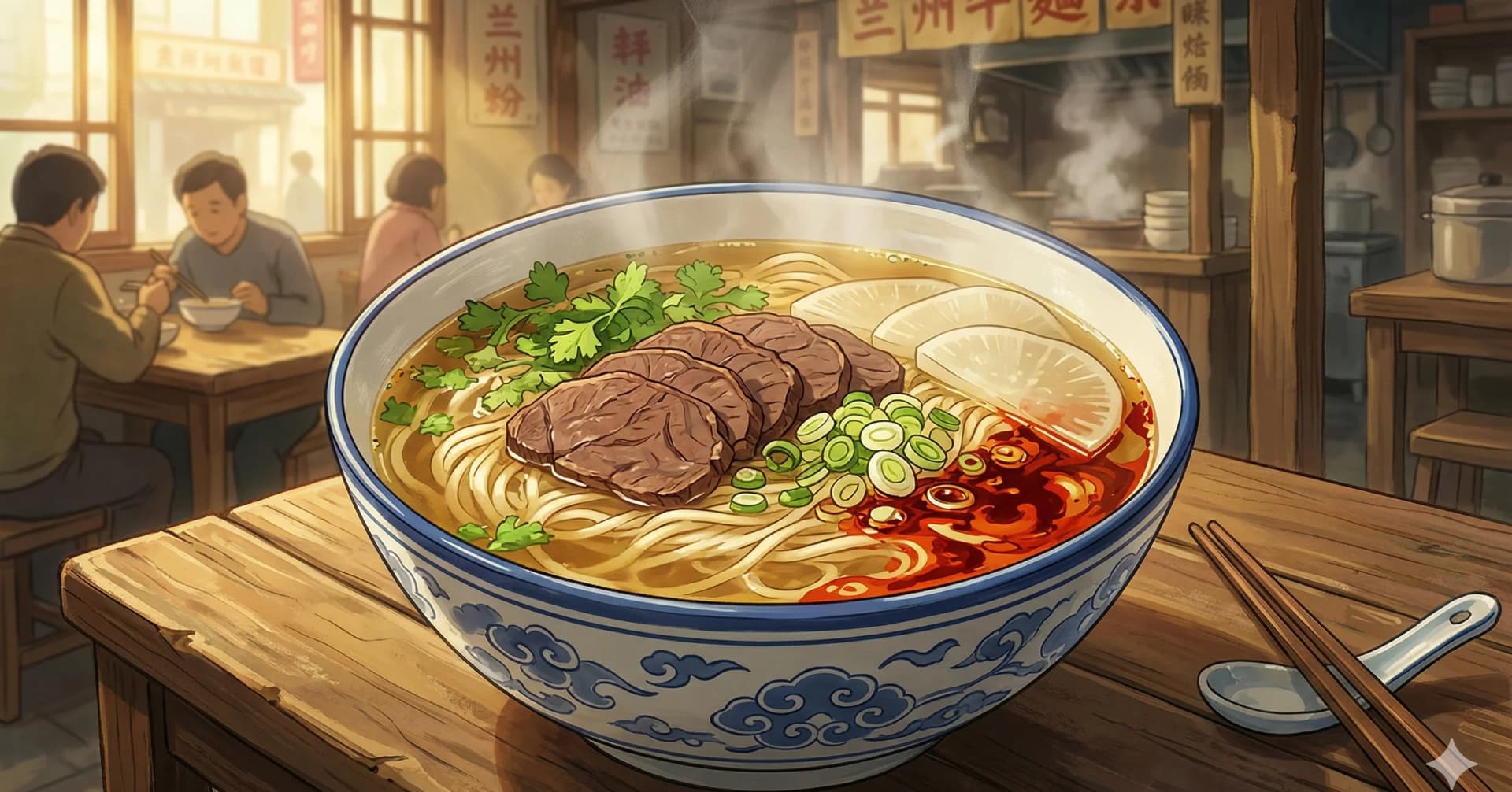
Lanzhou Beef Noodle Soup (兰州牛肉面)
A fragrant, clear-broth noodle soup built on slow-simmered beef, warm spices, tender daikon, and hand-pulled noodles
Walk into a Lanzhou noodle shop at six in the morning and the air hits you before anything else. Beefy, warm, faintly sweet from star anise and cinnamon, with a clean edge of white pepper cutting through the steam. The broth has been simmering since before dawn. The noodle puller is already working a rope of dough into a smooth, elastic strand, stretching and folding with a rhythm that looks effortless but takes years to perfect.
Lanzhou beef noodle soup is one of China's most beloved street foods, originating from the predominantly Muslim Hui community in Gansu province. Its identity rests on five elements: clear broth, white radish, red chili oil, green cilantro, and yellow noodles. Every bowl is built in that order, and every bowl follows the same philosophy. The broth must be honest. The spice must be aromatic, not heavy. The noodles must be fresh.
The spice blend is what separates this soup from other Chinese beef noodle soups. Where Taiwanese Beef Noodle Soup uses doubanjiang and soy sauce to build a dark, braised flavor, Lanzhou noodle soup depends on a delicate combination of sand ginger, licorice root, fennel, cumin, and white peppercorn. These warm the broth from the inside without muddying its color or weighing it down. Roasting the bones first builds depth without requiring a dark soy reduction.
The chili oil is not optional. It brings heat, color, and fragrance in one spoonful, transforming the pale gold broth into something vivid. A single drizzle is enough to change the character of the entire bowl.
At a Glance
Yield
6 servings
Prep
20 minutes
Cook
2 hours 40 minutes
Total
3 hours
Difficulty
Medium
Ingredients
Broth Ingredients
- 3 lbbeef shank, in 2 to 3 large pieces
- 2beef marrow bones
- 3¼ qtwater
- 1½ tspsalt, or to taste
- 1 piecefresh ginger (about 5 cm), sliced
- 3 stalksscallion, cut into 8 cm pieces
- 2star anise
- 1small piece cassia cinnamon (about 5 cm)
- 2bay leaves
- 1 tspSichuan peppercorns
- 1 tspwhite peppercorns
- 1 pinchfennel seeds
- 1 pinchcumin seeds
- 2 piecessand ginger (sha jiang)
- ¼ ozground licorice root (or 4 slices licorice root)
- 3dried red chilies
- 1 lbdaikon (Chinese white radish) (about 5½–6 radishes), peeled and sliced into thin half-moons
Noodle Ingredients
- 6portions hand-pulled noodles or fresh wheat noodles (about 680 g total)
Chili Oil Ingredients
- ¾ cupneutral oil
- 2star anise
- 1/2small cinnamon stick
- ⅓ tspSichuan peppercorns
- 1½ tbspcrushed red pepper flakes
- 1 tspsalt
- ¼ tspsugar
Method
- 1
Blanch the beef and bones. Place the beef shank and marrow bones in a large stockpot and cover with cold water. Bring to a rolling boil over high heat. You will see a thick layer of grey foam rise to the surface. Boil for 3 to 4 minutes, then drain everything and rinse the meat and bones under running water. Scrub the pot clean. This step removes blood and impurities so the finished broth will be clear and clean-tasting.
- 2
Build the broth. Return the blanched beef shank and bones to the clean pot. Add 13 cups of fresh water, the sliced ginger, and scallion pieces. Place all the spice bag ingredients into a piece of cheesecloth, tie securely, and add to the pot. Add the salt. Bring to a boil over high heat.
- 3
Simmer low and slow. Reduce the heat to low and maintain a very gentle simmer. The surface should barely ripple. Skim any foam that rises during the first 15 minutes. Simmer for 2 hours, or until the beef shank is completely tender and a chopstick slides through the thickest part with no resistance.
- 4
Remove the beef. Transfer the beef shank to a plate and cover loosely. Let it cool enough to handle, then slice against the grain into thin pieces about 1/8 inch thick. Set aside. Remove and discard the spice bag, bones, ginger, and scallion pieces.
- 5
Cook the daikon. Add the sliced daikon to the broth and simmer for 15 to 20 minutes until the slices are translucent and soft enough to break with a spoon. Taste the broth and adjust salt.
- 6
Make the chili oil. In a small saucepan, combine the oil, star anise, cinnamon stick, and Sichuan peppercorns. Heat over very low heat for 12 to 15 minutes. The spices should sizzle gently but never darken or smoke. Remove the whole spices with a slotted spoon and let the oil cool for 5 minutes. Stir in the crushed red pepper flakes and let them toast in the residual heat until the oil turns a deep brick red, about 2 minutes. Stir in the salt and sugar. Let cool completely. Transfer to a glass jar.
- 7
Cook the noodles. Bring a separate large pot of water to a rolling boil. Cook the noodles according to package directions, or if using hand-pulled noodles, drop them in and cook for 2 to 3 minutes until they float and feel springy. Drain and rinse briefly under cold water to remove excess starch.
- 8
Assemble the bowls. Divide the noodles among 6 large bowls. Fan slices of beef shank over the noodles. Ladle the hot broth and daikon slices into each bowl. Drizzle generously with chili oil. Scatter fresh cilantro and sliced scallions over the top.
Key Ingredient Benefits
Beef shank: One of the most collagen-rich cuts, beef shank breaks down during long simmering to produce gelatin that gives the broth body. A properly made Lanzhou broth will set to a soft jelly when refrigerated, a sign that the collagen has been fully extracted.
Sand ginger (sha jiang): Also known as galangal or kaempferia galanga, this rhizome has a camphor-like aroma distinct from common ginger. Traditional Chinese medicine considers it warming and beneficial for digestive discomfort. It is available dried in slices at Chinese herbal shops.
Licorice root: Used in minute quantities to round out the broth's flavor. Glycyrrhizin, the active sweet compound, is roughly 50 times sweeter than sugar. In traditional Chinese medicine, licorice is considered a harmonizer that helps other herbs work together. Excessive consumption of licorice root can affect blood pressure, but the small quantities used in broth are well below levels of concern.
Daikon: Chinese white radish becomes sweet and silky when simmered. It is high in vitamin C and digestive enzymes, and traditional Chinese medicine considers it cooling, making it a deliberate balance against the warming spice blend.
Why This Works
The double-boil technique (blanching, then simmering in fresh water) is the single most important step for achieving the clear, golden broth that defines Lanzhou noodle soup. Skipping the blanch will leave the broth murky and slightly metallic. The brief initial boil forces impurities to the surface in concentrated form, and draining them away means the second simmer starts clean.
The spice blend works differently from most Chinese noodle soup seasoning. Rather than building flavor through fermented pastes and soy sauce, Lanzhou broth relies on whole spices steeped gently over hours. Sand ginger and licorice root are unusual additions that contribute a faintly medicinal, warm sweetness without any sugar. The effect is closer to a sophisticated broth than a stew. Wrapping the spices in cheesecloth allows easy removal and prevents gritty sediment.
Simmering the beef shank whole and slicing it after cooking is deliberate. Large pieces lose less moisture to the broth than cubed meat, resulting in slices that are tender and pink at the center rather than dry and stringy. Slicing against the grain after cooling ensures each piece is easy to bite through.
Substitutions & Variations
Noodles: If hand-pulled noodles are unavailable, use fresh Chinese wheat noodles (the thick, round variety sold refrigerated at Asian markets). Dried wheat noodles work in a pinch but will lack the chewy, elastic bite of fresh ones. For a related noodle technique, see Dao Xiao Mian, which uses a knife-shaving method instead of pulling.
Bones: A mix of beef and pork bones produces a richer broth. Some recipes add half a chicken carcass for additional body. If using chicken, remove it after 1 hour to prevent the broth from becoming too poultry-forward.
Sand ginger and licorice root: If these are hard to find, the soup will still be delicious without them, just less complex. Do not substitute fresh galangal, which has a different flavor profile.
Spice level: The chili oil is served on the side, so heat is adjustable per bowl. For a milder oil, reduce the red pepper flakes to 1 1/2 tablespoons.
Beef cut: Beef brisket or boneless short ribs can replace the shank, though shank produces the best combination of sliceable meat and collagen-rich broth.
Serving Suggestions
Lanzhou noodle soup is a complete meal, traditionally eaten for breakfast or lunch. In China, it is served with nothing more than the chili oil and garnishes already in the bowl. If you want a side, pickled mustard greens or a plate of sliced cucumber with vinegar and garlic would be appropriate.
For a noodle-focused dinner, serve alongside Dan Dan Noodles to contrast the clear, gentle broth of Lanzhou with the intense, nutty heat of Sichuan. Hot and Sour Soup makes a good starter if you want to build toward the main bowl. Finish with a simple bowl of Congee the next morning, made with any leftover broth stirred into the rice porridge.
Storage & Reheating
Broth and beef: Store the broth and sliced beef separately in airtight containers. The broth keeps refrigerated for up to 4 days and freezes well for up to 3 months. The sliced beef keeps refrigerated for 3 days. Reheat the broth gently on the stovetop until simmering before serving.
Chili oil: Keeps in a sealed glass jar in the refrigerator for up to 1 month. Let it come to room temperature before serving for the best flavor and fluidity.
Noodles: Cook noodles fresh for each serving. Cooked noodles stored in the fridge become gummy and lose their texture.
Daikon: The daikon can be stored in the broth and reheats well. It will absorb more broth flavor over time.
Cultural Notes
Lanzhou niu rou la mian (蘭州牛肉拉麵, "Lanzhou beef hand-pulled noodles") is the hand-pulled beef noodle soup that takes its name from Lanzhou, the capital of Gansu province on the upper Yellow River in northwest China. The dish is the central culinary identity of Lanzhou and one of the most widely franchised Chinese noodle dishes inside China, with thousands of Lanzhou-style noodle shops operating in every major Chinese city. The dish reflects the Hui Muslim culinary tradition of northwest China, where halal beef rather than pork is the standard protein and where the wheat-flour noodle tradition has deep roots.
The form is technically and stylistically codified by a saying called yi qing er bai san hong si lu wu huang (一清二白三紅四綠五黃): "one clear, two white, three red, four green, five yellow." The clear is the broth (a long-simmered beef bone stock seasoned with Chinese spices and finished with no thickeners). The white is the daikon radish slices that soften in the broth. The red is the chili oil that floats on the surface. The green is the chopped cilantro and garlic chives that go on top. The yellow is the noodles themselves, which acquire their distinctive color from a small amount of peng hui (alkaline water) worked into the dough. A bowl missing any of the five elements is treated as non-canonical in Lanzhou.
The noodle-pulling technique is performed in front of the customer at every authentic Lanzhou noodle shop. A trained noodle master takes a ball of rested dough, stretches it into a long rope, folds the rope in half, twists, and stretches again, doubling the number of strands with each fold. After eight to nine folds the rope contains two hundred and fifty-six strands, each about the thickness desired by the customer (Lanzhou shops offer a standard menu of widths from mao xi, capillary-thin, up through kuan, wide flat ribbons). The strands are flicked into the boiling broth, cooked for under a minute, and ladled into the bowl with the broth, sliced braised beef, daikon, chili oil, and herbs. The dish is meant to be eaten immediately, while the noodles are still bouncy and the broth steaming.
Nutrition Facts
Calories: 943kcal (47%)|Total Carbohydrates: 68.7g (25%)|Protein: 81.9g (164%)|Total Fat: 36.8g (47%)|Saturated Fat: 8.1g (41%)|Cholesterol: 198mg (66%)|Sodium: 1472mg (64%)|Dietary Fiber: 4.4g (16%)|Total Sugars: 3.6g
You Might Also Like

Ratings & Comments
Ratings & Comments
Ratings
Share your thoughts on this recipe.
Sign in to rate and comment