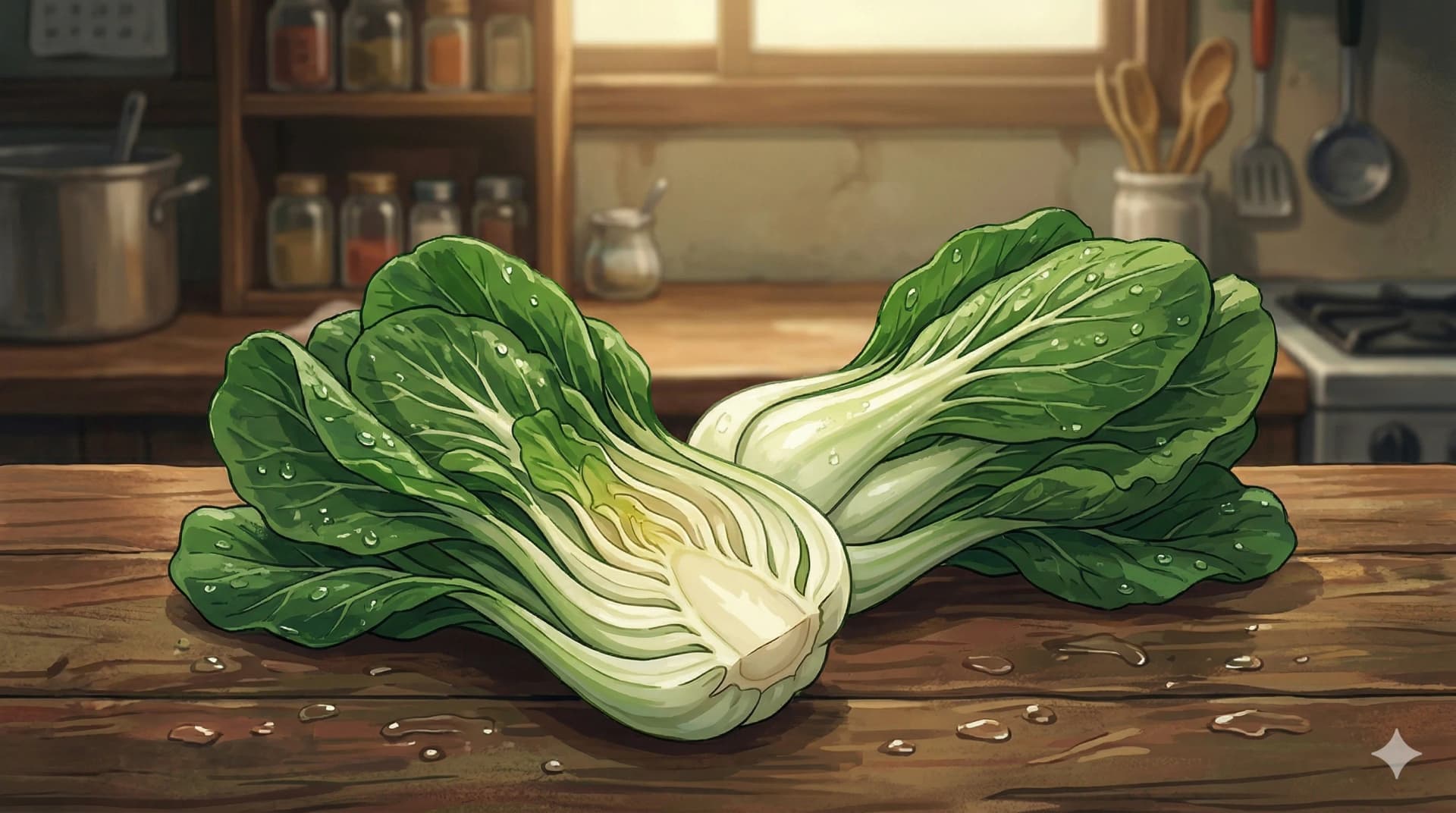
Bok Choy
Also known as: Pak Choi, Bai Cai, Chinese White Cabbage, Brassica rapa subsp. chinensis
Bok choy is one of the most recognizable Chinese vegetables — a compact brassica with crisp, juicy white stalks and dark, tender green leaves. The two parts cook at different rates and have distinct textures and flavors: the stalks are mild and slightly sweet, the leaves more tender and slightly bitter. It is one of the most widely consumed vegetables in Chinese cooking, appearing in stir-fries, soups, braises, and as a simple side dish blanched and dressed with oyster sauce.
Flavor Profile
Origin
China, East Asia
Traditional Medicine Perspectives
Traditional Chinese Medicine
Bok choy (Bai Cai) is classified as cool and sweet in TCM, associated with the Stomach, Large Intestine, and Lung meridians. It is used to clear heat, moisten dryness, detoxify, and support the Large Intestine. It is considered a gentle, safe vegetable appropriate for most constitutions, particularly those with heat conditions, dry cough, or constipation from heat and dryness.
Modern Scientific Research
Bok choy is exceptionally nutritious — it is rich in vitamins A, C, and K, folate, calcium, and glucosinolates. Glucosinolates in brassicas are precursors to isothiocyanates and indoles, compounds that have been studied for cancer-preventive properties in epidemiological research. Bok choy has among the highest calcium content of any common leafy vegetable.
Research on brassica consumption consistently shows associations with reduced cancer risk.
Cultural History
Bok choy has been cultivated in China for over five thousand years and is one of the oldest domesticated brassicas. It spread across East and Southeast Asia and is now grown globally. In Cantonese cooking, quickly blanched bok choy dressed with oyster sauce and sesame oil is a ubiquitous restaurant preparation that serves as a palate-cleansing vegetable course.
Different sizes are used for different purposes: large bok choy for braising, medium for stir-fries, baby bok choy for steaming and presentation.
Culinary Uses
Blanch and dress with oyster sauce and sesame oil for a classic Cantonese side. Stir-fry quickly in a very hot wok. Add to soups and hot pots.
Braise whole small heads in stock. Quarter and grill or roast. The leaves can be added to fried rice as a last-minute green.
Separating stalks and leaves and adding them at different times preserves the best texture of each.
Preparation Methods
Cut off the base, separate stalks, and wash well — grit hides at the base. For stir-fries, add stalks first, then leaves 30 seconds later. Blanch in boiling salted water for 60–90 seconds for a side dish.
Baby bok choy can be halved or quartered and cooked whole.
Traditional Dishes
- Oyster sauce bok choy
- Cantonese stir-fried greens
- Hot pot vegetable
- Braised bok choy with mushrooms
- Congee accompaniment
Comments
Share your thoughts on this ingredient.
Sign in to comment0 Comments