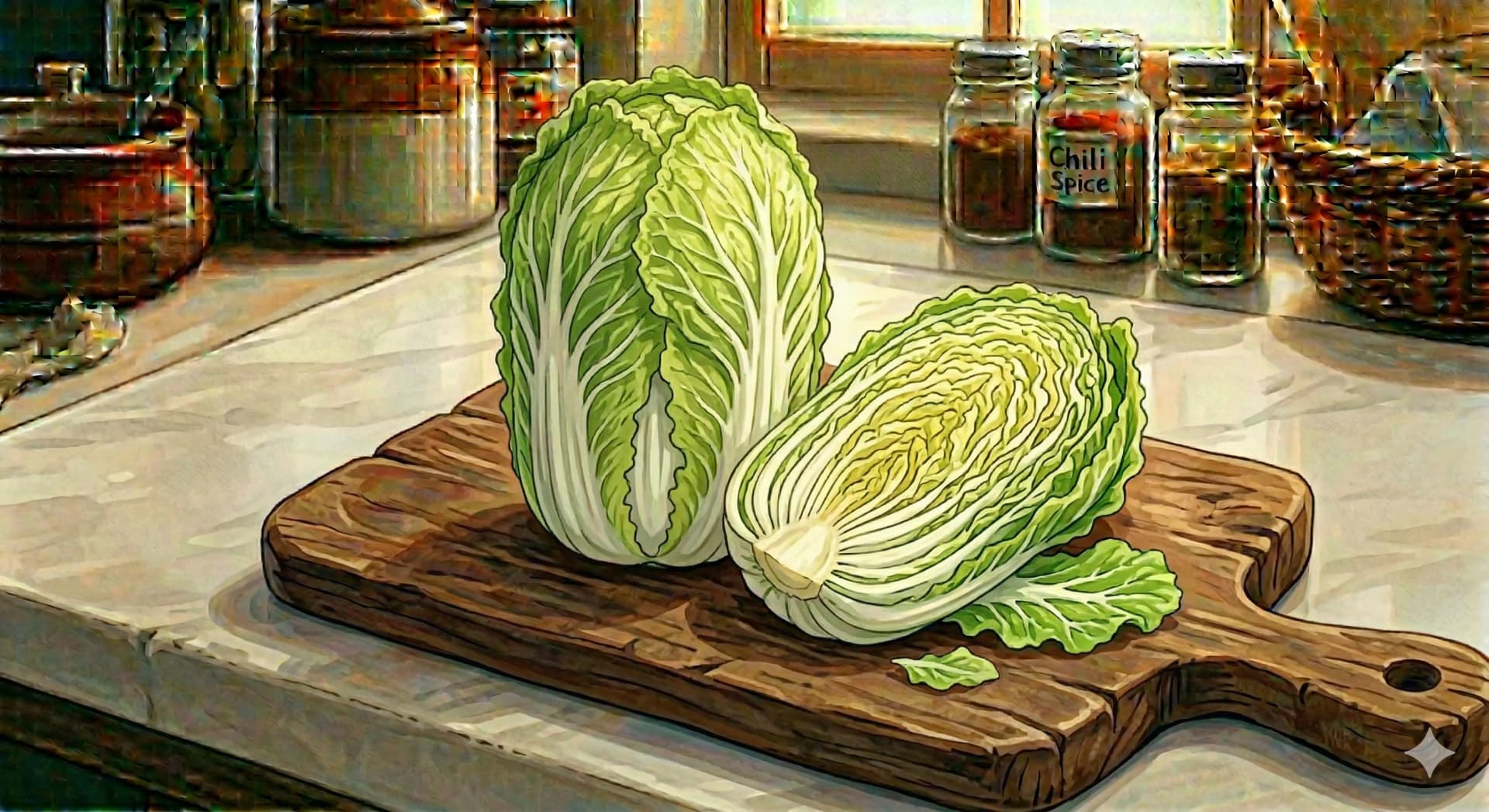
Napa Cabbage
Also known as: Da Bai Cai, Chinese Cabbage, Celery Cabbage, Brassica rapa subsp. pekinensis, Wong Bok
Napa cabbage is the large, pale green, barrel-shaped cabbage with crinkled leaves and a mild, slightly sweet flavor that is one of the most consumed vegetables in all of East Asian cooking. Unlike round Western cabbage, napa cabbage is tender enough to eat raw in salads, quick enough to stir-fry at high heat, and sturdy enough to survive long braises and fermentation.
It is the vegetable that becomes kimchi, that fills the best dumplings, and that makes the simplest braised pork extraordinary.
Key facts at a glance:
- Barrel-shaped brassica — mild, slightly sweet, and remarkably versatile
- Cultivated over 1,000 years — the dominant winter vegetable of northern China
- Essential to kimchi — and Dongbei suan cai (sour cabbage)
- Rich in vitamins C and K — plus glucosinolates with cancer-preventive associations
- Fermented forms — studied for probiotic content and gut health benefits
Flavor Profile
Origin
Northern China, China, Korea
Traditional Medicine Perspectives
Traditional Chinese Medicine
Napa cabbage (Da Bai Cai) is classified as neutral to cool and sweet in TCM, associated with the Stomach and Large Intestine. It is used to moisten dryness, clear heat, and support the Large Intestine. It is considered a gentle, nourishing vegetable appropriate for most constitutions. In winter, when fresh vegetables are scarce in northern China, napa cabbage has been the primary source of both nutrition and medicinal food for generations.
Modern Scientific Research
Napa cabbage is rich in vitamins C and K, folate, and glucosinolates. Research on brassica glucosinolates and their metabolites shows consistent cancer-preventive associations.
Fermented napa cabbage (sauerkraut, kimchi) has been studied for its probiotic content and associated gut health benefits, including improved microbiome diversity and immune function. The fermentation process increases bioavailability of certain nutrients.
Cultural History
Napa cabbage has been cultivated in northern China for over a thousand years and became the dominant winter vegetable across northern and northeastern China before modern refrigeration.
In the northeast (Dongbei), where winters are severe, napa cabbage was pickled in enormous quantities in autumn — suan cai (sour cabbage) — to provide vegetables through the long winter. The same preservation tradition in Korea produced kimchi.
In northern Chinese cooking, napa cabbage appears in dumplings, stir-fries, braises, and soups with an everyday familiarity that reflects its status as a fundamental staple.
Culinary Uses
Use in dumpling fillings — salt, squeeze dry, and combine with pork and aromatics. Braise whole with stock, oyster sauce, and mushrooms for a classic winter preparation.
Stir-fry quickly with garlic at high heat. Ferment for suan cai or kimchi. Add to hot pots and soups. Use raw in slaws and salads.
Preparation Methods
For dumpling fillings: salt shredded cabbage generously, let sit 20 minutes, then squeeze out all liquid — this is critical for a non-soggy filling.
For stir-fries: separate leaves, cut into bite-sized pieces, and cook in batches if necessary to avoid steaming. The white stem parts take longer than the leafy parts.
Traditional Dishes
- Pork and cabbage dumplings (shui jiao)
- Braised napa cabbage with mushrooms
- Dongbei suan cai hot pot
- Kimchi (Korean)
- Napa cabbage and vermicelli soup
Recipes Using Napa Cabbage
- Napa Cabbage Kimchi (통배추김치)
- Guo Tie (Potstickers)
- Jjajangmyeon (Black Bean Sauce Noodles)
- Gamjatang (Pork Bone Soup)
- Haejangguk (Pork Bone Hangover Soup)
- Jjamppong (Spicy Seafood Noodle Soup)
- Thai Sour Curry (Gaeng Som)
- Shi Zi Tou (Lion's Head Meatballs)
- Sizzling Rice Soup (鍋巴湯)
- Shabu-Shabu (Japanese Hot Pot)
Comments
Share your thoughts on this ingredient.
Sign in to comment0 Comments