Cross-Cultural · Korea
Napa Cabbage Kimchi (통배추김치)
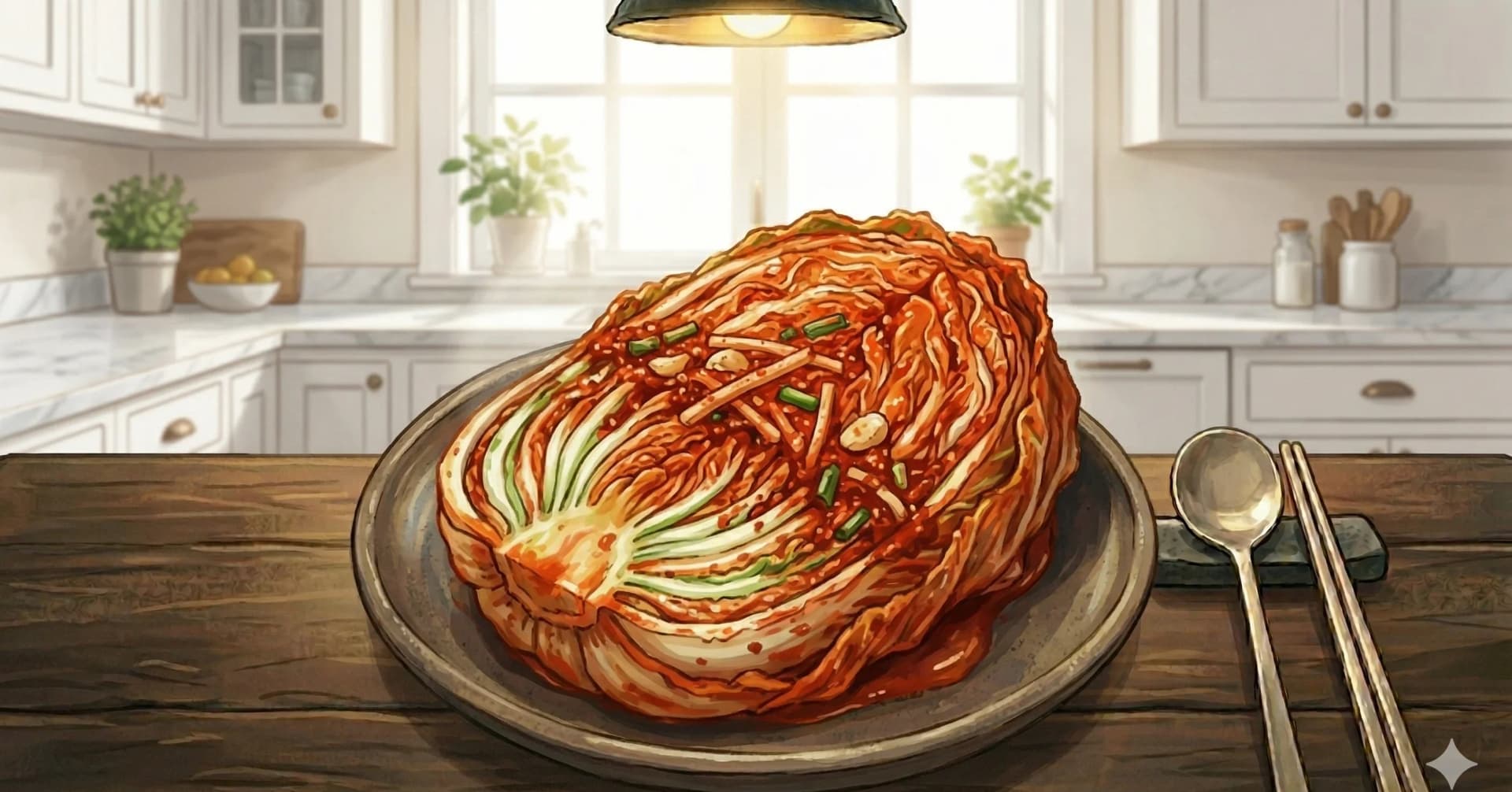
Traditional whole-leaf napa cabbage kimchi salted, stuffed with a gochugaru-fish sauce-garlic paste, and fermented for complex sour, spicy, umami flavor
Kimchi is the single most important food in Korean cooking. It appears at every meal, breakfast through dinner, and the act of making it, kimjang, is a communal ritual that UNESCO has recognized as an Intangible Cultural Heritage of Humanity. Every Korean family has their own recipe, adjusted over generations, and the variations are endless. This is the traditional tongbaechu version: whole cabbage leaves, salted, rinsed, and packed with a paste of gochugaru, fish sauce, garlic, ginger, and rice flour porridge.
The process takes time but very little skill. You salt the quartered cabbage for six to eight hours until the thick white parts bend without snapping. You rinse it three times and drain it. You make a rice flour paste that will feed the lactobacillus bacteria during fermentation. You build the kimchi paste, a vivid red mixture of gochugaru, fish sauce, garlic, ginger, and blended onion. You fold in matchstick radish, carrot, scallions, and chives. Then you work through the cabbage, spreading the paste between every leaf, and fold each quarter into a tight bundle.
The bundles go into an airtight container, pressed down to eliminate air pockets, and sit at room temperature for one to two days. During this time, the lactobacillus bacteria produce lactic acid, carbon dioxide, and the complex sour-spicy-umami flavor that makes kimchi kimchi. Then it goes into the refrigerator, where fermentation continues slowly for weeks and months. Fresh kimchi is mild and bright. Week-old kimchi is tangy. Month-old kimchi is deeply sour and complex, the kind that makes the best kimchi jjigae and kimchi fried rice.
At a Glance
Yield
about 1 gallon
Prep
1 hour
Cook
0 minutes
Total
8 hours plus 1-2 days fermentation
Difficulty
Medium
Ingredients
Cabbage Ingredients
- 5.7 lbsnapa cabbage (2.6 kg), 3-4 medium heads
- 1/2 cupcoarse sea salt, Korean or kosher
Rice Paste Ingredients
- 2 cupswater
- 2 tbspglutinous rice flour
- 2 tbspbrown sugar
Paste Ingredients
- 1 cupgochugaru, Korean red pepper flakes; up to 2 cups for spicier
- 1/4-1/2 cupfish sauce
- 24garlic cloves (about 1½ bulbs), minced or blended
- 1 inchfresh ginger, minced or blended
- 1medium onion, blended
Vegetable Ingredients
- 2 cupsKorean radish, cut into matchsticks
- 1 cupcarrot, cut into matchsticks
- 1 cupscallions, chopped
- 1 cupAsian chives (buchu), cut into 1-inch pieces
Method
- 1
Salt the cabbage. Quarter each head lengthwise. Sprinkle coarse salt between the leaves, concentrating on the thick white parts. Let sit 6-8 hours or overnight, turning halfway. Done when thick parts bend without snapping.
- 2
Rinse the cabbage 3 times under cold running water. Drain in a colander 30 min to 1 hour.
- 3
Make rice paste. Combine 2 cups water and glutinous rice flour in a pot over medium heat, stirring until thick and bubbly. Add sugar, stir, remove from heat. Cool completely.
- 4
Make kimchi paste. Combine cooled rice paste with gochugaru, fish sauce, minced garlic, ginger, and blended onion. Mix well.
- 5
Add vegetables. Fold in radish matchsticks, carrot, scallions, and chives.
- 6
Stuff the cabbage. Working one quarter at a time, spread paste generously between every leaf. Fold the outer leaf around to form a tight bundle.
- 7
Pack tightly into an airtight container, pressing down to remove air pockets.
- 8
Ferment at room temperature 1-2 days, then refrigerate. Continues fermenting slowly for weeks.
Key Ingredient Benefits
Napa cabbage: The defining vegetable of Korean kimchi. Its loosely packed leaves with thick white ribs hold salt and seasoning paste exceptionally well, and the high water content drains down during salting to leave behind a denser, chewier leaf that ferments cleanly. Napa is high in vitamin C, vitamin K, and folate, and the fermentation process actually increases the bioavailability of several of these nutrients.
Gochugaru: Sun-dried Korean chili pepper, coarsely ground. The slow drying preserves capsanthin pigment and a fruity, smoky depth you do not get from generic chili powder. Gochugaru also feeds the lactic acid bacteria during fermentation by providing accessible sugars from the chili flesh.
Fish sauce: The umami engine. Made from anchovies fermented with salt for months, fish sauce contributes free glutamates and nucleotides that give kimchi its profound savoriness even before fermentation begins. The amino acid content is what makes well-fermented kimchi taste like more than just spicy pickled cabbage.
Garlic and ginger: Both contribute organosulfur compounds and antimicrobial agents that help shape which microbes dominate during fermentation. Studies on traditional kimchi have identified specific Lactobacillus and Leuconostoc strains that thrive in the garlic-ginger-rich environment, producing the characteristic sour-fizzy quality of mature kimchi.
Why This Works
Salting the cabbage is the most important step, and the easiest one to rush. The salt draws water out of the leaves through osmosis, concentrating the cabbage's own sugars and creating a dense, chewy base that will not turn mushy during fermentation. Cabbage that bends without snapping when you pick up a quartered piece is properly salted. Cabbage that snaps is still too crisp; cabbage that flops limply has been salted too long.
The glutinous rice paste is a quiet workhorse. Cooked starch broken down with sugar provides a steady carbohydrate source for the lactic acid bacteria, jump-starting fermentation and giving the paste enough body to coat every leaf evenly.
Gochugaru, fish sauce, garlic, and ginger together do two jobs. They flavor the kimchi, but they also engineer the microbial environment. The salt and the antimicrobial compounds in garlic and ginger suppress unwanted bacteria, while the chili and sugar feed the Lactobacillus strains that produce lactic acid. The result is a controlled fermentation that consistently produces the same sour-spicy-umami flavor across batches.
Room-temperature fermentation for one to two days kicks the bacteria into high gear, then refrigeration slows them down without stopping them entirely. Mature kimchi continues to develop flavor for months in the fridge. Fresh kimchi is mild and bright; month-old kimchi is deeply sour, complex, and ideal for kimchi jjigae and kimchi fried rice.
Substitutions & Variations
Napa cabbage: Bok choy can be used for a smaller, faster-fermenting version (often called bok choy kimchi or baechu kimchi), but the texture and bite are different. Regular green cabbage is denser and produces a chewier kimchi with longer fermentation. Use a one-to-one weight substitution.
Gochugaru: There is no genuine substitute. A blend of sweet paprika and cayenne (3 to 1 ratio) approximates the color and heat for emergency situations, but the flavor will be flatter. Do not use Indian or Mexican chili powders, which have different aromatic profiles.
Fish sauce: For a vegan version, use a combination of soy sauce and miso paste (about 3 tablespoons soy sauce plus 1 tablespoon miso for every 1/4 cup fish sauce). The umami will be slightly different but recognizably savory. Some traditional Korean temple kimchi recipes skip fish sauce entirely and rely on extra dried mushroom powder.
Korean radish (mu): Daikon is a direct substitute and very common outside of Korea. Watermelon radish or even regular red radishes will work but produce a sharper, less sweet result.
Asian chives (buchu): Garlic chives or even fresh chives plus extra scallions can fill in. The flavor will be milder and less pungent.
Glutinous rice flour: Regular rice flour or even cornstarch will work in a pinch. The paste will be less elastic but still functional as a binder.
Serving Suggestions
Kimchi is the most versatile ingredient in the Korean kitchen. At its simplest, serve it chilled, straight from the jar, alongside any Korean meal as banchan. A small dish of kimchi with steamed rice and a fried egg is a complete breakfast in many Korean households.
As kimchi ages and turns more sour, it becomes the foundation for some of Korea's most beloved cooked dishes: kimchi jjigae, kimchi fried rice, kimchijeon (kimchi pancakes), and bossam (boiled pork wraps). Save your most aggressive, sour, slightly fizzy kimchi for these. Fresh kimchi is too mild to carry a stew.
For non-Korean meals, kimchi pairs surprisingly well with grilled cheese, scrambled eggs, hot dogs, ramen, and tacos. It cuts through fat with a clean, acidic snap.
Storage & Reheating
Room temperature fermentation: After packing the kimchi into containers, leave at room temperature (around 20°C / 68°F) for 1 to 2 days. You will see small bubbles forming and smell a slightly sour, fizzy aroma when fermentation has begun. In a warmer kitchen this happens faster; in a cooler one, give it the full 2 days.
Refrigerator: Once moved to the fridge, kimchi keeps for months and continues to ferment slowly. Fresh kimchi (1 to 2 weeks old) is mild and crunchy. Month-old kimchi is deeply sour and ideal for cooking. Six-month-old kimchi is intensely funky, almost cheesy, and prized for stews. Properly fermented kimchi rarely "goes bad" in the conventional sense; it just gets more sour over time.
Container choice: Use a non-reactive container (glass, ceramic, or food-grade plastic) with a tight lid. Press the kimchi down firmly to eliminate air pockets, which can cause oxidation and white film (kahm yeast). The brine should cover the cabbage.
Freezing: Possible but not recommended. The cabbage texture suffers significantly. If you must freeze it, use the kimchi only for cooking afterward, never raw.
Cultural Notes
Kimchi is not a single dish but a category of fermented vegetable preparations that anchors every Korean meal. The making of kimchi for the winter, called kimjang (김장), was added to UNESCO's list of Intangible Cultural Heritage of Humanity in 2013 — a recognition not just of the food but of the communal practice of women, families, and neighbors gathering to make hundreds of cabbages worth of kimchi together each November.
Tongbaechu kimchi, the whole-cabbage version made here, is the form most Koreans mean when they say "kimchi" without qualification. There are over 200 documented regional varieties, ranging from the bright, sweet baek kimchi (white kimchi without chili) of the colder northern regions to the funky, gochugaru-heavy varieties of Jeolla province in the south. Family recipes are guarded and passed through generations, and many Korean families still ferment their kimchi in traditional clay onggi pots buried partially in the ground.
The chili pepper that defines modern kimchi only arrived in Korea in the 17th century via Portuguese traders in Japan. Before that, kimchi was made with salt, ginger, garlic, and Sichuan peppercorn, more like the white kimchi served today. The transformation of kimchi by gochugaru is one of the great culinary borrowings in Asian food history, parallel to the way the chili reshaped Sichuan, Thai, and Indian cooking in the same era.
Nutrition Facts
Calories: 115kcal (6%)|Total Carbohydrates: 21.8g (8%)|Protein: 5.8g (12%)|Total Fat: 1.3g (2%)|Saturated Fat: 0.2g (1%)|Cholesterol: 0mg (0%)|Sodium: 4366mg (190%)|Dietary Fiber: 7.8g (28%)|Total Sugars: 8.1g
You Might Also Like
Ratings & Comments
Ratings & Comments
Ratings
Share your thoughts on this recipe.
Sign in to rate and comment