Thai Cuisine
Panang Curry
Thick, peanut-laced coconut curry with pork, makrut lime and toasted spice paste
Open a pot of panang curry and the first thing that reaches you is the scent of makrut lime, bright and almost floral, lifting through a base of roasted peanut and toasted cumin. The sauce is not soupy like a red curry or green curry. It clings. It coats. It is thick and deeply concentrated, more like a rich, fragrant glaze than a broth-based stew.
Panang (sometimes spelled phanaeng) is one of the most beloved curries across Thailand, and it occupies a distinct place in the Thai curry family. Where massaman curry borrows from Persian spice traditions and green curry leans on raw heat, panang sits in the middle: warm, nutty, and aromatic without being aggressively hot. The name likely traces to the Malay word "phanae," meaning cross-legged, though the etymology is debated. What is not debated is the role of peanuts, which are ground directly into the paste to thicken and enrich the sauce in a way that no other Thai curry achieves.
The technique that matters most here is reducing the coconut cream before adding the paste. You want to drive off water and concentrate the fat until the surface shimmers and the cream begins to separate. This creates a frying medium rather than a simmering liquid, and that distinction is everything. When the curry paste hits hot coconut fat, its aromatics bloom rapidly. The spices toast, the shrimp paste caramelizes, and the dried chilies release their color into the oil. Skipping this step, or rushing it, produces a flat, one-note sauce.
This recipe uses pork tenderloin, the most traditional protein for panang in Thailand, though chicken thigh works well too. The result is a small amount of intensely flavored sauce over tender meat, best served with plenty of steamed jasmine rice.
At a Glance
Yield
2 servings
Prep
25 minutes
Cook
10 minutes
Total
35 minutes (plus 20 minutes if making paste from scratch)
Difficulty
Easy
Ingredients
Curry Ingredients
- ¼ cuppanang curry paste, store-bought or homemade (see below)
- ¾ lbpork tenderloin or pork collar, sliced thinly against the grain (about 3 mm thick)
- 1¼ cupfull-fat coconut milk
- 2 tspneutral oil
- 1½ tspfish sauce, plus more to taste
- 1½ tbsppalm sugar, finely chopped (or light brown sugar)
- 7makrut lime leaves, roughly torn into large pieces
- 3makrut lime leaves, finely julienned, for garnish
- 1 ozred bell pepper, julienned, for garnish (optional)
- —Steamed jasmine rice, for serving
Curry Paste Ingredients
- ¼ ozdried mild chilies (guajillo or puya), stems removed, seeds shaken out
- ½ tspcoarse salt
- 1⅞ tspcumin seeds, toasted
- 1¼ tbspcoriander seeds, toasted
- ⅓ tspwhite peppercorns
- 1 ozlemongrass (bottom half only), finely sliced
- ¼ ozgalangal, finely sliced
- ¼ ozmakrut lime zest
- 2cilantro roots or 6 cilantro stems, chopped
- 3¼ tbspgarlic, roughly chopped
- 1 ozshallots, roughly chopped
- ¼ ozfermented shrimp paste (gapi)
- ¾ ozroasted unsalted peanuts
Semi-Homemade Paste Ingredients
- ¼ cupstore-bought red curry paste (Maeploy or Aroy-D recommended)
- 1⅞ tspcumin seeds, toasted
- 1¼ tbspcoriander seeds, toasted
- ¾ ozroasted unsalted peanuts
- ¼ ozfermented shrimp paste (gapi), optional
Method
- 1
If making the homemade paste, start by soaking the dried chilies in hot water for 15 minutes until they soften and become pliable. Drain and squeeze out excess water. Toast the cumin and coriander seeds in a dry pan over medium heat for 2 minutes, shaking frequently, until they smell warm and nutty. Grind the toasted seeds and white peppercorns to a fine powder in a mortar or spice grinder. Add all remaining paste ingredients and pound or process until smooth. The paste should be a deep red-orange color with no large fibrous pieces remaining. For the semi-homemade option, grind the toasted cumin, coriander, and peanuts together, then mix thoroughly into the store-bought red curry paste along with the shrimp paste.
- 2
Spoon about 80 ml of the thickest part of the coconut milk (the cream that rises to the top of the can) into a wok or large skillet set over medium-high heat. Let it come to a simmer without stirring. After 2 to 3 minutes, the cream will begin to reduce and the surface will look oily and slightly broken. Small bubbles of clear coconut fat will appear around the edges. This is the separation point you are looking for.
- 3
Add the curry paste to the separated coconut cream. Stir continuously for 1 to 2 minutes. The paste will sizzle in the coconut fat, darken slightly, and release a strong, fragrant aroma. You should see small pools of reddish oil bubbling around the paste. The kitchen will smell of toasted spice and roasted peanut.
- 4
Add the palm sugar and the 7 torn makrut lime leaves. Stir until the sugar dissolves completely, about 30 seconds. The sauce will become glossy and slightly thicker.
- 5
Add the sliced pork and toss to coat every piece in the paste. Let the pork cook for about 1 minute, stirring occasionally, until the outside of the slices turns opaque.
- 6
Pour in the remaining coconut milk. Stir gently to combine everything into a uniform sauce. Reduce the heat to medium and simmer for 2 to 3 minutes until the pork is just cooked through. The sauce should be thick enough to coat the back of a spoon. It should not be watery or soupy. If using chicken thigh, it may need an extra minute.
- 7
Remove from heat. Add the fish sauce and taste. The flavor should be rich, slightly sweet, nutty, and savory, with a gentle warmth rather than sharp heat. Adjust with more fish sauce if you want more salt depth or a pinch more sugar if the balance leans too savory. Stir in the red bell pepper strips if using.
- 8
Spoon the curry over steamed jasmine rice. Drizzle a small amount of coconut cream from the can over the top. Scatter the julienned makrut lime leaves over the surface. The lime ribbons will release their fragrance from the residual heat.
Key Ingredient Benefits
Coconut milk: Full-fat coconut milk is essential. Light or reduced-fat versions will not separate properly, and the paste will simmer rather than fry. Look for brands where the ingredients list only coconut and water, with no added stabilizers or gums. Aroy-D and Chaokoh are reliable. Coconut milk is high in saturated fat, primarily lauric acid. Research on coconut fat and cardiovascular health is ongoing; consumed in moderation as part of a varied diet, it does not appear to present the same risk profile as dairy-derived saturated fat.
Makrut lime leaves: Sometimes labeled as kaffir lime leaves. They provide a bright, citrus-floral note that is irreplaceable in panang. Fresh leaves are best, frozen are acceptable, dried are a last resort. The essential oils in fresh leaves are volatile and dissipate quickly with prolonged cooking, which is why torn leaves go into the sauce early for depth and julienned leaves are added at the end for aroma.
Fermented shrimp paste (gapi): A dense, salty paste of fermented shrimp that provides deep umami. It smells pungent on its own but becomes mellow and savory once cooked into the paste. If you are allergic to shellfish, omit it entirely and increase the fish sauce by 5 ml.
Peanuts: A tree-nut-free legume, but a common allergen. If working around a peanut allergy, sunflower seeds or roasted cashews can approximate the texture and fat contribution, though the flavor will shift.
Palm sugar: Less refined than white sugar, with a mild caramel, almost butterscotch quality. Light brown sugar is a reasonable substitute. The sweetness in panang curry is not decorative. It balances the salt from fish sauce and the heat from dried chilies, creating the rounded flavor that defines the dish.
Why This Works
Reducing the coconut cream before adding the paste is the single most important step. Full-fat coconut milk is an emulsion of coconut fat, water, and protein. When you heat it past the point where the emulsion breaks, the fat separates and becomes a frying medium. The curry paste then fries in coconut oil rather than simmering in coconut water. This extraction of fat-soluble compounds from the paste, particularly from the dried chilies and toasted spices, produces a far more aromatic and deeply colored sauce.
Peanuts in the paste serve two purposes. They contribute a subtle, roasted nuttiness that distinguishes panang from other Thai curries. More importantly, they act as a natural thickener. Ground peanuts absorb liquid and release their starch and fat into the sauce, creating the characteristic body without the need for flour or cornstarch.
Toasted cumin and coriander seeds at a higher ratio than in standard red curry paste give panang its distinctive warm, earthy backbone. These two spices, present in smaller amounts in most Thai curry pastes, are amplified here to create the flavor profile that sets panang apart.
Adding the pork after the paste is fried ensures the meat absorbs flavor from the concentrated sauce rather than releasing moisture that would dilute it. Thin slicing against the grain keeps the pork tender and allows it to cook through in minutes without toughening.
Substitutions & Variations
- Protein: Chicken thigh (boneless, sliced 1 cm thick) is the most common alternative. Beef flank or chuck, sliced thinly, also works but benefits from a longer simmer of 8 to 10 minutes. Prawns can be added in the last 2 minutes of cooking. For a vegan version, use pan-fried firm tofu, replace fish sauce with soy sauce, and omit the shrimp paste.
- Store-bought paste: If you cannot find panang-specific paste, use red curry paste and add 4 g toasted ground cumin, 7 g toasted ground coriander, and 15 g ground roasted peanuts.
- Nutmeg addition: A pinch of freshly grated nutmeg (about 0.5 g) added to the paste is a technique from some Bangkok recipes that adds a subtle warm sweetness. It is not traditional to all versions but worth trying.
- Thai basil finish: Some cooks stir in a handful of Thai basil leaves just before serving. This is more common in restaurant-style panang and adds an anise-like freshness. It sits nicely alongside the makrut lime.
- Green beans: Adding 100 g trimmed and halved green beans with the coconut milk is a popular variation outside Thailand. The beans add color and a slight crunch to the otherwise sauce-heavy dish.
- Spicier paste: Replace half the mild dried chilies with Thai bird's eye chilies or arbol chilies for more heat. The flavor will shift slightly toward sharper, more direct spice.
Serving Suggestions
- Over steamed jasmine rice. This is the default and correct pairing, allowing the thick sauce to mingle with the grains.
- Alongside pad thai for a full Thai spread.
- With larb and som tam as part of a shared table. The richness of panang balances the sharp, bright acidity of a green papaya salad.
- Next to gai yang (grilled chicken) with sticky rice for a northeastern-meets-central Thai combination.
- With roti or paratha for scooping up the thick sauce, a common pairing in Thai-Muslim restaurants.
- As a weeknight meal-prep dish. The sauce reheats well, and portions hold their flavor for several days.
Storage & Reheating
Panang curry stores well in the refrigerator for up to 5 days in a sealed container. The sauce will thicken further as it cools due to the coconut fat solidifying. Reheat gently over medium-low heat, stirring frequently, until the sauce loosens and the pork is warmed through. Do not boil vigorously or the pork will toughen. Add a splash of coconut milk or water if the sauce has reduced too much. The curry can be frozen for up to 2 months. Thaw overnight in the refrigerator before reheating. Leftover curry paste (if you made a double batch) freezes particularly well. Portion it into ice cube trays, freeze solid, then transfer to a zip-lock bag. Each cube is roughly one serving's worth of paste.
Cultural Notes
Phanaeng curry (พะแนง, also spelled panang or panaeng) is the thicker, drier, peanut-spiked cousin of red curry. The name's origin is debated. The traditional explanation links it to the Malaysian island of Penang, suggesting Malay-Thai trade influence; more recent scholarship leans toward a Thai-internal derivation from phanaeng, an old Thai word describing a crisscrossed butchering method for the duck or chicken used in the original court preparation. Either way, the dish is treated as a central Thai royal-court curry rather than a regional southern dish, and it sits firmly in the same culinary family as red curry, green curry, and massaman curry.
The defining characteristic of phanaeng is texture. Where red curry is built loose enough to spoon over rice, phanaeng is reduced until the curry clings to the meat as a thick paste with just enough oil-and-coconut-cream pooling around the meat to make the dish glossy. The curry paste includes the standard red-curry base of dried red chilies, shallots, garlic, lemongrass, galangal, kaffir lime peel, and shrimp paste, plus a generous addition of ground roasted peanuts that thickens the final dish and contributes a faint nutty sweetness. Beef is the most traditional protein; pork, chicken, and duck versions are also common, and the meat is typically cut larger and cooked longer than for red curry.
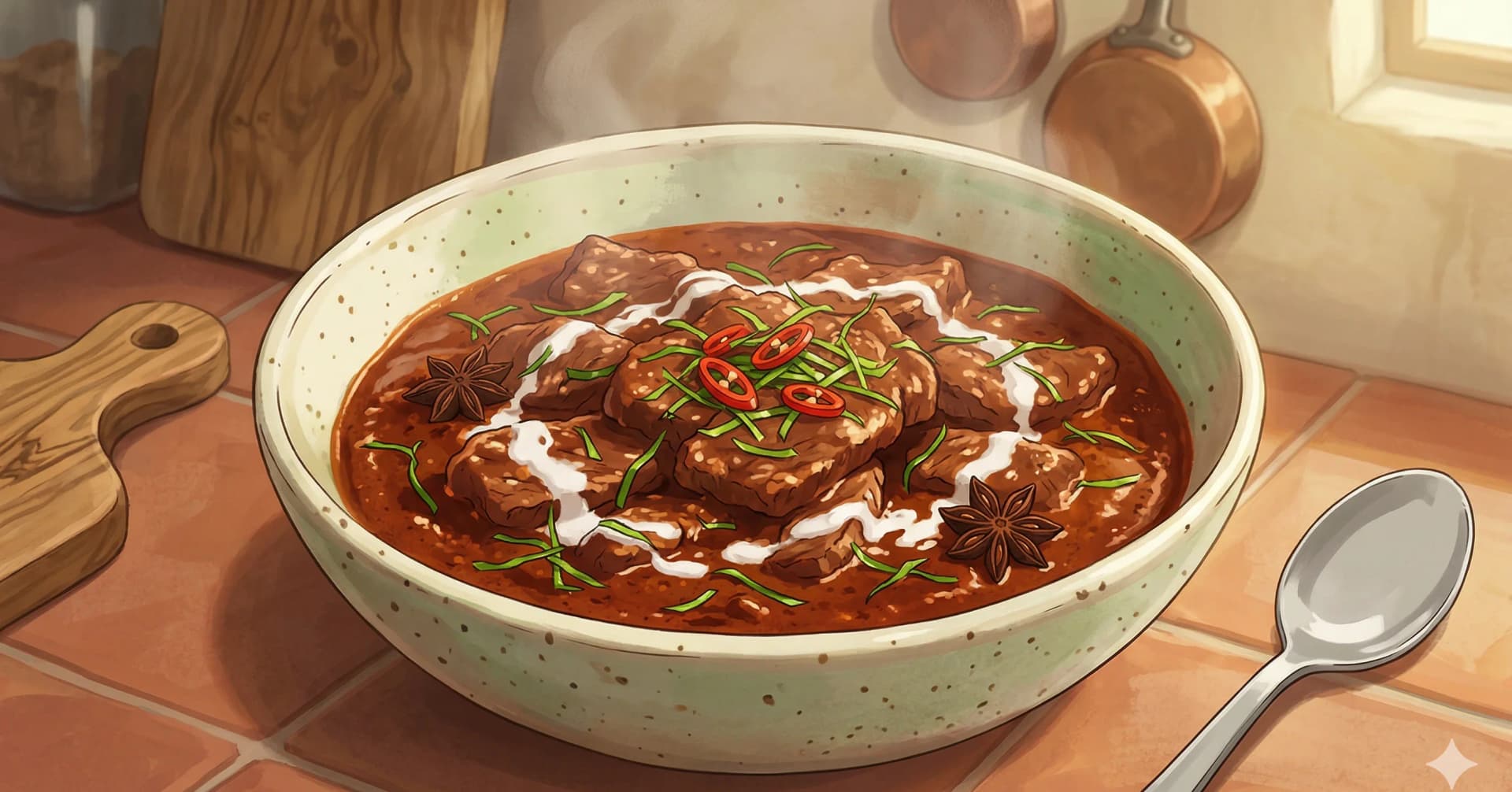
The serving format is part of the dish's identity. Phanaeng is traditionally garnished with whole kaffir lime leaves cut into fine julienne, scattered red chili threads for color, and a final spoon of unmixed coconut cream drawn across the top so the white cream contrasts visually with the dark curry. The dish is served with rice rather than noodles, and the small portion size and intense flavor concentration make it more of a feature dish in a multi-course Thai meal than a one-plate lunch.
Nutrition Facts
Calories: 978kcal (49%)|Total Carbohydrates: 44.6g (16%)|Protein: 44.6g (89%)|Total Fat: 73g (94%)|Saturated Fat: 41g (205%)|Cholesterol: 110mg (37%)|Sodium: 2447mg (106%)|Dietary Fiber: 11.3g (40%)|Total Sugars: 19.3g
You Might Also Like
Ratings & Comments
Ratings & Comments
Ratings
Share your thoughts on this recipe.
Sign in to rate and comment