Indian Cuisine
Onion Kulcha
Leavened flatbread stuffed with spiced raw onion, green chilli and coriander — an Amritsari specialty baked in the tandoor
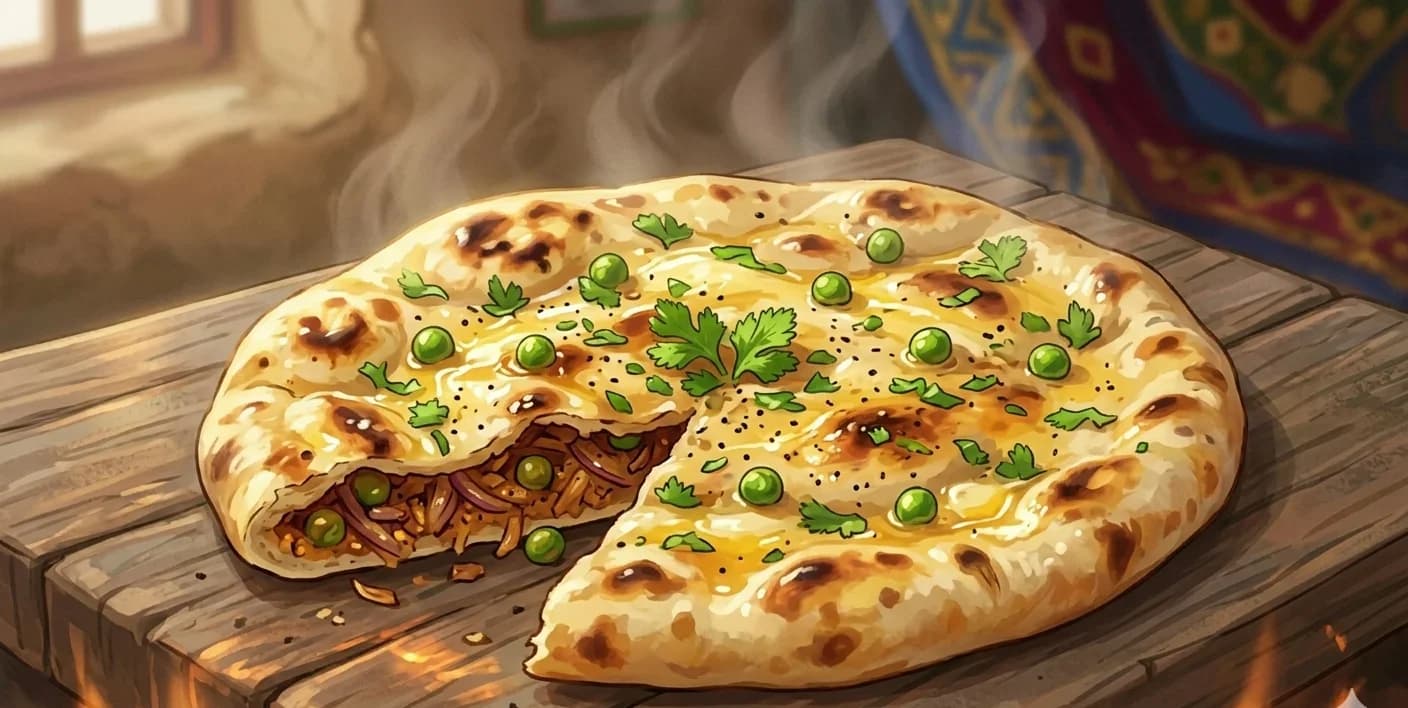
Amritsar has one of the most specific and celebrated bread cultures in North India. The kulcha — a leavened, slightly chewy flatbread distinct from naan — is its centrepiece, and the most particular expression of Amritsari kulcha is the onion variety: filled with a sharp, uncooked mixture of grated onion, green chilli, fresh ginger, coriander, and chaat masala, all pressed raw into the dough so the filling steams inside the tandoor and the bread emerges fragrant and slightly sharp, with the onion just cooked through from the intense radiant heat.
What makes this different from an onion naan is the quantity of filling, the rawness of that filling, and the quality of the dough. The naan dough used here is already a mature leavened dough — made and rested, light and extensible. The filling is mixed with intention: the onion must be grated and squeezed of excess moisture so the bread doesn't become soggy; the chaat masala and the chilli provide the salt and heat; the coriander brings freshness.
The filling is packed generously. A kulcha with a little filling is a disappointment; a kulcha where the filling is assertive enough to be tasted in every bite is the correct version. After stuffing, the dough is rested again — twenty minutes — to allow the gluten to relax around the filling. Then it is flattened and cooked.
A proper tandoor produces a kulcha that no oven can exactly replicate: the fierce dry heat, the contact with the clay walls, the rapid puff and caramelization on the outside while the inside steams in the bread's own moisture. A home oven at its highest setting on a preheated baking stone or steel is the closest approximation.
White butter is applied immediately out of the tandoor. This is not optional.
At a Glance
Yield
Approximately 20 kulchas (from 1.5 kg dough and the given filling)
Prep
30 minutes + 20 minutes resting after stuffing
Cook
3–4 minutes per kulcha
Total
1 hour (assuming naan dough is ready)
Difficulty
Medium
Ingredients
- 3¼ lbnaan dough, prepared and rested
- 2¼ lbonion (about 6½–7 onions), grated and moisture squeezed out thoroughly
- 3¼ tbspchaat masala
- 1 cupgreen chilli, finely chopped
- 3¼ tbspfresh ginger, finely chopped
- 1¼ cupfresh coriander, finely chopped
- ¾ cupwhite butter (unsalted cultured butter), for applying after cooking
Method
- 1
Make the filling. Peel and grate the onions on the coarse side of a box grater. Working in batches, place the grated onion in a clean cloth and wring firmly to squeeze out as much liquid as possible. The onion should be dry enough to hold together when pressed. Transfer to a bowl. Add the chaat masala, finely chopped green chilli, ginger, and fresh coriander. Mix thoroughly. Taste — the filling should be well-seasoned, sharp from the chaat masala, hot from the chilli. Adjust as needed. The filling should be cold and firm enough to hold when pressed into a ball.
- 2
Stuff the dough. Divide the naan dough into portions — roughly 90–100 g each for a medium kulcha. Flatten each portion into a disc with your hands. Place a generous tablespoon of filling (approximately 50 g) in the centre. Draw the edges of the dough up and over the filling, pinching them firmly together at the top to seal. Press the sealed side down and flatten the ball gently with your palm.
- 3
Rest. Place the stuffed dough balls on a lightly oiled tray, cover with a damp cloth, and rest for 20 minutes. This allows the gluten to relax around the filling, making the final flattening easier and reducing the risk of tearing.
- 4
Flatten. Gently press each stuffed ball flat with your hands, then use a rolling pin to roll into a disc approximately 15–18 cm in diameter and about 5–6 mm thick. Do not press too hard or the filling will burst through the dough. Work from the centre outward.
- 5
Cook in the tandoor. If using a tandoor: dampen the outer side of the kulcha (the side that will contact the clay wall) and press it onto the inner wall. Cook for 3–4 minutes until the top surface is blistered and golden and the sides show char in patches. Remove with a hooked skewer. If using a home oven: preheat to the highest possible setting (250°C or higher) with a baking stone or heavy baking tray in the oven. Slide the kulcha directly onto the hot surface and bake for 3–5 minutes until puffed and golden on top with light charring. If using a tawa: cook on a very hot dry tawa for 2 minutes per side, pressing gently with a cloth, until both sides have dark spots and the bread is cooked through.
- 6
Apply butter and serve. Remove from heat and immediately apply white butter liberally to the top surface. The butter will melt into the warm bread. Serve at once.
Key Ingredient Benefits
Naan dough: Typically made with maida (refined wheat flour), yogurt, and leavening — either yeast or baking powder. The yogurt's acidity and the leavening produce a slightly tangy, airy dough that bakes to a soft, slightly chewy interior with a blistered exterior. The recipe here assumes a prepared naan dough; any well-made leavened flatbread dough of similar character can be used.
Chaat masala: A blend of amchoor (dried mango powder), black salt (kala namak), cumin, coriander, black pepper, and other spices. The black salt provides a sulphurous, egg-like savoury note distinct from regular salt; the amchoor provides sourness. Together they create the characteristic "chaat" flavour profile — simultaneously sour, salty, warm, and slightly funky.
White butter: Freshly churned, cultured white butter — the butter traditionally made from dahi (yogurt) rather than cream — has a lower water content and a slightly sour, complex flavour quite different from commercial salted butter. It is the traditional finish for all Amritsari kulchas.
Green chilli: Used raw in the filling. The heat of green chilli is partially released during the tandoor cook, permeating the entire filling without becoming sharp or aggressive. The quantity here is generous — this is Punjab, where chilli is not an afterthought.
Why This Works
Squeezing the moisture from the grated onion is not just about texture — it is about steam control inside the bread. Raw onion is approximately 90% water. If this water enters the bread's interior, it will turn to steam in the tandoor and push through the dough, tearing it or causing the filling to leak. Squeezed dry, the onion concentrates its flavour and the bread can seal cleanly.
The 20-minute rest after stuffing allows the gluten network, stretched during the stuffing and sealing process, to relax. Gluten that has not rested will resist rolling and is more likely to tear when flattened, exposing the filling. After resting, the dough becomes extensible again and flattens smoothly around the filling.
Chaat masala in the filling provides sourness (dried mango powder, amchoor), heat, and salt all at once. It is a compound spice built for exactly this kind of application — seasoning a filling that needs to be vivid and sharp enough to cut through the bread.
Substitutions & Variations
- Aloo kulcha: Replace onion filling with spiced mashed potato (boiled potato, green chilli, coriander, chaat masala, and salt) for the equally classic Amritsari aloo kulcha.
- Paneer kulcha: Crumbled fresh paneer with spices, green chilli, and coriander as the filling.
- Without tandoor: A cast iron tawa over high heat, combined with an open flame to char the top surface briefly, produces a very good approximation of the tandoor result.
- Ghee instead of butter: Use ghee in place of white butter for a richer, more intensely flavoured finish.
Serving Suggestions
- The Amritsari pairing is with chole (spiced chickpea curry) — kulcha-chole is a street food institution.
- With dal makhani for a more substantial meal.
- As a bread alongside any North Indian curry.
- In Amritsar, kulcha is served in the morning at kulcha stalls — a very particular timed experience, sometimes queued for.
Storage & Reheating
Kulcha is best eaten immediately from the tandoor, while the butter is still melting and the bread is still hot. Leftover kulcha can be reheated in a dry tawa over medium heat for 1–2 minutes per side — it will lose its initial softness but remains good. Uncooked stuffed kulcha dough can be refrigerated on a tray for up to 4 hours before cooking. Do not freeze stuffed dough — the onion filling releases significant moisture on thawing and the bread becomes soggy.
Cultural Notes
Onion kulcha (अमृतसरी प्याज़ कुलचा, often called Amritsari kulcha after the Punjabi city of Amritsar where the dish reached its modern form) is the Punjabi stuffed flatbread made from a refined-flour dough leavened with yogurt and baking soda, stuffed with a filling of finely chopped onion, mashed potato, green chili, fresh cilantro, ajwain seeds, and ground spices, then either baked in a tandoor or shallow-cooked on a tava griddle until the surface develops golden charred spots and the interior puffs around the filling. The dish is the signature street and restaurant kulcha of Amritsar (the largest city of Punjab) and has spread across the Punjab belt, Delhi, and the Punjabi diaspora as one of the canonical Punjabi flatbreads.
The Amritsari kulcha tradition is a documented Punjabi institution. The street kulcha shops of Amritsar (centered around the old city near the Golden Temple) have served the dish for generations, with families specializing in kulcha-making passing the technique through hereditary apprenticeships. The classic Amritsari kulcha is baked in a tandoor clay oven, with the dough slapped against the inside wall of the tandoor and removed with long iron tongs when the top develops the characteristic charred spots. The dish is traditionally paired with chana-masala (chickpea curry) in the Amritsari morning street-food combination called kulcha-chole, served with a side of sliced raw onion, green chili, and a small pat of butter melting on top.
The technique builds the kulcha in two stages: the dough and the stuffing. The dough is mixed from refined flour (maida), yogurt, baking soda, a small amount of sugar, salt, and milk, kneaded until smooth and soft, and rested for at least an hour (the yogurt-and-baking-soda combination provides the leavening that gives the kulcha its characteristic light puff). The stuffing is mixed from finely chopped onion, mashed boiled potato, finely chopped green chili, chopped fresh cilantro, ajwain seeds, ground coriander, ground cumin, Kashmiri red chili powder, amchur (dried mango powder), and salt. To shape, a small ball of dough is flattened, a generous spoon of stuffing is placed in the center, and the edges of the dough are gathered up over the stuffing to seal completely. The stuffed ball is rested briefly, then rolled out gently into a thick oval or round (about seven inches across) with the stuffing distributed evenly without breaking the dough surface. The kulcha is baked in a hot tandoor (about 280°C) for three to four minutes, or cooked on a hot tava with a brushing of butter on both sides. The hot kulcha is brushed with melted butter and a scatter of fresh cilantro before serving.
Nutrition Facts
Calories: 551kcal (28%)|Total Carbohydrates: 85.6g (31%)|Protein: 11.6g (23%)|Total Fat: 17.2g (22%)|Saturated Fat: 10.2g (51%)|Cholesterol: 43mg (14%)|Sodium: 1008mg (44%)|Dietary Fiber: 4.4g (16%)|Total Sugars: 4.2g
You Might Also Like
Ratings & Comments
Ratings & Comments
Ratings
Share your thoughts on this recipe.
Sign in to rate and comment