Bengali · Indian Cuisine
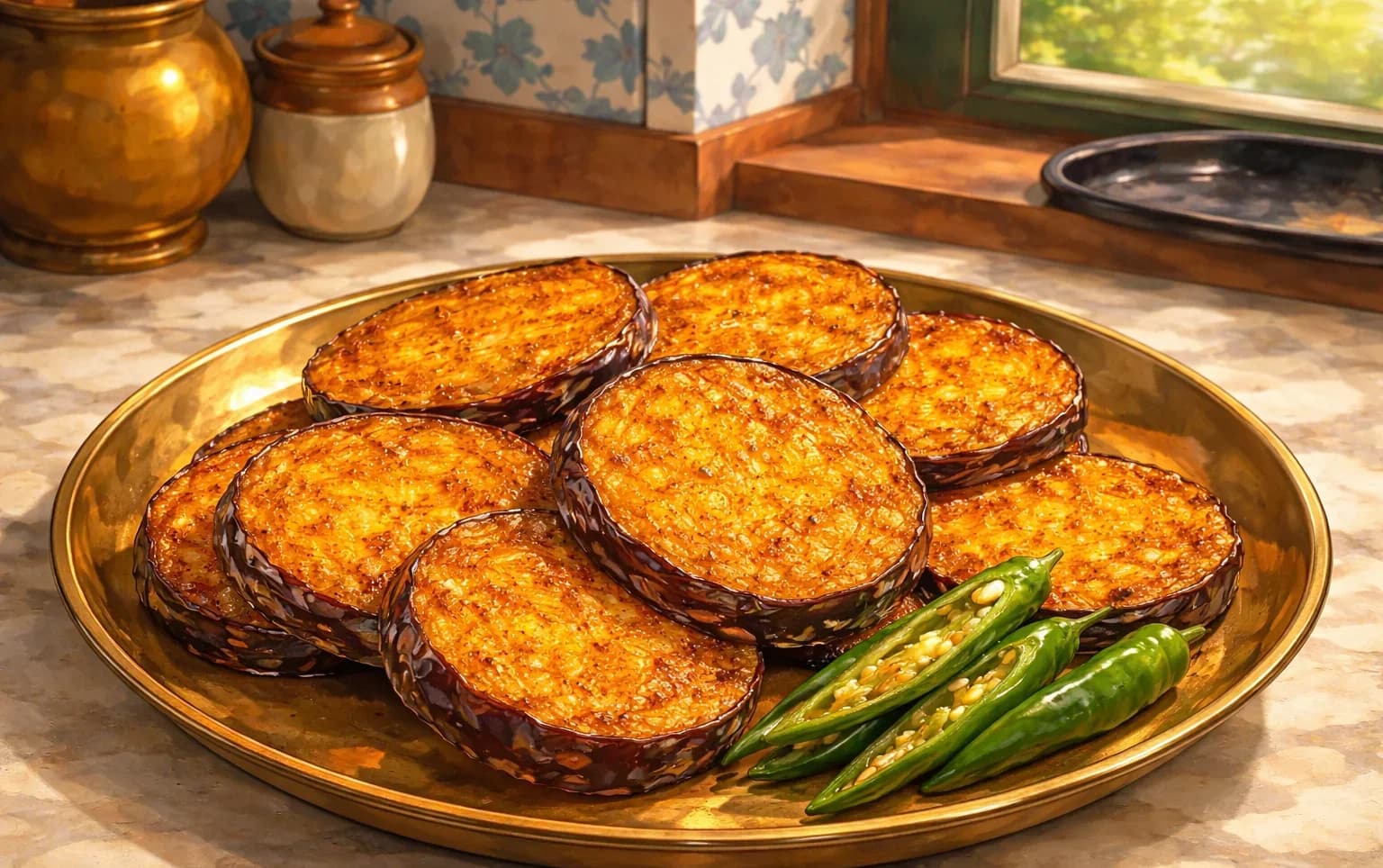
Fried Eggplant Slices (Begun Bhaja)
Pan-fried aubergine slices — crisp-edged, spiced, and deeply satisfying
Begun bhaja is the dish you make when there is little else in the house, and it is extraordinary. A single large aubergine, a little mustard oil, turmeric and salt, a hot pan — and within twenty minutes the kitchen smells of something deeply savoury and slightly smoky, and the aubergine slices emerge from the pan with edges that have crisped and caramelised and a centre that has softened to a yielding, almost creamy tenderness. The simplicity is not poverty. It is mastery.
Begun is the Bengali word for aubergine (brinjal in many parts of South Asia, eggplant in North America). Bhaja means fried, a broad term in Bengali cooking that encompasses shallow-frying and pan-frying as much as deep-frying. Bhaja preparations are a structural element of the Bengali meal: they provide texture, crispness, and a different kind of satisfaction from the wet dishes and dal that surround them. On a Bengali thali, that orderly arrangement of small portions around a mound of rice, begun bhaja sits as the textural anchor. The thing your fork or fingers return to between mouthfuls of fish curry and dal.
The quality of the final dish depends on three things: the aubergine, the oil, and the heat. The aubergine should be large, firm, and dense. Not the small Italian variety but the big, round, almost spherical Bengali aubergine (nayantara or similar large varieties) if you can find it, or a large conventional aubergine otherwise. Cut into rounds no thinner than 8 mm and no thicker than 12 mm. Thinner and they lose structural integrity; thicker and the centre never reaches that particular softness.
The oil must be mustard oil, heated to smoking. This is the step most cooks rush, and it is the step that matters most. Mustard oil brought to its smoke point loses its raw harshness and develops a complex, forward character that penetrates the aubergine as it fries. The result from a neutral vegetable oil is thinner and less interesting. The aubergine soaks up whatever it is cooked in, and what mustard oil deposits in those cells is irreplaceable.
At a Glance
Yield
Serves 4 as a side
Prep
10 minutes (plus 15 minutes resting)
Cook
20 minutes
Total
45 minutes
Difficulty
Easy
Ingredients
- 1large aubergine (about 600–700 g), cut into rounds 1 cm thick
- 1 tspturmeric powder
- 1 tspfine salt
- —½ teaspoon red chilli powder
- 1 tspcumin powder (optional, but recommended)
- ⅓ cupmustard oil (enough for a generous shallow layer in the pan)
- —A pinch of fine salt for final adjustment
- 2–3green chillies, slit and added to the pan during the last minute (optional)
Method
- 1
Prepare the aubergine (1). Cut the aubergine into rounds approximately 1 cm thick. Lay them in a single layer on a tray or plate. Combine the turmeric (1 teaspoon), salt (1 teaspoon), red chilli powder (½ teaspoon), and cumin powder (1 teaspoon) in a small bowl and mix together. Dust both sides of each aubergine round evenly with the spice mixture, patting gently so it adheres. Allow the seasoned slices to rest for 15 minutes. They will release a small amount of moisture, which concentrates the flavour and helps the spice coating stick through the frying.
- 2
Heat the mustard oil. Pour the mustard oil into a wide, heavy-based pan — a cast-iron skillet or a flat-based karahi works best. Heat over high heat until the oil just begins to smoke, watching for the first wisps of white smoke and the slight lightening of the oil's colour. Remove from heat briefly, then return to medium-high heat.
- 3
Fry the first side. Place the aubergine rounds in the hot oil in a single layer without overlapping. Cook in batches if necessary. Do not move them for the first 3–4 minutes. Let them sit and develop a proper golden crust on the underside. You will hear a steady sizzle; if it drops to a murmur, increase the heat slightly. After 3–4 minutes, check the underside by lifting one round with a spatula. It should be a deep golden-brown, with a slightly crisped, almost caramelised edge.
- 4
Fry the second side. Flip each round carefully with a flat spatula. The second side takes slightly less time, 2–3 minutes, as the aubergine is already partway cooked through from the first side's heat. Add the slit green chillies to the pan alongside the aubergine for this second frying if using. The chillies will blister and soften in the oil.
- 5
Check and drain. The rounds are done when both sides are deep golden-brown with crisped edges and the centre yields easily to a light press. It should feel soft, not resistant. Transfer to a plate lined with kitchen paper and allow to drain for 1 minute.
- 6
Serve. Taste one piece and adjust salt if needed. Serve immediately while the edges are still crisp. Begun bhaja loses its crispness quickly and is best eaten within a few minutes of leaving the pan.
Key Ingredient Benefits
Aubergine (Solanum melongena) is low in calories and high in dietary fibre, with significant quantities of nasunin — the anthocyanin responsible for its deep purple skin — which has demonstrated antioxidant activity in laboratory studies. Aubergine contains solanine and other glycoalkaloids at low levels; cooking eliminates any concern about these compounds at normal dietary intake. In Ayurveda, aubergine is considered a warming food, recommended in small quantities as it was traditionally associated with aggravating certain constitutions, though this should be taken in the context of a pre-scientific medical tradition rather than contemporary nutritional research.
Turmeric contributes curcumin, one of the most studied plant compounds in recent nutrition research. Curcumin has demonstrated anti-inflammatory and antioxidant activity in cell and animal studies; its bioavailability is enhanced significantly in the presence of fat and piperine (black pepper). The quantity used here is flavouring-level, not supplemental, but cooking turmeric in oil, as this recipe does, does maximise what uptake occurs.
Mustard oil: see notes in other Bengali recipes in this collection. Its flavour and fat profile are both distinctive and appropriate to this cuisine in a way that is difficult to replicate.
Why This Works
The resting step after seasoning — allowing the salt and turmeric to sit on the aubergine surface for fifteen minutes — draws a small amount of moisture from the flesh through osmosis. This light purging does two things: it reduces the quantity of oil the aubergine absorbs during frying (aubergine is notorious for soaking up fat), and it concentrates the colour and flavour of the spice coating by removing the diluting surface moisture. The exterior that enters the pan is drier, more concentrated, and therefore fries rather than steams.
Not moving the aubergine for the first few minutes of frying is fundamental to developing a proper crust. Aubergine, like most vegetables, will steam in its own released moisture if moved too often; the constant agitation prevents the Maillard reaction from proceeding properly. A pan left alone, with steady, assertive heat underneath, allows the moisture to escape and the surface sugars to caramelise, producing the golden-brown, slightly crisped edge that defines begun bhaja. Patience here costs nothing and rewards generously.
Mustard oil at cooking temperature saturates the aubergine's cell walls with flavour compounds that a neutral oil simply cannot. The particular, slightly bitter depth of cooked mustard oil transforms aubergine from a neutral vegetable into something with presence and character. This is not hyperbole. Taste the dish made in refined vegetable oil alongside a version made in mustard oil and the difference is immediate and significant.
Substitutions & Variations
Aubergine varieties: The large, round Bengali aubergine (nayantara type) produces the most authentic result — dense, slightly less seedy than the common Italian variety, with a firmer flesh that holds up to frying. Long Japanese or Chinese aubergines also work well, cut on the diagonal into oval slices for more surface area. The common large Italian/globe aubergine is entirely suitable and widely available.
Battering: A variation common in Kolkata street food adds a light chickpea flour (besan) batter to the seasoned aubergine before frying, producing begun bhaja with a thin, slightly crisped shell around the spiced flesh. Mix 3 tablespoons besan with water to a thin batter consistency, dip each round briefly, and fry as above. The oil should be slightly deeper for this version.
Additional spices: Some households add a pinch of nigella seeds (kalo jeera) and a pinch of panch phoron to the frying oil before adding the aubergine. This produces a more aromatic base note without altering the fundamental character of the dish.
Sesame: A version found in some parts of Bengal coats the aubergine in sesame seeds after the spice rub, pressing them gently into the surface before frying. The seeds toast in the hot oil and create a nutty crust.
Serving Suggestions
Begun bhaja is always part of a larger Bengali meal. It appears as a side alongside dal, fish curry, and rice. Its textural function (crisp edges, soft centre) is what makes it essential rather than optional. It is placed on the thali so that rice can be scooped alongside a piece of bhaja and eaten together, the oil from the aubergine seasoning the rice. Begun bhaja also appears as a component of the Durga Puja feast plate alongside kasha mangsho and luchi. A simple accompaniment of sliced raw onion with a squeeze of lime alongside is traditional in Kolkata's para restaurants.
Storage & Reheating
Begun bhaja is at its best in the minutes after leaving the pan, when the edges are still firm and the centre is hot. Leftovers can be refrigerated for up to 1 day, but the texture changes significantly. The crisp edges soften completely in storage. To reheat, arrange the slices in a single layer in a dry pan over medium-high heat for 2–3 minutes per side to restore some colour and heat. The reheated version will not have the original crispness but is still flavourful and perfectly pleasant. Begun bhaja does not freeze.
Cultural Notes
Begun bhaja (বেগুন ভাজা, "fried eggplant") is the simple Bengali preparation of thick eggplant slices coated in turmeric, salt, kashmiri red chili powder, and a small amount of rice flour or chickpea flour, then shallow-fried in mustard oil until both surfaces turn deep golden and the interior softens to creamy tenderness. The dish is one of the foundational Bengali vegetable preparations and one of the most basic everyday foods of Bengali home cooking, appearing on home tables across Kolkata, Dhaka, and the Bengali diaspora as the most common simple vegetable side at lunch.
The Bengali variety of eggplant matters. Bengali cooking strongly prefers the long thin purple eggplant (the same variety used across the broader Indian tradition) over the round Italian eggplant, since the thinner cylindrical shape produces uniform slices that fry evenly and develop a higher proportion of crisp surface to creamy interior. The eggplant is sliced into half-inch rounds, then either salted briefly to draw out moisture (the traditional Bengali approach) or used directly without salting (the home shortcut). The slices are dusted with turmeric, salt, kashmiri red chili powder, and a small amount of rice flour for added crispness on the surface.
The technique uses mustard oil, the Bengali signature cooking oil. The mustard oil is heated to smoking and then slightly cooled (the smoking step takes away the raw pungent edge of the oil and allows its characteristic flavor to develop), then the eggplant slices slide in for three to four minutes per side until both surfaces turn deep golden brown and the interior softens. The slices are removed and drained on paper, then served immediately while still hot and crisp. The dish appears alongside dal and rice at lunch, as part of the Bengali home lunch sequence that progresses through bitter (often neem-begun or a karela preparation), then dal and rice with vegetables, then fish or meat, then chutney, then sweet. Begun bhaja is among the most reliable everyday vegetables and a dish that Bengali mothers teach to children as one of the first cooking lessons in the bhadralok kitchen tradition.
Nutrition Facts
Calories: 137kcal (7%)|Total Carbohydrates: 12g (4%)|Protein: 2g (4%)|Total Fat: 10g (13%)|Saturated Fat: 1.1g (6%)|Cholesterol: 0mg (0%)|Sodium: 685mg (30%)|Dietary Fiber: 5.7g (20%)|Total Sugars: 6.3g
You Might Also Like



Ratings & Comments
Ratings & Comments
Ratings
Share your thoughts on this recipe.
Sign in to rate and comment