Punjabi · Indian Cuisine
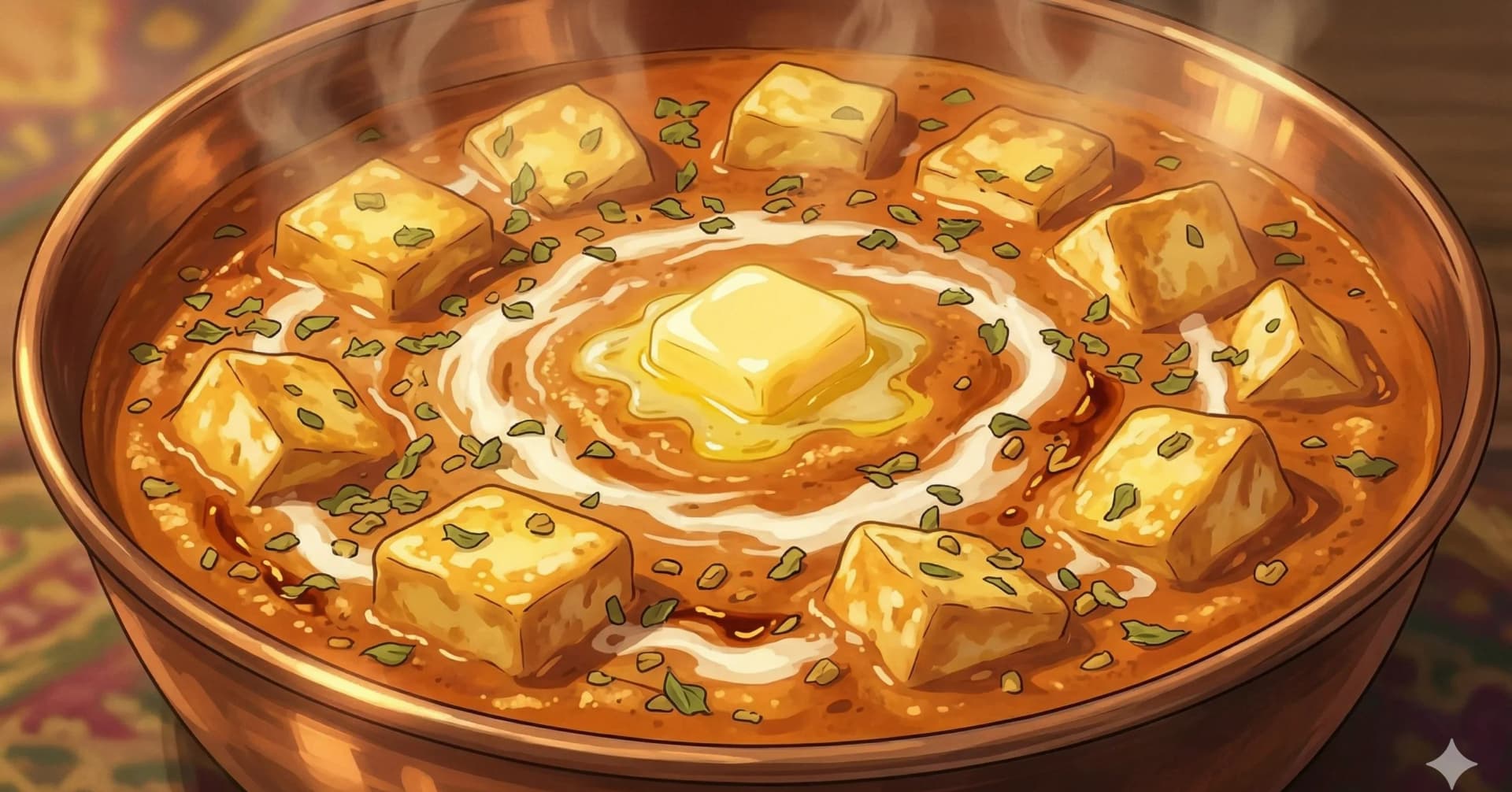
Paneer Makhni
Velvet tomato butter sauce with golden-edged paneer
There is a moment, midway through making makhni sauce, when the kitchen fills with a smell that is impossible to describe without sounding excessive: butter and onion softening into each other, tomato deepening into something darker, spices blooming in the fat. The sauce turns from orange to a deep, faintly lacquered red. That is the moment you know you are close.
Makhni, from the Punjabi word for butter, began as the sauce behind the famous murgh makhni (butter chicken) but the vegetarian version with paneer may be even more satisfying. The paneer has no bones to navigate, no sinew. It sits in the sauce cleanly, taking on the color and warmth of the masala while staying firm enough to hold its shape on the spoon.
This is Punjabi restaurant cooking translated faithfully to the home kitchen. The technique belongs to the tandoor-era kitchens of Lahore and Delhi, where rich, slow-cooked tomato gravies became the defining flavor of North Indian cooking for generations. The cashews here are not a shortcut; they give the sauce body and a faint sweetness that rounds out the acidity of the tomato without adding more sugar than necessary.
What the dish delivers is richness without heaviness, warmth without fire. The heat is gentle and layered. The kasuri methi (dried fenugreek leaves) added at the end is essential: it gives the sauce its characteristic bitterness that cuts through the cream and keeps the whole thing from becoming cloying.
One practical note: pan-frying the paneer before it goes into the sauce is not optional. Even a minute in a hot pan gives each cube a lightly golden crust that prevents it from breaking apart in the simmering sauce, and adds a faint savory edge that the plain white cube cannot offer.
At a Glance
Yield
4 servings
Prep
20 minutes
Cook
40 minutes
Total
1 hour
Difficulty
Medium
Ingredients
- ½ cupunsalted butter
- 2¾ ozonion (about ½–1 onion), roughly chopped
- 1¼ tbspginger garlic paste
- 1 lbtomato puree (good quality (about 3–3½ tomatoes), or blend fresh tomatoes)
- 1¾ tbspred chilli powder (Kashmiri for color, or reduce for less heat)
- 2¾ tspcoriander powder
- 2⅓ tspcumin powder
- ¾ ozraw cashews
- ⅓ cupheavy cream
- 2⅓ tspsugar
- ¼ ozkasuri methi (dried fenugreek leaves), crumbled
- 1⅔ tspgaram masala
- —Salt to taste
- 1 lbpaneer, cut into 3cm cubes
- 1 tbspneutral oil or ghee
- —Pinch of salt
- 1 tbspcold butter
- —Fresh coriander leaves (optional)
Method
- 1
Build the sauce base. Melt the butter in a heavy-bottomed pan over medium heat. Add the chopped onion and cook, stirring occasionally, for 8–10 minutes until completely soft and beginning to turn golden at the edges. Do not rush this; the onion needs to be fully cooked.
- 2
Add aromatics and spices. Add the ginger garlic paste and cook for 2 minutes, stirring, until the raw smell fades. Add the red chilli powder, coriander powder, and cumin powder. Stir to coat the onion and cook for 1 minute until fragrant.
- 3
Add tomatoes and cook down. Pour in the tomato puree and stir well to combine. Cook over medium heat, stirring every few minutes, for 15–20 minutes until the sauce has reduced, thickened, and the oil begins to separate and pool around the edges. The sauce will deepen in color and smell noticeably sweeter.
- 4
Blend with cashews. Allow the sauce to cool slightly. Transfer to a blender with the raw cashews. Blend until completely smooth. Pass through a fine sieve if you want a restaurant-smooth texture, though this is optional.
- 5
Return to pan and finish the sauce. Pour the blended sauce back into the cleaned pan over low heat. Stir in the cream, sugar, and a pinch of salt. Simmer gently for 10 minutes. Crumble in the kasuri methi between your palms (this releases the oils) and add the garam masala. Taste and adjust salt and sugar.
- 6
Pan-fry the paneer. While the sauce simmers, heat oil or ghee in a separate frying pan over medium-high heat. Add the paneer cubes in a single layer with a pinch of salt. Cook undisturbed for 1–2 minutes until the bottom is lightly golden. Turn and color one or two more sides. Remove from heat.
- 7
Combine and serve. Gently slide the pan-fried paneer into the makhni sauce. Simmer together on low heat for 5 minutes, just long enough for the paneer to absorb the sauce without falling apart. Finish by stirring in the cold butter (1 tablespoon), which gives the sauce a final gloss. Serve immediately.
Key Ingredient Benefits
Kasuri methi (dried fenugreek leaves): The most important finishing ingredient in makhni sauce. Fenugreek is traditionally used in Ayurvedic practice to support digestion and warm the body. Research suggests that fenugreek contains compounds with potential antioxidant properties. In cooking, it provides a distinctive, slightly bitter flavor that no substitute can replicate. Do not skip it.
Butter: Full-fat Punjabi cooking has always used butter and ghee as primary fats. Research now suggests that the relationship between saturated fat and cardiovascular health is more nuanced than previously understood. Butter from grass-fed dairy contains fat-soluble vitamins including A, D, E, and K2.
Cashews: Traditionally considered nourishing and strengthening. Research suggests cashews are a source of magnesium, zinc, and healthy monounsaturated fats. They are calorie-dense; used here for texture and richness rather than in large quantity.
Paneer: An excellent source of complete protein for vegetarians. Traditionally considered sattvic (pure, calming) in Ayurvedic dietary philosophy. Also provides calcium and phosphorus.
Kashmiri red chilli: Used primarily for color rather than heat. Provides a bright, deep red hue and mild warmth. High in carotenoids including capsanthin.
Why This Works
The cashews are blended directly into the sauce rather than soaked and made into a separate paste. At this stage, the sauce is already hot and partially cooked, which means the cashews blend down completely and integrate without any raw, starchy taste. They thicken the sauce from within and mellow the acidity of the tomato.
Pan-frying the paneer before adding it to the sauce creates a thin crust via the Maillard reaction, the same browning that happens on bread or seared meat. This crust is structurally important: it keeps the paneer from absorbing too much sauce and softening into shapeless pieces. The cubes should still feel slightly firm at the center when bitten.
The cold butter added at the end, known as monte au beurre in French technique, is a finishing step used in Punjabi cooking by instinct for generations: swirling cold fat into a hot sauce just before serving creates an emulsion that gives the sauce a silky, restaurant-quality gloss.
Substitutions & Variations
Paneer alternatives: Extra-firm tofu, pressed and pan-fried the same way, works well for a dairy-free version. The sauce flavor will carry it. Halloumi is an unusual but effective substitute; it holds up even better to heat.
Cream: Coconut cream makes a good dairy-free substitute and gives a slightly different but pleasant sweetness. Full-fat oat cream also works if texture-matched carefully.
Cashews: Blanched almonds can replace cashews for thickening. Soak them for 20 minutes before blending for the smoothest result.
Heat level: This recipe as written is mild-medium. Increase red chilli powder or add fresh green chillies to the sauce for more fire. For a completely mild version suitable for children, use 2g chilli powder and add a pinch of sweet paprika for color.
Murgh makhni (butter chicken): Replace paneer with 600g bone-in chicken pieces or 400g boneless thigh, marinated in yogurt and spices and cooked before adding to the sauce.
Serving Suggestions
Serve with butter naan, garlic naan, or plain roti to scoop the sauce. Basmati rice is equally at home alongside; the sauce pools beautifully in a bed of rice. A simple cucumber raita with mint rounds out the richness. For a full Punjabi spread, pair with dal makhni, a small salad of sliced onion, green chilli, and lemon, and laccha paratha.
Storage & Reheating
Refrigerator: Store the sauce (without paneer if possible) in an airtight container for up to 4 days. The sauce keeps better separately; paneer sitting in acidic tomato sauce for days softens considerably.
Freezer: The makhni sauce without paneer freezes exceptionally well for up to 3 months. Portion into 200ml freezer bags. Thaw in the fridge overnight and reheat gently.
Reheating: Warm over low heat, adding a splash of water or cream if the sauce has thickened. Add freshly pan-fried paneer each time for best texture. Do not microwave paneer sitting in sauce; it toughens the cheese.
Cultural Notes
Paneer makhni (पनीर मक्खनी, "butter paneer") is the vegetarian counterpart to the Punjabi-Mughlai murgh-makhni, in which cubes of fresh paneer replace the chicken in the same rich butter-tomato gravy enriched with cream, fenugreek leaves (kasuri methi), and Mughlai spices. The dish belongs to the post-Partition Punjabi restaurant tradition that developed at Moti Mahal in Delhi in the late 1940s alongside the meat butter-chicken preparation, and it became one of the canonical vegetarian dishes of the Indian restaurant menu across India and the global diaspora.
The dish's character is identical in technique and flavor to the murgh-makhni, with paneer providing a substitute that absorbs the gravy in a way that complements rather than competes with the butter-tomato richness. Where the chicken version uses pre-cooked tandoori chicken pieces (the smoky char of the tandoor adding depth to the gravy), the paneer version uses lightly sautéed paneer cubes (the surface just golden, not deep brown) to keep the cubes intact and visually clean against the orange-red gravy. The dish is among the most widely ordered vegetarian preparations at Indian restaurants worldwide, where it pairs with naan, rumali roti, or basmati pulao as the standard vegetarian banquet centerpiece.
The technique relies on the foundational makhni-gravy base that anchors the broader makhni family. The gravy is prepared by simmering chopped tomatoes, ginger-garlic paste, green cardamom, cloves, cinnamon, Kashmiri red chili powder, and a small amount of water for forty-five minutes until the tomatoes break down completely. The mixture is puréed and strained, then returned to the pot with a generous knob of butter and brought to a gentle simmer. The paneer is cubed (about three-quarter-inch cubes), sautéed briefly in a small amount of ghee until the surfaces just turn golden, and added to the simmering gravy. The dish cooks for ten minutes (paneer cooks quickly and turns rubbery if overcooked, so the time is short). Cream is added off the heat, along with a generous pinch of crushed kasuri methi (dried fenugreek leaves, the herb that gives makhni gravies their distinctive savory depth) and a small amount of garam masala. The dish is finished with a swirl of cream and a scatter of cilantro, and served immediately.
Nutrition Facts
Calories: 656kcal (33%)|Total Carbohydrates: 18.3g (7%)|Protein: 21.5g (43%)|Total Fat: 56.6g (73%)|Saturated Fat: 32.3g (161%)|Cholesterol: 134mg (45%)|Sodium: 1298mg (56%)|Dietary Fiber: 2.1g (8%)|Total Sugars: 9.6g
You Might Also Like
Ratings & Comments
Ratings & Comments
Ratings
Share your thoughts on this recipe.
Sign in to rate and comment