Punjabi · Indian Cuisine
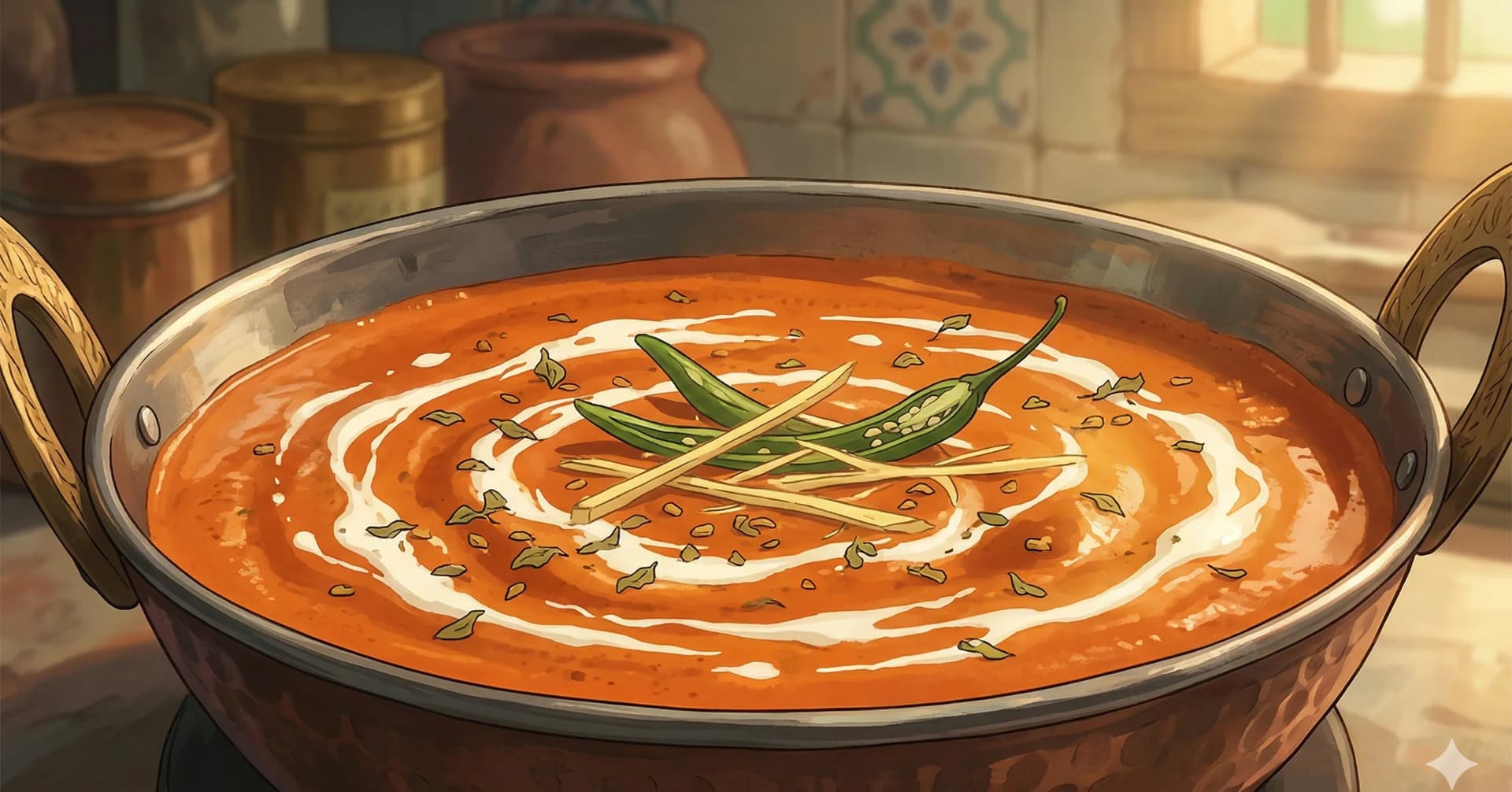
Butter-Tomato Sauce (Makhni Gravy)
The foundational tomato and butter base for makhni dishes
Almost every makhni dish (murgh makhni, paneer makhni, dal makhni) rests on the same underlying gravy. This is that gravy: a deep, velvety tomato sauce slow-cooked with whole spices and ginger-garlic, strained until completely smooth, then finished with butter, cream, and kasoori methi. The recipe is deceptively simple; its quality comes from time and patience rather than technique.
The origins of makhni sauce trace to Moti Mahal restaurant in Delhi, where a chef named Kundan Lal Gujral is credited with creating what became one of the most replicated sauces in the world, and one of the most frequently diluted. The commercial versions found in jars and restaurant supply depots are shadows of the original. The real version requires properly ripe, flavourful tomatoes cooked long enough to lose all their raw acidity and develop the deep, almost jammy sweetness that makes the sauce what it is.
The final note of honey is not sweetness for sweetness's sake. It is an acid corrector. Fresh tomatoes vary considerably in their sugar-acid balance depending on the season, and a small amount of honey, added at the end, smooths out any lingering sharpness without making the sauce taste sweet. Taste first and add only if needed.
This recipe makes a batch of the basic gravy to be used as the base in makhni preparations. It keeps well in the refrigerator for several days and freezes excellently. A supply of makhni gravy on hand means any makhni dish is twenty minutes away.
At a Glance
Yield
Makes approximately 600 ml (base for 4–6 servings)
Prep
10 minutes
Cook
40 minutes
Total
50 minutes
Difficulty
Easy
Ingredients
- 1½ lbripe tomatoes (about 5½–6 tomatoes), roughly chopped
- 1 tspginger paste
- 1 tspgarlic paste
- 2½ tspgreen chillies (about 2), roughly chopped
- 1⅔ tspred chilli powder
- ½ tspwhole cloves (about 3–4)
- ¼ ozgreen cardamom pods (about 5–6 pods)
- ⅓ tspsalt
- 2⅓ tbspbutter
- 1 ozsingle cream
- ¼ ozdried kasoori methi, lightly crushed
- 1½ tspfresh ginger, cut into fine julienne (for finishing)
- 2–3green chillies, slit lengthways (for finishing)
- 1 tsphoney (optional, to balance acidity)
Method
- 1
Cook the tomatoes (700 g). Place the roughly chopped tomatoes in a heavy-based pot. Add 500 ml of water, the ginger (3 g) paste (5 g), garlic paste (5 g), chopped green chillies (2), and whole cloves (3–4) and green cardamom. Bring to a boil over high heat, then reduce to a steady simmer. Cook uncovered for 20–25 minutes, stirring occasionally, until the tomatoes have completely collapsed and the mixture has reduced to a thick, pulpy sauce. The liquid should have reduced by roughly half.
- 2
Strain. Pass the cooked tomato mixture through a fine-mesh sieve or a food mill, pressing firmly to extract all the liquid and pulp. Discard the skins, seeds, and whole spices. The strained sauce should be smooth and deeply coloured.
- 3
Reduce. Return the strained sauce to the pot over medium heat. Bring to a boil and cook, stirring regularly, until it has reduced to your preferred consistency; the sauce should coat a spoon thickly and hold a line when you draw your finger through. This takes another 8–10 minutes.
- 4
Season and finish. Reduce the heat to low. Add the salt (½ teaspoon) and red chilli powder (½ teaspoon). Stir in the butter (35 g) in pieces, swirling or stirring until fully melted and incorporated. Add the cream (2 tablespoons) and stir through. Rub the kasoori methi (½ teaspoon) between your palms and add; the heat of your hands releases its aroma before it goes into the pot.
- 5
Taste and correct. Taste the gravy. It should be rich, slightly sweet from the tomatoes, with a clean tomato flavour and the warm finish of butter. If it tastes sharp or sour, add the honey (1 teaspoon) and stir through. If it tastes flat, add a small pinch more salt.
- 6
Finish and store (or use immediately). The makhni gravy is now ready to use. Finish with the ginger julienne and slit green chillies if using it immediately as a finished dish. If storing for later use, allow to cool completely before refrigerating or freezing; add the julienne and chillies only when using.
Key Ingredient Benefits
Kasoori methi (dried fenugreek leaves, Trigonella foenum-graecum) is one of the most distinctive aromatic ingredients in the North Indian pantry. Its flavour (slightly bitter, slightly sweet, with a characteristic complexity) comes from volatile compounds including sotolon. In Ayurvedic and Unani traditions, fenugreek is used to support digestion and is traditionally associated with improving appetite and easing digestive discomfort. Research has also explored its relationship with blood glucose regulation, though findings remain preliminary.
Tomatoes (Solanum lycopersicum) are one of the primary dietary sources of lycopene, a carotenoid compound that research suggests may act as an antioxidant. Importantly, cooking significantly increases the bioavailability of lycopene compared to raw tomatoes: the long reduction process here is not just culinary; it is the transformation that makes the tomato's nutritional compounds most accessible. Lycopene is fat-soluble, meaning the butter and cream in the finished sauce further enhance its absorption.
Butter used here in the traditional makhni style contributes saturated fat and fat-soluble vitamins (A, D, E, K). In Ayurvedic cooking, butter and especially ghee are not treated as ingredients to limit but as essential fats that support the absorption of fat-soluble nutrients from vegetables and spices. A principle that modern nutritional science increasingly supports.
Why This Works
The two-stage reduction (first cooking the whole tomatoes with the spices until broken down, then straining and reducing again) achieves a depth that a single shorter cook cannot. The first stage extracts flavour from the whole spices into the liquid and breaks the tomato cells down completely. The straining removes the fibrous material and concentrates the pure tomato liquid. The second reduction deepens and sweetens the sauce as water evaporates and the natural sugars concentrate.
The kasoori methi (dried fenugreek leaf) is added last for a specific reason: its primary aromatic contribution comes from sotolon and other volatile compounds that dissipate with prolonged cooking. Added right at the end and allowed only brief contact with the heat, it contributes a distinctive slightly bitter, maple-adjacent fragrance that is one of the most recognisable elements of makhni sauce. Crushing it lightly between the palms first breaks the dried leaves and releases these compounds before they enter the pot.
Butter at the end, rather than at the beginning, is the makhni technique: fat added to a finished reduced sauce creates an emulsion, giving the sauce a glossy, slightly velvety texture. Added to the pot from the start, the same butter would simply be cooking fat rather than a finishing emulsifier.
Substitutions & Variations
Vegan version: Replace butter with a neutral oil or refined coconut oil, and cream with coconut cream. The character changes significantly; the sauce loses its particular dairy richness, but it remains a good spiced tomato base.
Cashew cream for dairy-free: Blend soaked cashews with water to the consistency of cream and add in place of dairy cream. This provides richness and creaminess closer to the original.
Richer sauce: Add an extra 20 g of butter and increase the cream to 50 ml for a restaurant-style richness.
Herb finish: Some versions add a few fresh coriander stems with the tomatoes during the initial cook and strain them out, adding a subtle herbaceous undertone to the background.
Serving Suggestions
This gravy is a base, not a finished dish. Use it as the foundation for murgh makhni (add grilled or tandoori chicken), paneer makhni (add fried or grilled paneer), or as a sauce for prawns, seared fish, or roasted vegetables. It can also be used as a dipping sauce for naan; warmed in a small saucepan and served alongside for tearing and dipping. The ginger julienne and slit green chillies are the traditional garnish when serving makhni dishes at the table.
Storage & Reheating
The base gravy (without the julienne and chilli garnish) keeps refrigerated for up to 5 days. Freeze in portions of approximately 150 ml (single-serving sauce portions) for up to 2 months. Reheat gently over low heat, stirring, and finish with a small knob of butter and a splash of cream to restore the emulsion.
Cultural Notes
Makhni gravy (मक्खनी ग्रेवी, "butter gravy") is the foundational butter-tomato-cream sauce that anchors the entire makhni family of North Indian dishes: murgh-makhni (butter chicken), paneer-makhni (butter paneer), dal-makhni (butter dal), and the dozens of other restaurant-menu preparations built on the same base. Rather than a dish on its own, the makhni gravy is the base preparation that home cooks and restaurants prepare in volume and use as the starting point for many different finished dishes. The gravy has a documented modern origin at Moti Mahal restaurant in Delhi in the late 1940s, where the kitchen of Kundan Lal Gujral and his partners developed the butter-tomato-cream base as a way to use leftover tandoori chicken pieces.
The makhni gravy's flavor profile is the signature of post-Partition Punjabi restaurant cuisine. The base is built on slow-simmered tomato (which provides the sweet-tart anchor), butter and cream (which provide the silky richness), Kashmiri red chili (which provides the deep red-orange color without aggressive heat), ginger-garlic, whole spices, and the distinctive kasuri methi (dried fenugreek leaves) that gives makhni gravies their characteristic savory note. The combination is rich, mildly spiced, and broadly appealing across a wide range of diners, which helped the makhni family become the canonical menu offering at Indian restaurants from Delhi to London to New York and beyond. The gravy is among the most documented modern Indian culinary creations, with multiple cookbook authors (Tarla Dalal, Sanjeev Kapoor, Camellia Panjabi, Pushpesh Pant) describing the technique and its application across the makhni family.
The technique builds the gravy through a long slow tomato cook. Ripe tomatoes (about a pound for a working batch) are chopped roughly and combined in a heavy pot with chopped onion, ginger-garlic paste, whole green cardamom, cloves, cinnamon stick, bay leaves, Kashmiri red chili powder, salt, and a small amount of water. The mixture is brought to a gentle simmer, covered, and cooked over low heat for forty-five minutes to an hour, with occasional stirring, until the tomatoes break down completely and the spices have flavored the base. The whole spices (bay leaves, cinnamon stick) are removed, and the remaining mixture is puréed with an immersion blender and strained through a fine-mesh sieve (the straining removes the tomato seeds and skins, producing the silky-smooth gravy that distinguishes restaurant makhni from rustic home-style tomato curries). The strained gravy is returned to the pot with a generous knob of butter and brought to a gentle simmer. The base is ready: it accepts the addition of cooked meat, paneer, lentils, or vegetables, finished with cream, kasuri methi, and garam masala.
Nutrition Facts
Calories: 73kcal (4%)|Total Carbohydrates: 5.2g (2%)|Protein: 1.3g (3%)|Total Fat: 5.8g (7%)|Saturated Fat: 3.5g (18%)|Cholesterol: 15mg (5%)|Sodium: 17mg (1%)|Dietary Fiber: 1.4g (5%)|Total Sugars: 3.2g
You Might Also Like

Ratings & Comments
Ratings & Comments
Ratings
Share your thoughts on this recipe.
Sign in to rate and comment