Punjabi · Indian Cuisine
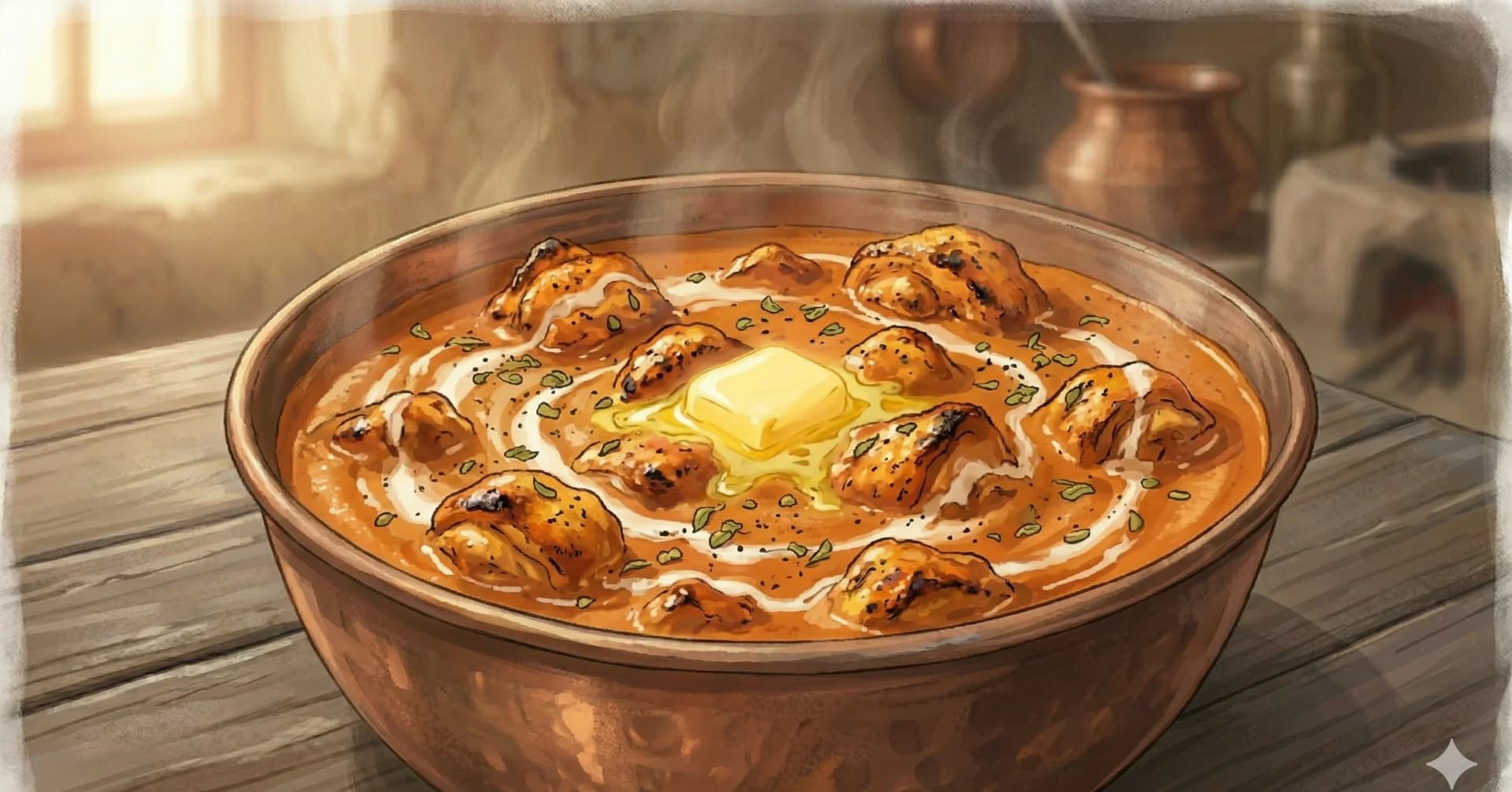
Butter Chicken (Murgh Makhni)
Butter Chicken — The Original Moti Mahal Recipe
There is something almost paradoxical about the world's most popular Indian dish having such a specific and modest origin story. Butter chicken was not the result of years of culinary refinement. It was, by all accounts, an act of improvisation: Kundan Lal Gujral at Moti Mahal restaurant in Daryaganj, Delhi, in the 1950s, facing leftover tandoori chicken that would have been too dry to serve the next day. He loosened it in a sauce of butter, tomatoes, and cream. The chicken recovered. The dish became legendary.
What Gujral discovered, perhaps more intuitively than analytically, was that the char and smoke from the tandoor-cooked chicken would transform that simple sauce from something mild and domestic into something deep and complex. The two elements needed each other. Bold, lightly burnished chicken and gentle, rich sauce. The chicken gives the sauce its backbone. The sauce gives the chicken its setting.
The dish as it spread around the world accumulated variations: more cream, less cream, sweeter, spicier, thicker. What distinguishes the best versions from the merely acceptable is the depth of the tomato base. It must be cooked long enough that the raw acidity is gone and the tomatoes have reduced to something almost jammy. And then there is the final addition of kasuri methi (dried fenugreek leaves), which gives the sauce its characteristic faint bitterness and that distinctive aroma that is unmistakably makhni.
Cashews blended into the sauce provide body and a natural sweetness that allows the cream quantity to stay restrained. This is the technique used in better Delhi kitchens; it gives the sauce a glossy, full texture without the heaviness of a purely cream-based approach.
At a Glance
Yield
4 servings
Prep
30 minutes (plus 2–4 hours marinating)
Cook
45 minutes
Total
1 hour 15 minutes (plus marinating)
Difficulty
Medium
Ingredients
- 2¼ lbchicken (bone-in thighs and drumsticks, or boneless thighs cut into large pieces)
- 4 ozfull-fat yogurt
- 1¼ tbspginger garlic paste (equal parts fresh ginger and garlic, blended smooth)
- 1½ tspKashmiri red chilli powder (for colour and mild heat)
- —½ tsp garam masala
- 1 tspsalt
- 1 tbspneutral oil
- ⅔ cupunsalted butter
- 3½ ozonion (about 1 medium), finely diced
- 1¼ tbspginger garlic paste
- 1 lbtomato purée (or 700g fresh tomatoes (about 4–4½ tomatoes), blended smooth)
- 1¾ tbspKashmiri red chilli powder
- 2¾ tspcoriander powder
- 2⅓ tspcumin powder
- 1 tspsalt
- 3½ ozraw cashews, soaked in warm water for 20 minutes
- ⅓ cupdouble cream
- 2⅓ tspsugar
- ¼ ozkasuri methi (dried fenugreek leaves), lightly crushed between palms
- 1⅔ tspgaram masala
- 2 tbspcold butter, to finish
Method
- 1
Marinate the chicken. Combine all marinade ingredients in a bowl and mix well to coat the chicken thoroughly. Cover and refrigerate for a minimum of 2 hours, or overnight for deeper flavour. Bring to room temperature 30 minutes before cooking.
- 2
Cook the chicken. For best results, grill the chicken on a hot grill pan or under a broiler/grill set to high heat, turning once, until the exterior is lightly charred in places and the chicken is just cooked through; about 12–15 minutes for bone-in pieces, 8–10 minutes for boneless. The char is important: it provides the smoky depth that defines this dish. Alternatively, roast in an oven at 220°C / 430°F for 20–25 minutes, turning halfway, until the edges begin to colour. Set the cooked chicken aside while you make the sauce. Do not discard any resting juices; add them to the sauce.
- 3
Cook the tomato base. In a wide, heavy-bottomed pan or kadai, melt 100g of the butter over medium heat. Add the diced onion (1 medium) and cook, stirring occasionally, for 8–10 minutes until soft and turning golden at the edges. Add the ginger garlic paste and cook for 2 minutes, stirring, until the raw smell cooks off. Add the tomato purée, Kashmiri chilli powder, coriander powder, cumin powder, and salt. Stir well to combine. Cook over medium heat, stirring regularly, for 20–25 minutes until the sauce has thickened, darkened slightly, and the fat begins to separate and pool at the edges. The rawness of the tomato should be entirely gone.
- 4
Blend with cashews. Drain the soaked cashews. Add them to the tomato mixture and stir through. Remove from heat and let the mixture cool slightly, then blend in batches (or with a stick blender) until very smooth and glossy. Pass through a fine sieve back into the pan if you want an exceptionally smooth restaurant-style texture.
- 5
Finish the sauce. Return the blended sauce to medium-low heat. Stir in the cream, sugar, and kasuri methi. Simmer gently for 5 minutes; the sauce will become noticeably more glossy and the fenugreek fragrance will bloom. Add the garam masala and stir through. Taste and adjust salt, sugar, or cream as needed. The sauce should be thick enough to coat the back of a spoon, not watery, not stiff.
- 6
Add the chicken. Add the charred chicken pieces to the sauce along with any resting juices. Stir gently to coat every piece. Simmer over low heat for 8–10 minutes, until the chicken is heated through and the sauce and chicken have come together.
- 7
Finish with butter. Remove from heat. Add the remaining cold butter in pieces, stirring gently to melt it into the sauce. This final butter addition gives the sauce its silky finish and is what makes makhni taste like makhni.
- 8
Serve. Transfer to a warm serving dish. If you like, add a thin swirl of cream and a few torn coriander leaves. Serve immediately with naan, tandoori roti, or steamed basmati rice.
Key Ingredient Benefits
Kashmiri red chilli powder is used here rather than regular chilli powder. It provides the vivid brick-orange colour of a good butter chicken without excessive heat. It is notably milder than cayenne or regular degi mirch. Seek it out; the colour difference is significant.
Kasuri methi (dried fenugreek leaves) is worth seeking out specifically for this recipe. It cannot be replaced by fresh fenugreek, which is bitter in a different and less pleasant way in this context. It is available at any Indian grocery store. Traditionally used as a digestive spice in Indian cooking, research suggests fenugreek may have effects on blood glucose regulation.
Tomatoes cooked in fat show increased lycopene bioavailability according to nutritional research; the fat helps the body absorb this carotenoid antioxidant. This is relevant to a sauce that combines tomatoes with substantial butter and cream.
Ginger garlic paste is the backbone of North Indian cooking. Research suggests both ginger and garlic contain compounds (gingerols and allicin respectively) with anti-inflammatory and antimicrobial properties. Traditionally used as digestive aids in Ayurvedic cooking.
Butter and cream are used generously here, as in the original preparation. This is an occasional or celebratory dish in most households. The recipe can be made lighter by reducing butter to 80g and cream to 50ml, with some loss of the characteristic richness.
Why This Works
The char on the chicken is not cosmetic. When the Maillard reaction occurs on the surface of the yogurt-marinated chicken, it creates hundreds of flavour compounds that the cream-and-butter sauce cannot produce on its own. The chicken literally seasons the sauce as it simmers.
Cashews as a thickener is a technique from Mughal and Punjabi restaurant cooking. Blended cashews create emulsified body in the sauce: smooth, slightly sweet, with no floury or starchy aftertaste. They allow the cream quantity to remain restrained, which keeps the sauce from becoming heavy.
Cooking the tomatoes until fat separates is a fundamental step in Indian sauce-making. This signals that the water has evaporated, the tomatoes have fully broken down, and the flavour has concentrated. A sauce that hasn't reached this stage will taste thin and slightly raw.
Kasuri methi at the end rather than at the beginning is deliberate. The fenugreek's volatile aroma compounds dissipate quickly with prolonged heat. Adding it late preserves the characteristic slightly bitter, herbal top note that is the olfactory signature of this sauce.
Substitutions & Variations
Chicken cuts: Bone-in pieces give deeper flavour to the sauce as they simmer. Boneless thighs are easier to eat and cook faster. Avoid breast meat if possible; it dries out quickly in the sauce.
Without a grill: If you cannot char the chicken, sear it hard in a very hot cast-iron pan with a small amount of oil. You won't achieve the same smoke, but the Maillard browning will still add depth.
Vegan / dairy-free: Replace butter with neutral oil, yogurt marinade with coconut yogurt, and cream with coconut cream. The sauce will be different but still very good; earthier, slightly tropical. The kasuri methi remains essential.
Paneer makhni: Replace the chicken entirely with 400g paneer cut into large cubes, lightly pan-fried until golden. Add directly to the finished sauce and simmer for 5 minutes. The makhni sauce recipe is identical.
Smokier result without a tandoor: Place a small steel katori (bowl) in the centre of the finished curry, put a piece of lit charcoal in it, pour a teaspoon of ghee over the charcoal, and immediately cover the pan with a lid for 2–3 minutes. This is the dhungar technique and introduces real smoke flavour.
Serving Suggestions
- Naan or tandoori roti: the bread is essential for scooping the sauce
- Steamed basmati rice: lets the sauce be the focus
- Dal makhni alongside: the classic pairing in Punjabi dhabas and Delhi restaurants
- Sliced raw onion, cucumber, and lime wedges: palate cleansers between bites
- A cold lassi or raita to balance the richness
Storage & Reheating
Refrigerator: Store in an airtight container for up to 3 days. The flavour deepens and improves overnight; this is genuinely better the next day.
Freezer: Freeze the sauce (with or without chicken) for up to 2 months. Cream-based sauces can split slightly on freezing, but stirring gently during reheating will bring it back together. Adding a small knob of butter while reheating helps restore the texture.
Reheating: Reheat gently over low heat with a splash of water, stirring frequently. Do not boil vigorously; the cream can split. Add a small swirl of fresh cream when serving reheated portions to refresh the texture.
Cultural Notes
Murgh makhani (मुर्ग़ मखनी, "butter chicken") is the Delhi Punjabi dish of pieces of tandoor-roasted chicken simmered in a tomato-cream gravy enriched with butter, fenugreek leaves, and a small amount of garam masala. The dish has a specific documented origin: it was created in the late 1940s at Moti Mahal restaurant in the Daryaganj neighborhood of Old Delhi, a restaurant founded by Kundan Lal Gujral, a refugee from Peshawar (in present-day Pakistan) who had relocated to Delhi after Partition in 1947. The story attached to the dish is functional: leftover tandoor-cooked chicken would dry out by the next day, and Gujral and his partners worked out that simmering the pieces in a buttery tomato gravy not only revived the meat but produced a richer, more crowd-pleasing dish than the original tandoori chicken.
The technical foundation is the gravy. A makhani sauce is built from ripe tomatoes (puréed and strained for smoothness), a generous amount of butter, fresh cream, ground cashews or almonds in some versions for body, ginger-garlic paste, kashmiri red chili powder for color without aggressive heat, and a finishing pinch of kasuri methi (dried fenugreek leaves) crushed between the palms to release their characteristic bitter-toasted aroma. The tandoor-roasted chicken pieces (marinated first in yogurt, ginger-garlic, and spices, then cooked over wood charcoal until the edges char) are added to the simmering sauce for the last ten minutes so they absorb the gravy without losing their smoky character.
The dish has had outsized global influence on the perception of Indian food. Moti Mahal's success in postwar Delhi attracted government dignitaries, including Jawaharlal Nehru, and the restaurant became one of the founding institutions of the modern Delhi Punjabi restaurant style that spread across India and then internationally with the South Asian diaspora. Butter chicken became one of the most ordered dishes at Indian restaurants in the United Kingdom, the United States, Canada, and Australia from the 1960s onward, often paired with dal-makhni (also a Moti Mahal creation) and naan as the prototypical Indian restaurant meal. Kundan Lal Gujral's family still operates Moti Mahal restaurants in Delhi, and a legal dispute in 2024 between Moti Mahal and Daryaganj restaurant chains over which has the rightful claim to inventing the dish was widely covered in Indian and international press.
Nutrition Facts
Calories: 772kcal (39%)|Total Carbohydrates: 15.5g (6%)|Protein: 42.5g (85%)|Total Fat: 59.1g (76%)|Saturated Fat: 25.9g (130%)|Cholesterol: 234mg (78%)|Sodium: 1831mg (80%)|Dietary Fiber: 2.1g (8%)|Total Sugars: 8.6g
You Might Also Like
Ratings & Comments
Ratings & Comments
Ratings
Share your thoughts on this recipe.
Sign in to rate and comment