Bengali · Indian Cuisine
Prawn Kabiraji Cutlet
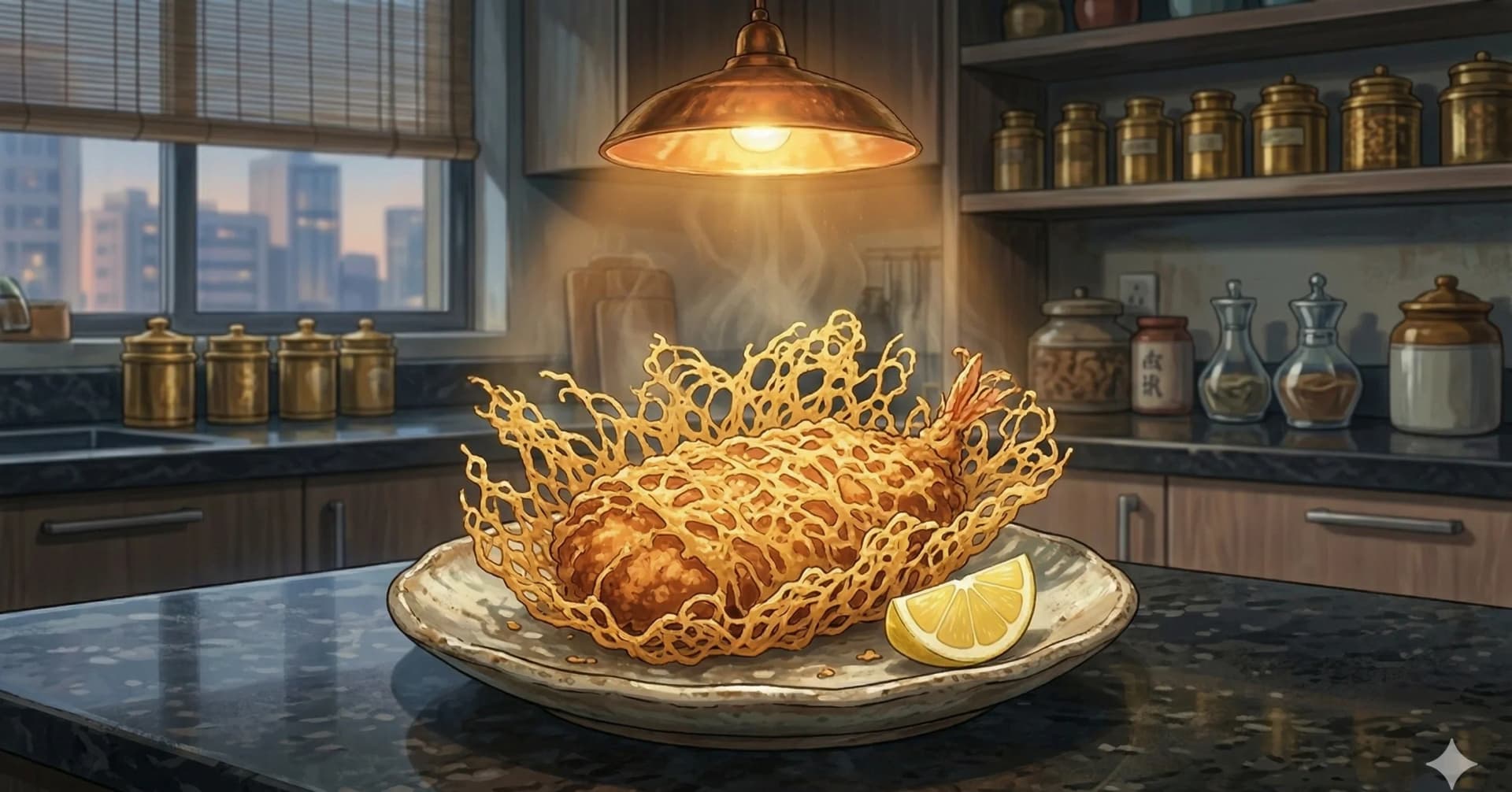
Calcutta's Anglo-Indian jewel — prawns encased in a golden lacy egg net
Calcutta — now Kolkata — was for nearly two centuries the capital of British India, and its culinary legacy is unlike that of any other Indian city. In its coffee houses and para restaurants, in establishments like Flurys on Park Street and the long-gone Hotel Cecil, a cuisine developed that was neither British nor Bengali but something entirely its own: Anglo-Indian food, the product of colonial cooks, memsahibs' instructions, Bengali invention, and the perpetual negotiation between two culinary traditions forced into proximity by history. Kabiraji cutlet is one of this tradition's finest achievements.
The name is itself a piece of culinary archaeology. Kabiraji is almost certainly a Bengali corruption of coverage, referring to the defining technique of the dish: the cutlet is completely wrapped in a gossamer layer of beaten egg that is drizzled in a circular motion over the hot oil just before the cutlet is submerged, creating a lacy, golden-amber net that envelops the filling like a Japanese temari pattern. The effect is extraordinary to look at and even better to eat. The egg net forms a thin, slightly crisp lattice that shatters lightly at the first bite, releasing the spiced, herbed filling within.
The filling is a keema-style spiced mixture of minced or chopped prawn — bright with ginger, garlic, green chilli, and fresh coriander — moulded into an oval patty, coated first in spiced breadcrumbs, then in the egg net that gives the dish its identity. There is a double cooking: the prawn filling sets in the initial frying, and the egg net seals and crisps around it in the same hot oil. The technique requires practice and some courage. The first kabiraji may not be perfect. The second will be better. By the third you will understand what your wrist is doing and the net will fall in a coherent circle.
In Kolkata's old-school restaurants — the para joints of College Street, the roll shops of New Market — kabiraji cutlet is still made by cooks who learned the egg-drizzling technique by watching someone else do it, who learned it in turn by watching someone else. It is a living piece of culinary heritage that requires embodied knowledge, and making it at home is both a technical challenge and a small act of preservation.
At a Glance
Yield
Serves 4 (8 cutlets)
Prep
30 minutes (plus 30 minutes chilling)
Cook
30 minutes
Total
1 hour 30 minutes
Difficulty
Involved
Ingredients
Filling Ingredients
- 1 lbraw prawns, peeled, deveined, and very finely chopped (almost a mince)
- 1small onion (about 80 g), very finely chopped
- 2 tspfresh ginger, finely grated
- 2 tspgarlic, finely minced
- 2–3green chillies, finely chopped
- 3 tbspfresh coriander leaves, finely chopped
- 1 tspcumin powder
- 1 tspcoriander powder
- —½ teaspoon turmeric powder
- —½ teaspoon red chilli powder
- 1 tspgaram masala
- 1 tbsplemon juice
- 1 tspfine salt (or to taste)
- 2 tbspfresh breadcrumbs (to bind)
Coating Ingredients
- ⅔ cupplain flour (maida), seasoned with a pinch of salt
- 2eggs, beaten well with a pinch of salt (for binding)
- 3½ ozfine dry breadcrumbs, seasoned with salt and a pinch of red chilli powder
- 4eggs, beaten with a pinch of salt until completely homogeneous and pourable
- —The egg net is drizzled separately for each cutlet (see method)
- 3 cups–1 litre refined vegetable oil, for deep-frying
To Serve
- —Lime wedges
- —Sliced onion with lime juice and salt (*laccha onion*)
- —Green chutney or kasundi (Bengali mustard sauce)
Method
- 1
Make the filling. Combine the finely chopped prawns (400 g), onion (1), ginger (2 teaspoons), garlic (2 teaspoons), green chillies, coriander (3 tablespoons), all the powdered spices, garam masala (1 teaspoon), lemon juice (1 tablespoon), salt (1 teaspoon), and fresh breadcrumbs (2 tablespoons) in a bowl. Mix thoroughly with your hands. You want the mixture to be cohesive and hold a shape when pressed. Test by pressing a small amount in your palm; it should hold together without crumbling. Adjust salt. Cover and refrigerate for 30 minutes. Chilling makes the mixture firmer and much easier to mould.
- 2
Shape the cutlets. Divide the chilled mixture into 8 equal portions (about 60–65 g each). With damp hands, mould each portion into a flat oval shape approximately 8 cm long, 5 cm wide, and 1.5 cm thick — the traditional cutlet shape. Place the shaped cutlets on a tray lined with cling film and refrigerate for a further 10–15 minutes if time allows.
- 3
Set up the coating station. Arrange three shallow bowls in sequence: seasoned flour (80 g), beaten egg, seasoned breadcrumbs. Working with one cutlet at a time, dust it lightly in the flour, shaking off the excess. Dip it into the beaten egg, letting the excess drip. Roll it in the breadcrumbs, pressing gently to adhere on all sides. Set aside. The breadcrumbed cutlets can rest for up to 30 minutes before frying.
- 4
Heat the oil. Pour the oil into a deep, heavy-based pan to a depth of at least 8 cm. Heat to 175°C. Use a thermometer if possible. The kabiraji technique is easier when you know the oil temperature is stable.
- 5
Create the egg net — the kabiraji technique. This is the defining step. Beat the 4 eggs for the net well until completely liquid with no streaks. Have a fork or a small whisk in your hand. Working over the hot oil, hold the fork or whisk above the surface and drizzle the beaten egg in rapid back-and-forth zigzag motions over a circular area roughly 15 cm in diameter. Move quickly. The egg will set in the hot oil almost instantly, forming the lacy net on the surface of the oil. After 3–4 seconds of drizzling, you will have a thin, golden-lace circle floating on the oil's surface.
- 6
Seal the cutlet in the net. Immediately place a breadcrumbed cutlet in the centre of the egg net while it is still setting. Using a slotted spoon, fold the edges of the egg net up and around the cutlet, then gently submerge the wrapped cutlet in the oil, pressing down with the slotted spoon so the net adheres to the breadcrumbs. Fry for 3–4 minutes, turning carefully once, until the cutlet is cooked through and the egg net is golden-amber and set. The interior prawn should reach 70°C; cut one test cutlet in half to check. The filling should be uniformly pink-white, not translucent.
- 7
Drain. Remove the cutlet with a slotted spoon and drain on kitchen paper. Allow the oil to return to temperature between each cutlet. Repeat the egg-net drizzling process fresh for each cutlet. The net should be made immediately before each cutlet is fried.
- 8
Serve immediately. Kabiraji cutlet must be served within minutes of frying. Have the accompaniments ready: lime wedges, laccha onion, and kasundi or green chutney.
Key Ingredient Benefits
Prawns are an excellent source of lean protein, selenium, iodine, and vitamin B12. They are low in total fat but contain some cholesterol. This has become less nutritionally significant as dietary cholesterol's role in cardiovascular disease has been progressively recontextualised in recent research; the current scientific consensus does not support treating dietary cholesterol as a primary cardiovascular risk factor for most people. Prawns are also a source of astaxanthin, the carotenoid responsible for their pink colour after cooking, which has demonstrated antioxidant properties in laboratory studies.
The cooking process — double frying in the sense that the breadcrumbed cutlet enters hot oil and is immediately sealed with the egg net — produces less oil absorption than single frying at lower temperatures, because the high heat rapidly sets the exterior and limits oil penetration. The egg net itself, being composed primarily of egg protein, absorbs very little oil.
Garam masala in the filling provides the warming aromatic top note — cinnamon, cardamom, clove — that is the characteristic signature of Anglo-Indian spiced preparations. This spice blend has a long history in both Ayurvedic and Unani medicine as a digestive and warming preparation. In cooking, its volatile aromatic compounds are best preserved by adding it at the end of cooking or, as here, incorporating it into a mixture that is not subjected to prolonged high heat.
Why This Works
The breadcrumb layer beneath the egg net is not redundant. It is structural. The beaten egg drizzled onto the hot oil surface sets into a fragile, lacy lattice that has no adhesive quality on its own. It must attach to something. The breadcrumbed exterior of the cutlet provides the rough, textured surface that the egg net clings to as it is folded around the cutlet and submerged. Without the breadcrumb layer, the egg net peels away during frying. With it, the two layers fuse into a single, unified crust that separates cleanly from the cutlet's interior at the first bite.
The drizzling speed matters enormously. If you move the fork too slowly, the egg falls in thick streams rather than fine threads and produces a sheet rather than a lacy net. The movement must be quick — almost flicking — so the egg breaks into fine streams that form the characteristic open lattice. Practice with water over a bowl before attempting with egg over hot oil. The motion is a rapid wrist movement, not a slow pour.
Chilling the filling twice — once after mixing and once after shaping — is what makes the cutlet fryable. Raw prawn mince is wet and slightly sticky; a fresh, unchilled mixture will deform in the oil, fall apart around the breadcrumb casing, and resist holding its shape through the folding-in-net-and-submerging process. A cold, firm cutlet behaves like a solid object. The thirty minutes of refrigeration after mixing and the additional fifteen after shaping are not optional steps.
The two-egg coating system (first beaten egg, then breadcrumbs, then the egg net) creates a structure with layered functions: the flour absorbs surface moisture from the cutlet and gives the egg something to adhere to; the egg binds the breadcrumbs; the breadcrumbs provide crunch and a scaffold for the net. Each layer makes the next one work.
Substitutions & Variations
Fish kabiraji: The same technique applied to a fish filling — fine-minced firm white fish such as bhetki (barramundi) or tilapia — produces the most common version of kabiraji cutlet in Kolkata. The method is identical; the fish filling uses the same spicing.
Chicken kabiraji: Minced chicken thigh with the same spice profile works well. The chicken needs slightly longer internal cooking. Ensure the filling reaches 75°C before removing from the oil.
Vegetarian kabiraji: A filling of mashed spiced potato with paneer or boiled green peas can replace the prawn. The egg net technique and breadcrumb coating remain the same. This version is softer and benefits from very firm shaping and thorough chilling before coating.
Egg net tool: A traditional Bengali cook makes the net by drizzling beaten egg from cupped fingers, controlling the flow with the spaces between fingers. A fork, whisk, or squeeze bottle with a fine tip all produce the same result by different means. Practice determines which tool you find most controllable.
Kasundi: Bengali mustard sauce — darker, more fermented, and more complex than the ground mustard paste used in cooking — is the traditional dipping accompaniment. It can be found in South Asian grocery stores or made from scratch by fermenting mustard seeds with turmeric and salt over several days. Dijon mustard thinned slightly with water is a reasonable substitute.
Serving Suggestions
Prawn kabiraji cutlet is served as a starter in the restaurant context — brought to the table on a plate lined with a paper doily, with lime wedges, laccha onion (thin-sliced raw onion dressed with lime juice and a pinch of chilli), and a small bowl of kasundi or green chutney alongside. In Kolkata's old coffee houses, it arrives at the table in minutes, still sizzling, with a glass of cold lemon water. At home, serve immediately as the dish comes out of the oil. It does not wait. A cold Bangla beer alongside, if you are inclined, is the Kolkata para restaurant tradition.
Storage & Reheating
Kabiraji cutlet does not store or reheat well. The egg net, which is the defining element of the dish, becomes soggy and loses its lacy character within minutes of being made. The breadcrumbed cutlet shapes can be made up to the point of the egg net step, covered, and refrigerated for up to 4 hours before frying. Beyond that window, refrigerate the shaped and breadcrumbed cutlets for up to 24 hours; the prawn filling will remain safe and the cutlets will fry even better from cold than from room temperature. The egg net must always be made fresh, immediately before frying. There is no reheating method that restores the original texture. Make to order, eat immediately.
Cultural Notes
Kabiraji cutlet (কবিরাজি কাটলেট) is the Anglo-Bengali fried cutlet in which a piece of marinated prawn (or fish, chicken, or mutton in other variations) is dipped in a thin egg batter, deep-fried with the egg forming a delicate lacy web around the cutlet, and served with a thin onion-tomato salad and a kasundi (Bengali mustard sauce) dip. The dish is a defining example of the Calcutta Anglo-Indian cooking tradition that developed during the British colonial period in the eighteenth and nineteenth centuries, when Bengali cooks working in British households and clubs adapted European cutlet, croquette, and fritter techniques into a hybrid cuisine that took elements from both traditions.
The name has a documented Bengali origin. The word kabiraji is the Bengali corruption of the English "coverage" (referring to the egg-lace covering that distinguishes the dish), though some sources alternatively trace it to kabiraji meaning "physician" in Bengali, suggesting an association with a particular doctor who popularized the dish in the late nineteenth century. The dish itself appears in Calcutta restaurant menus from the early twentieth century and has been continuously served at Anglo-Indian restaurants and Bengali clubs ever since. Kolkata's Mocambo, Trincas, Olypub, and the old institutions of Park Street and Esplanade restaurant district all serve canonical versions.
The technique demands timing for the egg lace. The prawn (or other protein) is marinated in ginger-garlic paste, kashmiri red chili powder, turmeric, lemon juice, and salt, then dredged in flour and beaten egg. The cutlet slides into hot oil and immediately, additional beaten egg is drizzled in fine streams across the surface of the oil so the egg cooks into a thin lacy network that wraps around the cutlet as it fries. The whole process takes about ninety seconds. The finished cutlet is served on a small plate with a few rings of raw onion, a slice of lime, a few pieces of sliced cucumber, and a small dish of kasundi mustard. The dish is most strongly associated with the Calcutta tradition of late-evening dining at the city's heritage Anglo-Indian and Bengali restaurants, and it appears at the gentlemen's club tradition (Bengal Club, Calcutta Club, Tollygunge Club) that has continued through the post-independence period as one of the city's culinary fixtures.
Nutrition Facts
Calories: 543kcal (27%)|Total Carbohydrates: 41.3g (15%)|Protein: 36g (72%)|Total Fat: 25.4g (33%)|Saturated Fat: 5.1g (26%)|Cholesterol: 440mg (147%)|Sodium: 1700mg (74%)|Dietary Fiber: 2g (7%)|Total Sugars: 2.9g
You Might Also Like


Ratings & Comments
Ratings & Comments
Ratings
Share your thoughts on this recipe.
Sign in to rate and comment