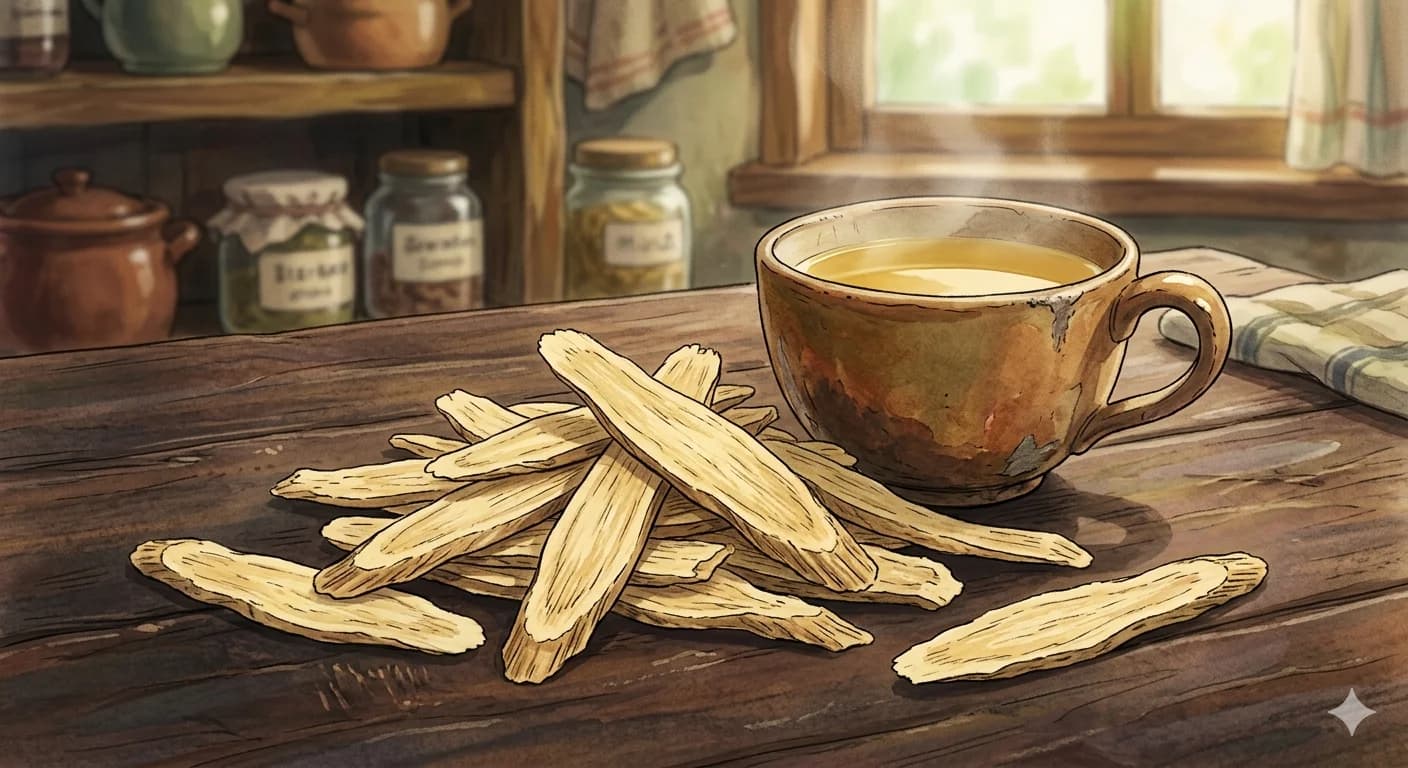
Astragalus Root
Also known as: Huang Qi, 黄芪, Astragalus membranaceus, Milk Vetch Root
Astragalus root (huang qi, 黄芪) — pale yellow, flat slices of dried root that look like tongue depressors — is one of the most important tonic herbs in Traditional Chinese Medicine, used for over two thousand years to strengthen the body's defensive energy.
The flavor is mildly sweet and faintly bean-like, without any bitterness or strong medicinal taste. This makes astragalus one of the easiest TCM herbs to incorporate into everyday cooking — it blends seamlessly into soups and broths, adding a gentle sweetness.
In TCM, astragalus is classified as a qi tonic — specifically one that strengthens "wei qi" (defensive qi), the body's outer protective energy. This traditional understanding has driven significant modern research into astragalus's potential immunomodulatory properties.
Key facts at a glance:
- Premier qi and immune tonic in Traditional Chinese Medicine
- Mildly sweet, no bitterness — one of the easiest medicinal herbs to cook with
- Flat, pale yellow root slices — distinctive tongue-depressor shape
- Over 2,000 years of documented use — one of the most researched TCM herbs
- Not eaten directly — simmered in soups and removed before serving
Flavor Profile
Origin
Northern China, Mongolia, Manchuria
Traditional Medicine Perspectives
Traditional Chinese Medicine
Astragalus (Huang Qi) is classified as sweet and slightly warm, entering the Spleen and Lung meridians. It is the primary herb for tonifying wei qi (defensive qi) and is used to strengthen the exterior, tonify Spleen qi, raise yang qi, and promote tissue regeneration. It is prescribed for frequent colds, spontaneous sweating, fatigue, poor appetite, and slow-healing wounds. It is one of the most important and commonly used qi tonics in TCM.
Modern Scientific Research
Astragalus has been one of the most extensively researched TCM herbs in modern science. Its primary bioactive compounds include astragalosides (triterpenoid saponins), astragalus polysaccharides, and flavonoids.
Astragalus polysaccharides have demonstrated immunomodulatory activity in numerous laboratory and animal studies, including effects on natural killer cell activity, macrophage function, and T-cell proliferation. Some clinical studies have used astragalus as an adjunct in conventional cancer treatment protocols, though results are mixed and study quality varies.
Research has also investigated astragaloside IV for potential cardioprotective and anti-aging properties, including effects on telomerase activity. While promising, most evidence remains preclinical.
Cultural History
Astragalus has been documented in Chinese medicine since the Shennong Ben Cao Jing (Divine Farmer's Materia Medica), one of the oldest TCM texts, where it is classified as a superior herb — meaning it is considered safe for long-term use and beneficial for overall vitality.
The name "huang qi" (黄芪) means "yellow leader," referring to both the root's color and its leading role among qi-tonifying herbs. It is one of the most frequently prescribed herbs in modern TCM practice, appearing in formulas for fatigue, frequent colds, wound healing, and recovery from illness.
In Chinese home cooking, astragalus slices are added to soups as routinely as bay leaves in Western cooking. A few slices in the family chicken soup is considered basic health maintenance, not exotic herbalism.
Culinary Uses
Add 5-8 slices of dried astragalus to chicken soup, pork rib broth, or bone broth at the start of cooking. Simmer for at least 1 hour. The slices release a mild sweetness into the broth and are removed before serving — they are too fibrous to eat.
Combine with codonopsis, jujubes, and goji berries for the classic Chinese herbal chicken soup formula. This four-herb combination is the foundation of Chinese medicinal soup-making.
Astragalus slices are not eaten — they are simmered in soups and broths to release their compounds, then removed before serving, like bay leaves in Western cooking.
For a daily tonic tea, simmer 3-4 slices with goji berries and jujubes in water for 20-30 minutes. The resulting tea is mildly sweet and can be drunk regularly as a wellness practice.
Preparation Methods
Rinse dried slices briefly and add directly to simmering liquid — no soaking needed. The flat slices are designed for maximum surface area extraction during cooking.
Simmer for at least 1 hour for full extraction. In a slow cooker or double-boiler soup, cook for 2-4 hours. Remove slices before serving — they are too woody and fibrous to eat.
Look for astragalus slices that are pale yellow, thick, and slightly flexible. Very thin, dark, or brittle slices may be old or low quality. The cross-section should show a fibrous, slightly sweet-smelling interior.
Traditional Dishes
- Astragalus chicken soup
- Yu ping feng san (Jade Screen formula)
- Herbal bone broth
- Astragalus goji tea
- Bu zhong yi qi tang
Comments
Share your thoughts on this ingredient.
Sign in to comment0 Comments