Japanese Cuisine
Tonkotsu Ramen (Pork Bone Broth Ramen)
A milky, collagen-rich pork bone broth ladled over springy noodles, built in layers from cold-brew dashi and hidden seasonings
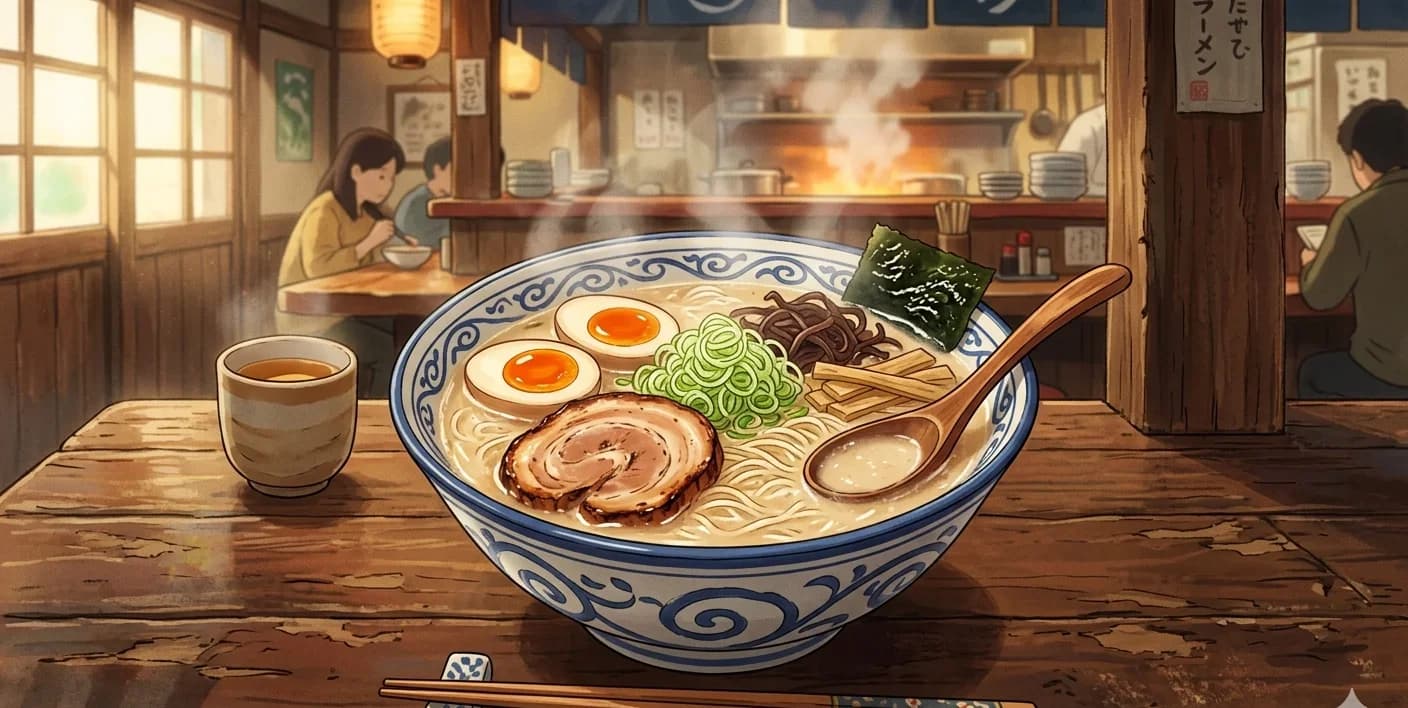
Tonkotsu ramen comes from Fukuoka, on the southern island of Kyushu, and it is one of the most recognizable bowls of noodle soup in the world. The broth is the point. Pork leg bones and hock are boiled hard enough and long enough that the collagen, marrow, and fat break down into a thick, opaque, cream-colored soup with a body that coats the back of a spoon. In a traditional ramen shop, this process takes anywhere from 6 to 18 hours over high heat. The method here, adapted from Namiko Hirasawa Chen, uses a pressure cooker to collapse that timeline to about 3 hours without losing the richness that makes tonkotsu worth the effort.
What separates a good bowl from a forgettable one is layering. The broth alone provides body, but depth comes from three supporting elements that work quietly behind it: a cold-brew dashi made with kombu, dried shiitake, and niboshi, which contributes oceanic umami without any fishiness in the finished soup; a shoyu tare of light soy sauce, sake, and mirin that seasons each bowl individually; and a set of hidden seasonings, known as kakushiaji, that include onion, scallion, bonito flakes, rice vinegar, and sake. The vinegar is particularly clever. Its acidity helps break down the bones during cooking, releasing more gelatin into the broth, while also cutting through the richness and lifting the overall flavor.
This is not a recipe that belongs to any single source. The primary structure follows Namiko Hirasawa Chen's pressure cooker approach. Technique notes on bone preparation and the physics of emulsification draw from J. Kenji Lopez-Alt's detailed work at Serious Eats. Broader broth-building principles are informed by Nagi Maehashi at RecipeTinEats. The result is a bowl that rewards a weekend afternoon and fills the kitchen with one of the best smells in cooking.
At a Glance
Yield
4 servings
Prep
1 hour
Cook
2 hours 10 minutes
Total
3 hours 10 minutes
Difficulty
Medium
Ingredients
Broth Ingredients
Dashi Ingredients
- 2 cupwater
- 1 piecekombu (dried kelp), about 15 x 15 cm
- 2dried shiitake mushrooms (about 16 g)
- 5niboshi (dried anchovies, about 8 g), heads and intestines removed
Tare Ingredients
Seasoning Ingredients
- 1medium onion, halved with skin on
- 2scallions, cut in half crosswise
- ½ ozkatsuobushi (dried bonito flakes), about 1 cup loosely packed
- 2 tbspsake
- 2 tbsprice vinegar (unseasoned)
Noodle Ingredients
- 4portions fresh ramen noodles (about 480 g total; frozen or dried also work)
To Serve
- 2scallions, thinly sliced, for garnish
- 4ramen eggs (ajitsuke tamago), halved
- 8 sliceschashu (braised pork belly), warmed
- —Menma (seasoned bamboo shoots)
- —Dried wood ear mushrooms, rehydrated and thinly sliced
- 1 tbsppickled red ginger (beni shoga)
- —Nori sheets
- —Toasted white sesame seeds
Method
- 1
Rinse the pork leg bones and pork hock under cold running water to remove any loose debris. Place them in a large bowl and cover with cold water. Soak for 15 minutes, changing the water several times, until the water runs mostly clear. This draws out residual blood that would otherwise cloud the broth and produce off-flavors. If using pork backbones, look for any white spinal cord tissue and remove it with chopsticks, as it can produce a strong odor.
- 2
While the bones soak, peel away the papery outer layers of the garlic head and trim off the root end. Slice the head in half crosswise to expose the cloves. Slice the ginger thinly, leaving the skin on. ### Pressure cook the broth
- 3
Place the drained bones, pork hock, garlic, ginger, and 1.9 L of water in the pressure cooker pot. The water level should sit at or below the maximum fill line. If it exceeds the line, remove some water and set it aside to add back later during the open boiling stage. Lock the lid, set the valve to sealing, select high pressure, and cook for 60 minutes. The cooker will take roughly 40 minutes to reach full pressure before the countdown begins. You now have about 100 minutes to prepare everything else.
- 4
If you do not have a pressure cooker, use a large stockpot. Add an extra 500 ml of water (for a total of 2.4 L) and bring to a vigorous boil. Reduce to a strong simmer, partially covered, and cook for 3 to 4 hours. The longer the bones simmer, the more collagen and flavor they release. ### Start the cold-brew dashi
- 5
Combine the kombu, dried shiitake mushrooms, and niboshi in a bowl with 480 ml of water. Set it aside at room temperature. The umami compounds will extract slowly over the next hour or so without any cooking. This gentler approach avoids the bitterness that boiling kombu can introduce and produces a cleaner supporting stock. ### Make the shoyu tare
- 6
Combine the sake, mirin, usukuchi soy sauce, and water in a small saucepan. Drop in the small piece of kombu and set over medium heat. Bring the liquid close to a simmer, watching for small bubbles at the edges, then reduce the heat to low and hold there for 3 to 4 minutes. The kombu will soften and release a faint sea scent. Turn off the heat.
- 7
Add the 25 g of salt and stir until fully dissolved. Let the tare cool to room temperature. Do not reheat the tare after the salt is added, as the salt can crystallize and refuse to dissolve properly. The finished tare should taste intensely salty and savory on its own. It will balance once diluted in the broth. ### Prepare the hidden seasonings
- 8
Cut the onion in half, leaving the skin on. The skin adds a gentle golden tint to the broth. Cut the scallions in half crosswise. Set both aside until the pressure cooking is done. ### Open-boil and skim the broth
- 9
When the pressure cooker cycle ends, carefully release the pressure using the quick-release valve. Use a long spatula to turn the valve and drape a paper towel over the opening to catch splatter. Open the lid and set the pot to saute mode on high heat (or transfer the contents to a large stockpot over high heat on the stove). Bring the broth to a vigorous, rolling boil.
- 10
Skim the scum and foam that rise to the surface using a fine-mesh skimmer. You will need to do this repeatedly over the next hour. Take care not to remove the rendered fat or any pale, creamy bone marrow along with the scum. The fat and marrow are essential to the richness of the finished broth. Keep the heat high throughout. Lowering the heat causes the scum to sink back into the liquid rather than floating where you can catch it. ### Add the hidden seasonings
- 11
After 5 to 10 minutes of skimming, add the halved onion and scallion pieces to the boiling broth. Add the sake and rice vinegar. The vinegar will help break down the bones further and brighten the overall flavor without tasting sour in the finished soup.
- 12
Fish the shiitake mushrooms and niboshi out of the cold-brew dashi and add them directly to the broth. Reserve the dashi liquid in its bowl. The solids will contribute another layer of umami as they simmer.
- 13
Add the katsuobushi to the broth and stir to combine. The bonito flakes will darken and soften as they absorb the liquid. Continue boiling vigorously for 30 minutes, stirring occasionally to prevent anything from sticking to the bottom. The broth should be bubbling actively. If it splashes, place a mesh splatter guard over the pot. ### Finish and strain
- 14
After 30 minutes, pour only the dashi liquid into the pot, leaving the kombu behind in the bowl. Discard the kombu or save it for another use. Continue boiling for another 30 minutes, stirring occasionally. The broth will reduce slightly and take on a thick, opaque, creamy appearance. This is the emulsification happening: the vigorous boil is forcing fat and collagen into a stable suspension in the liquid.
- 15
Turn off the heat. Using tongs, lift out the large bones and transfer them to a fine-mesh strainer set over a clean pot. Let any residual broth drain through, then discard the bones. Remove the remaining solids (onion, scallion, ginger, garlic, mushrooms, bonito) with tongs and press them firmly against the strainer with a wooden spatula to extract as much liquid as possible. Discard the solids.
- 16
Strain the broth through the fine-mesh strainer in small batches, pressing gently on any remaining bits. Working in small pours prevents the strainer from overflowing and catches all the fine sediment. The finished broth should be creamy, opaque, and thick enough to coat a spoon. You should have roughly 1.4 to 1.6 L. ### Assemble the ramen
- 17
Bring a large pot of water to a rolling boil for the noodles. Reheat the tonkotsu broth in a separate pot, keeping it covered and at a gentle simmer. Warm four ramen bowls by filling them with hot water and letting them sit for a minute.
- 18
Drain the hot water from the bowls. Spoon 1 Tbsp of shoyu tare into each bowl. This is the right amount of seasoning. Adding more will darken the soup and overpower the milky broth.
- 19
Cook the ramen noodles according to the package directions. Fresh noodles typically need only 1 to 2 minutes in rapidly boiling water. They are done when they are tender on the outside but still have a slight resistance at the core. Drain thoroughly.
- 20
Ladle about 350 ml of hot tonkotsu broth into each bowl over the tare. Divide the drained noodles among the bowls. Use chopsticks to lift the noodles from the broth and lay them back down so they line up neatly in one direction.
- 21
Add your toppings quickly and serve immediately. The noodles will absorb the broth as they sit, so speed matters here. Arrange the chashu, ramen egg halves, menma, wood ear mushrooms, pickled ginger, and nori around the noodles. Scatter the sliced scallions and sesame seeds on top.
Key Ingredient Benefits
Pork leg bones. The femur and knuckle bones of the pig are ideal for tonkotsu because they contain large amounts of marrow and collagen-rich connective tissue. When cooked under pressure and then boiled vigorously, these bones release gelatin that gives the broth its characteristic viscosity and body. Pork backbones are a good alternative and produce a rich broth somewhat faster due to their higher surface area. Look for bones at Asian grocery stores (H Mart is a reliable source) or ask a butcher to save them for you.
Pork hock. The section of leg just above the trotter, containing bone, muscle, skin, and a generous amount of connective tissue. The skin is especially valuable here, as it is almost pure collagen and contributes significantly to the thickness of the broth. A pig trotter (foot) can be substituted and provides even more gelatin, though some cooks find its appearance off-putting.
Niboshi (dried anchovies). Small sardines or anchovies that have been boiled and dried. They add a savory backbone to the dashi without the fishiness you might expect, especially when cold-brewed rather than boiled. Removing the heads and intestines before steeping reduces any bitter or off flavors. Niboshi are common in Korean cooking as well and can be found at most Asian grocery stores.
Usukuchi soy sauce. Light-colored Japanese soy sauce that is, counterintuitively, saltier than dark (koikuchi) soy sauce. It is used here to season the tare without darkening the broth. The milky, pale appearance of tonkotsu soup is part of its identity, and switching to regular soy sauce would compromise that visual quality. This is the same ingredient used in udon broth for the same reason.
Katsuobushi. Dried, smoked, and fermented bonito flakes rich in inosinic acid. Added to the broth during the open boiling stage, they contribute a smoky umami layer that rounds out the pork flavor. The same ingredient forms the backbone of dashi in miso shiru.
Why This Works
The milky appearance and rich body of tonkotsu broth are the result of emulsification, not just flavor extraction. When pork bones are boiled vigorously, the collagen in the connective tissue breaks down into gelatin, and the fat from the marrow and surrounding tissue is forced into tiny droplets that become suspended in the liquid. The vigorous boil is not optional. A gentle simmer produces a clear broth (as in pho bo or shoyu ramen), while a hard rolling boil creates the turbulence needed to break fat into small enough particles that they stay suspended rather than floating to the surface. This is the same principle behind making a vinaigrette emulsify: mechanical energy keeps the oil and water phases mixed.
The pressure cooker accelerates the collagen-to-gelatin conversion. Under pressure, water reaches temperatures above its normal boiling point (around 115 to 120C), which breaks down connective tissue roughly three to four times faster than atmospheric boiling. The 60-minute pressure cook followed by 60 minutes of open vigorous boiling approximates what a traditional ramen shop achieves in 8 to 12 hours.
The cold-brew dashi provides a second dimension of umami that pork bones alone cannot supply. Kombu contributes glutamate, niboshi contribute inosinate, and dried shiitake contribute guanylate. When these three umami compounds meet in the same bowl, they produce a synergistic effect that is many times more intense than any single source alone. This is the same principle at work in miso shiru and udon broth, applied here as a supporting layer rather than the main event.
The rice vinegar in the hidden seasonings serves a dual purpose. Its acidity helps dissolve calcium and other minerals from the bones, producing a more mineral-rich broth. It also cuts through the fat and heaviness of the finished soup, creating the impression of lightness even in a rich bowl. By the time the broth is strained, the vinegar itself has cooked off and left no sour flavor behind.
Substitutions & Variations
Stovetop method. If you do not have a pressure cooker, use a large stockpot with an extra 500 ml of water. Bring to a vigorous boil and cook uncovered (or partially covered) for 3 to 4 hours, skimming regularly. Top up with hot water if the level drops below the bones. The result will be comparable, though the longer cook time means more monitoring.
Chicken tonkotsu. Replace the pork bones with an equal weight of chicken carcasses and wings. The broth will be lighter in body but still milky when boiled hard. This is sometimes called tori paitan and is popular in lighter ramen styles.
Spicy tonkotsu. Stir 1 to 2 tsp of tobanjiang (fermented chili bean paste) or la-yu (chili oil) into each bowl just before serving. This transforms the broth into something closer to the tantanmen family, with a warming heat that plays well against the richness. For a Southeast Asian direction, a spoonful of the chili paste from bun bo hue works beautifully.
Miso tonkotsu. Add 1 Tbsp of white (shiro) miso to each bowl alongside the tare. The fermented soybean paste deepens the umami and adds a faintly sweet, earthy quality. This bridges tonkotsu and miso ramen styles.
Curry tonkotsu. For a fusion approach, stir a small amount of Japanese curry roux or a teaspoon of Thai khao soi curry paste into the broth. The warm spices complement the pork richness surprisingly well.
Quick broth shortcut. If time is very limited, combine 1 L of good-quality store-bought chicken stock with 500 ml of unsweetened soy milk and heat gently. Season with the shoyu tare as written. This will not replicate true tonkotsu, but it produces a passable creamy ramen broth in minutes.
Serving Suggestions
Tonkotsu ramen is a meal unto itself, but ramen shops in Japan commonly serve it alongside small plates. Gyoza (pan-fried dumplings) are the classic pairing, their crispy bottoms and juicy pork filling echoing the flavors in the bowl. Karaage (Japanese fried chicken) is another natural companion, and its crunchy exterior provides a textural contrast to the soft noodles and silky broth.
A simple green salad dressed with a ginger-carrot dressing cuts through the richness and refreshes the palate between bites. Pickled vegetables, especially beni shoga (pickled red ginger) or takuan (pickled daikon), serve the same purpose and are traditional table condiments at ramen shops.
For a larger spread, you could serve the tonkotsu alongside bowls of miso shiru for guests who prefer a lighter soup, or set out udon noodles as an alternative for anyone who wants a different texture in the same broth. Leftover broth also makes a deeply satisfying base for a hot pot meal the next day.
Storage & Reheating
The tonkotsu broth keeps in an airtight container in the refrigerator for up to 3 days. It will set into a firm gel as it cools, which is a sign of high gelatin content and a mark of a well-made broth. It also freezes well for up to 1 month. Reheat gently on the stovetop, stirring occasionally as it liquefies. If the broth has separated or looks grainy after reheating, bring it to a brief vigorous boil and whisk to re-emulsify.
The shoyu tare keeps in the refrigerator for up to 2 weeks.
Cooked ramen noodles do not store well. They become soft and bloated within minutes of sitting in broth, and they turn gummy in the refrigerator. Always cook noodles fresh for each serving. Store uncooked fresh noodles according to the package directions, and keep dried or frozen noodles in the pantry or freezer until needed.
Toppings like chashu and ramen eggs should be stored separately and can be prepared 1 to 2 days in advance. Cool the broth rapidly in an ice bath before refrigerating, especially during warm weather, as the high protein content makes it a hospitable environment for bacteria if left at room temperature.
Cultural Notes
Tonkotsu ramen (豚骨ラーメン), pork-bone broth ramen, is the regional ramen of Fukuoka and the broader Kyushu region in southwestern Japan. What defines the dish is the broth: milky white, fully opaque, with a richness that no other ramen tradition reaches. That texture comes from a specific technique. You boil pork bones at high temperature for 12 to 24 hours, hard enough that the bone marrow and the collagen emulsify into microscopic fat droplets suspended in the liquid. Those droplets scatter light and give the broth its color. The technique is much more time-intensive and harder to execute than the clearer broths of shōyu ramen or miso ramen, and a real tonkotsu shop is in continuous broth production around the clock.
The dish came out of Fukuoka's Hakata district in the 1940s, with multiple Hakata shops claiming origin. The most widely repeated story credits the Nankin Senryo shop in Kurume city, just south of Fukuoka, where around 1947 the cooks accidentally over-boiled a batch of pork-bone broth and discovered the milky cloudy result had a deeper, more satisfying flavor than the clearer broths everyone else was making. The accident spread. Hakata-style ramen moved fast across Kyushu and gradually northward through Japan, and by the 1990s it was one of the dominant ramen styles in the country.
Outside Japan, the dish has become almost synonymous with "Japanese ramen" in international perception, particularly after the 2010s global ramen boom. The major chains went international: Ichiran (founded 1960), Ippudo (1985), Hakata Ippudo, Ramen Nagi, Tonkotsu Ramen Bankara. Ichiran's distinctive single-counter dining booth, where you eat alone facing a wall with the kitchen passing your bowl through a small curtained window, has become an instantly recognizable Japanese restaurant format worldwide.
The accompaniments do a lot of work. Thin straight noodles, very different from Tokyo's wavy noodles. The kombu-pickled boiled egg (ajitsuke tamago, 味付け玉子). Pickled mustard greens (takana, 高菜). A fresh garlic press at the table. Sesame seeds. And the kaedama (替え玉) tradition, where you finish your first round of noodles and order a refill that gets dropped into the remaining broth. Together they define what most of the world now thinks of as "authentic Japanese ramen," even though tonkotsu is only one regional Japanese tradition among many.
Nutrition Facts
Calories: 834kcal (42%)|Total Carbohydrates: 55g (20%)|Protein: 35g (70%)|Total Fat: 45g (58%)|Saturated Fat: 17g (85%)|Cholesterol: 130mg (43%)|Sodium: 1280mg (56%)|Dietary Fiber: 2g (7%)|Total Sugars: 2g
You Might Also Like
Ratings & Comments
Ratings & Comments
Ratings
Share your thoughts on this recipe.
Sign in to rate and comment