Japanese Cuisine
Katsudon (Pork Cutlet Rice Bowl)
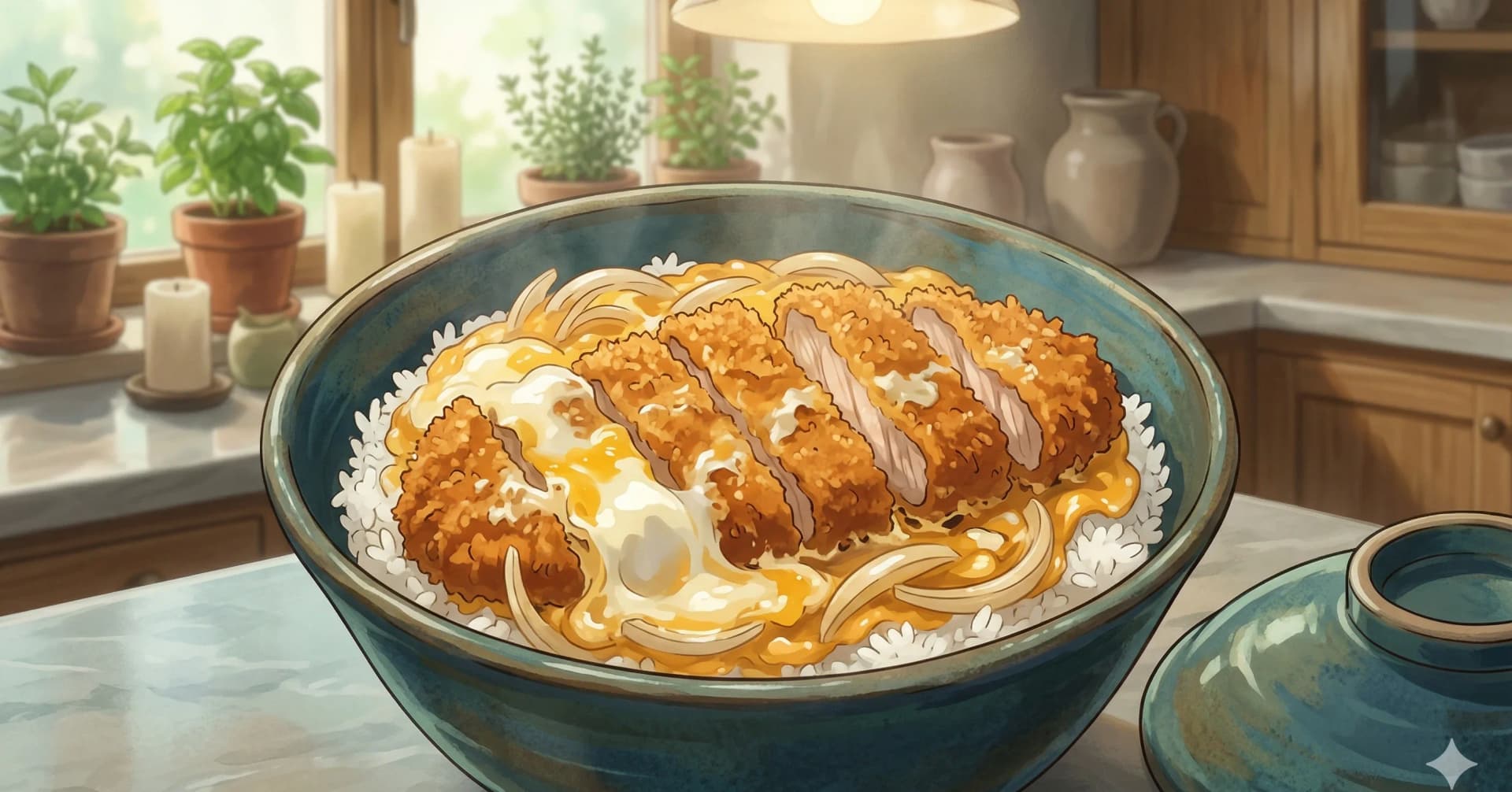
A crispy tonkatsu cutlet simmered briefly in sweet dashi and onions, then bound with barely set egg and laid over steamed rice
There is a moment in making katsudon that feels almost reckless. You take a freshly fried tonkatsu, its crust perfectly golden and crackling, and you place it into a shallow pan of simmering dashi and onion. The sauce climbs up the sides of the cutlet. The bottom layer of panko softens. Then you pour beaten egg around and over it, clap on a lid, and wait just 30 seconds before sliding the whole thing, still trembling and barely set, over a bowl of hot rice. It seems like you are ruining perfectly good fried food, but the result is something greater than either component alone.
Katsudon is comfort food in its purest form, consistently ranked as one of the most beloved meals in Japan. It is the dish students eat the night before exams, because "katsu" is a homophone for the verb meaning "to win." It is the dish that appears in countless anime and drama scenes as shorthand for determination, warmth, and home. The appeal is not hard to understand. The combination of textures is extraordinary: the top of the cutlet retains some crunch where the egg has not reached it, the bottom has absorbed the sweet, savory dashi and become almost bread-pudding-like, and the egg itself is a soft, custard-like blanket that ties everything to the rice beneath.
The cooking sauce is simple but precisely balanced. Dashi, soy sauce, mirin, and a touch of sugar create a sweet-savory broth that is characteristically Japanese in its restraint. The egg must be added in two stages for the best texture: the first addition sets into curds that catch in the crevices of the cutlet, the second stays soft and glossy on top. This dual-stage technique is the same one used in oyakodon and produces that signature half-set, half-flowing consistency.
At a Glance
Yield
4 servings
Prep
15 minutes
Cook
20 minutes
Total
35 minutes (assuming pre-made tonkatsu)
Difficulty
Easy
Ingredients
- 4[tonkatsu](/recipes/tonkatsu) cutlets, freshly fried or reheated until crisp, sliced into 2 cm strips
- ⅓ cupdashi stock
- 1¼ tbspsoy sauce
- 1¼ tbspmirin
- 1¼ tspsugar
- —Half a medium onion (about 80 g), sliced into thin half-moons
- 2large eggs, lightly beaten (do not over-beat; streaks of white and yolk should remain visible)
- —A few sprigs of mitsuba (Japanese parsley) or scallion greens, cut into 3 cm lengths
- 4bowls of freshly steamed Japanese short-grain rice (about 200 g uncooked per bowl)
- —Shichimi togarashi, optional
Method
- 1
Cook the rice and have it ready in bowls. Katsudon is assembled per serving, so prepare the rice and keep it warm. If your tonkatsu is pre-made, reheat it in a 190 degree Celsius oven until the crust is crisp, then slice into strips. Keep warm while you prepare the egg topping.
- 2
Mix the simmering sauce. For each serving, combine 75 ml dashi, 20 ml soy sauce, 20 ml mirin, and 5 g sugar in a small bowl. Stir until the sugar dissolves. Taste and adjust: the sauce should be distinctly sweet-savory, a notch sweeter than you might expect, because the egg and rice will dilute it.
- 3
Prepare the eggs for one serving. Crack 2 eggs into a small bowl and beat them lightly with chopsticks. Do not whisk until uniform. You want visible streaks of white and yolk, as this creates a more interesting texture in the finished dish.
- 4
Heat a small skillet (about 18 to 20 cm, ideally with a lid) over medium heat. Pour in one portion of the simmering sauce and add one portion of sliced onion. Spread the onion slices across the pan in a single layer.
- 5
Bring the sauce to a gentle simmer and cook the onions for 3 to 4 minutes until they are soft and translucent but still have some shape. They should not be browned or caramelized. The sauce will reduce slightly and become more concentrated.
- 6
Lay the sliced tonkatsu across the onions in the pan, arranging the strips in a rough circle that fits over a rice bowl. Let the cutlet sit in the simmering sauce for about 30 seconds so the bottom absorbs some of the liquid.
- 7
Pour approximately two-thirds of the beaten egg around and between the tonkatsu pieces, letting it flow into the gaps and under the cutlet. Cover the pan and cook for 30 to 40 seconds until this first addition of egg is just set on the bottom but still soft on top.
- 8
Remove the lid and pour the remaining egg over the top of the cutlet, focusing on any areas that look dry. Scatter the mitsuba or scallion greens over the surface. Cover again and cook for just 15 to 20 seconds. The second layer of egg should be barely set, still glistening and slightly runny. Remove from heat immediately.
- 9
Slide the entire contents of the pan onto a bowl of hot rice, using a spatula if needed to guide it. The egg and cutlet should sit on top of the rice as a single, cohesive layer. The residual sauce in the pan should be poured over as well.
- 10
Repeat steps 4 through 9 for each remaining serving. Katsudon is made one bowl at a time because the egg-setting timing is precise and difficult to control in a larger pan.
- 11
Serve immediately with shichimi togarashi on the side for those who want a touch of heat. The donburi should be eaten while the egg is still soft and the rice is steaming.
- 12
If serving all four bowls for a family meal, keep the completed bowls covered with a plate or in a warm oven (set to its lowest temperature) while you assemble the remaining portions. They hold well for 5 to 10 minutes.
Key Ingredient Benefits
Eggs are a complete protein source and one of the richest dietary sources of choline, a nutrient research suggests supports brain function and liver health. The partially cooked egg in katsudon retains more of its heat-sensitive nutrients than a fully cooked egg, though individuals concerned about food safety should cook the egg more thoroughly. Onions provide quercetin and sulfur compounds traditionally associated with cardiovascular health. Dashi stock is low in calories while providing significant umami, which research suggests may help increase satiety and satisfaction from meals.
Why This Works
The two-stage egg technique is the key to katsudon's distinctive texture. Adding the egg all at once results in a uniformly overcooked layer, rubbery on the bottom and firm on top. By pouring two-thirds first and letting it partially set before adding the final third, you create a gradient: cooked and custardy on the bottom where it contacts the hot pan, soft and flowing on top where it barely has time to warm through. This gradient gives each bite a different texture depending on where your chopsticks land.
The simmering sauce is sweeter than many Western cooks expect, but this sweetness is essential. It balances the richness of the fried cutlet, the savoriness of the soy sauce, and the blandness of the rice. Without sufficient sugar, katsudon tastes flat. The mirin contributes both sweetness and a subtle gloss that coats the egg and rice.
Making katsudon one serving at a time in a small pan ensures even cooking and allows precise control over the egg. A larger pan spreads the sauce too thin, and the egg sets unevenly. The traditional oyakodon pan, a small skillet with a long handle, is designed exactly for this purpose.
Substitutions & Variations
- Chicken katsudon: Substitute chicken katsu for pork tonkatsu. The technique is identical.
- Sauce adjustments: Some households add a splash of Worcestershire sauce to the simmering liquid for added depth. Others increase the sugar for a sweeter profile.
- Egg doneness: If you prefer fully set egg, cook for an additional 30 seconds after the second egg addition. The texture will be firmer but still good.
- Katsu curry don: Skip the egg entirely and serve sliced tonkatsu over rice with Japanese curry sauce.
- Shio katsudon: A lighter variation from some regions that uses a salt-based dashi broth instead of the soy-mirin sauce.
- Mitsuba: If unavailable, scallion greens or a small amount of fresh parsley (flat-leaf) provide a similar fresh herbal note.
Serving Suggestions
Katsudon is a complete, self-contained meal. The traditional accompaniments are a small bowl of miso shiru and a few pickles (tsukemono), usually takuan (pickled daikon) or shibazuke (purple pickles). Nothing more is needed. In restaurants, katsudon sets often include a small salad as well. The dish pairs well with hot green tea, which helps cut the richness.
Storage & Reheating
Katsudon does not store or reheat well, as the egg overcooks and the tonkatsu crust completely softens. It is best eaten immediately after assembly. If you have leftover components, store the tonkatsu and simmering sauce separately. Reheat the tonkatsu in the oven to re-crisp, then assemble fresh katsudon with new eggs. Leftover simmering sauce keeps in the refrigerator for up to 3 days and can be used for oyakodon or other donburi dishes.
Cultural Notes
Katsudon (カツ丼) is what happens when two distinctly Japanese inventions meet. The first is tonkatsu, the breaded pork cutlet that itself began as a yōshoku (洋食) adaptation of European schnitzel and got refined into a uniquely Japanese form. The second is donburi (丼), the format of putting a topping directly over a bowl of rice that gave Japan gyūdon, oyakodon, and a half dozen other staples. Take a pork cutlet, simmer it briefly in dashi and soy with onion and egg, slide the whole thing onto rice, and you have katsudon. Nothing in it traces back to traditional Japanese cooking. The result is unmistakably Japanese.
The dish's origin is usually placed in the Waseda University neighborhood of Tokyo around 1921. The credit usually goes to a restaurant called Sangaku-do, which reportedly figured out that leftover tonkatsu, gently reheated in a sweet-savory broth with onion and bound by egg, made an even better meal the next day than the cutlet had been the first time. The recipe spread quickly through the student and worker districts of early-20th-century Tokyo, where a cheap and filling lunch was a real need. Katsudon hit every requirement at once: protein, rice, sauce, binder, satisfying enough to power through an afternoon shift.
Then there is the superstition. Katsu (勝つ), the Japanese verb "to win," is a perfect homophone for the katsu in tonkatsu. So the dish became a good-luck meal: students eat it the night before exams, athletes the day before a match, anyone facing a big test before the test. The connection is silly and serious at the same time, the way good-luck rituals tend to be.
The dish has another, stranger cultural niche. Japanese police interrogators historically served (and reportedly sometimes still serve) katsudon to suspects as a gesture of humane treatment, a small kindness intended to lower defenses and encourage confession. The scene has shown up in countless detective dramas and novels. Between exams, sports, and confession booths, katsudon carries more symbolic weight than its actual ingredients suggest.
Nutrition Facts
Calories: 1030kcal (52%)|Total Carbohydrates: 172g (63%)|Protein: 37g (74%)|Total Fat: 18g (23%)|Saturated Fat: 4g (20%)|Cholesterol: 165mg (55%)|Sodium: 850mg (37%)|Dietary Fiber: 2g (7%)|Total Sugars: 6g
You Might Also Like
Ratings & Comments
Ratings & Comments
Ratings
Share your thoughts on this recipe.
Sign in to rate and comment