Japanese Cuisine
Tonkatsu (Japanese Breaded Pork Cutlet)
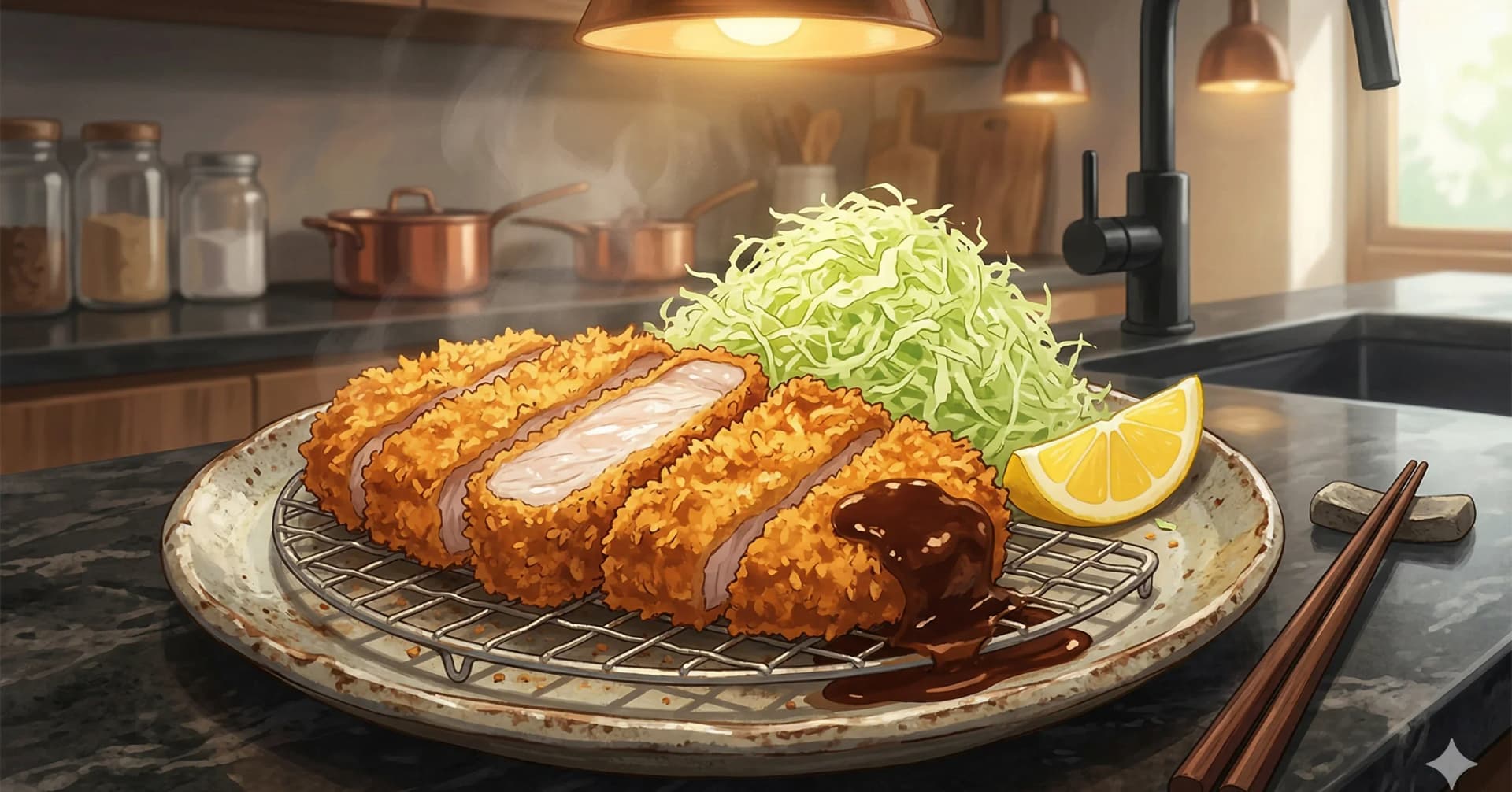
A thick pork loin cutlet pounded tender, triple-coated in flour, egg, and panko, then fried to a golden, shattering crust
The sound a knife makes cutting through properly fried tonkatsu is satisfying in a way that is difficult to overstate. The blade passes through the panko crust with an audible crunch, each slice revealing a clean cross-section: a ring of deep gold surrounding pale, steaming pork that is still faintly pink at its center. The crust holds its shape perfectly, not a single flake falling away, because panko breadcrumbs, those coarse, airy shards of crustless white bread, lock together during frying into an architecture of tiny air pockets and crisp walls.
Tonkatsu arrived in Japan during the Meiji era as part of the broader wave of Western-influenced cooking known as yoshoku. Its ancestor is the European schnitzel, but the Japanese version diverged quickly: thicker cuts of pork, the switch to panko, the addition of shredded raw cabbage as a mandatory accompaniment, and the development of a thick, fruity, Worcestershire-derived sauce made it something entirely its own. Today, tonkatsu holds a position in Japanese food culture roughly equivalent to a good burger in America. It is everywhere, from dedicated tonkatsu-ya restaurants that serve nothing else to convenience store bento boxes, and it forms the foundation of katsudon, one of the most beloved rice bowl dishes in Japan.
The technique is not difficult but rewards attention to detail. Pounding the pork to an even thickness ensures uniform cooking. Scoring the connective tissue along the edge prevents curling. A three-stage coating of flour, egg, and panko, pressed firmly but not compacted, creates the insulating layer that keeps the meat juicy while the exterior fries. Resting the cutlet after frying is as important as resting a steak: the juices redistribute, and the residual heat finishes the center gently.
At a Glance
Yield
4 servings
Prep
20 minutes
Cook
15 minutes
Total
35 minutes
Difficulty
Easy
Ingredients
Pork Ingredients
- 4boneless pork loin chops (about 150 g each, 2 to 2.5 cm thick)
- —Fine sea salt
- —Freshly ground black pepper
Coating Ingredients
- ½ cupplain flour (all-purpose)
- 2large eggs, beaten
- 4 ozpanko breadcrumbs
For Frying
- —Neutral oil such as vegetable, canola, or rice bran, enough for 4 to 5 cm depth
To Serve
- —Half a small head of green cabbage (about 250 g), very finely shredded
- —Tonkatsu sauce (bulldog brand or similar)
- —Karashi (Japanese hot mustard), optional
- —Lemon wedges
- —Steamed Japanese short-grain rice
- —[Miso shiru](/recipes/miso-shiru)
Method
- 1
Remove the pork chops from the refrigerator 15 minutes before cooking to take the chill off. Using a sharp knife, make small cuts at 2 cm intervals along the fat cap and any connective tissue running along the edge of each chop. These cuts prevent the meat from curling during frying.
- 2
Place each chop between two sheets of plastic wrap and pound with a meat mallet or rolling pin to an even thickness of about 1.5 cm. Work from the center outward. The goal is uniformity, not thinness. A consistent thickness ensures the pork cooks evenly throughout.
- 3
Season both sides of each chop generously with salt and pepper. Set up your breading station in order: a plate of flour, a shallow bowl of beaten egg, and a plate of panko breadcrumbs.
- 4
Dredge each chop in flour, shaking off the excess so only a thin, even layer remains. The flour provides a dry surface for the egg to grip. Skip this step and the coating will slide off during frying.
- 5
Dip the floured chop into the beaten egg, turning to coat both sides completely. Let the excess drip off for a moment.
- 6
Press the egg-coated chop into the panko, then flip and press the other side. Use your hands to gently press the panko onto the surface so it adheres, but do not compact it. The air between the panko flakes is what makes the crust light and crunchy. Set the breaded chops on a wire rack and let them rest for 5 minutes. This brief rest helps the coating set and prevents it from falling off in the oil.
- 7
Pour oil into a heavy-bottomed pot to a depth of 4 to 5 cm. Heat to 170 degrees Celsius over medium heat, monitoring with a deep-fry thermometer. Test the temperature by dropping a few panko crumbs into the oil: they should sink briefly, then float to the surface and sizzle steadily.
- 8
Gently slide one or two cutlets into the oil, depending on the size of your pot. Do not crowd the pan, as this drops the oil temperature and produces a greasy, soggy crust. Fry for about 2 minutes on the first side without moving the cutlets. The panko will begin turning from white to pale gold.
- 9
Flip the cutlets carefully and fry for another 2 to 3 minutes. The total frying time should be 4 to 5 minutes for a 1.5 cm thick cutlet. The crust should be a deep, even golden brown. If it colors too quickly, reduce the heat slightly. If it stays pale, increase it.
- 10
Remove the cutlets to a wire rack set over a baking sheet and let them rest for 4 to 5 minutes. Do not place them on paper towels, as the trapped steam will soften the bottom crust. During this rest, the internal temperature will rise by a few degrees and the juices will redistribute. The center should reach 65 degrees Celsius.
- 11
While the cutlets rest, fry the remaining chops, bringing the oil back to 170 degrees between batches. Meanwhile, prepare the shredded cabbage: slice it as finely as possible, then soak in ice water for 5 minutes to crisp it. Drain thoroughly.
- 12
Slice each cutlet crosswise into 1.5 cm strips using a sharp knife. Arrange the slices on a plate, fanned slightly to show the cross-section, with a mound of shredded cabbage beside it. Serve with tonkatsu sauce for drizzling or dipping, a small dab of karashi mustard, lemon wedges, steamed rice, and miso soup.
Key Ingredient Benefits
Pork loin is one of the leaner cuts of pork, providing a high ratio of protein to fat along with significant amounts of thiamine, a B vitamin essential for energy metabolism. The raw cabbage served alongside tonkatsu is not merely decorative; in Japanese food culture, it is considered an essential digestive counterpoint to fried foods, and cabbage does contain compounds research suggests may support digestive health. Karashi mustard contains isothiocyanates, the same class of compounds found in wasabi, which have been studied for potential antimicrobial properties.
Why This Works
The three-stage coating system creates distinct functional layers. The flour absorbs surface moisture from the pork, creating a dry base. The egg wash provides a sticky binder. The panko layer traps air and insulates the meat from the direct heat of the oil. Because panko crumbs are larger and more irregular than standard breadcrumbs, they create more surface area and more air pockets, which is why panko-coated foods are crunchier and lighter than their standard-breadcrumb equivalents.
Frying at 170 degrees Celsius is the sweet spot for thick cutlets. Any hotter and the crust burns before the center is done. Any cooler and the crust absorbs oil and becomes greasy. The resting period after frying is not optional: a cutlet sliced immediately after leaving the oil will leak juice onto the cutting board and have a slightly underdone center. After 4 to 5 minutes of rest, carryover cooking finishes the center while the juices redistribute evenly throughout the meat.
Scoring the connective tissue is a small step that prevents a common frustration. The protein in the connective tissue along the edge contracts faster than the meat during cooking, causing the cutlet to bow upward like a dome. Small cuts release this tension and allow the cutlet to lie flat, ensuring even contact with the oil on both sides.
Substitutions & Variations
- Hire-katsu: Use pork tenderloin (hire) instead of loin for a leaner, more delicate cutlet. It requires less pounding and cooks slightly faster.
- Chicken katsu: Substitute boneless, skinless chicken breast, pounded to 1.5 cm thickness. Fry for the same time.
- Menchi-katsu: Form seasoned ground pork (or a pork-beef mix) into oval patties, bread and fry the same way.
- Panko: For an even crunchier crust, pulse the panko once or twice in a food processor to create a mix of fine and coarse crumbs.
- Gluten-free: Use rice flour instead of wheat flour and gluten-free panko (made from rice bread) for a fully gluten-free version.
- Oven-baked: Spray breaded cutlets with oil and bake at 220 degrees Celsius for 20 to 25 minutes, flipping once. The result is lighter but lacks the deep-fried crunch.
Serving Suggestions
The classic tonkatsu set meal (tonkatsu teishoku) includes shredded cabbage, tonkatsu sauce, steamed rice, miso soup, and pickles. This is the standard at dedicated tonkatsu restaurants. For a more casual meal, slice the cutlet and serve it in a sandwich (katsu sando) on thick, soft white bread with tonkatsu sauce and karashi. Tonkatsu is also the base for katsudon, simmered with egg and onion over rice, and for katsu curry, where the sliced cutlet sits atop kare raisu.
Storage & Reheating
Cooked tonkatsu keeps in the refrigerator for up to 2 days. Reheat in a 190 degree Celsius oven for 8 to 10 minutes to restore crispness, or re-fry briefly at 180 degrees for 1 minute per side. Uncooked breaded cutlets can be frozen on a parchment-lined tray, then transferred to a freezer bag once solid. They keep for up to 1 month. Fry directly from frozen, adding 1 to 2 minutes to the cooking time and checking the internal temperature before serving. The microwave will ruin the crust and is not recommended.
Cultural Notes
Tonkatsu (豚カツ), Japanese breaded pork cutlet, is one of the most iconic yōshoku (洋食) dishes in the Japanese repertoire. Yōshoku names the category of Western-style Japanese cooking that emerged in the late 19th century, and tonkatsu is one of the clearest examples of how Japan took European techniques and remade them into something nobody in Europe would entirely recognize. The cutlet itself descends most directly from the French côtelette and the Austrian-German Schnitzel, both brought to Japan during the Meiji Restoration's (1868-1912) modernization push.
The widely accepted origin credits Motojirō Kida, founder of the Rengatei restaurant in Tokyo's Ginza district, with developing the modern tonkatsu in 1899. Rengatei is still open today and is considered one of Japan's most prestigious yōshoku addresses. Kida's innovations defined the dish for the next century. He substituted the coarse Japanese-style breadcrumbs called panko (パン粉) for the fine European breadcrumbs. He deep-fried rather than pan-fried. He served the cutlet with a bed of shredded raw cabbage rather than the boiled vegetables a European cutlet would arrive with. Those three choices, together, are what makes a tonkatsu a tonkatsu.
The dish has spawned an entire small family of related preparations. Katsudon puts sliced tonkatsu over rice with egg and onion. Katsu kare combines tonkatsu with Japanese curry rice. Katsu sando (カツサンド) is the tonkatsu sandwich, served on milk bread with karashi mustard and tonkatsu sauce, and it has become one of the great Tokyo street-food orders of the last decade. Menchi katsu (メンチカツ) substitutes a ground beef-and-pork patty for the whole pork cutlet.
The specialty tonkatsu-ya (とんかつ屋) restaurants do nothing else. The most respected addresses operate continuously for decades: Tonkatsu Maisen in Tokyo (1965), Ichino-ya in Tokyo (1925), Kimukatsu in Kichijoji (famous for its 25-layer pork preparation, where the cutlet is built from many thin slices of pork pressed together before breading). The dish travels well, and tonkatsu has become a reliable top order at Japanese restaurants worldwide.
Nutrition Facts
Calories: 642kcal (32%)|Total Carbohydrates: 35g (13%)|Protein: 37g (74%)|Total Fat: 38g (49%)|Saturated Fat: 10g (50%)|Cholesterol: 150mg (50%)|Sodium: 420mg (18%)|Dietary Fiber: 1g (4%)|Total Sugars: 1g
You Might Also Like
Ratings & Comments
Ratings & Comments
Ratings
Share your thoughts on this recipe.
Sign in to rate and comment