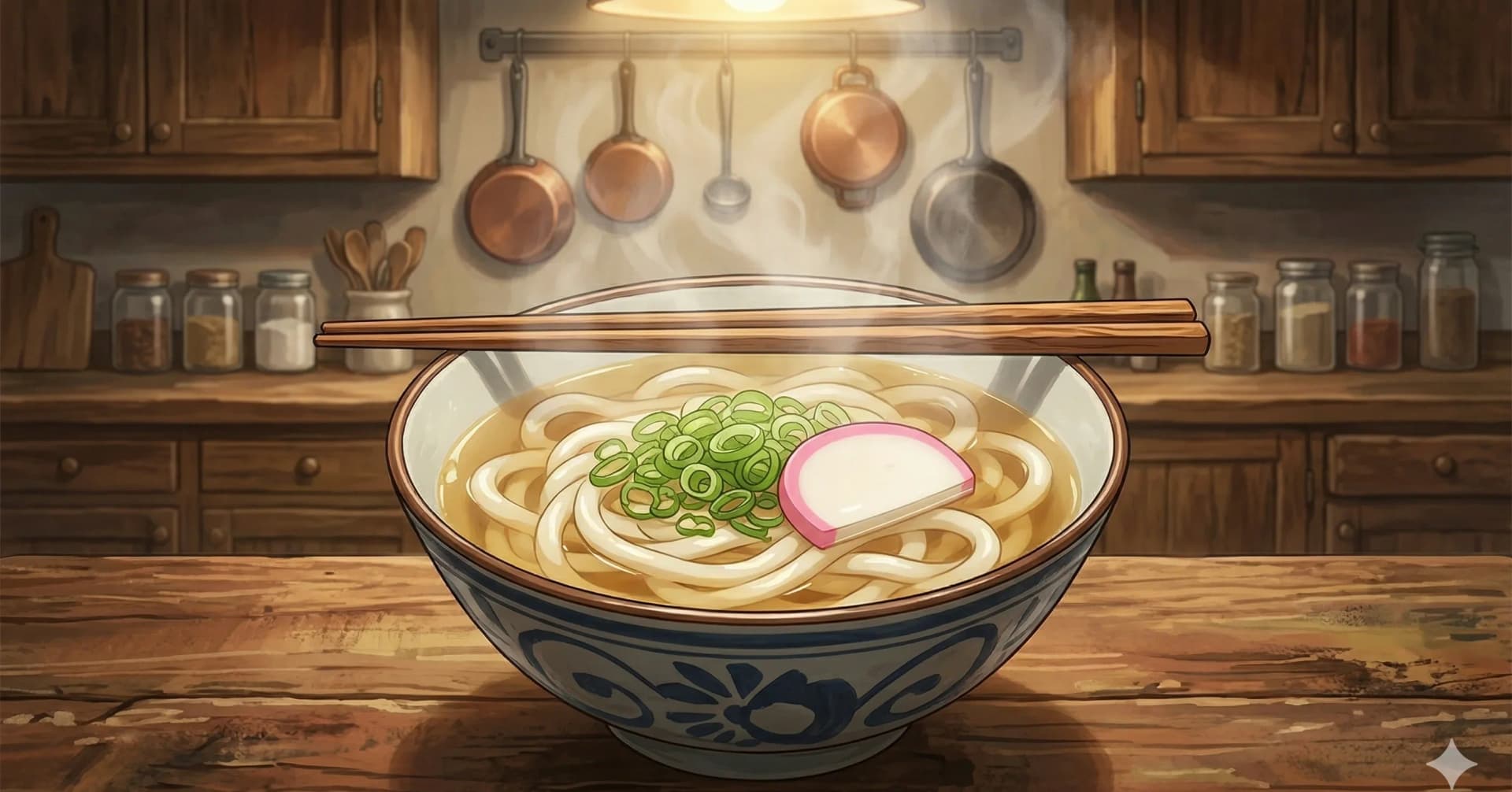
Japanese Cuisine
Udon Noodle Soup (Kake Udon)
Thick wheat noodles in a clear, gently sweet dashi broth, finished with nothing more than scallions and a wisp of steam
Kake udon is the dish that Japanese home cooking returns to when nothing else seems right. It is noodle soup at its most stripped back: fat udon in a warm dashi broth seasoned with soy sauce, mirin, and a pinch of sugar. There is no protein to sear, no paste to fry off, no spice blend to toast. The whole thing comes together in the time it takes to boil water twice, and the result is something far more satisfying than its short ingredient list would suggest.
The reason it works is the broth. A proper kake udon broth starts with dashi, the foundational stock of Japanese cuisine made from kombu (dried kelp) and katsuobushi (bonito flakes). When these two ingredients meet hot water, they release glutamate and inosinate, which combine to create an umami depth that no single ingredient can produce on its own. The soy sauce and mirin that go in afterward are supporting players, adding salt, sweetness, and a faint caramel quality to the finished soup.
Unlike tonkotsu ramen, which demands hours of boiling to extract its milky richness, udon broth rewards restraint. The dashi should steep rather than boil, and the seasoning should enhance rather than mask the sea-and-smoke flavor underneath. If you have made miso soup before, you already know how dashi behaves. This is the same base taken in a slightly different direction.
The noodles themselves matter. Good udon is thick, glossy, and resilient, with a satisfying chew that holds up even after sitting in hot broth. Frozen udon from Japanese grocery stores is excellent and often better than dried, since the noodles are made fresh and frozen at peak texture. If you want to try making them from scratch, the process is straightforward but physical: flour, salt, water, and a good deal of kneading and rolling.
At a Glance
Yield
2 servings
Prep
10 minutes
Cook
15 minutes
Total
25 minutes
Difficulty
Easy
Ingredients
- 3 cupwater
- 1 piecekombu (about 10 g), roughly 10 x 10 cm
- ½ ozkatsuobushi (bonito flakes), loosely packed
- 1 tbspmirin
- 1 tspsugar
- —1.5 Tbsp soy sauce (usukuchi/light soy sauce preferred)
- —Pinch of fine sea salt, plus more to taste
- 2portions udon noodles (frozen, fresh, or dried; about 400 g total)
- 2scallions, thinly sliced on a diagonal
- —Shichimi togarashi (seven-spice blend), for serving (optional)
- 3 cupwater
- ⅓ cupmentsuyu (concentrated noodle soup base, 3x concentrate)
- 1 tbspmirin
Method
- 1
Make the dashi. Place the kombu in a medium saucepan with 700 ml of cold water and let it soak for at least 10 minutes, or up to 30 minutes if you have the time. The kombu will soften and the water will take on a faint greenish tint. Set the pan over medium heat and bring it slowly toward a simmer. Watch carefully: just before the water reaches a full boil, when you see small bubbles forming steadily around the edges and the surface begins to tremble, remove the kombu. Letting it boil will draw out bitter, slimy compounds you do not want.
- 2
Add the bonito flakes. Once the kombu is out, bring the water to a gentle boil. Scatter the katsuobushi across the surface and immediately turn off the heat. Let the flakes steep undisturbed for about 30 seconds to 1 minute. They will slowly sink to the bottom. Strain the dashi through a fine mesh strainer into a clean bowl or measuring jug, pressing lightly on the flakes. The finished dashi should be clear and golden, with a clean oceanic aroma.
- 3
Season the broth. Return the strained dashi to the saucepan over medium heat. Add the mirin, sugar, soy sauce, and salt. Stir gently until the sugar dissolves and the broth comes to a low simmer. Taste and adjust: it should be savory, lightly sweet, and well-balanced, not aggressively salty. If using usukuchi (light soy sauce), you will get a cleaner color and a slightly saltier result, so season with a lighter hand. Remove from the heat and cover to keep warm.
- 4
Boil the noodles. Bring a large pot of unsalted water to a rolling boil. Add the udon noodles and stir immediately with chopsticks or tongs to prevent them from clumping. Cook according to the type: frozen udon takes about 1 to 2 minutes from the time the water returns to a boil; fresh udon takes 2 to 3 minutes; dried udon takes 8 to 12 minutes (check the package). The noodles are ready when they are tender but still have a pleasant, springy chew at the center. Drain in a colander and rinse briefly under warm running water to remove surface starch and stop the cooking.
- 5
Assemble and serve. Divide the hot noodles between two deep bowls. Ladle the warm broth over the noodles until they are just submerged. Top with sliced scallions and a small pinch of shichimi togarashi if you like. Serve immediately while the broth is still steaming.
Key Ingredient Benefits
Kombu. Dried kelp harvested primarily in Hokkaido. It is the original source from which glutamate (the G in MSG) was first identified by Kikunae Ikeda in 1908. A 10 g piece is enough to flavor about 700 ml of water. Kombu is naturally rich in iodine, so people with thyroid conditions should consult a doctor before consuming it frequently.
Katsuobushi. Skipjack tuna that has been smoked, fermented, and dried into blocks as hard as wood, then shaved into thin flakes. The fermentation process concentrates inosinate, one of the key umami nucleotides. Pre-shaved flakes lose potency over time, so buy them in small quantities and store in a sealed bag.
Udon Noodles. Made from wheat flour, salt, and water, with no egg. The dough is typically kneaded vigorously (sometimes by treading on it in a plastic bag) to develop the gluten that gives udon its distinctive chew. Frozen udon is par-cooked before freezing, which preserves its texture better than drying.
Usukuchi Soy Sauce. Light-colored Japanese soy sauce that is actually saltier than dark (koikuchi) soy sauce, despite the paler appearance. It is preferred in broths and delicate dishes where you want seasoning without darkening the liquid. If substituting regular soy sauce, reduce the quantity slightly and omit the added salt.
Why This Works
Dashi succeeds because of a principle called umami synergy. Kombu is rich in glutamate, and katsuobushi is rich in inosinate. When these two compounds meet in solution, they amplify each other, producing an umami sensation roughly eight times more intense than either ingredient alone. This is why a broth made from two modest ingredients can taste so deeply satisfying.
Removing the kombu before the water boils prevents the release of alginate and other polysaccharides that would make the broth viscous and slightly bitter. The katsuobushi, by contrast, needs heat to release its flavor compounds, but only briefly. Steeping for longer than a minute or two extracts tannins that turn the broth harsh. The technique is more like brewing tea than making stock.
Rinsing the cooked noodles removes loose surface starch, which would otherwise cloud the broth and turn it gummy as it sits. This step is especially important with dried udon, which sheds more starch during cooking than frozen or fresh.
Substitutions & Variations
Shortcut broth with mentsuyu. Combine 700 ml of water with 80 ml of mentsuyu (3x concentrate) and 1 Tbsp of mirin in a saucepan. Heat gently until simmering. Adjust the mentsuyu ratio according to the bottle instructions if your brand has a different concentration. This produces a very good broth in under 5 minutes.
Instant dashi. Dissolve 1 tsp of dashi powder (hon-dashi) in 700 ml of hot water, then season with the soy sauce, mirin, and sugar as directed. The flavor will be less nuanced than fresh dashi but entirely serviceable for a quick meal.
Vegan dashi. Skip the katsuobushi entirely and make a kombu-only dashi, or supplement with a small handful of dried shiitake mushrooms soaked alongside the kombu. The shiitake contribute guanylate, another umami nucleotide, and produce a surprisingly full-bodied broth. This variation works well as a base for oden.
Toppings. Kake udon is a canvas. Common additions include a poached egg dropped into the hot broth, thinly sliced kamaboko (fish cake), crispy tempura bits (tenkasu), a sheet of nori, grated fresh ginger, or a spoonful of yuzu kosho. For a heartier bowl approaching sukiyaki territory, add thinly sliced beef simmered briefly in the broth.
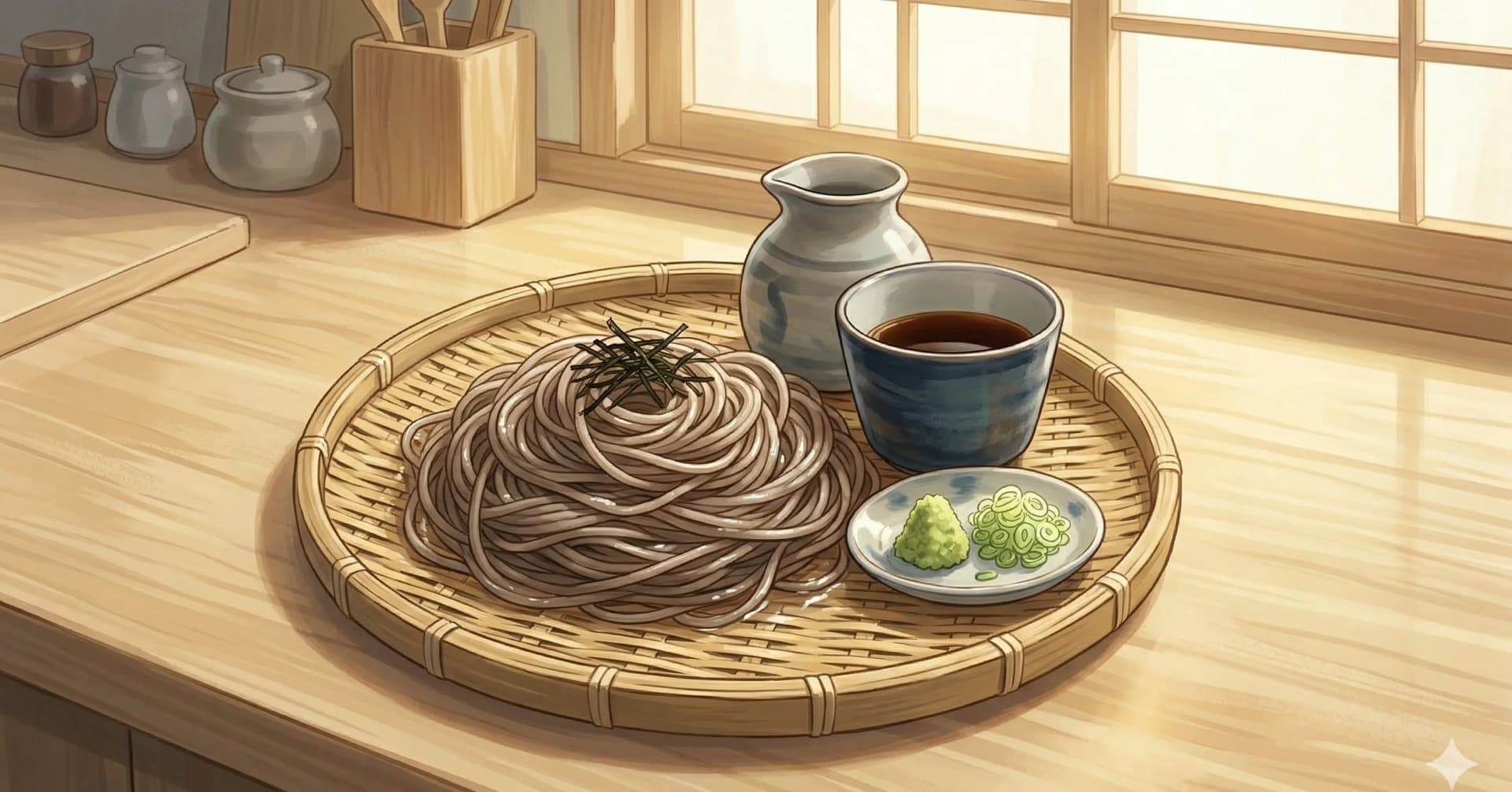
Chilled udon (Zaru udon). In summer, cook and rinse the noodles with cold water, then serve on a bamboo mat with the broth concentrated into a cold dipping sauce on the side. The noodle-to-broth ratio inverts: the sauce is stronger because you dip rather than submerge.
Curry udon. Thicken the broth with a block of Japanese curry roux for a warming, fragrant variation that bridges udon and rice-curry traditions.
Serving Suggestions
Kake udon is a complete meal on its own, but it pairs naturally with small side dishes in the Japanese tradition. A few pieces of vegetable or shrimp tempura placed on top of the noodles just before serving turns kake udon into tempura udon, one of the most popular variations at noodle shops.
For a fuller table, serve alongside soba for a noodle pairing that contrasts wheat and buckwheat textures, or offer a bowl of miso soup as a lighter starter. Pickled vegetables, especially quick-pickled cucumber or takuan (pickled daikon), add crunch and acidity.
If you are building a larger Japanese meal, kake udon works as the noodle course between lighter dishes and a main like grilled fish or tonkotsu ramen for guests who want to compare broths side by side.
Storage & Reheating
The seasoned broth keeps in an airtight container in the refrigerator for up to 3 days. It also freezes well for up to 1 month. Reheat gently on the stovetop until just simmering; avoid a hard boil, which can dull the dashi's delicate flavor over time.
Cooked udon noodles do not store well. They absorb moisture and turn soft and pasty within a few hours. Cook noodles fresh for each serving. If you have leftover frozen udon, simply keep them in the freezer until needed, as they cook from frozen in under 2 minutes.
If you plan to meal-prep, store the broth and noodles separately. When ready to eat, boil fresh noodles, reheat the broth, and assemble.
Cultural Notes
Udon (うどん), thick wheat noodles, is one of the three foundational Japanese noodle traditions, alongside soba (buckwheat) and ramen (Chinese-derived wheat). It is also the oldest documented of the three. Both archaeological and textual evidence place wheat-noodle consumption in Japan as early as the 9th century CE. The noodles arrived from China through Buddhist monks who brought wheat-noodle techniques alongside their religious practice, and the Sanuki region of Shikoku island became the historical heart of Japanese udon production.
Sanuki udon, produced specifically in Kagawa Prefecture on Shikoku island (Sanuki is the old province name), is officially recognized as a protected regional cuisine within Japan and is treated as the highest-prestige udon style. The Sanuki tradition is defined by exceptionally chewy, thick noodles with serious structural integrity, made from specific wheat varieties, given careful kneading, and finished with a traditional dough-treading step where the cook works the dough underfoot. Kagawa Prefecture produces and consumes more udon per capita than anywhere else in Japan by a wide margin. In some Kagawa neighborhoods, shop density reaches roughly one udon-ya per 200 residents. The Marugame Seimen and Hanamaru Udon chains, both born in Kagawa, have carried the Sanuki style across Japan and into international markets.
The basic preparation is called kake udon (掛けうどん), "thrown udon," and it is as simple as the form gets. Thick udon noodles in clear dashi broth, scallions, sometimes a scatter of tempura crumb. That stripped-down version is the diagnostic dish for evaluating an udon-ya. There is nowhere to hide. If the noodles are weak, the dashi is flat, or the seasoning is off-balance, kake udon will tell you immediately.
The more elaborate preparations build out from there. Tempura udon, kitsune udon with sweet-simmered fried tofu, curry udon, yamakake udon with grated mountain yam, zaru udon served cold for dipping. Every prefecture has its own variations, and the regional differences add up to a substantial subculture inside Japanese noodle cooking.
Nutrition Facts
Calories: 272kcal (14%)|Total Carbohydrates: 50g (18%)|Protein: 6g (12%)|Total Fat: 1g (1%)|Saturated Fat: 0g (0%)|Cholesterol: 0mg (0%)|Sodium: 720mg (31%)|Dietary Fiber: 2g (7%)|Total Sugars: 5g
You Might Also Like
Ratings & Comments
Ratings & Comments
Ratings
Share your thoughts on this recipe.
Sign in to rate and comment