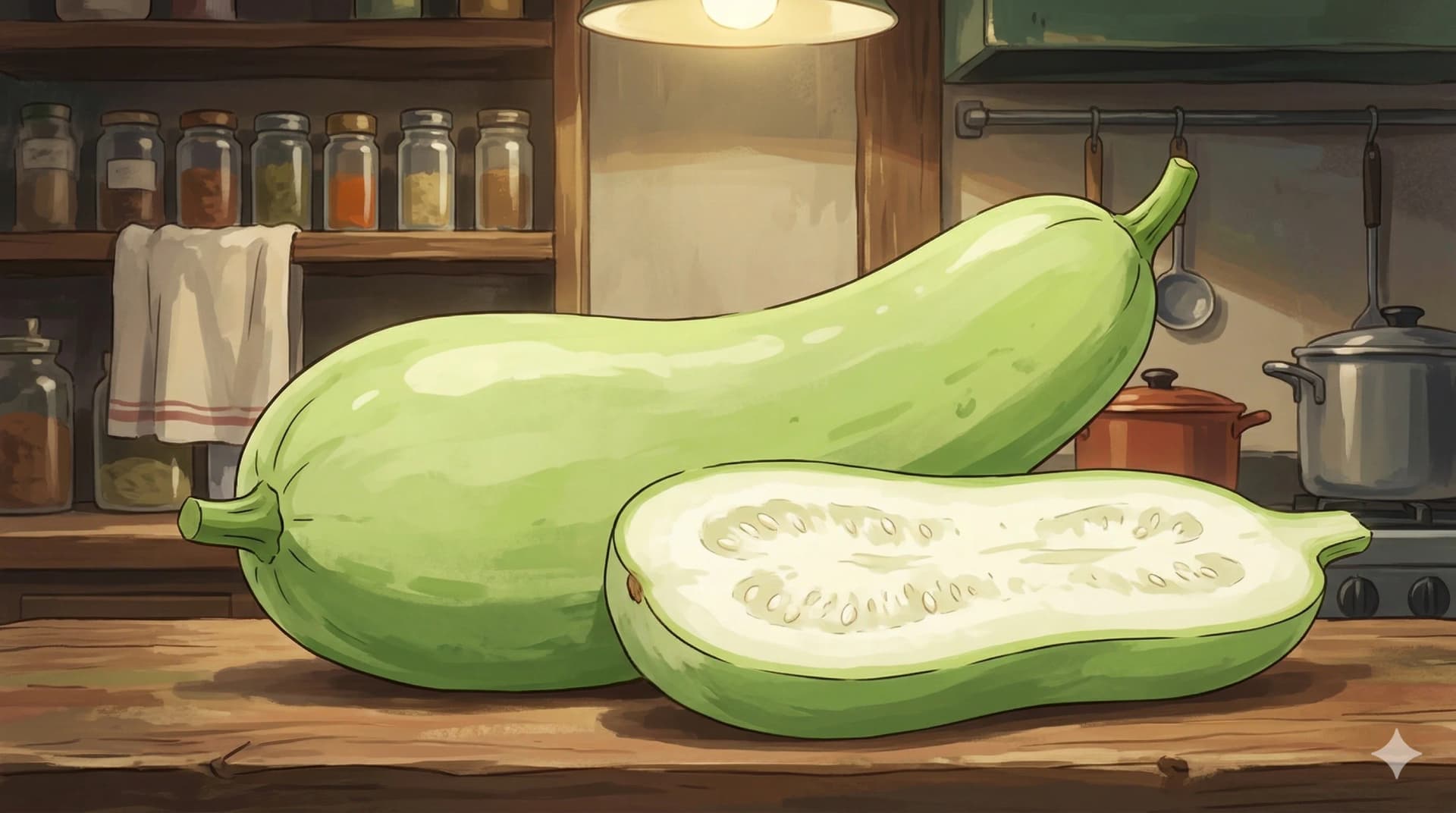
Bottle Gourd
Also known as: Lauki, Dudhi, Ghiya, Calabash, Lagenaria siceraria, Doodhi
Bottle gourd is one of the oldest cultivated plants on earth. Archaeological evidence places its cultivation across Africa and Asia from at least 10,000 BCE, predating the domestication of most grain crops. The large, smooth gourds were among the first plants humans deliberately grew and propagated, valued initially for their dried shells as water vessels and storage containers before their culinary potential was systematically explored.
Today, the dried shells are still used as water gourds, musical instruments, and fishing floats across Africa, Asia, and the Americas. The vegetable itself, harvested young and tender, has become a staple of South Asian home cooking with a culinary identity quite separate from any thoughts of its ancient history.
The flavor of fresh bottle gourd is deliberately understated. It is mild, slightly sweet, and gently watery, with a clean, almost neutral character that makes it an ideal vehicle for whatever spices and aromatics it is cooked with. This quality is both its limitation and its strength.
Cooks who expect bold vegetable flavor from it will be disappointed. Cooks who understand that it functions as a carrier of other flavors, adding body and texture to a dish without competing with the seasoning, find it extraordinarily useful. It stretches dal, adds volume to curries, and provides a soft, absorbent counterpoint in dishes where it is paired with more assertive ingredients.
The gourds vary in shape: some are elongated and cylindrical (the form most common in Indian markets), others are rounded and squat, and others have the characteristic bottle shape that gives the plant its English name. All forms are used interchangeably in cooking. Freshness is indicated by skin that is uniformly pale green, firm, and without yellowing.
The interior should be white and moist, with small, undeveloped seeds. As the gourd matures beyond its edible stage, the flesh becomes more fibrous and bitter, the seeds harden, and eventually the whole structure dries out into the hard shell that humans have used as a container for millennia.
Key facts at a glance:
- Bottle gourd — Is one of the oldest cultivated plants on earth.
- The flavor — Of fresh bottle gourd is deliberately understated.
- Cooks who — Expect bold vegetable flavor from it will be disappointed.
- Archaeological evidence — Places its cultivation across Africa and Asia from at least 10,000 BCE, predating the domestication of most grain crops.
- Today — The dried shells are still used as water gourds, musical instruments, and fishing floats across Africa, Asia, and the Americas.
- This quality — Is both its limitation and its strength.
Flavor Profile
Origin
Africa, South Asia, India, Southeast Asia
Traditional Medicine Perspectives
Ayurveda:
Bottle gourd holds a prominent position in Ayurvedic medicine, classified as one of the most cooling, calming, and easily digestible vegetables available. It is strongly associated with reducing pitta (heat, inflammation) and is specifically recommended for conditions involving excess heat in the body: fever, burning sensations, urinary irritation, and inflammatory digestive conditions. Lauki juice, consumed raw in small quantities, is a traditional Ayurvedic home remedy for cooling the system during summer and for managing acidity. It is considered ideal food for convalescents, children, the elderly, and anyone with a weakened digestive capacity. Its high water content, easy digestibility, and mild nature make it one of the first vegetables reintroduced after illness. Charaka Samhita and other classical texts reference it repeatedly as both food and medicine.
Important safety note:
Raw bottle gourd juice, despite its traditional use as a health drink, has been associated with serious adverse reactions including severe gastrointestinal symptoms, low blood pressure, and in rare documented cases, fatality. The cause is cucurbitacins, naturally occurring bitter compounds that appear at elevated concentrations in some specimens due to genetics, stress, or cross-pollination with related plants. Always taste a small piece of raw bottle gourd before cooking: if it is bitter, discard the entire gourd and do not cook or consume it. Properly mild, non-bitter bottle gourd is safe and beneficial. Bitter specimens are not.
Modern Scientific Research
Bottle gourd's high water content (approximately 92 to 96 percent by weight) makes it one of the lowest-calorie vegetables available, contributing dietary fiber and hydration with minimal caloric load. It contains vitamin C, B vitamins including folate and B6, iron, calcium, magnesium, and potassium in moderate amounts. The overall nutrient density is moderate rather than exceptional, which aligns with its traditional classification as a nourishing but light food rather than a concentrated nutritional source.
Research has focused particularly on the anti-inflammatory and hepatoprotective properties of bottle gourd extracts. Studies have documented activity against liver enzyme elevation and oxidative stress markers. The cucurbitacin compounds responsible for bitterness in toxic specimens are separately studied for potential anti-tumor properties in controlled laboratory settings, illustrating the dual nature of these compounds as both hazardous in high concentrations and potentially pharmacologically useful in others.
Research into bottle gourd's role in blood sugar regulation and diuretic effects has produced promising preliminary findings consistent with traditional Ayurvedic applications.
Cultural History
The dispersal history of Lagenaria siceraria is one of the more remarkable botanical puzzles. Genetic and archaeological evidence suggests the plant originated in Africa and spread to the Americas and Asia independently, possibly by floating across oceans in its dried form (the hard dried gourd can survive extended immersion in saltwater while keeping seeds viable inside). This makes it one of the few plants to have reached the Americas before European contact through natural, non-human-mediated dispersal.
In the Americas, pre-Columbian peoples cultivated bottle gourds from at least 10,000 years ago.
In India, bottle gourd has been a kitchen staple for thousands of years, appearing in Sanskrit texts under various names and referenced in traditional Ayurvedic literature extensively. It is particularly associated with North Indian home cooking, where lauki features in everyday vegetable preparations, lentil dishes, and sweets. The Gujarati community has developed a particularly rich repertoire of bottle gourd dishes, including the beloved dudhi muthia (steamed dumplings made with grated bottle gourd) and the slow-cooked dudhi halwa.
In Punjabi cooking, lauki appears regularly in dal-based dishes and as a simple sabzi.
The vegetable's long history of cultivation meant that by the time other gourds arrived in India (bitter gourd, ridge gourd, snake gourd, ash gourd), bottle gourd already occupied a secure place in the agricultural and culinary landscape. Its uses as both food and container gave it a dual significance that no other vegetable quite matches. In many folk traditions across South Asia, the bottle gourd tree is considered auspicious, and there are specific customs around its cultivation in home gardens.
Culinary Uses
The fundamental cooking approach for bottle gourd is simple and forgiving. Its mild character means it benefits from confident spicing and benefits most from preparations that give it a seasoning foundation to absorb. Lauki sabzi begins with a standard tempering in oil or ghee: cumin seeds crackling in hot fat, followed by green chili, ginger, and spices.
The cubed bottle gourd is added, tossed with the tempering, and cooked covered until tender, typically 10 to 15 minutes with occasional stirring. The result is soft, fragrant cubes that taste primarily of the spice blend rather than of themselves.
In lauki dal, the gourd is cooked directly with lentils (toor dal or chana dal are common pairings), often in a pressure cooker, until both are completely soft. The combination produces a thick, comforting dish with the gourd providing a textural contrast to the smooth dal and a subtle sweetness that rounds out the lentil's earthiness. Lauki kofta involves grating the raw gourd, squeezing out excess liquid, mixing with chickpea flour and spices, and frying or baking into dumplings that are then simmered in a curry sauce.
This preparation transforms the mild vegetable into something richer, using its moisture-rich, grate-able texture as an asset for binding. Lauki halwa follows the same logic as carrot halwa: the grated gourd is cooked slowly in ghee with sugar and milk until reduced to a dense, fragrant sweet.
Preparation Methods
Safety first: Cut a small sliver of raw bottle gourd and taste it before cooking. It should be mild, slightly sweet, and completely without bitterness. Discard any specimen that tastes bitter. Do not cook bitter bottle gourd.
Selecting: Choose firm, uniformly pale green gourds with no soft spots or yellowing. Smaller to medium gourds (around 30 to 40 cm for elongated varieties) tend to be more tender than very large ones. The skin should feel smooth and slightly waxy.
Preparing: Peel the skin completely with a vegetable peeler. Halve lengthwise and scoop out the seedy center with a spoon if the seeds are developed. Cut into cubes, slices, or grate depending on the preparation. Young, fresh gourds with undeveloped seeds need minimal scooping.
Cooking: Bottle gourd cooks quickly: cubes become tender in 8 to 12 minutes in a covered pan, and grated gourd releases considerable liquid almost immediately. For sabzi, cook covered on medium heat with minimal additional water as the gourd releases its own moisture. Avoid overcooking, which turns the pieces mushy and watery.
Traditional Dishes
- Lauki sabzi (North Indian)
- Lauki dal (with toor or chana dal)
- Lauki kofta curry
- Lauki halwa (sweet
- slow-cooked)
- Lauki raita (grated and cooked
- mixed with yogurt)
- Dudhi muthia (Gujarati steamed dumplings)
- Dudhi halwa
- Lauki soup
- Lauki with moong dal
Comments
Share your thoughts on this ingredient.
Sign in to comment0 Comments