Punjabi · Indian Cuisine
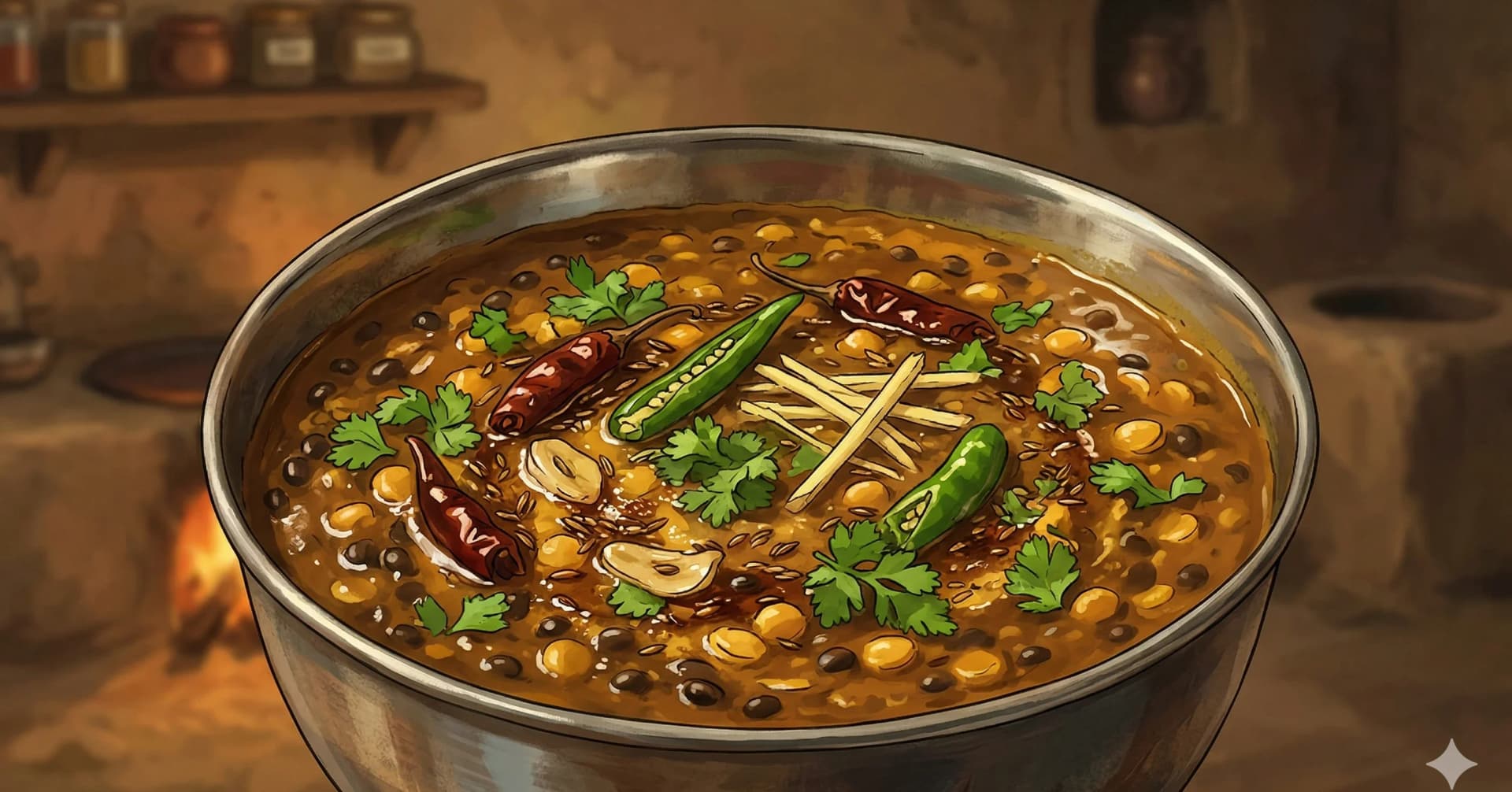
Black Chickpea Dal (Maa Chana Dal)
Slow-cooked split black lentils and chickpea dal with a fried onion-tomato masala
Maa is the Punjabi word for the small black urad lentil; specifically, the split version with the husk on, called urad dal chilka, which has a more assertive, slightly earthy flavour than its de-husked counterpart. Combined here with chana dal, the two lentils produce a bowl with real depth: the urad dal contributes body and a faintly mineral earthiness, the chana dal adds a nuttier, slightly buttery note and a firmer bite.
This is a weekday dal, not the slow, overnight labour of dal makhni, but something that can be on the table in under an hour from a morning soak. The technique is straightforward: soak the lentils, boil them separately until cooked through, then build a fried masala and fold the lentils in to finish together. The onions should not be deep-fried to a dark colour here; they are cooked to a light golden rather than the deep caramel used in richer preparations, giving the finished dal a clean, lighter base.
The finishing garnish (green coriander, fresh ginger, green chilli) is important. Dals have a tendency toward flatness as they sit on the heat, and the raw aromatics scattered over just before serving re-introduce brightness and lift that the cooking process drives off. This is a dish that tastes best served immediately, with chapati and a simple kachumber salad, or simply as it is, in a bowl, with nothing else required.
At a Glance
Yield
Serves 4–6
Prep
10 minutes (plus 30 minutes soaking)
Cook
35 minutes
Total
1 hour 15 minutes
Difficulty
Easy
Ingredients
- 6 ozurad dal chilka (split black lentils with husk)
- 3 ozchana dal (split chickpeas)
- ¼ cupneutral oil
- 1¾ tbspgarlic, finely chopped
- 1⅓ tspcumin seeds
- 3½ ozonion (about ½–1 onion), thinly sliced
- 1¼ oztomatoes, finely chopped
- 2 tspginger paste
- 2 tspgarlic paste
- 1⅔ tspred chilli powder
- ¾ tspturmeric
- 1¼ tbspcoriander powder
- 2½ tspgreen chillies (about 2), finely sliced
- 1¾ tbspfresh ginger, finely chopped
- 1 cupfresh coriander, roughly chopped
- ⅔ tspfine salt
Method
- 1
Soak the lentils. Soak the urad dal chilka (175 g) and chana dal (85 g) in separate bowls of cold water for 30 minutes. Drain and rinse both.
- 2
Boil the lentils. Place the urad dal and chana dal in separate pots (or together if sizes are similar; the chana dal takes a little longer). Cover with plenty of fresh cold water and bring to a boil. Add the salt (¾ teaspoon) to the urad dal pot. Cook at a steady simmer until both are completely tender: the urad dal should be completely soft and beginning to break apart; the chana dal should be soft through but just holding its shape, about 25–30 minutes. Drain and combine. Set aside.
- 3
Chop aromatics. Finely chop the onions, tomatoes (35 g), fresh ginger (10 g), and green chillies (2) while the lentils cook.
- 4
Build the masala. Heat the oil in a wide kadhai over medium heat. Add the cumin seeds (¾ teaspoon); when they splutter and darken, add the chopped garlic (10 g). Stir and fry for 1–2 minutes until the garlic is golden at the edges. Watch carefully, as chopped garlic burns quickly. Add the sliced onions and stir-fry for 8 minutes until softened and lightly golden but not deeply browned.
- 5
Add spice pastes. Add the ginger paste (10 g) and garlic paste (10 g) and stir for 1 minute. Add the red chilli powder (½ teaspoon), turmeric (½ teaspoon), and coriander (20 g) powder (2 teaspoons). Stir for 30 seconds.
- 6
Add tomatoes. Add the chopped tomatoes and stir well. Cook for 4–5 minutes until the tomatoes have broken down and the masala looks glossy and cohesive.
- 7
Combine and finish. Add the drained cooked lentils to the masala. Mix well with a light hand; the goal is to bring the lentils and masala together while lightly mashing some of the urad dal to give the finished dish body and cohesion without puréeing it entirely. Bring to a boil, then simmer for 8–10 minutes to allow the lentils and masala to fully integrate. Taste and adjust salt.
- 8
Serve. Transfer to a serving bowl. Scatter the chopped fresh ginger, green chillies, and fresh coriander over the top immediately before serving.
Key Ingredient Benefits
Urad dal chilka (split black gram with husk, Vigna mungo) is particularly rich in protein, dietary fibre, and B vitamins, specifically folate and thiamine. The husk contains additional fibre and some iron. In Ayurvedic tradition, urad dal is considered bala (strengthening) and is used in preparations associated with physical vitality. It is also one of the key ingredients in traditional south Indian fermented preparations (idli, dosa) where it provides the protein and starch that fermentation transforms.
Chana dal (split chickpea, Cicer arietinum) has a lower glycaemic index than most grains and legumes, attributed to its relatively high amylose and fibre content. Research suggests that regular consumption of legumes like chana dal is associated with improved blood lipid profiles. In Unani medicine, chana dal is considered muqawwi (strengthening to the body) and is a staple of preparations for sustained energy.
Garlic (Allium sativum) is used both as chopped (frying in oil first) and as paste (added with the onion base) in this recipe, contributing two slightly different flavour notes. The fried chopped garlic at the beginning develops a toasted, nutty character; the paste adds the raw, sulphurous depth that gives the masala its baseline savour. Regular garlic consumption has been associated with improved cardiovascular markers in multiple clinical studies, though the research primarily relates to consistent long-term dietary use rather than individual servings.
Why This Works
Soaking both lentils separately before cooking is practical rather than ceremonial; chana dal and urad dal have different textures and cooking times. Soaking reduces cook time significantly and softens both evenly from the outside in. Boiling with salt only in the urad dal is a traditional technique: salt added to the cooking water before legumes are tender can tighten the seed coat, making them take longer to cook. Adding it to one and not the other is a shortcut; the combined dish will be salted through the masala phase.
The decision to keep the onions at a light golden colour rather than deep brown is deliberate for this dal. Dal makhni uses slow-fried, deeply caramelised onions for its richness; maa chana dal aims for a cleaner, lighter character. The masala provides structure without heaviness, letting the earthy quality of the urad husk come through.
Lightly mashing some of the urad dal when combining is the key textural step. A dal with fully intact lentils swimming in thin liquid lacks cohesion; fully blended is uniform but loses the contrast between the two lentil textures. A partial mash (pressing down on the urad dal occasionally while stirring) creates a self-thickening dal that coats rather than pools.
Substitutions & Variations
All urad dal: Omit the chana dal and increase the urad dal to 250 g for a more unified, slightly silkier dal. This is closer to the overnight slow-cooked maa ki dal style.
Pressure cooker: Soak lentils as directed, then cook both together in a pressure cooker with 3–4 cups of water and the salt for 2–3 whistles on medium pressure. Continue with the masala method from step 4.
Finishing with butter: A tablespoon of butter or ghee stirred in just before serving enriches the dal significantly and is a common Punjabi touch that bridges this lighter dal toward the richer makhni style.
Tomato variation: Some versions use only onion and skip the tomato entirely, producing a slightly drier, earthier dal. Both are traditional.
Serving Suggestions
Maa chana dal is a generous, accommodating dish. It works as a complete meal with chapati or paratha, or as one of several dishes at a larger spread alongside a sabzi and rice. A dollop of plain yoghurt and a simple chopped salad (onion, tomato, cucumber, lemon, salt) on the side turns it into a balanced plate. It holds well in a covered pot on low heat, which makes it good for a family meal where everyone sits down at different times.
Storage & Reheating
Refrigerate for up to 3 days. The dal thickens as it cools; add a splash of water when reheating and stir over medium heat until loosened and hot through. Freezes well for up to 1 month; portion before freezing, reheat from frozen over low heat with added water.
Cultural Notes
Maa chana dal (माह छणे दी दाल) is the Punjabi everyday dal made from whole black gram (maa or sabut urad in Hindi, maah in Punjabi) cooked together with split Bengal gram (chana dal) until both lentils soften into a thick savory stew, then tempered with onion, tomato, ginger-garlic, garam masala, and ghee. The dish is the everyday home cooking counterpart to the richer restaurant dal-makhni, with maa chana dal kept simpler and less heavy on the cream and butter that define the restaurant version. The dish appears at Punjabi-Sikh family kitchens, gurdwara langar (the community kitchens of Sikh temples that serve free meals to all visitors), and the broader north Indian home cooking belt.
The dish's role in Punjabi-Sikh culinary identity is significant. The combination of whole black gram (which provides substance, dark color, and the slightly stringy texture from the bean skins) and split chickpea (which provides body, starchy thickening, and a lighter color contrast) is one of the foundational two-lentil pairings of Punjabi cooking, with several regional variants (maa chana dal, maa rajma, dal makhni) all building on the same family of pairings. The use of whole rather than split black gram is important: split black gram (urad dal) cooks faster and turns mushier, while the whole bean retains its structural integrity through the long cook and provides the chewy textural contrast that distinguishes Punjabi maa chana dal from the smoother dals of other regional traditions. The dish is among the most-served preparations at Sikh gurdwara langars across India, where the rich nutritional content and the long-cooking efficiency make it suited to community kitchen scale.
The technique requires soaking and a long cook. Whole black gram is soaked overnight (or for at least four hours), then drained and rinsed. Split chickpea dal is soaked separately for an hour, drained, and rinsed. Both lentils are combined in a pressure cooker (or heavy pot) with water (about four times the volume of lentils), salt, turmeric, ginger paste, and crushed garlic, and cooked for at least thirty minutes in a pressure cooker (or two to three hours in a heavy pot over low heat) until both lentils soften thoroughly. Some of the cooked dal is mashed lightly with the back of a spoon to thicken the mixture, while the whole black gram beans stay intact for texture. A separate tempering (tadka) is prepared: ghee heated with cumin seeds, chopped onion, ginger paste, garlic paste, chopped tomato, garam masala, Kashmiri red chili powder, and kasuri methi (dried fenugreek leaves) cooked until the tomato breaks down and the oil separates from the masala. The tadka is poured over the cooked dal, the mixture is stirred together and simmered for ten more minutes, then served with garnish of chopped cilantro and fresh ginger juliennes, alongside roti, naan, or steamed rice.
Nutrition Facts
Calories: 214kcal (11%)|Total Carbohydrates: 29.3g (11%)|Protein: 10.5g (21%)|Total Fat: 6.7g (9%)|Saturated Fat: 0.9g (5%)|Cholesterol: 0mg (0%)|Sodium: 39mg (2%)|Dietary Fiber: 8.1g (29%)|Total Sugars: 2.5g
You Might Also Like
Ratings & Comments
Ratings & Comments
Ratings
Share your thoughts on this recipe.
Sign in to rate and comment