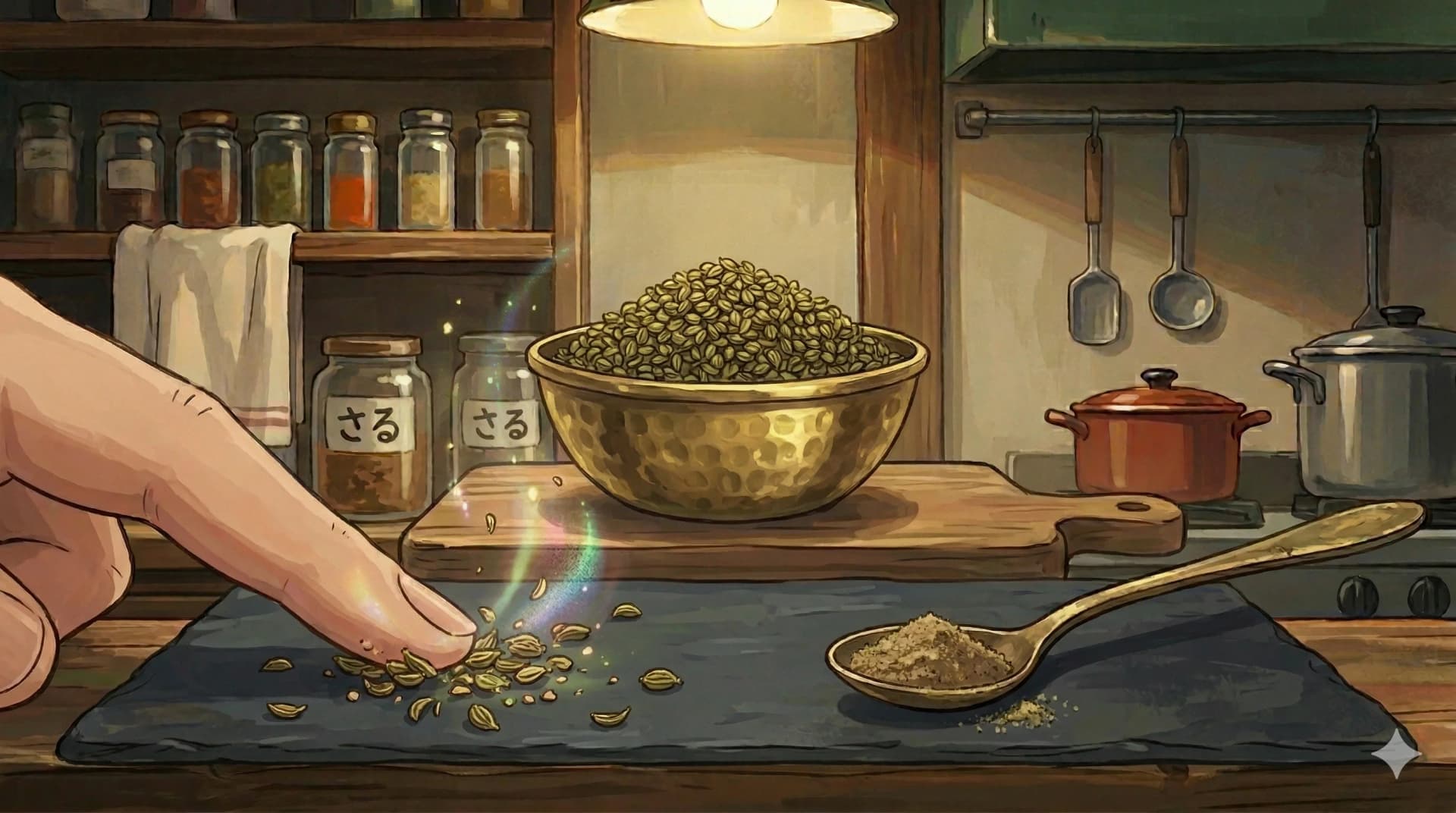
Carom Seeds
Also known as: Ajwain, Bishop's Weed, Thymol Seeds, Trachyspermum ammi, Ajowan
Carom seeds are perhaps the most potently flavored spice in the Indian pantry by volume. A single teaspoon added to a large batch of bread dough will perfume every piece; a tablespoon in a small dish becomes medicinal rather than culinary. The seeds resemble celery seeds or small cumin seeds in appearance, ridged and greenish-brown, but the resemblance ends there.
Crushed between the fingers, they release an immediate, intense blast of thymol, the same aromatic compound that gives thyme its characteristic scent, but in far higher concentration than any amount of the fresh herb could deliver. Carom seeds can contain up to 50% thymol in their essential oil, making them one of the highest natural sources of this compound.
Despite this intensity, carom seeds are used with great precision and purpose in Indian cooking. They are not a background spice but a deliberate flavoring applied to specific categories of food, particularly leavened and unleavened breads, fried snacks, and fish preparations. The reason for this specificity is not just flavor preference but an integrated food-as-medicine logic: carom seeds are understood in Ayurvedic tradition to actively counteract the digestive heaviness and flatulence-producing qualities of the foods they accompany.
Adding ajwain to oil-fried puris, rich parathas, or dal-based mathri crackers is understood as a built-in digestive safeguard, not just a seasoning choice.
The plant belongs to the carrot family (Apiaceae) and is believed to have originated in the eastern Mediterranean or Persia before being cultivated extensively in the Indian subcontinent, where it now grows primarily in the states of Rajasthan, Gujarat, Uttar Pradesh, and in Pakistan. The seeds are technically the fruit of the plant. Despite the common name "Bishop's Weed" in English, which it shares with another, unrelated plant (Ammi majus), carom seeds have no particular ecclesiastical history and the English name is largely unused in culinary contexts, where the Hindi ajwain is the standard reference.
Flavor Profile
Origin
India, Pakistan, Iran, Egypt
Traditional Medicine Perspectives
Ayurveda:
Ajwain holds a prominent place in classical Ayurvedic medicine as one of the most important digestive herbs in the materia medica. It is classified as katu (pungent) in taste, heating in virya (potency), and light and dry in quality. Its primary therapeutic functions are deepana (kindling of digestive fire), pachana (digestion of undigested matter), and shoolahara (relieving pain, particularly abdominal pain). It is strongly carminative, meaning it relieves intestinal gas, and this property is among the most consistently noted across classical texts. For infant colic, the classical formulation uses ajwain water, sometimes with a small amount of rock salt. For respiratory congestion and cough, ajwain seeds are burned and the smoke inhaled, or the essential oil is applied with steam inhalation. The seeds are considered to be among the fastest-acting of the digestive spices, providing relief more quickly than milder digestive agents like coriander or fennel.
Modern Scientific Research
The pharmacological activity of carom seeds is well supported by research, much of it focused on the isolated compound thymol. Thymol has demonstrated strong antimicrobial activity against a broad spectrum of bacteria and fungi in laboratory studies, which supports the traditional understanding of ajwain as a food preservative and antimicrobial agent. Its antifungal activity is particularly well documented, with efficacy against Aspergillus mold species that commonly contaminate grains and stored foods.
The anti-flatulent and digestive properties of carom seeds have been investigated directly. Research on Trachyspermum ammi extracts has found significant antispasmodic effects on smooth muscle in the gastrointestinal tract, a mechanism that would explain the relief of cramping and colic. Thymol also exhibits bronchodilatory effects, relaxing airway smooth muscle, which provides biochemical plausibility for the traditional use of ajwain in respiratory preparations.
Clinical trials specifically on carom seeds for human digestive complaints are limited in number compared to the strength of the traditional evidence base, but the known pharmacology of thymol is substantial enough that the therapeutic claims are considered plausible within evidence-based herbal medicine.
Cultural History
Ajwain has been cultivated in South Asia since antiquity. It appears in Charaka Samhita and Sushruta Samhita, the foundational texts of Ayurvedic medicine compiled roughly between the 2nd century BCE and the 2nd century CE, as both a medicinal herb and a culinary ingredient with therapeutic applications. The consistent appearance of ajwain in ancient Indian medical literature points to a long pre-Islamic, pre-Mughal history of use in which the spice occupied a more explicitly medical category than a purely culinary one.
In the North Indian and Pakistani flatbread traditions, ajwain paratha became a household staple whose preparation reflects a practical wisdom about food pairings. The paratha, made with whole wheat flour and cooked in generous ghee or butter, is a rich, heavy food that can slow digestion. The ajwain worked into the dough is not decorative: it is functional.
The same logic appears in the mathri, a deep-fried flaky cracker made with white flour and oil, which is a common festival and travel food precisely because of its shelf stability, and which would be heavy and potentially gas-producing without the ajwain worked into it.
Ajwain water, a simple infusion of carom seeds in hot water, is one of the most widespread home remedies across North India and Pakistan. Mothers give it to infants for colic, adults drink it for indigestion, and it is recommended in folk medicine for menstrual cramps and respiratory congestion. The remedy crosses religious and regional lines: it is equally common in Hindu, Muslim, and Sikh households, and in urban and rural settings.
This near-universal domestic knowledge about ajwain as medicine reflects its long integration into the practical healing culture of the subcontinent.
Culinary Uses
The cardinal rule with carom seeds is restraint. Their intensity means that more is not better: the correct quantity is just enough to provide a warm, aromatic background note without the dish tasting medicinal. In bread doughs, the standard is roughly one-quarter to one-half teaspoon per two cups of flour.
In fried snack doughs, a similar small quantity is mixed directly into the dough. In fish preparations, ajwain is used in marinades and spice rubs, where its thymol compounds complement the natural oiliness of fish and help to moderate fishy odors. It is not commonly used in long-simmered sauces or curries, where the subtlety of green herbs and whole spices has more room to develop.
When carom seeds appear on the surface of a bread rather than inside it, such as on flatbreads pressed before cooking, they benefit from direct contact with the hot griddle or oil, which volatilizes the thymol quickly and delivers an immediate aroma. They are never a finishing spice added after cooking. Their flavor requires some heat activation to fully develop, and raw seeds chewed directly have a harsher, more medicinal character than seeds that have been cooked.
Preparation Methods
In bread dough: Add one-quarter to one-half teaspoon whole seeds per two cups of flour directly to the dough during mixing. The seeds will distribute evenly and release flavor during cooking. No pre-toasting is necessary.
In fried foods: Incorporate whole seeds into the dough or batter before frying. For fish, coat with a marinade containing a small quantity of ajwain, salt, and red chili. The heat of frying activates the thymol.
Ajwain water (digestive tea): Dry-roast one teaspoon of seeds in a dry pan for one minute until fragrant. Add to two cups of boiling water and steep for five minutes. Strain and add a pinch of rock salt if desired. Drink warm after heavy meals or when experiencing indigestion.
Dry toasting: Toast in a dry pan over medium heat for 60 to 90 seconds, stirring constantly, until the seeds darken slightly and become more aromatic. This mellows the raw edge and brings out a nuttier quality. Use immediately or cool and store briefly.
For steam inhalation (traditional remedy): Crush one teaspoon of seeds, add to a bowl of just-boiled water, and inhale the steam for nasal and chest congestion. This is a common North Indian home practice and not a culinary preparation, but it illustrates the range of the spice's traditional applications.
Traditional Dishes
- Ajwain paratha
- Mathri (fried flaky crackers)
- Puri
- Ajwain puri (spiced deep-fried bread)
- Kadhi (yogurt-based gravy)
- Fish tikka
- Methi ajwain laccha paratha
- Ajwain namak pare (salted fried snacks)
- Thepla (Gujarati flatbread)
- Ajwain water (digestive infusion)
Comments
Share your thoughts on this ingredient.
Sign in to comment0 Comments