Indian Cuisine
Bhel Puri
Mumbai's puffed rice chaat — sweet, sharp, spiced, and gone in minutes
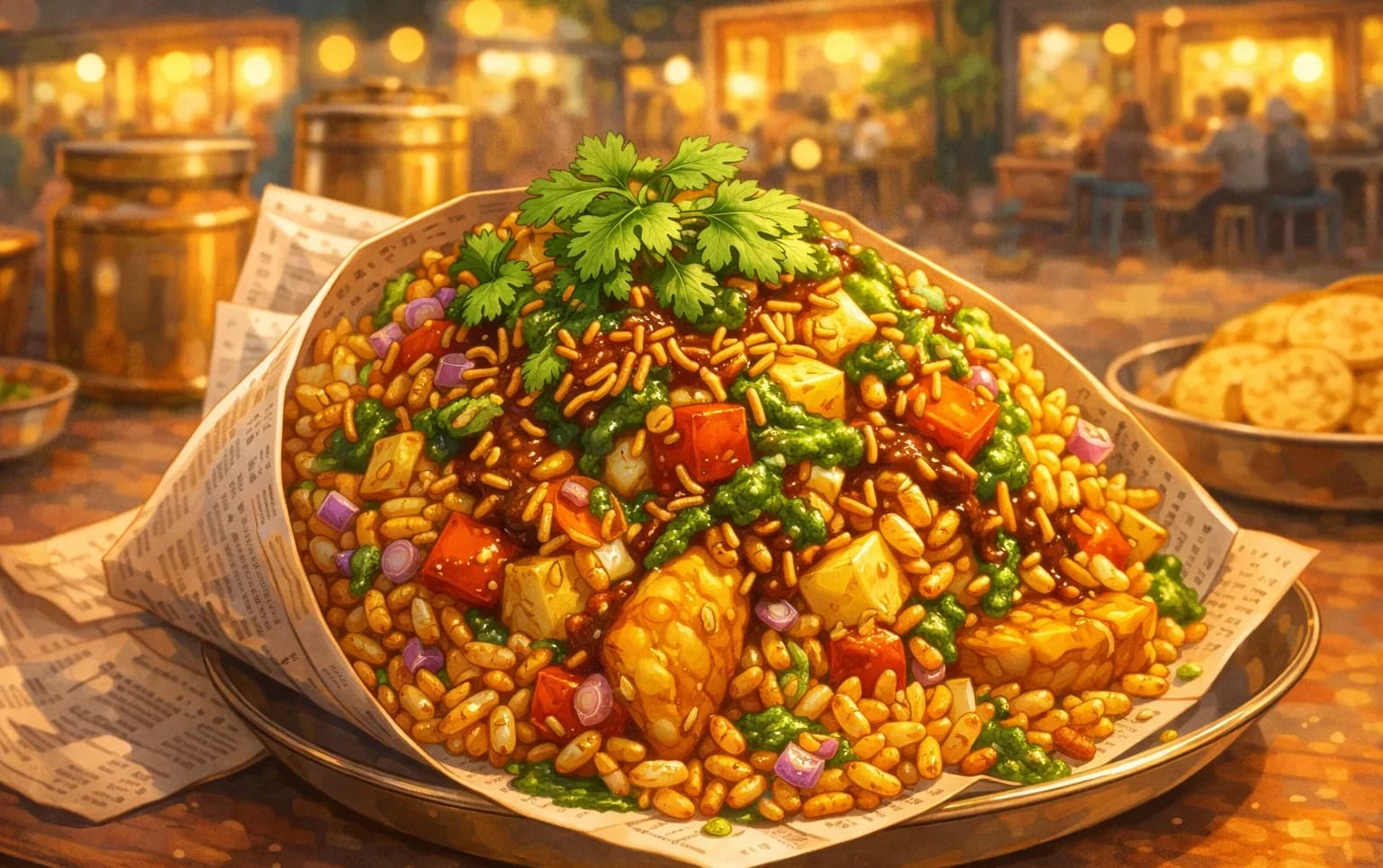
There is a particular pleasure in watching a Mumbai bhel vendor work. Everything moves quickly: the tin bowl, the measuring cup for puffed rice, the practiced ladle of each chutney, the deft toss with the hand that blends everything without crushing the delicate puffed rice. From the moment the first ingredient hits the bowl to the moment the cone is handed to you is perhaps 45 seconds. You eat it in another two minutes. If you don't, it goes soft.
Bhel puri is the ultimate assembly dish (no cooking required beyond boiling a potato), and its excellence depends entirely on the quality and balance of its components and the speed with which it is assembled and consumed. The puffed rice is the carrier, mild and airy; the sev (thin fried chickpea noodles) adds crunch and salt; the boiled potato provides substance; the raw onion adds bite. The two chutneys are the soul: green coriander-mint chutney for sharpness and heat, tamarind chutney for deep sweetness and sourness. The ratio between them is personal and contested. Some prefer more tamarind; others more green. Adjust to your palate, but both must be present.
Chaat masala does what it always does: adds a complex, slightly sulphurous, tart edge that is unmistakably the flavour of the Indian street food world. Cumin powder amplifies the earthiness. Red chilli powder adds colour and heat. Lemon juice brightens everything and provides the final acid note that binds the flavours.
The single most important rule: once assembled, bhel puri must be eaten immediately. Puffed rice softens in the presence of chutneys within 3–4 minutes. Do not assemble in advance. Do not leave it sitting while you fetch something from the kitchen. Bhel puri is one of those preparations that demands the cook and the eater be in the same place at the same moment.
At a Glance
Yield
4 servings
Prep
10 minutes (plus potato boiling time)
Cook
None
Total
10 minutes
Difficulty
Easy
Ingredients
To Assemble
- 7 ozpuffed rice (murmura / kurmura)
- 1¾ ozsev (thin chickpea noodles; use the thinnest variety, called nylon sev or fine sev)
- 3½ ozpotatoes, boiled, peeled (about ½–1 potato), and cut into small 1 cm dice
- 1¾ ozonion, very finely chopped
- 1 oztomato, deseeded and finely diced
- 1 ozgreen chutney (coriander-mint; see below)
- 1 oztamarind chutney (store-bought or homemade)
- 1 tbspchaat masala
- 1½ tbspcumin powder
- 1¾ tbspred chilli powder (about 2 tsp; adjust to heat preference)
- 1 cupfresh coriander, roughly chopped
- 2 tsplemon juice (about half a lemon)
- ⅞ tspsalt, or to taste
Method
- 1
Prepare the components. Ensure all components are ready before starting: potato is boiled, cooled, and diced; onion (50 g) is chopped fine; chutneys are in small bowls with spoons. Once you start mixing, there is no pausing.
- 2
Combine the dry components. In a large bowl, combine the puffed rice (200 g) and sev (50 g) first. Toss lightly to mix.
- 3
Add potato, onion, and tomato (30 g). Add the diced potato, onion, and tomato. Toss again.
- 4
Add chutneys and spices. Add the green chutney (30 g) and tamarind chutney (30 g). Sprinkle over the chaat masala (2 tsp), cumin powder (2 tsp), red chilli powder (2 tsp; adjust to heat preference), and salt (5 g). Add the lemon juice (half a lemon). Toss thoroughly but gently. You want everything evenly distributed without crushing the puffed rice to dust.
- 5
Taste and adjust. Take a quick taste. The bhel should be simultaneously sweet (tamarind), sharp (green chutney, lemon), salty, spicy, and earthy. Adjust any element you feel is missing. This is a deeply personal balance.
- 6
Scatter and serve immediately. Divide into individual portions. Scatter extra sev on top of each serving for an extra crunch layer, and add a few sprigs of coriander (20 g). Serve within 1–2 minutes of mixing.
Key Ingredient Benefits
Puffed rice is mostly simple carbohydrate with minimal protein and fibre. Its culinary value is textural. Rice is gluten-free, making bhel puri naturally suitable for those avoiding wheat (though check that your sev is also gluten-free if needed).
Tamarind provides the sweet-sour chutney base. Rich in tartaric acid and natural fruit sugars, and a meaningful source of B vitamins and iron. Traditionally used as a digestive souring agent across South and Southeast Asian cuisines.
Coriander (in the green chutney) provides the characteristic herbal sharpness. Its volatile oils, primarily linalool, degrade quickly, which is why fresh chutney is so much more vibrant than store-bought.
Chaat masala contains black salt (kala namak), which provides the sulphurous, slightly metallic notes distinctive of the chaat flavour profile. The amchoor in most blends provides tartaric acid; asafoetida provides ferula compounds that research associates with reduced flatulence from the legume-based sev.
Sev (chickpea noodles) provides protein and iron from chickpea flour alongside its characteristic crunchy texture. Being fried, it is calorie-dense relative to its volume, but it is used in small quantities.
Why This Works
Puffed rice is the ideal vehicle for chaat because of its texture. It is nearly pure air held in a rigid starch matrix. This airy structure creates a gentle crunch and allows it to absorb flavour on its surface without immediately becoming waterlogged. But its water absorption capacity is also its vulnerability: in the presence of liquid chutneys, the starch begins to absorb moisture almost immediately, collapsing the rigid matrix and producing the soggy bhel that every Mumbai vendor will tell you is a failure.
The double-chutney system represents a studied flavour architecture. Tamarind chutney contributes tartaric acid, natural fruit sugars from tamarind and jaggery, and deep umami notes from slow-cooked tamarind pulp. Green chutney provides acetic and citric acids from lemon juice, the volatile chlorophyll-and-herb freshness of coriander and mint, and the sharp capsaicin heat of green chilli. Together they form a complex acid-sweet-spice matrix that neither chutney could achieve alone.
Chaat masala is the aromatic backbone. Its black salt component provides a sulphurous, mineral edge; the dried mango provides sharpness; the cumin and asafoetida provide earthiness. It is the flavour that says "chaat" to anyone who has eaten it.
Substitutions & Variations
- Sukha bhel (dry bhel): Use only dry chutneys (powdered chaat masala, cumin, chilli) and no wet chutneys. Mixed with puffed rice, potato, and onion, this version stays crunchy much longer and is good for packed lunches. Popular in Maharashtra as a drier, less messy alternative.
- Dahi bhel: Add 3–4 tablespoons of whisked plain yogurt to the standard bhel for a creamier, cooler version that contrasts with the sharp chutneys.
- Sev addition variations: Use a mix of fine sev and papdi (small fried dough crackers) for extra textural variety.
- Raw mango bhel: Add ¼ raw green mango, peeled and finely grated, for an extra layer of sourness and fruity sharpness. Excellent when raw mango is in season.
- Pomegranate: Scatter a handful of pomegranate arils over the finished bhel for sweet, jewel-like bursts.
Serving Suggestions
Bhel puri is an inherently informal preparation. It is served in newspaper cones, in small steel bowls, in the palm of your hand at the beach at Chowpatty. It is not a starter to a meal; it is an occasion in itself, eaten standing, talking, watching the crowd. At home, serve in small wide bowls, with extra sev and coriander on top and a wedge of lemon. Pair with cold nimbu pani (fresh lime soda) or just cold water. It is best eaten at the tempo of the street: quickly, while it's still crisp, with full attention.
Storage & Reheating
Bhel puri cannot be stored once assembled. The puffed rice will be completely soft within 10–15 minutes. All components can be prepared ahead and stored separately: boiled diced potato refrigerates for 2 days; chutneys refrigerate for 5 days (tamarind) and 2 days (green). The spice powders need no preparation. Sev and puffed rice keep in sealed containers at room temperature for weeks. Assembly is the only step that cannot be done in advance.
Cultural Notes
Bhel puri (भेल पूरी) is the Mumbai street snack of puffed rice mixed at the moment of serving with chopped onion, chopped tomato, chopped boiled potato, sev (crispy fried lentil-flour noodles), green chutney, tamarind chutney, chopped cilantro, and broken pieces of papdi (crisp fried wheat crackers). The dish is the central member of the broader Mumbai chaat (street snack) family that includes pav-bhaji, vada-pav, pani puri, sev puri, and dahi puri. The dish is structurally related to the Bengali jhal-muri but distinguishes itself with its sweet-sour-savory chutney combinations and its inclusion of cooked vegetables and crackers.
The dish has a documented Mumbai origin in the city's chaat stalls along Chowpatty Beach and Juhu Beach, where it became one of the standard offerings at the seaside snack vendors who served the city's evening crowds from the early twentieth century onward. The dish has spread across Maharashtra and to other regional Indian cuisines, with variations including the Kolkata jhal muri (which uses mustard oil and skips the chutneys), the Delhi bhel (which uses heavier amounts of chutney and sometimes adds sprouted moong beans), and the south Indian masala puri (which uses chopped onion and lemon as the main accompaniments).
The assembly is the technical heart. The vendor scoops puffed rice into a paper cone or bowl, adds spoonfuls of finely chopped raw onion, chopped tomato, diced boiled potato, and the two chutneys (green cilantro-mint chutney and sweet tamarind-date chutney), tosses everything together briefly with a small spoon, then adds the crispy elements (sev and broken papdi) on top so they stay crisp until the diner eats them. A final scatter of chopped cilantro, a squeeze of lemon, and the dish is handed to the customer to eat immediately with a small wooden or paper spoon. The crispness of the puffed rice and the crackers degrades within minutes of mixing (the chutneys add moisture that the puffed rice absorbs quickly), so the dish has to be eaten right after assembly. The eating ritual at the Mumbai beach front, where customers stand on the sand or sit on benches watching the sunset over the Arabian Sea while sharing plates of bhel puri, is one of the foundational social experiences of urban Mumbai life.
Nutrition Facts
Calories: 317kcal (16%)|Total Carbohydrates: 68g (25%)|Protein: 7g (14%)|Total Fat: 2g (3%)|Saturated Fat: 0.2g (1%)|Cholesterol: 0mg (0%)|Sodium: 835mg (36%)|Dietary Fiber: 4.3g (15%)|Total Sugars: 4.1g
You Might Also Like
Ratings & Comments
Ratings & Comments
Ratings
Share your thoughts on this recipe.
Sign in to rate and comment